Get a 300mm or 600mm? Oh the agony...

Eldar said:
MichaelHodges said:
Interesting points about the 300 2.8 II and the 200-400. But...the 300 2.8 II is almost half the cost of the 200-400, and it's a sharper, faster lens. Which makes me wonder, why even bother with the 200-400? At 12k, shouldn't it have the performance of the 300?
the 200-400 is actually a razor sharp 200-560mm f4-5.6 lens. I was thinking really hard about getting the 300 at the time I bought it. But today I don´t regret it. It gives you a flexibility that is unsurpassed. Because it is a zoom lens, I throw away much less image area due to less need for cropping. So in practical terms, I make up for the (very minor) IQ penalty. But for very fast action, the AF on the 300 is still the one to beat. It is still high on my wish list, but there is a limit to how many lenses I can justify having ... ::)

First off, thanks to those who left comments about the eagle and the junco. I don't always handhold the 600II but it is fun to challenge myself especially framing a bird at 1200mm....that shot is almost FF with only about 10% of the upper right sky cropped out.

Well in my case the 200-400 is the next lens on my hit list. But I'm happy I went for the 300II before it because I really wanted a lens that I could get up to 600 and hike with. I can't hike with the 600II very far and the 200-400 also is just as heavy (although much more compact). I got to handhold a 200-400 in AK this November shooting eagles and it felt very nice to hold, way easier than the bulky 600II that I already handhold a large portion of the time.

I'm planning a trip to Antarctica this next November and I'm debating if I should get the 200-400 for that trip along side or instead of the 300. I won't be packing the 600II on that trip as it is not needed but having the flexibility to get up to 784mm with the 200-400 would be nice. Most likely I will buy it before the trip next summer to test it out or rent it first if I'm smart ;D

But I do think the 300II and the 200-400 aren't direct competitors and both can be owned as I'm sure you've considered also!!
 
Upvote 0
candc said:
Jack Douglas said:
I can sight down this "handle" like a gun barrel and be very close to dead on the center of my viewfinder and I'm thinking, hey I can shoot from the hip so to speak without the viewfinder. Is this potentially useful, from you folk who have done a lot of BIF, or a totally dumb idea??
I see this issue brought up here, not being able to get the subject in the viewfinder at long focal length, finding the target and then zooming in.

Right, except that it's not much of an issue with a 200mm lens. Now...a 600mm lens, perhaps with a TC, finding the subject in the VF becomes an issue. I've used a hotshoe-mounted 'red dot' sight to assist with that - the ~50mm FoV and long eye relief make it easy. Alternatively, positioning the hood attachment thumbscrew exactly at vertical can help substantially.
 
Upvote 0
neuroanatomist, would you mind providing a bit more information. I don't doubt the 200 will not be much of an issue although I might be using it X2. However, my 300 X2 has been an issue for me and I'm interested in this. Is this the unit and what mount??

http://www.amazon.com/Bushnell-Trophy-TRS-25-Reticle-Riflescope/dp/B00200E0HM/ref=sr_1_3?s=sporting-goods&ie=UTF8&qid=1388992770&sr=1-3&keywords=red+dot+sight

I have tried shooting with eyes open and sometimes it seems to work great and other times not so great, maybe because of the lighting, I can't recall. I know the brain can adjust to it fairly well.

Jack
 
Upvote 0
arbitrage said:
I got to handhold a 200-400 in AK this November shooting eagles and it felt very nice to hold, way easier than the bulky 600II that I already handhold a large portion of the time.
...
But I do think the 300II and the 200-400 aren't direct competitors and both can be owned as I'm sure you've considered also!!
I actually don't agree on the first statement. I find the 600 easier to handhold than the 200-400, because it becomes difficult to efficiently operate the zoom ring when you handhold. For hikes they are both big, but I'm used to big backpacks and heavy loads when I hike, so I can manage. The issue with the 600 is the size though. It consumes a Lot of backpack space.

Unfortunately there are too many practical examples to choose from, to justify owning both the 300 and the 200-400 ... ;) (and I am drooling every time I hold the 300..)
 
Upvote 0
Jack Douglas said:
neuroanatomist, would you mind providing a bit more information. I don't doubt the 200 will not be much of an issue although I might be using it X2. However, my 300 X2 has been an issue for me and I'm interested in this. Is this the unit and what mount??

I use this Truglo sight. Actually, I use the green dot more than the red, since it's more easily visible in daylight.

Almost all sighting aids for rifles have a Weaver mount, so I also use this Weaver-hotshoe adapter to mount the sight to the camera.

Hope that helps!
 
Upvote 0
neuroanatomist said:
candc said:
Jack Douglas said:
I can sight down this "handle" like a gun barrel and be very close to dead on the center of my viewfinder and I'm thinking, hey I can shoot from the hip so to speak without the viewfinder. Is this potentially useful, from you folk who have done a lot of BIF, or a totally dumb idea??
I see this issue brought up here, not being able to get the subject in the viewfinder at long focal length, finding the target and then zooming in.

Right, except that it's not much of an issue with a 200mm lens. Now...a 600mm lens, perhaps with a TC, finding the subject in the VF becomes an issue. I've used a hotshoe-mounted 'red dot' sight to assist with that - the ~50mm FoV and long eye relief make it easy. Alternatively, positioning the hood attachment thumbscrew exactly at vertical can help substantially.

Practice makes perfect. I just use the knob on the lens hood for my sighting. I can pickup a BIF immediately with 600mm or 700mm focal length. These lenses are already heavy enough and bulky enough without adding more gear. I respect those who find benefit by adding the sights, but putting lots of time behind the glass has worked for me.
 
Upvote 0
This thread has been fascinating to follow, especially the merits of the 300 f/2.8 vs. the 200-400 vs the 500/600. Since one of the issues is the relative masses of the lenses, I am curious if anyone has tried the Bush Hawk shoulder mount to facilitate hand holding these beasts. see: http://www.bushhawk.com/bushhawk . Granted hiking with a heavier lens would not be easier, but in terms of the flexibility of hand holding for capturing moving targets, a shoulder mount seems like it could increase the "keeper" rate. Any experience out there? Thanks.
 
Upvote 0
neuroanatomist said:
candc said:
Jack Douglas said:
I can sight down this "handle" like a gun barrel and be very close to dead on the center of my viewfinder and I'm thinking, hey I can shoot from the hip so to speak without the viewfinder. Is this potentially useful, from you folk who have done a lot of BIF, or a totally dumb idea??
I see this issue brought up here, not being able to get the subject in the viewfinder at long focal length, finding the target and then zooming in.

Right, except that it's not much of an issue with a 200mm lens. Now...a 600mm lens, perhaps with a TC, finding the subject in the VF becomes an issue. I've used a hotshoe-mounted 'red dot' sight to assist with that - the ~50mm FoV and long eye relief make it easy. Alternatively, positioning the hood attachment thumbscrew exactly at vertical can help substantially.

If you keep both eyes open and don't favor the eye in the viewfinder you will see what is best described as a heads up display of your AF points superimposed in your normal field of vision, this is really useful at long focal lengths of 600+ when you are trying to follow and aquire a distant moving object. It's a technique used in long range rifle/high powered scope shooting and it works equally well with a camera at long focal lengths. If you give it a try I think you will find it more natural than external sights and such.
 
Upvote 0
I'll definitely be trying both eyes wide open, that is, if I can find any birds that are flying. I think they're all huddled hidden in the trees trying not to freeze!

Another BIF question, you can laugh at me having a 6D but that's what I'm stuck with for now, I assume the best bet is to have all the focus points active but that seems to present problems. Is it DOF that saves the day, not shooting wide open, plus not filling the frame?

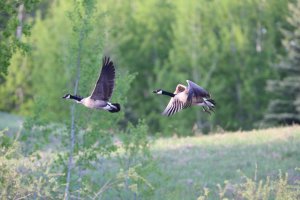
Typically I'd have 300 X2 and be really challenged unless I was back off a ways such as in this uncropped shot.

Jack
 

Attachments

  • CG_2293.JPG
    CG_2293.JPG
    315.9 KB · Views: 528
Upvote 0
Another question/comment on the red dot gun sight. Seems to me that having that extra weaver adapter to the hot shoe is just dumb. Should be possible to remove the gun mount and replace it with a hot shoe mount - no?? I'm thinking smaller/lower is better.

Jack
 
Upvote 0
Jack Douglas said:
Another question/comment on the red dot gun sight. Seems to me that having that extra weaver adapter to the hot shoe is just dumb. Should be possible to remove the gun mount and replace it with a hot shoe mount - no?? I'm thinking smaller/lower is better.

On mine, the Weaver mount bracket provides a base for the angular adjustments (elevation/rotation to align the sight), so removing it might not work. Also, the reticle selection dial hangs below the body of the sight, behind the Weaver mount - a lower profile mount would have to go forward of that dial, meaning the sight would protrude behind the camera, likely causing a problem when you try to look through the viewfinder (the adapter I linked above places the hot shoe mount underneath the dial, so the back of the site is flush with the hot shoe).

I know of only one red dot sight which comes with a hot shoe mount integrated. It's the FastFinder, made by Shield - it looks like a nice little item, but it seems to be available only direct from the manufacturer in the UK, and costs >£200.
 
Upvote 0
Neuroanatomist, thanks for that. Neuro (or others), how often have you felt a need for a sight and on what lenses and in what circumstances? How do you set AF and which points are active and is it a matter of luck some/most of the time having the eye in focus? I plan for another camera but have been satisfied with the 6D for now. My friend just bought 1DX with 300 X2 based on portability (and from observing my 300) and boy the camera adds quite a bit of weight but is impressive. How often do you find yourself willing to crop as opposed to filling the frame with 600? Do you often use 600 X1.4, why, why not. Are you thinking more MP relative to more cropping capability or is that the wrong line of reasoning relative to acquiring longer lenses/new camera? You get the gist of what's going through my head I'm sure.

Expecting a lot for free aren't I! ;) Thanks in advance.

Jack
 
Upvote 0
300 or 600 ?

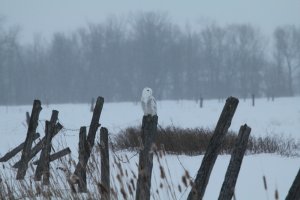
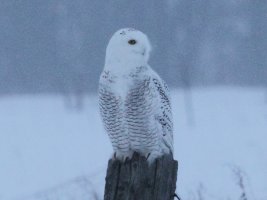
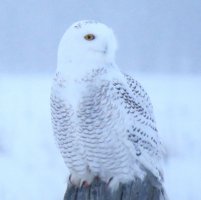
This is a snowy owl, the heaviest member of the owl family and almost the biggest. The first picture was taken from fairly close to the owl at 300mm (actually 280) on a crop camera. The second picture is a 1 to 1 crop of the center 1000x667 pixels. The third picture is close to what you would see with a 600mm lens and a 2X teleconverter....

If you are going to take pictures of birds you really need longer lenses than 300mm... and keep in mind that on a FF camera the owl will be only .6 times as high or wide.... 600MM plus a teleconverter is the way to go.

Please forgive the poor image quality... the picture was taken in a snowstorm and visibility was poor... no sharpening, no white balance, no noise reduction... I just wanted to make a point about how little of the frame will be occupied with a shorter lens
 

Attachments

  • owl1.JPG
    owl1.JPG
    551.1 KB · Views: 408
  • owl3.jpg
    owl3.jpg
    196.7 KB · Views: 412
  • owl7.jpg
    owl7.jpg
    216.9 KB · Views: 397
Upvote 0
Jack Douglas said:
Neuroanatomist, thanks for that. Neuro (or others), how often have you felt a need for a sight and on what lenses and in what circumstances? How do you set AF and which points are active and is it a matter of luck some/most of the time having the eye in focus? I plan for another camera but have been satisfied with the 6D for now. My friend just bought 1DX with 300 X2 based on portability (and from observing my 300) and boy the camera adds quite a bit of weight but is impressive. How often do you find yourself willing to crop as opposed to filling the frame with 600? Do you often use 600 X1.4, why, why not. Are you thinking more MP relative to more cropping capability or is that the wrong line of reasoning relative to acquiring longer lenses/new camera? You get the gist of what's going through my head I'm sure.

Initially, I used the sight pretty often (only with my 600mm lens). But it's sort of like training wheels on a bike - once you get used to finding the subject with assistance, you can start to forego the assistance.

For setting AF points, it depends on whether the bird is perched or flying. For perched, I use Spot AF and focus on the eye. For BIF, I use the center point with 8-point expansion, and use an aperture to give sufficient DoF that the eye(s) are sharp even if the AF point is on the body.

Over 80% of the time, I'm using the 1.4xIII on my 600 II, and I still usually need to crop (I sometimes use the 2xIII, but only for static birds as you're limited to just the central 5 AF points). For shooting birds, you really want as much focal length as you can get. Even with 840mm, it's really hard to fill the frame with a bird. So far, there has been one time – just one – when 840mm was too long; it was with a great egret who flew too close. I'm sure it will happen again, but not often enough for me to choose a shorter lens for that reason (as opposed to portability). There was another occasion where it was close to being too long (some frames had a wingtip cut off) - images from that series are posted in this thread (which is a topic relevant to your question!).

More MP gives you more cropping ability, true. But if you can afford it and can carry it, a longer lens is better. Optical magnification is better than digital magnification. Importantly, optical magnification helps your AF system acquire, lock onto, and track the subject, whereas a higher MP sensor does not.
 
Upvote 0
I originally got really excited about the 200-400mm f/4L IS + 1.4x converter. But after the delays, steep pricing, and darn heavy weight, decided to skip it. I instead got the lovely 300mm f/2.8L IS II with its relative light weight and the amazingly well balanced 600mm f/4L IS II. I think they are the best combo going now on the Canon side. I must admit that I rarely ever use the 600mm bare. I always have one of the version 3 extenders on it. Seldom do I use the 300mm f/2.8L IS II bare either, but it is so buttery and sharp when it is bare!

The 300mm II + 2x III is my go to wildlife combo, when I want to travel light and expect to hike around looking for my subjects. I would not try doing the same with my 600mm II + 1Dx. I typically will walk around with the 300mm II + 2x III + 1Dx on the RRS monopod with their very nice and useful monopod head.

The 600mm II + 1.4x III + 1Dx is my birding rig when I have a set subject and plan on being in one general spot for a while. The rig is supported by a Gitzo GT4542LS Series 4 tripod, RRS universal leveling base with lever clamp and a Wimberley full gimbal head.

If I ever stopped wanting to bird, I'd probably get rid of the 600mm II and keep the 300mm II with the two converters.

If you want to save money and your primary subject are birds, I suggest finding a nice condition used 800mm f/5.6L IS. They have the 4th gen IS system and is super sharp wide open. They are going for around $8500 - $9500 used.

Hope this helps the original poster make a wise decision.
 
Upvote 0
Thanks jasonsim and neuro,

I know I strayed (a little) off topic but I expect that whomever is debating 300 vs 600 probably is not much further along than me and has many of the questions I do. These comments are VERY helpful, especially given the major outlay of money all of this entails! ;)

Jack
 
Upvote 0
surapon, I just wanted to say that I appreciate your posts, willingness to share and your good attitude. I also appreciate that you don't let English as a second language deter you - you're easy to follow and it provides a little smile sometimes -pardon me for saying this. ;)

Jack
 
Upvote 0
I am enjoying this thread, as I am saving my pennies and most likely picking up a 300 f/2.8 II in sometime in February.

While most of the subjects discussed relate to wildlife and birding - some things I may run into as part of landscape work; my intended primary use for the lens is motorsports. The rationale for the lens is mobility - being able to move out of the way very quickly (either in the pits or along the track) - and wide aperture for capturing fast action in darkened conditions such as dirt tracks at night.

I've had a chance to play with the 300 and the 200-400 at various tradeshows such as CES and NAB, and yeah, the 200-400 just seems too heavy and long for effective run and shoot work. In a stationary location (blind or sports risers) the 200-400 could be a winner; but then I might be looking at a 500mm or 600mm for the price. With the 300, I think I can hand-hold that all day (well, with breaks every 10 minutes).

So while one loses a bit of flexibility with the 300, it seems to be the best tool for my job and the forum discussion has helped cement that.
 
Upvote 0