How can Nikon remain in business with 12MP FF?

Status
Not open for further replies.
Like this:

d700-85mm14.jpg


(D700 & 85mm f/1.4 wide-open)

I was the backup that day on a friend's D300, but got to use the D700 for about a minute. Sweet setup.

Note to self: make sure the bride doesn't take her earrings off before a shoot...
 
Upvote 0
funkboy said:
Like this:

d700-85mm14.jpg


(D700 & 85mm f/1.4 wide-open)

I was the backup that day on a friend's D300, but got to use the D700 for about a minute. Sweet setup.

Note to self: make sure the bride doesn't take her earrings off before a shoot...

Fantastic shot, but with 12mpx, you are hoping that your shot is spot on (like this) so that you do not have to crop much. My philosophy in shooting is bringing in raw ingredients and it is in PP where the magic happens.

Most of my 21mpx turn out to be 15 or even 10mpx even everything is said and done. I cannot afford a 12mpx, because it will cripple my WF (and may be make me better). The risk is too much!
 
Upvote 0
poias said:
funkboy said:
Like this:

d700-85mm14.jpg


(D700 & 85mm f/1.4 wide-open)

I was the backup that day on a friend's D300, but got to use the D700 for about a minute. Sweet setup.

Note to self: make sure the bride doesn't take her earrings off before a shoot...

Fantastic shot, but with 12mpx, you are hoping that your shot is spot on (like this) so that you do not have to crop much.

Not heard of genuine fractals then?
 
Upvote 0
poias said:
Fantastic shot, but with 12mpx, you are hoping that your shot is spot on (like this) so that you do not have to crop much. My philosophy in shooting is bringing in raw ingredients and it is in PP where the magic happens.

Most of my 21mpx turn out to be 15 or even 10mpx even everything is said and done. I cannot afford a 12mpx, because it will cripple my WF (and may be make me better). The risk is too much!

Isn't it riskier to hope that what you want just happens to be in your image? Don't want to sound belligerent but, um, aren't you supposed to use the viewfinder to make sure your shot is 'spot on'?
 
Upvote 0
poias said:
funkboy said:
Like this:

d700-85mm14.jpg


(D700 & 85mm f/1.4 wide-open)

I was the backup that day on a friend's D300, but got to use the D700 for about a minute. Sweet setup.

Note to self: make sure the bride doesn't take her earrings off before a shoot...

Fantastic shot, but with 12mpx, you are hoping that your shot is spot on (like this) so that you do not have to crop much. My philosophy in shooting is bringing in raw ingredients and it is in PP where the magic happens.

Most of my 21mpx turn out to be 15 or even 10mpx even everything is said and done. I cannot afford a 12mpx, because it will cripple my WF (and may be make me better). The risk is too much!

Great shot funkboy. For me though i am not yet at the level where I can compose eveyone of my shot like this one. To get there, I still need to crop a lot of them. What ISO was your shot taken again?
 
Upvote 0
Cetalis said:
Isn't it riskier to hope that what you want just happens to be in your image? Don't want to sound belligerent but, um, aren't you supposed to use the viewfinder to make sure your shot is 'spot on'?

Not to pick on you specifically, but it seems like there is a lot of "if you fix it in post, you suck as a photographer" type of comments or at least insinuations, and I guess I disagree with that. I view photography as a visual art, not a "how well can you time the button pushing" art.

If you can capture that visual art straight out of the camera, great. But if I use a bunch of post processing and get as good or better results, does that somehow make my product inferior? We are using different tools and skills neither of which is inherently superior to the other to achieve the same end result.
 
Upvote 0
neuroanatomist said:
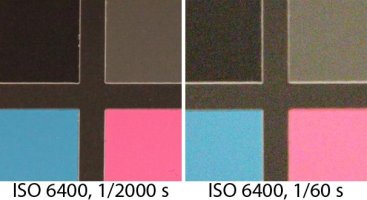
Those short shutter speeds minimize the effect of read noise, which is a major contributor to total noise when light is limiting. So, ISO 6400 and 1/2000 s is going to look a lot better than ISO 6400 at 1/60 s.

I found this intriguing. Why would read-out noise change with exposure time? Is the read-out mode really different for different exposure times? If that was indeed the case, I would have expected the slower read-out mode to be cleaner. Are you sure you don't mean the dark current? I wouldn't have though the dark current would be perceptible for exposures shorter than 1 second, even at 6400, but I could be wrong of course. I usually like to refer to Clarkvision for technical details, because I like their write up, but unfortunately they haven't measured the dark noise of detectors (probably because it is negligible in typical situations with shorter than a second exposures). Can you point me to somewhere where the effect you describe is documented?
 
Upvote 0
Mt Spokane Photography said:
I would have bought a D3S for the low light performance, but switching all my lenses makes the cost of a body look like chump change.

Tha main advantage of high mp is the ability to crop, and I do a lot of cropping of my 5D MK II images with good results. If you fill the frame of a 12 mp camera the image will be excellent, since 6mp is about all you need for most prints.

In the last sentence lies the point as to why 12MP is not an issue for many shooters: an image file is not a final product and, in most cases, clients never get to see the image file. If you consider the portrait/wedding world, clients buy prints, mounted prints, albums etc. In many areas of photography (there are exceptions to this) the client does not care what camera you use, provided you deliver the results - which the client can hang on the wall or moor on the coffee table.
For press shooters, for instance, it is more important to get the shot (i.e. AF, high ISO capability, fps) than being able to blow the result up to billboard size.

(There are more specialised areas where the specific gear you use matters more.)

for my personal photos, I like to have as much resolution as possible - who knows what I may want to do with the image in 10 years time. For the material my wife shoots for her clients, the files will all be deleted after a few years anyhow - you can't keep all the material for ever, so as long as there is enough resolution there to produce the products the client wants, that is good enough.

Camera manufacturers have done a good job so far, continually convincing us that we always need more megapixels, in order to sell us new cameras. With the exception of a few users who really need high resolution, the times have changed, and Canon, Nikon et al need to find new reasons to convince us to shell out for new gear if our current gear isn't broken.
Digital has been wonderful for Canon and Nikon, because we have all been buying new bodies at a much higher rate. Film bodies had a much longer "lifespan" before anyone worried about upgrading, with the end result of lower sales. (Of course we didn't spend less money, because a lot of our money went into film and developing.)

 
Upvote 0
thepancakeman said:
Cetalis said:
Isn't it riskier to hope that what you want just happens to be in your image? Don't want to sound belligerent but, um, aren't you supposed to use the viewfinder to make sure your shot is 'spot on'?

Not to pick on you specifically, but it seems like there is a lot of "if you fix it in post, you suck as a photographer" type of comments or at least insinuations, and I guess I disagree with that. I view photography as a visual art, not a "how well can you time the button pushing" art.

If you can capture that visual art straight out of the camera, great. But if I use a bunch of post processing and get as good or better results, does that somehow make my product inferior? We are using different tools and skills neither of which is inherently superior to the other to achieve the same end result.

I believe you misunderstand me; I'm not implying anything about post, except cropping, and even then, there are many legitimate reasons to crop. I agree that it does not matter how you got the shot and what you do to it as long as the result works. What I don't understand is why the OP seems to believe that cropping is more likely to work than framing the shot, where one can see the results in the viewfinder and thus not have to rely on luck. There are times when erratic subject movement makes shooting wider more practical, but few people have to shoot this way all the time and the OP hasn't said that he is one of them.

poias said:
Fantastic shot, but with 12mpx, you are hoping that your shot is spot on (like this) so that you do not have to crop much. My philosophy in shooting is bringing in raw ingredients and it is in PP where the magic happens.

Most of my 21mpx turn out to be 15 or even 10mpx even everything is said and done. I cannot afford a 12mpx, because it will cripple my WF (and may be make me better). The risk is too much!
 
Upvote 0
JR said:
Great shot funkboy. For me though i am not yet at the level where I can compose eveyone of my shot like this one. To get there, I still need to crop a lot of them. What ISO was your shot taken again?

Thanks poias & JR.

My friend the wedding photographer has all the RAWs & did most of the post-prod on it, so to be honest, I don't recall the capture settings (other than the aperture), but given that we were in light shadows in a park on a sunny afternoon I'd say probably around ISO400 & exposed to the right. Anyway one likely couldn't tell the difference with this little thumbnail even if it was shot at ISO6400 with that thing.

For the record, I recall that we may have cropped it a little bit when we first took a look at it, maybe 5%. The evening after the shoot we went over a good chunk of the ~2.5k photos from our two cameras, so my memory on this particular one's a little hazy...
 
Upvote 0
poias said:
Most of my 21mpx turn out to be 15 or even 10mpx even everything is said and done. I cannot afford a 12mpx, because it will cripple my WF (and may be make me better). The risk is too much!

Native resolution of an A3 print at 240dpi is about 10mp. That happens to work out rather well with my 40D. I consider anything over that to be a bonus, as I've never needed a print bigger than A3 and I don't have any friends with a printer bigger than that anyway. (Granted, there's a shop a few blocks away with a pair of Epson 9600s that do wall posters for boutiques, but I shudder to think what they'd charge for a print that big...).

Now don't get me wrong, it would certainly be nice to have the luxury of being able to crop half the image away & still have that kind of resolution if necessary, but it's not too high on my wish list. I'd say that if you're cropping most of your shots more than 5-10% then you might be better served just taking more shots from different focal lengths to be sure that you got what you want from the beginning.
 
Upvote 0
epsiloneri said:
neuroanatomist said:
So, ISO 6400 and 1/2000 s is going to look a lot better than ISO 6400 at 1/60 s.

Can you point me to somewhere where the effect you describe is documented?

In the example below (100% crops from the 5DII, processed with DPP using no NR or other adjustments), the light source illumination was the same. For the shot on the right, ND filters were used reduce illumination by a fixed amount to match exposure, giving (IMO) a more common real-world situation where you might need to use ISO 6400.
 

Attachments

  • ISOvsShutterSpeed.jpg
    ISOvsShutterSpeed.jpg
    27.3 KB · Views: 1,483
Upvote 0
neuroanatomist said:
In the example below (100% crops from the 5DII, processed with DPP using no NR or other adjustments), the light source illumination was the same. For the shot on the right, ND filters were used reduce illumination by a fixed amount to match exposure, giving (IMO) a more common real-world situation where you might need to use ISO 6400.

This is very insightful Neuro! I would be sooo curious to see the same chart done with a D700...just curious... But the difference in your test is striking. I would say almost 1 to 2 stop delta no?
 
Upvote 0
12 mp is plenty for almost any usage. In fact for most pro photographers more than 12 mp serves literally no purpose whatsoever. To this majority therefore Nikon provides cameras that have much higher ISO performance, much better A/F and much better ergonomics than Canon, Nikon devastates Canon in performance on it's bodies. Even the 1Dx is better for studio stuff. Personally though I like to crop my images a bit so 18mp is a must for me but beyond that i have no use for more MP. Either way Canon has superior lenses which is why I chose Canon. However Nikon really does have better bodies not the other way around and they are driving technology. Canon's dynamic range and USO are laughable in comparison.

In any case for me the 1Dx is the holy grail cropping + ISO + Dynamic range. It's perfect.
 
Upvote 0
Radiating said:
12 mp is plenty for almost any usage. In fact for most pro photographers more than 12 mp serves literally no purpose whatsoever. To this majority therefore Nikon provides cameras that have much higher ISO performance, much better A/F and much better ergonomics than Canon, Nikon devastates Canon in performance on it's bodies.

Hyperbole on every point. The D3s has better high ISO (not much better) because it's a newer sensor design than the 5D2. The D700 does not have better high ISO despite being 12 MP.

AF is better on the D700. With Canon you can get a low cost 21 MP FF body, with Nikon you can get low cost pro AF in a FF body. Only their sales departments know which differentiation is better. (That said, I don't understand it when competitors fail to take open shots. Canon should have put pro AF in the 5D2.)

Ergonomics is very much a matter of personal preference. There are things I like and dislike about both.

That said, 12 MP is enough for many uses, so Nikon is not at a huge disadvantage. But there are some popular uses which require more MP. I would rather shoot landscapes with my 7D than with my friend's D700.

Canon's dynamic range and USO are laughable in comparison.

A roughly 1 stop difference on either is not laughable, especially when Nikon has younger sensor designs. Let's see what the differences are with Canon's newest FF sensor.
 
Upvote 0
Meh said:
neuroanatomist said:
short shutter speeds minimize the effect of read noise

How so? Can you explain how read noise is affected by shutter speed? Careful now...

The other parts of your comment sound about right... just this particular point somehow seems off.
I'd tend to agree, read noise is probably not the cause. Same ISO IMO would lead to the same amplification and the number of photons striking the sensor with the ND filter should be the same. I'd suspect it's thermal noise, I'm a bit rusty but think that increases either directly or with the sqare root of time. Also the dark current of a photodiode may have an effect, the low level when you get a reading when no light is present, it would make sense that accumulates over time.

Anyway bit of a technical argument, end result is the same that high ISO and lighting with short shutter speeds isn't a good comparison against low light with longer shutter speeds. Interesting discussion because I've seen a few test shots that look very different to my results and I've never given it much thought before.
 
Upvote 0
Status
Not open for further replies.