How many megapixels can these lenses resolve?

Nov 4, 2011
61
0
5,136

Attachments

  • Screen Shot 2013-11-11 at 10.38.46 AM.png
    Screen Shot 2013-11-11 at 10.38.46 AM.png
    56.9 KB · Views: 1,356
  • Screen Shot 2013-11-11 at 10.42.32 AM.png
    Screen Shot 2013-11-11 at 10.42.32 AM.png
    62 KB · Views: 1,329
The numbers mean nothing as far as the number of MP a lens can resolve, and can not be extrapolated. The resolution will increase on a camera with more MP, but at some point, any improvement is very slight.

Aside from the fact that lens resolution is not measured in MP, the tests are run on a particular camera and only apply to that camera. Thus, to get a meaningful measurement, you would have to put it on a XX mp camera and check the resolution to see what it was on that camera.

Your best bet is to view Canon's calculated MTF curves. The center will be excellent, of course, but as you move toward the edges, things deteriorate.

As you get sensors with higher numbers of photosites, diffraction starts at wider apertures, so that means you cannot resolve each pixel sharply unless you use wider apertures. This is a big factor in resolution, maybe more than the resolution of lens itself.

Since its a f/4 lens, at f/4 on a 36 mp FF body, diffraction would have just begun to have a tiny effect at f/4. At f/8, it would be significant, but not a big issue.

I wouldn't worry about it until you got a 120 or higher MP body.
 
Upvote 0
lens resolution is a misunderstood topic.... the resolution is not a hard limit, it is the point where the curve bends....

For ease of example, let us assume everything is full frame... Let's say you have a lens with 18Mixels of resolution. If you put it on a 10Mpixel body, it is capable of resolving 10M. Put it on a 15M body and it will resolve 15M. Put it on an 18M body and it will resolve 18M... but beyond this point the line changes from straight to a curve... Put it on a 20M body and it does not resolve 20M, it will resolve a number somewhere between 18 and 20... for the sake of argument, let's say 19.5.... put it on a 40M body and it might only resolve 35M... and so on...
 
Upvote 0
Pi said:
The question does not even make sense but I have seen shots on Pentax Q, which pixel density corresponds to 200-300mp on FF, I believe, and the small pixels resolve much much more than today's 20mp sensors.

That is irrelevant, it is much easier to design an 8.5mm lens with an 8mm diameter image circle than a 50mm lens with 44mm image circle. Look at 8"x10" cameras, they make very high resolution images, but their lenses have very low comparative resolving power.
 
Upvote 0
privatebydesign said:
Pi said:
The question does not even make sense but I have seen shots on Pentax Q, which pixel density corresponds to 200-300mp on FF, I believe, and the small pixels resolve much much more than today's 20mp sensors.

That is irrelevant, it is much easier to design an 8.5mm lens with an 8mm diameter image circle than a 50mm lens with 44mm image circle. Look at 8"x10" cameras, they make very high resolution images, but their lenses have very low comparative resolving power.

I meant, of course, an EF lens mounted on the Q - otherwise I would have given as an example the iphone.
 
Upvote 0
Don Haines said:
lens resolution is a misunderstood topic.... the resolution is not a hard limit, it is the point where the curve bends....

For ease of example, let us assume everything is full frame... Let's say you have a lens with 18Mixels of resolution. If you put it on a 10Mpixel body, it is capable of resolving 10M. Put it on a 15M body and it will resolve 15M. Put it on an 18M body and it will resolve 18M... but beyond this point the line changes from straight to a curve... Put it on a 20M body and it does not resolve 20M, it will resolve a number somewhere between 18 and 20... for the sake of argument, let's say 19.5.... put it on a 40M body and it might only resolve 35M... and so on...

Don, that is a great example, but where does one find the resolution numbers for a particular lens? It would be great if they stamped on the box "This lens has 25MP of resolution capability" or similar...
 
Upvote 0
The simple answer to your question is as follows:

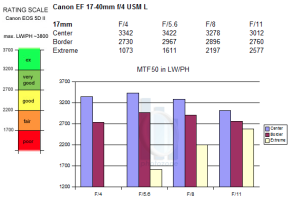
for any given region of interest, use the table of numbers of LW/PH

take that number, square it, multiply by 1.5 for the 3:2 aspect ratio
divide that by 1,000,000 if you want simple MP and you'll get the equivalent resolution if that portion of the measurement was uniform for the whole frame.

e.g. center of 17-40 @ f/8 will = ~ 16MP

it's pretty sad when you calculate the corners!

If you measure the top level of the graph, ~3700, you'll get ~21MP which is the MP of the sensor in that body.
 
Upvote 0
bgran8 said:
Mt. Spokane,

Thanks for the reply. I really like my 17-40 paired with my 5dii, but I am wondering if it will stand up to the demands of Sony's a7r.
It will be better, just how much we don't know. Canon's cameras actually process differently based on the camera lens mounted, the Sony might autofocus and adjust the aperture, but just how well is a big question. It certainly will not recognize the lens or make any adjustments based on it.

For example, different Canon lenses activate different autofocus points in a Canon body depending on the lens and the body. I doubt if the Sony will do anything but the center point, but I'd like to know.
 
Upvote 0
Aglet said:
The simple answer to your question is as follows:

for any given region of interest, use the table of numbers of LW/PH

take that number, square it, multiply by 1.5 for the 3:2 aspect ratio
divide that by 1,000,000 if you want simple MP and you'll get the equivalent resolution if that portion of the measurement was uniform for the whole frame.

e.g. center of 17-40 @ f/8 will = ~ 16MP

it's pretty sad when you calculate the corners!

If you measure the top level of the graph, ~3700, you'll get ~21MP which is the MP of the sensor in that body.

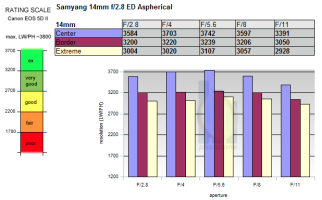
Thanks, Aglet, that makes sense! I noticed on Photozone that only a couple of Canon lenses could hit that 3700 value... Oh, and the Sigma 35...

Which leads me to ponder... I know Photozone uses a 5DII for their testing - if some of the lenses are hitting the top end of that sensor - would using a Nikon/Sony 36MP test vehicle let us really see where the lens hits its peak? Until Canon brings out their own high MP body, of course...
 
Upvote 0
Old Shooter said:
Don, that is a great example, but where does one find the resolution numbers for a particular lens? It would be great if they stamped on the box "This lens has 25MP of resolution capability" or similar...

The resolution of a lens cannot be measured in mp (despite what DXO tells you). The accepted metrics is MTF-xx.

Based on a simple model, one can extrapolate, say the old DXO data, where the resolution was given in MTF. This is based on an assumption that the AA filters have strength proportional to the pixel size. I have done such calculations in the past, and if I remember well, I got that the typical decent lens has 2-3 times, if I remember well, the potential compared to what they measure now on a typical crop sensor. This was for MTF-20, what DXO used to measure, and will change if you change xx in MTF-xx. Roughly speaking, the extinct resolution can be increased 2-3 times or so, but the contrast cannot.

Anyway, since DXO decided to hide the original data, I cannot do this anymore.
 
Upvote 0
Old Shooter said:
- if some of the lenses are hitting the top end of that sensor - would using a Nikon/Sony 36MP test vehicle let us really see where the lens hits its peak? Until Canon brings out their own high MP body, of course...
Putting a finer resolution sensor behind any given lens will get you a little more total image resolution but gets to be dimishing returns pretty quickly.

Like Pi sez, there are other factors too, mostly what contrast ratio is the bottom end of acceptable for these MTF tests. You can resolve more if you accept lower contrast.

On Photozone, you can get a bit of a sense of this if you compare the same lens tested on an 8MP 350D vs the 15MP 50D. If it doesn't max out on the 350d, how high up does it get on the 50d? It'll likely resolve more LP/PH on the 50d vs 350d but the lense may not be able to max out either of those bodies.
On some lenses the result may be very close or at max on the 350d but will it also be max on the 50d? If so, heck of a good lens, if not then we're on that diminishing returns part of the curve where the 15MP body may be capable of more.

AA filter strengths and other processing factors also come into play..


So the only thing these kinds of tests, from DxOmark or photozone etc, are good for, is comparing different lenses on the same body if they're evaluated with the same method. Which, for a given site, is usually consistent enough to be useful for this purpose.
It's a bit of extrapolation to try compare the same lense on different bodies as AA filters and internal camera processing are relatively unknown variables to us.

many grains of salt...

 
Upvote 0