ILC Camera Sales Slightly Down from Last Year

Canon Rumors

Who Dey
Canon Rumors Premium
Jul 20, 2010
12,848
5,686
279,596
Canada
www.canonrumors.com
HTML:
Interchangeable lens camera shipments remain slightly down from last year, according to the latest data. DSLRs remain the bread and butter of the industry, as the perceived mirrorless shift still hasn’t taken hold when looking at the raw numbers, especially in North America. Could that be because the two biggest DSLR manufacturers don’t appear to have taken mirrorless seriously for the advanced amateur/professional, like Fuji, Olympus and Sony have?</p>
<p>As for Canon’s place in the mirrorless segment, it’s the same old story, is Canon not serious about mirrorless because the market isn’t growing, or is the market not growing because Canon doesn’t appear serious about it?</p>
<p><a href="http://www.personal-view.com/talks/discussion/12720/camera-sales-february-2015-data-quiet-corpse" target="_blank">See more charts and sales data at PV</a></p>
 
Canon Rumors said:
Interchangeable lens camera shipments remain slightly down
Always interesting to see sales numbers etc. Thanks.

"Slightly down"? I wonder if we are looking at the same charts? The poster says the charts for the last years resemble a Seneca Cliff scenario (= collapse, the word I would use to describe whats happening in the DSLR market).

Canon's wording looking at 2014 was that: "Demand for interchangeable-lens digital cameras continued to face harsh conditions due to the economic slowdown." That's not "slightly down".

In addition we could use some source clarification.
 
Upvote 0
There are things I need to purchase first (house renovations), but as soon as I have the disposable cash, I'm going to buy a Sony A7RII, a Canon fd 50 1.2L and an fd 24 1.4L. The main reason I want this stuff is for casual "fun" shooting (which I need to do more often) and travel. Until native lens selections in the mirrorless world improve, as does AF, my Canon DSLR and EF lenses will remain my bread and butter moneymakers, but there is definitely an appeal to a low-weight high quality kit.
 
Upvote 0
Fatfaso said:
There are things I need to purchase first (house renovations), but as soon as I have the disposable cash, I'm going to buy a Sony A7RII, a Canon fd 50 1.2L and an fd 24 1.4L. The main reason I want this stuff is for casual "fun" shooting (which I need to do more often) and travel. Until native lens selections in the mirrorless world improve, as does AF, my Canon DSLR and EF lenses will remain my bread and butter moneymakers, but there is definitely an appeal to a low-weight high quality kit.

Now that Sony is starting to come out with faster FE glass, it'll be easier to compare whether or not a mirrorless kit will be lighter. The new Sony FE 35 f/1.4 is 4.5x3.1 in and weighs 22.3 oz. The 35L is 3.4x3.1 in and weighs 20.5 oz. The body may be smaller/lighter, but if the lenses end up being of comparable size, then it's appeal is reduced.
 
Upvote 0
Canon Rumors said:
Could that be because the two biggest DSLR manufacturers don’t appear to have taken mirrorless seriously for the advanced amateur/professional, like Fuji, Olympus and Sony have?

I think you could just as easily reverse that question and ask why Fuji and Olympus don't have Full Frame bodies.
Sony has them but still for more money, and then there's lenses.
That said I am going to take a serious look at the Fuji 400mm zoom lens when it comes out, but you still have a lot of performance gaps between the different systems.
 
Upvote 0
In a situation where the market seems to collapse (slightly down is quite an understatement, considering the development over some time now), it becomes very difficult to understand how Canon, being the market leader in ILC, only dash out minor improvements on very traditional platforms, at a very slow pace. That is something you can do when you have growth and you are top of the heap.

In a falling market, you need catalysts, to motivate your existing customer base and attract new ones. Where are Canon´s catalysts to boost more life into this? I don´t see them. I see a market leader, stuck in the strategies of yesterday, failing to see new trends, failing to attract new customers, failing to offer enough new exciting options to existing customers.

I know some will tell me that these are strategic decisions, based on very thorough market research, has nothing to do with lack of capability and they are still the greatest etc. etc. and I am only a peripheral customer, with way off requirements to main stream. Well, I have bought lots of Canon gear in the past, so I was not so peripheral then, and I am willing to buy more, if they provide what I want. Now they don´t, so I may as well sit with what I have. And main stream, who ever they are, they are abandoning ILC. So simply summed up, Their strategy sucks ... big time ...
 
Upvote 0
Eldar said:
In a falling market, you need catalysts, to motivate your existing customer base and attract new ones. Where are Canon´s catalysts to boost more life into this? I don´t see them.

It's been argued that Sony is doing that – Exmor sensors, FF mirrorless. They're likely spending significant R&D resources to do so. Is it helping the market? Is it helping Sony?
 
Upvote 0
dilbert said:
tiger82 said:
The peaks seem to coincide with major new DSLR camera releases.

it would be interesting to take out of those sales figures those that upgrade from one DSLR model to another to get an idea of what the DSLR market is doing.

+1

My background is in business management & marketing, so details about Canon’s selling strategies and information about the camera / photography market is very interesting to me. (I currently work as a manager in the Australian federal government… but that’s another story)

I find the information presented here quite interesting – at a macro scale. However I wish there was more detailed information available (entry level, mid level, enthusiast, brand, APS-C vs FF, 1st, 2nd, 3rd camera, etc). I realise there are many sources for this information, but I wonder where the most comprehensive information is (and how do they work out if a camera purchase is a 1st, 2nd, 3rd body).

Then what about lenses and other photography / camera components and accessories…

Yes, as you can see I’m hungry for more information / data. However what I enjoy much more is actually taking photos and sharing with friends and those who appreciate images. Cheers everyone!

Paul 8)
 
Upvote 0
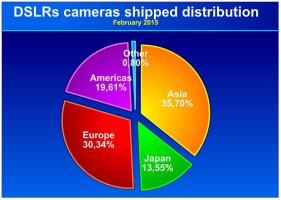
When you look at the geographical distribution of DSLRs it may explain why it is so much easier to find lenses here in Asia than in the Americas. At least going by what some people have been reporting with regards to not being able to find some of the newer lenses.

Makes sense for Canon to put more lenses where the majority of DSLRs are sold.
 
Upvote 0
Of course the mirrorless market is not growing when the two biggest manufacturers don't make it grow.

I'm a Canon user and have been waiting for 2 years now to be able to purchase a mirrorless SYSTEM.
The Sony a6000 and available lenses are still far better :(((
I do NOT want to buy other brands, having a gear set with a mix of different incompatible stuff, different handling, etc, is stupid.

I would also add, that Canon cameras are not supported in special fields!!! I'm dreaming of an M line camera that I can use for travel, underwater and aerial. Still not really possible :( The M line is barely supported for underwater, and not at all supported for aerial. Sony is way ahead in this matter too.

As for the Sony A7 series, as much as I love the innovative approach and would love Canon to do something similar, since you end up using the same heavy lenses, all together, even a small travel set (let's say body + 3 lenses) does not become much smaller and lighter.

I think one reason for why Canon is terribly slow in the mirrorless filed is that they are affraid of sacrificing the APS-C DSRL market. Let's admit, you have (or can easily have) the quality and performance of an APS-C body + EF-S lens in a compact size mirrorless setup. With a proper mirrorless system, the whole APS-C DSLR technology/idea becomes obsolate...while they have most of their income in that market.
And at the same time, there are LOTS of people who do not need a DSLR, but they buy one instead of a compact (often with just a kit lens), just because it looks more professional. Would they buy mirrorless which has the same performance?

What is "funny" though, that is the most natural thing that we always want things smaller and lighter and Japan was the country which made it possible for all of us, not just in photography but in the whole electronics field. Now they seem to forget that most basic drive.

The whole camera design and concept is obsolate as is, having the same size, weight and design of professional cameras for decades. Canon's last innovation in this matter that is worth mentioning was the 100D, even though it's not real innovation, just a step, a decision....they made it. It could have been made anytime.
In my dreamland, even professionals are using EOS M size bodies, with the possibility of addons for better grip, more battery and processing power, memory, etc. A modular camera design, where the user can choose the size, weight and performance of the camera and configure it for the situation the camera is needed for. I keep it small and light for travel but can make 2-3X size for studio, sports, whatever.

 
Upvote 0