
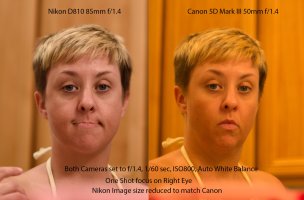
I just got my 5D Mark III back from Canon Irvine service. It was in for a misaligned viewfinder that they "reworked". They stated all product functions correctly according to specifications. Ive been curious about the D800 since its release, so I rented the new D810 to compare. I set up the two cameras almost identical - except for the lenses. The nikon had an 85mm f/1.4, while the Canon had the 50mm f/1.4. I set them both to manual, f/1.4, 1/60 sec, ISO800, AWB, and used the leftmost focus point in one shot mode over the right eye (AF-S for Nikon). I reduced the Nikon image size to match that of the canon and cropped at 100%. Are these results typical, or should I send it in for service again? The AWB totally missed, more noise, the image is soft and flat. Is my camera a dud, or does the nikon simply crush it? I always have to compensate for my Canon by manually setting the white balance, using only the center focus point, overexposing by 1/2 stop, and stopping down for sharper images, but in this test I just let the cameras and lenses do their thing.
You are using an out of date browser. It may not display this or other websites correctly.
You should upgrade or use an alternative browser.
You should upgrade or use an alternative browser.
Is there something wrong with my 5D Mark III?
- Thread starter kram7211
- Start date
L
Loswr
Guest
You've demonstrated that Nikon's 85/1.4, which is among Nikon's very best performing lenses even wide open, is sharper than Canon's 50/1.4, which is not a particularly sharp lens, particularly wide open. You make no mention of performing an AF microadjustment/fine tune, which can be critical for sharpness with fast primes shot wide open.
You've demonstrated that Canon's AWB is poor...something most of us know already (although it's better on the 1D X than any other Canon camera I've used).
I'm not convinced you've learned anything beyond the obvious...
You've demonstrated that Canon's AWB is poor...something most of us know already (although it's better on the 1D X than any other Canon camera I've used).
I'm not convinced you've learned anything beyond the obvious...
Upvote
0
I AFMA'd the 50 1.4 to +4. I didn't AFMA the nikon. I didn't know Canons AWB was that poor - I actually assumed the opposite. Part of the learning curve I guess. So basically what you're saying is these results are in fact typical? I was kinda hoping they were isolated to my body - so I could send it for service again or sell it and take my chances on buying another.
Upvote
0

kram7211 said:I AFMA'd the 50 1.4 to +4. I didn't AFMA the nikon. I didn't know Canons AWB was that poor - I actually assumed the opposite. Part of the learning curve I guess. So basically what you're saying is these results are in fact typical? I was kinda hoping they were isolated to my body - so I could send it for service again or sell it and take my chances on buying another.
There is probably nothing wrong with your gear, just your ideas of what a comparison is.
In defense of the 50 f1.4, which is as sharp as the 100L Macro at f5.6 ( http://www.the-digital-picture.com/Reviews/ISO-12233-Sample-Crops.aspx?Lens=115&Camera=453&Sample=0&FLI=0&API=6&LensComp=107&CameraComp=453&SampleComp=0&FLIComp=0&APIComp=3 ), try them both stopped down.
As for the AWB result, what colour was the light? If it was tungsten then the Canon is a more accurate representation of the actual colour of the scene, the NIkon has removed the colour, take your pick.
Upvote
0
kram7211 said:I set up the two cameras almost identical - except for the lenses. The nikon had an 85mm f/1.4, while the Canon had the 50mm f/1.4. I set them both to manual, f/1.4, 1/60 sec, ISO800, AWB,
As others have pointed out, this is not an identical set up. I think you have discovered how difficult it is to do an actual comparision between different camera manufacturers. It is not easy.. as you found out.
AWB for Nikon is not the same as AWB for Canon.
Upvote
0

privatebydesign said:As for the AWB result, what colour was the light? If it was tungsten then the Canon is a more accurate representation of the actual colour of the scene, the NIkon has removed the colour, take your pick.
I'm wondering what the light source was, if it was fluorescent, that might be the issue.
I tend to prefer letting me adjust colors rather than the camera. Often I prefer to keep colors just as they look to me rather than changing them to look different.
I did go back and look at my D800 raw images, they seemed to have retained the lighting color properly, I'd prefer to make my own corrections.
Upvote
0

L
Loswr
Guest
privatebydesign said:As for the AWB result, what colour was the light? If it was tungsten then the Canon is a more accurate representation of the actual colour of the scene, the NIkon has removed the colour, take your pick.
Sorry, but it's auto white balance – the idea is to render a white/neutral object in the scene as white/neutral in the image, not to render it as 'the actual color of the scene'. Under tungsten light, AWB on most Canon bodies will render a white object as orange. That's a WB fail (even if it's by Canon's design - they should put that tweak into a Picture Style, not AWB).
Upvote
0
L
Loswr
Guest
Mt Spokane Photography said:I'm wondering what the light source was, if it was fluorescent, that might be the issue.
Still an AWB issue, though. It's not a shutter speed vs. light cycle frequency issue, since 1/60 s would encompass a full cycle.
But...1/60 s isn't always enough to fully eliminate the blur from random motion of even a 'posed' subject, so that could be a factor.
Upvote
0

There is also another issue which I don't recall seeing in the thread. With an aperture of 1.4, the dof is very thin. If you are not on a tripod mount any movement will affect the focus, and the subject also isn't static.
Granted the Canon is soft generally, it would be better to conduct the comparison on tripod and using a subject that is static, say an object that won't move. We don't realize it, but we even move with each heartbeat.
Just my 2 cents.
sek
Granted the Canon is soft generally, it would be better to conduct the comparison on tripod and using a subject that is static, say an object that won't move. We don't realize it, but we even move with each heartbeat.
Just my 2 cents.
sek
Upvote
0
neuroanatomist said:privatebydesign said:As for the AWB result, what colour was the light? If it was tungsten then the Canon is a more accurate representation of the actual colour of the scene, the NIkon has removed the colour, take your pick.
Sorry, but it's auto white balance – the idea is to render a white/neutral object in the scene as white/neutral in the image, not to render it as 'the actual color of the scene'. Under tungsten light, AWB on most Canon bodies will render a white object as orange. That's a WB fail (even if it's by Canon's design - they should put that tweak into a Picture Style, not AWB).
I have found that to be the theory, but not the execution. Certainly all bodies seem to handle AWB differently, often the same body in the same situation will produce different WB levels in a sequence. Also, WB is only one part of the WB control, Tint is the other.
When I shoot tethered I can do an in camera custom WB and it looks good, if I then go into DPP whilst tethered I can re WB that image with the additional Tint control and it shifts, sometimes quite a lot.
I know WB is supposed to give you "true", even valued, white black and gray tones, but there is no doubt that in camera it doesn't, all my AWB tungsten shots have an orange colour, and I am happy with that, maybe it is just the difference between the Tungsten temp and the actual colour if the bulbs I have used.
My first 1D actually had an exterior WB window that measured some ambient, it didn't rely on 100% TTL, I really liked the AWB on that camera but not so much since.
AWB, like auto exposure, kinda seems to put you in the ball park most of the time, but it doesn't actually know what you are trying to do as a photographer.
Upvote
0
L
Loswr
Guest
privatebydesign said:I know WB is supposed to give you "true", even valued, white black and gray tones, but there is no doubt that in camera it doesn't, all my AWB tungsten shots have an orange colour, and I am happy with that...
AWB, like auto exposure, kinda seems to put you in the ball park most of the time, but it doesn't actually know what you are trying to do as a photographer.
Exactly. Well, almost - orange really isn't in the ballpark with white, it's somewhere in the next town over. I sometimes leave indoor shots a bit warmer than neutral, but I don't like them orange.
Upvote
0
neuroanatomist said:privatebydesign said:I know WB is supposed to give you "true", even valued, white black and gray tones, but there is no doubt that in camera it doesn't, all my AWB tungsten shots have an orange colour, and I am happy with that...
AWB, like auto exposure, kinda seems to put you in the ball park most of the time, but it doesn't actually know what you are trying to do as a photographer.
Exactly. Well, almost - orange really isn't in the ballpark with white, it's somewhere in the next town over. I sometimes leave indoor shots a bit warmer than neutral, but I don't like them orange.
 Alright, maybe not orange, perhaps "warm", a few hundred degrees off for pure even tones.
But the tint issue in AWB is one I never really did get my head around, if WB just does blue to yellow, then tint, with green to magenta, is every bit as important, particularly for things like stadium gas lights and fluorescent lamps and the multitude of colours they now come in.
Upvote
0
Granted the white balance is off, but otherwise you are stupefied that a camera with 50% more pixels on the same sensor size and mounted to a lens that frame the subject 50% tighter gives you more details? Now I'm stupefied...
Upvote
0
L
Loswr
Guest
privatebydesign said:Also, WB is only one part of the WB control, Tint is the other.
When I shoot tethered I can do an in camera custom WB and it looks good, if I then go into DPP whilst tethered I can re WB that image with the additional Tint control and it shifts, sometimes quite a lot.
privatebydesign said:But the tint issue in AWB is one I never really did get my head around, if WB just does blue to yellow, then tint, with green to magenta, is every bit as important, particularly for things like stadium gas lights and fluorescent lamps and the multitude of colours they now come in.
Yes, tint is important. The in-camera Auto WB applies both a color temperature and a tint value. For example, an image open in DxO on my desktop right now and taken in mixed lighting (tungsten with daylight from a large window) shows As Shot values of 4298 K for the temperature and –27 for the tint (a bit green-shifted, the slider runs from –100 green to +100 magenta).
As far as I can tell, Canon's DPP doesn't show the tint value for RAW images or allow you to edit it...but it's recorded as part of the AWB saved in the RAW metadata. RAW converters that are more functional than DPP allow you to view and adjust the tint as well as the color temperature. Just one more reason I don't like DPP...
Upvote
0
I suppose the newer cameras with a WB target on a colour wheel are much better than the older cameras that only allowed you to dial in WB on the Kelvin scale. On my 1Ds MkIII's when I put in a personally selected ºK value I get a zero tint value and no in camera way to change it. That's progress for ya..... 
Lightroom also displays the camera derived Tint value.
Lightroom also displays the camera derived Tint value.
Upvote
0

I must say that I NEVER use my Canon 50mm F1.4 at apertures larger than F1.8, it is admittedly low contrast and low sharpness.
Whereas Nikon 85mm F1.4 costs at least three times more expensive, it is quite obvious that it will have better picture than Canon 50mm f1.4 when used wide open.
Yes, AWB Canon misses a lot and tends to orange colors. So I also NEVER use AWB.
Whereas Nikon 85mm F1.4 costs at least three times more expensive, it is quite obvious that it will have better picture than Canon 50mm f1.4 when used wide open.
Yes, AWB Canon misses a lot and tends to orange colors. So I also NEVER use AWB.
Upvote
0

Irrespective of the difference in resolution and WB the Nikon D810 clearly records the model smiling and the Canon records frowning. I'd be much more concerned about this than WB. If you're shooting in raw WB can be corrected in post.
Upvote
0
Similar threads
- Replies
- 1
- Views
- 487


- Replies
- 239
- Views
- 39K

- Replies
- 3
- Views
- 898
D
- Replies
- 32
- Views
- 5K
