
You are using an out of date browser. It may not display this or other websites correctly.
You should upgrade or use an alternative browser.
You should upgrade or use an alternative browser.
Is this fungus?
- Thread starter leGreve
- Start date


If it is inside the lens, then yes.
But find a 'local' camera repairer, they can clean it for reasonable money.
If it is just on the outer side of the outer element, clean it yourself, it won't do any harm.
The worst thing you can do to a lens is not use it, UV kills fungus. But if you have to store them in the dark make sure you store them with desiccant to keep the moisture level very low.
But find a 'local' camera repairer, they can clean it for reasonable money.
If it is just on the outer side of the outer element, clean it yourself, it won't do any harm.
The worst thing you can do to a lens is not use it, UV kills fungus. But if you have to store them in the dark make sure you store them with desiccant to keep the moisture level very low.
Upvote
0

I once had a lens looking something like this. Turned out to be on the front surface and closer inspection (loupe) identified it as corrosion, as furthermore it couldn't be cleaned. The coatings were destroyed, must have been by water, no salt water, however. Now, I was quite lucky because it was not on the front element of the lens, but only on the protective filter.
So to answer your question: if it is on the front side, it could also be corrosion. If it is inside, I would assume it to be fungus indeed.
So to answer your question: if it is on the front side, it could also be corrosion. If it is inside, I would assume it to be fungus indeed.
Upvote
0
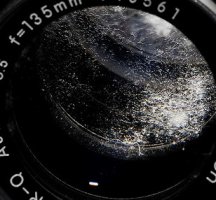
leGreve said:Just took a look at one of my lenses to sell it... then I discovered this.
Is it fungus?
I'd take it to DFA Service and have them check it out.
Upvote
0
I had an FD lens with fungus that I had cleaned at Camera Clinic in Sparks, NV this year. Good work for a fair price, if it is fungus you should consider them if you don't have anyone local.
Upvote
0

Good tips all... I'll double check the front element, just didn't seem like it was on that.
I contacted Zeiss as well, and they told me to ship it in, as they weren't sure it was fungus.
So I guess that's what I'll do.
I contacted Zeiss as well, and they told me to ship it in, as they weren't sure it was fungus.
So I guess that's what I'll do.
Upvote
0

privatebydesign said:If it is inside the lens, then yes.
But find a 'local' camera repairer, they can clean it for reasonable money.
If it is just on the outer side of the outer element, clean it yourself, it won't do any harm.
The worst thing you can do to a lens is not use it, UV kills fungus. But if you have to store them in the dark make sure you store them with desiccant to keep the moisture level very low.
Never thought of using desiccant in the lens bag. Good idea. Thanks!
Wondering if the lens, bag and all, should also be placed in a ziplock bag so that the little desiccant bag isn't trying to dry the whole room?
It is very dry here in Nevada, but we keep the apartment at about 50% humidity for the piano, guitars, ukuleles, and violins. The humidifier goes through a gallon and a half of water a day. That's in a 700 sq. foot apartment.
Upvote
0
L
Loswr
Guest
CanonFanBoy said:privatebydesign said:The worst thing you can do to a lens is not use it, UV kills fungus. But if you have to store them in the dark make sure you store them with desiccant to keep the moisture level very low.
Never thought of using desiccant in the lens bag. Good idea. Thanks!
Wondering if the lens, bag and all, should also be placed in a ziplock bag so that the little desiccant bag isn't trying to dry the whole room?
That's why I store my lenses in Pelican Storm cases with desiccant cartridges inside, the indicator kind so you can see when they need to be replaced/recharged.
There's not going to be a lot of air movement into/out of a closed camera bag in an out-of-the-way spot, but you'll likely exhaust the desiccant a bit faster than with a sealed environment.
Upvote
0
neuroanatomist said:CanonFanBoy said:privatebydesign said:The worst thing you can do to a lens is not use it, UV kills fungus. But if you have to store them in the dark make sure you store them with desiccant to keep the moisture level very low.
Never thought of using desiccant in the lens bag. Good idea. Thanks!
Wondering if the lens, bag and all, should also be placed in a ziplock bag so that the little desiccant bag isn't trying to dry the whole room?
That's why I store my lenses in Pelican Storm cases with desiccant cartridges inside, the indicator kind so you can see when they need to be replaced/recharged.
There's not going to be a lot of air movement into/out of a closed camera bag in an out-of-the-way spot, but you'll likely exhaust the desiccant a bit faster than with a sealed environment.
Smart.
Upvote
0

Zeiss
http://www.zeiss.co.uk/camera-lenses/en_gb/website/service/fungus_on_lenses.html
states that the humidity should be between 30-60% for storage - never less than 30% as "as it is dangerous for the instrument".
http://www.zeiss.co.uk/camera-lenses/en_gb/website/service/fungus_on_lenses.html
states that the humidity should be between 30-60% for storage - never less than 30% as "as it is dangerous for the instrument".
Upvote
0
AlanF said:Zeiss
http://www.zeiss.co.uk/camera-lenses/en_gb/website/service/fungus_on_lenses.html
states that the humidity should be between 30-60% for storage - never less than 30% as "as it is dangerous for the instrument".
Why do you think it can't be below 30% humidity? I would have thought the drier the better.
Upvote
0

Lenses that are stored for prolonged periods with extremely low humidity will dry out the internal lubricants, and friction can cause damage.Flamingtree said:Why do you think it can't be below 30% humidity? I would have thought the drier the better.AlanF said:Zeiss
http://www.zeiss.co.uk/camera-lenses/en_gb/website/service/fungus_on_lenses.html
states that the humidity should be between 30-60% for storage - never less than 30% as "as it is dangerous for the instrument".
Upvote
0

ajfotofilmagem said:Lenses that are stored for prolonged periods with extremely low humidity will dry out the internal lubricants, and friction can cause damage.Flamingtree said:Why do you think it can't be below 30% humidity? I would have thought the drier the better.AlanF said:Zeiss
http://www.zeiss.co.uk/camera-lenses/en_gb/website/service/fungus_on_lenses.html
states that the humidity should be between 30-60% for storage - never less than 30% as "as it is dangerous for the instrument".
That used to be a issue, but that was 30 years ago. Zeiss is very conservatitive, maybe they still use those old lubricants that dry out. I've had a Nikon 200-400mm AIS dry out, the friction from the almost solid lube made focusing impossible.
Upvote
0
Similar threads
- Replies
- 0
- Views
- 345
- Replies
- 6
- Views
- 2K


- Replies
- 149
- Views
- 20K


