ISO Poll

JohnDizzo15 said:
So I guess my question for Mackguyver goes for you as well. Since you do so much around ISO 100-160, have you felt compelled at all to consider getting a body with the Sony sensor in it?

Yep. D800 would produce better results for me I guess. I'm not changing all my lenses though & I don't really like the Nikon ergonomics.
 
Upvote 0
Is there such thing as a "native ISO"...for a camera?

Is there an ISO that a particular camera works at the absolute best it can for its sensor?

I thought I'd heard something about the Canon 5D3...having a native or ideal ISO at something other than the lowest 100??

Is there something to this, or have I heard wrong?

I was lending some credence to it..since at least with video there seems to be better quality if you use ISO's in multiples of 160...?

Thanks in advance,

cayenne
 
Upvote 0
cayenne said:
Is there such thing as a "native ISO"...for a camera?

Is there an ISO that a particular camera works at the absolute best it can for its sensor?

I thought I'd heard something about the Canon 5D3...having a native or ideal ISO at something other than the lowest 100??

Is there something to this, or have I heard wrong?

I was lending some credence to it..since at least with video there seems to be better quality if you use ISO's in multiples of 160...?

Thanks in advance,

cayenne

Yes and it is easy to test. M mode lens cap on 1 second exposure f4. Take one shot at each iso, the bigger the file the more noise. The smallest file should be your optimum/base iso.
 
Upvote 0
privatebydesign said:
cayenne said:
Is there such thing as a "native ISO"...for a camera?

Is there an ISO that a particular camera works at the absolute best it can for its sensor?

I thought I'd heard something about the Canon 5D3...having a native or ideal ISO at something other than the lowest 100??

Is there something to this, or have I heard wrong?

I was lending some credence to it..since at least with video there seems to be better quality if you use ISO's in multiples of 160...?

Thanks in advance,

cayenne

Yes and it is easy to test. M mode lens cap on 1 second exposure f4. Take one shot at each iso, the bigger the file the more noise. The smallest file should be your optimum/base iso.

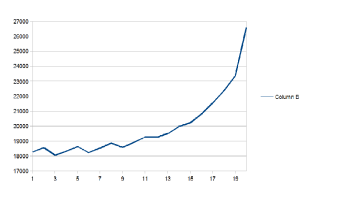
I did this a while ago for a 60D... same procedure but used F5.6...

The numbers are:
1 100 18266
2 125 18557
3 160 18072
4 200 18325
5 250 18624
6 320 18235
7 400 18530
8 500 18849
9 640 18589
10 800 18908
11 1000 19264
12 1250 19248
13 1600 19509
14 2000 19963
15 2500 20221
16 3200 20798
17 4000 21543
18 5000 22374
19 6400 23372
20 12800 26591

As you can see in the graph, the best ISO's to shoot at are 160, 320, which have lower noise than the next 2 lower settings, ISO 640 which has lower noise than the next lower setting, and ISO 1250 which is about the same as ISO1000... and the graph really shows the skyrocketing noise above ISO 3200...
 

Attachments

  • Untitled.png
    Untitled.png
    11.4 KB · Views: 412
Upvote 0
privatebydesign said:
90% 100-200iso; 8% 400-800iso; 2% either under 100 or over 800.

I suspect that I'm the same. When I get home tonight, I'll have a look at the exact numbers (but this might be thrown out by night-time timelapse photos, which I normally shoot at 1600). Most of my photos tend to be deliberately planned, tripod mounted shots where I want the best possible IQ. Plus lately I've been getting into long exposure shots, and low ISOs help me obtain longer exposures. ISO 100 is where I live.

Re changing brands/cameras to get better IQ. Its never really occurred to me. I'm happy with Canon and prefer their cameras and lenses. I don't really choose cameras on IQ, but on other features. My latest purchase was theoretically a downgrade in IQ - to an APS-C Fuji X-E1. But even it produces great photos. My reasons for purchasing it included it being enjoyable to use, it has a smaller/more socially acceptable body, direct access dials, better IR performance and better AF with IR filters and ND filters. I'm one of those people for whom, once image quality reaches an acceptable level, it ceases being an important deciding factor.
 
Upvote 0