Its official now. The new EF 100-400 from Canon is on its way! *** FAKE ****

Status
Not open for further replies.

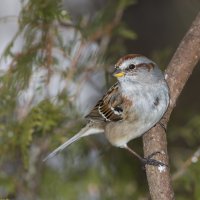
Took this today, overcast and in the hedges. 5dmk iii canon ef 400mm f5.6. 430 ex ii flash with beamer. f8.0 iso 125, 1/200
 

Attachments

  • American Tree Sparrow-2.JPG
    American Tree Sparrow-2.JPG
    3.1 MB · Views: 2,251
Upvote 0
Shooting small birds in flight is very difficult at best, most photographers have learned that its a losing battle.

Notice that most of the beautiful bird in flight photos are of large birds. Your first image was taken of a bird that was not flying, my comments did not totally apply to a small bird in flight.


I think you did pretty well with a small bird flying, I'd have to take a lot of shots to capture one in flight.

Here is one that I was lucky to capture with my 100-400L of a female Redwing blackbird as she dropped out of our crab apple tree.

20100516-IMG_9567-L.jpg
 
Upvote 0

Attachments

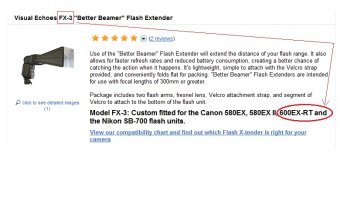
  • Bryrt Beamer FX-3 for Canon 600EX-RT.jpg
    Bryrt Beamer FX-3 for Canon 600EX-RT.jpg
    99.5 KB · Views: 1,755
Upvote 0
With the Better Beamer, be sure to set the zoom head manually to 50mm (or wider); the usual recommendation is to apply a bit of negative FEC. Personally, I often don't, because I'm using HSS to allow a high shutte speed, and I find that cuts the flash power sufficiently.

Also, a word of caution - be careful when using it to fill shadows when shooting in sunlight...you might find out the hard way why it's also called the Better Burner. A Fresnel lens works both ways - it will concentrate the light output of the flash, but if the sun shines on the front, it can be focused on your gear with deleterious effects (burn/melt marks on plastic surfaces).
 
Upvote 0
Mt Spokane Photography said:
Shooting small birds in flight is very difficult at best, most photographers have learned that its a losing battle.

Notice that most of the beautiful bird in flight photos are of large birds. Your first image was taken of a bird that was not flying, my comments did not totally apply to a small bird in flight.


I think you did pretty well with a small bird flying, I'd have to take a lot of shots to capture one in flight.

Here is one that I was lucky to capture with my 100-400L of a female Redwing blackbird as she dropped out of our crab apple tree.

20100516-IMG_9567-L.jpg
Fabulous colours. The bird is beautiful.

I understand about your comments, but the critters are so fast I have no time to set a focus point on them,
at least in most cases. And you are correct, larger birds are more predictable as the follow more of a flight path.

And I have a question. Shooting yesterday in very dim light. I wanted 1/1500Sec but instead of using TV I used Manual and set Aperture at something smaller than F5.6 to get more DOF. Auto ISO. So how can I get exposure compensation in such a setup? Or am I going about this in the wrong fashion?
Cheers
 
Upvote 0
bjd said:
Fabulous colours. The bird is beautiful.

I understand about your comments, but the critters are so fast I have no time to set a focus point on them,
at least in most cases. And you are correct, larger birds are more predictable as the follow more of a flight path.

And I have a question. Shooting yesterday in very dim light. I wanted 1/1500Sec but instead of using TV I used Manual and set Aperture at something smaller than F5.6 to get more DOF. Auto ISO. So how can I get exposure compensation in such a setup? Or am I going about this in the wrong fashion?
Cheers

That image used a Better Beamer, which is part of why the colors are bright. A also hit the "Punch" button in Lightroom to enhance it more.

If you are using full manual, there is no need to set exposure compensation, since you have already entered the exposure you want. Just be sure to set the ISO and not leave it on automatic, or its not really full Manual, since the ISO will vary.


F/5.6 should give reasonable depth of field unless you are very close. The image of the blackbird was at f/6.3, ISO 200 1/200 sec. I had been focused on the bird on its branch and taken a couple of shots. Then it dropped to the ground to eat some sunflower seeds and I happened to catch it as it dropped.


When you are shooting birds with the sky as a background, the camera will expose for the sky, and leave the bird vastly underexposed. Thats where full manual settings work best.


As Neuro noted, never use a Better Beamer on flying birds where you might inadvertently point it at the sun. Only use one where there is a controlled background that will not bring light the wrong way.
 
Upvote 0
I wanted to order the Better Beamer and an SB910 from B&H but B&H does not ship Nikon gear to the Middle East ... so I had to choose Adorama, but Adorma does not have Better Beamer, instead they have a similar one called Harbor Digital XT Flash Extender (http://www.adorama.com/HBXTA29.html) ... does anyone know much about this? i.e. anything I should watch out for etc?
 
Upvote 0
Status
Not open for further replies.