Lens dilemma for night sky

Nov 19, 2013
2
0
4,596
Hi.

I'm looking forward to buy some new lenses. The primary goal would be landscapes and night sky photos.
I'd like to mention that I own a Canon 5d Mark III so noise is acceptable, but I wanna lower that.
I'm looking right now to:
Canon 16-35 f2.8 II L
Canon 16-35 f2.8 II L + Rokinon 24 F1.4
Canon 17-40 f4 L + Rokinon 24 F1.4
Canon 17-40 f4 L + Canon 24 F1.4 L

Keeping in mind that I need option for filters too and aperture for night sky(no star trail). Sky trackers are not an option because of the foreground.
I read a lot about the Canon 24 vs Rokinon 24 coma problem.
In the future I also wanna buy a Canon 24 TS-E lens, but that's gonna wait.

I'm curios about your opinions. Renting these lenses, unfortunately is not an option.
Thank you for your time and patience.
 
Well, for both landscapes and night shots of stars, I like things real wide. But you want a large aperture for night stars, to get them without the trails.. Meaning medium-ish shutter speed. But you want small apertures for landscape, considering it's during the day. The canon 24 1.4 would be my pick.. Due to the max aperture. What about the canon 14mm 2.8 L? Since 5m3 has excellent ISO capabilities.
 
Upvote 0
Not sure if the new canon 24-70 2.8 mk2 has a lesser "comma" issue....but I would assume not, and would go instead with the Rokinon 14mm - as suggested already, along with the Zeiss 21mm. There are a few options with older Contax and Leica zoom lenses whithin the 24-80mm range , allowing a bit more flexibility and still affordable - you should do a search in some other nightscape forums.
No need for AF in nightscapes, and the hard stop at infinity is really usefull, along with live view - sure, low noise iso helps a lot too.

In sum:
Rokinon 14mm for sure
- assuming that your budget it's around +/- 2k, then you will have to compromise between night and day, zoom or prime combination for a second lens
 
Upvote 0
I have had good luck shooting the night sky with the Canon 28mm f1.8 lens. I shoot with it stopped down to 2.0 and there about. I do the same with the 50mm 1.4. I have the Canon 17- 40mm F4.0 but it takes longer exposures than I like. I like to shoot at 400 to 800 ISO. I have shot as high as 1600 ISO with acceptable results.
 
Upvote 0
flajcsi said:
Canon 16-35 f2.8 II L
Canon 16-35 f2.8 II L + Rokinon 24 F1.4
Canon 17-40 f4 L + Rokinon 24 F1.4
Canon 17-40 f4 L + Canon 24 F1.4 L
I'd look at a zoom + Zeiss 21mm. The problem with night sky shooting is that you need speed and the lenses mentioned (the f1.4's) suffer badly from a bunch of optical aberrations, with coma being the worst (the Canon is a shocker). At f2.8 on a 5D3, the ISO capabilities are sufficient to cope with a stop or two loss. The Zeiss 21mm is crazily sharp wide open, but I went for the Zeiss 15mm because I wanted a wider lens.

You could go for the Canon 17-40 for landscape and Zeiss 21mm for night shooting, but it does a great job for landscapes at f8 :)
 
Upvote 0
gigabellone said:
Have you considered the Samyang/Rokinon 14/2.8? It looks like it's very sharp and woth very low chromatic aberrations and no coma. I'm considering it myself as my night sky lens. I think that the 17-40/4 might be a little too slow to photograph stars.

+1
 
Upvote 0
The problem with the Rokinon 14/2.8 is that it will not let you add a filter, although you just might be able to find some kind of wonky adapter. But even in spite of that, I still recommend the Canon 17-40mm + Rokinon 14mm. For scenes where you do need a filter, you can use the Canon 17-40mm. The Rokinon would do very well at night for stars, but will still do wonders in the day when you don't specifically need a filter. I think you'll get the best of both worlds with that combination.
 
Upvote 0
I shoot with a mkii, I've had alright luck with the 50mm 1.8 when used to create panoramas. I've also used the 17-40 and would not recommend. I'm on the same boat as you and I'm choosing between selling my 17-40 and getting a Tokina 16-28, though the lack of filters bothers me, especially sense my 17-40 would be in the trash right now had it not been for one. The rokinon 14, 24 and 35 all sound like great lenses and I'm trying to make the choice between them.

Pano with the 50

8970169572_1da5236216_k.jpg


Shot with the 17-40

8355812530_12d992a4ce_k.jpg
 
Upvote 0
If you want to have good star images in the corners you will have to stop down most (all wider) of the lenses for one to two stops, sometimes even 3. So the argument to save money when using at 2.8 optic instead of a 1.4 stopped down to 2.8 is not correct since the 2.8 optic needs to be stopped down again to at least 4.... I even stop down fantastic lenses like the 135/2, the 200/2.8 or the 300/2.8 and 500/4 since you benefit a lot in quality when doing this in astrophotography!.
 
Upvote 0
nubu said:
If you want to have good star images in the corners you will have to stop down most (all wider) of the lenses for one to two stops, sometimes even 3. So the argument to save money when using at 2.8 optic instead of a 1.4 stopped down to 2.8 is not correct since the 2.8 optic needs to be stopped down again to at least 4.... I even stop down fantastic lenses like the 135/2, the 200/2.8 or the 300/2.8 and 500/4 since you benefit a lot in quality when doing this in astrophotography!.
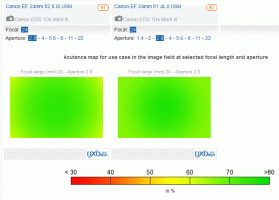
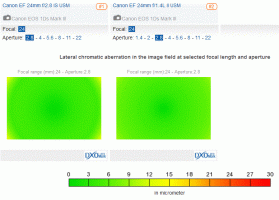
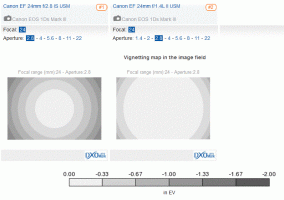
Maybe you're right, i never used these lenses and i can't swear by it, but if we can trust DxOMark, it looks like the two lenses behave close enough to make a 1000$/€ price difference look a bit of an exaggeration. Check the images attached to this post, i'm looking for a wideangle too, and i need some feedback. :)
Mr Bean said:
The other benefit of the Zeiss 21mm, other than being tack sharp wide open at f2.8 is that it has a hard infinity stop. Sooooo much easier to set in the dark than fiddling with Live View to get focus on an AF lens.
I agree with you, the Zeiss 21/2.8 is the best at astrophotography, but MF makes it a very specialized lens.
 

Attachments

  • 24S.GIF
    24S.GIF
    64.2 KB · Views: 1,609
  • 24CA.GIF
    24CA.GIF
    60 KB · Views: 1,551
  • 24V.GIF
    24V.GIF
    73 KB · Views: 1,589
Upvote 0
Thank you for all the responses.
My big concern is that I read about the 24mm f1.4L coma and some review said that the Rokinon does a better job with this problem. It's kinda unbelievable, that a 1800 dollar lens is being beaten by a 600 dollar one. Again I'm looking at the widest aperture possible, because of the noise.
The Zeiss lenses would be a good idea, but those are 2.8.
Autofocus is not an issue. My priority is light and image quality.
I tried my 50mm 1.4 for this kind of photography, but it's not wide enought.
Something between 14-24.
Thanks again for the help and I'm curious for all of your experience with these lenses.
 
Upvote 0
Stars are the hardest test for chromatic abberations, coma and astigmatism. Moreover, in more light polluted areas vignetting is quite obvious. Whereas I will not question the high quality of the Zeiss optics (had many of them in my analog Contax time) wide open is not an option if you want high quality results. This link is somewhat outdated but still valid for its basic message: http://www.astropix.com/HTML/I_ASTROP/LENSES.HTM
 
Upvote 0
flajcsi said:
... Again I'm looking at the widest aperture possible, because of the noise. ...

Astrophotographers beat noise by exposure time (stacking of many indv. exposures) and not open aperture!
It is much easier and cheaper to double exposure times than to double apertures! Only in special cases (astrophotography incl. landscape or moving phenomena like aurora) one fully opens up to have the shortest exposure times possible.... I fully agree that manual focus is perfectly o.k. since compared to any meaningful exposure time the manual focusing time with e.g. live view in 10x mode is negligible. In the analog times it was much harder with test images or knife edge focusing....
 
Upvote 0
Sorry I forgot to make a note on Sky trackers which you excluded. This is only partly true even for pics including landscape!

Modern systems have so called half speed modes correcting only have of earths rotation and by this also causing smearing problems in the landscape part later. So by this it is possible to gain some extra photons on both the landscape and the starry sky ... Examples are: http://www.vixenoptics.com/mounts/polarie.html or the by me preferred: http://www.ioptron.com/index.cfm?select=productdetails&phid=cffad01a-797c-4cf4-beb8-a64bc8e09b06 (its the more complete package for a better price)
 
Upvote 0
I did quite a few tests using my Zeiss ZE 25/2, 50/2 MP and 100/2 MP. These are all superb lenses but like all lenses, they exhibit a combination of vignetting, optical aberration and field curvature.

On an APS-C frame, they can all be used stopped down 1 stop. On a full frame, they they are not good enough for astrophotography unless stopped down to f/5.6, f/4 and f/4 respectively. The same conclusion largely holds for the 21/2.8 except that the field of view becomes something of a liability rather than a help.

This should hardly be a surprise - even the very fastest astrograph from Takahashi operates at f/2.8 which is really about T/3.5 and can only illuminate an APS-C frame.

You can draw your own conclusions on how this relates to the 16-35 and 17-40, neither of which is particularly sharp unless stopped down considerably. I have no experience of the 14 mm Samyang but I friend uses the 14 mm Canon lens quite successfully.

Secondly, I honestly don't know what the OP's problem is with a sky tracker. You can get a sharp foreground and sharp stars by layering two images. As others have pointed out, it is sensible to stack the astro-image so that you can suppress noise. It may have been linked to above but this ebook is worth study http://astropix.com/BGDA/BGDA.HTM .

If cost is the issue, a sky tracker is easy to make - basically two pieces of wood and a hinge and a screw to rotate at 1 rpm using your finger. Look up "barn door tracker." Here's a very basic one that's good for 30 minutes at least... http://psychohistorian.org/display_article.php?id=201303261529_barn-door
 
Upvote 0