MP-E 65mm - High Difficulty Level

Man! Am I equal parts excited and frustrated by this lens!

I've read the reviews saying how difficult it is to use this lens at higher magnifications, reading that the viewfinder gets darker and small movements are massively exaggerated.

I thought I was prepared. lol I fooled myself ;D

I've now decided to work with magnifications no higher than 2.5X until I have worked out the muscle memory needed to wield the camera but I'd much appreciate some advise if anybody is willing to teach me.

My subject matter are insects, shot handheld like I do with my 100L.

And BIG respect to those of you who have taken pin sharp photos of live insects at 5X magnification

Thanks everyone
 
I've never done "real" macro work with 1x+ mag but I think typically they do one of the following:

1) focus rails + focus stacking
2) the above + flash
3) handheld + flash

In my limited experience I found flash was key in getting sharp handheld shots when shooting extremely close. Flash is faster than a shutter. I assume you aren't using flash since you didn't mention it.
 
Upvote 0
Flash is definitely key for handheld insect shooting. With the MP-E 65, I usually use Live View. Pick a magnification, rock back and forth to focus.

"Mantis"

EOS 1D X, MP-E 65mm f/2.8 1-5x Macro @ ~3x, 1/250 s, f/14, ISO 400, MT-24EX


"Tiny Hopper"

EOS 5D Mark II, MP-E 65mm f/2.8 1-5x Macro @ 3.5x, 1/60 s, f/14, ISO 400, MT-24EX
 
Upvote 0
neuroanatomist said:
Flash is definitely key for handheld insect shooting. With the MP-E 65, I usually use Live View. Pick a magnification, rock back and forth to focus.

"Mantis"

EOS 1D X, MP-E 65mm f/2.8 1-5x Macro @ ~3x, 1/250 s, f/14, ISO 400, MT-24EX


"Tiny Hopper"

EOS 5D Mark II, MP-E 65mm f/2.8 1-5x Macro @ 3.5x, 1/60 s, f/14, ISO 400, MT-24EX

Thanks for the LiveView tip, I've been trying through my viewfinder and it's way hard than using the 100 L. I'll invest some of my practise time into familiarizing myself with your technique.

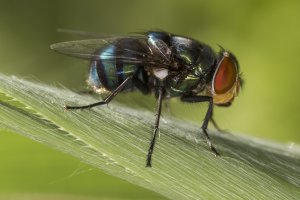
Here's my first okay shot with the MP-E 65

Canon 7Dii + Canon MP-E65 + Canon MR-14-EX | ISO 400 | SS 1/250 | 2.5X magnification (est)
 

Attachments

  • European Green Blowfly 05.jpg
    European Green Blowfly 05.jpg
    3.9 MB · Views: 273
Upvote 0
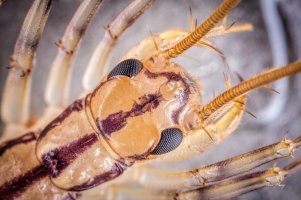
Flash is a must with that lens. I have found a Yongnuo ring flash (not LED) that works a treat. The attached image was at 5:1 handheld, but I usually prop the end of the ring flash on something and rock the camera until I see the eye come in focus and snap. The other key is to take as many photos as you can (not always easy with insects though).

I almost sold the lens after having it for a year and never really getting good results. Finally took the time to learn the lens and technique and now it's one of my favorite lenses and macro work has become my second favorite type of photography. Have fun!
 

Attachments

  • 2W0A4314-Edit.jpg
    2W0A4314-Edit.jpg
    421.9 KB · Views: 177
Upvote 0
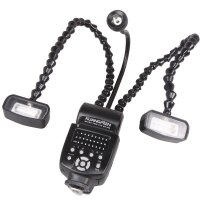
I'd prefer a macro flash with two heads to a ring light. That way, you can control the output of each and avoid the "Flat" look from a ring light. Shadows actually can add to a photo if you control them.

If you are looking for low price, I've seen some good comments about this one from Venus Optics a few months ago. You might want to search again. Search for Venus Optics (Laowa) Kuangren KX800 Macro Twin Flash
 

Attachments

  • macro flash.jpg
    macro flash.jpg
    82.2 KB · Views: 165
Upvote 0
I've never done macro, but I have done astrophotography.. and focussing/target finding is a similar nightmare.

In astrophotography the real solution is to teather.. you can then focus being able to identify individual pixels, you can target find with noise supression techniques (binning in astro) allowing you to see things totally invisible through the viewfinder.

a steady mount + USB cable may be all you need.
 
Upvote 0
Mt Spokane Photography said:
I'd prefer a macro flash with two heads to a ring light. That way, you can control the output of each and avoid the "Flat" look from a ring light. Shadows actually can add to a photo if you control them.

If you are looking for low price, I've seen some good comments about this one from Venus Optics a few months ago. You might want to search again. Search for Venus Optics (Laowa) Kuangren KX800 Macro Twin Flash
That is one cool looking flash! From the looks of it, it must be great for ant photography :)
 
Upvote 0
Sabaki said:
Guys, I'm shooting at f/8.0, should I change to f/16 instead?

Depends on what you want and at what magnification you shoot. The MP-E 65 adjusts the physical f-stop, but due to the extension of the helicoid, light scatters further and the effective f-stop at the sensor is quite a bit larger:
f-effective = f-stop-lens x (magnification +1).
so at 5x, your f/8 becomes f/8x(5+1) = f/8x6 = f/48
f/16 it becomes f/96.
Depending on how you want to show your work, this may lead to significant diffraction blur. But if you need/want the depth of field, you may chose to live with the blur. If you want a small 2x3" image, you can stop down to your heart's content. If you want to enlarge to about 8x10", then effective f-stop f/32 is about the max you want to permit. If larger print formats, then smaller number f/stop.

For maximum sharpness, you shoot at either f/2.8 or f/4. There is quite a bit of copy variation in the MP-E 65. Mine is sharpest at f/2.8 and that is what I use when I stack. I ran tests from 1:1 to 5:1 and for every magnification, f/2.8 was sharper. Very easy to see once you blow the images up on screen.

The MP-E 65 is a high delete-rate lens hand-held. Shoot lots, delete most, and hopefully you will get a couple of keepers. For terrestrial arthropods, I will easily shoot 50, toss 48. The biggest limiting factor for the shooting speed is the recharge rate of the flash. Bracing techniques will help with higher keeper rates. Try to have as many contact points of your body with solid surfaces, or with your own body (elbow along chest, or on knee while sitting on ground). Wear old clothes.

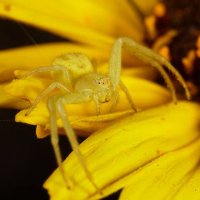
Attached a crab spider Misumena vatia, handheld, about 2-3:1, in Southern California chaparral.
 

Attachments

  • 12920505_1587954981521215_5970050651730439650_n.jpg
    12920505_1587954981521215_5970050651730439650_n.jpg
    146.7 KB · Views: 885
Upvote 0
Mt Spokane Photography said:
I'd prefer a macro flash with two heads to a ring light. That way, you can control the output of each and avoid the "Flat" look from a ring light. Shadows actually can add to a photo if you control them.

If you are looking for low price, I've seen some good comments about this one from Venus Optics a few months ago. You might want to search again. Search for Venus Optics (Laowa) Kuangren KX800 Macro Twin Flash

Thank you Spokane :)

I had the fullest intention to pick up a MT-24EX but after chatting with Dalentech for a while, he advised me to play the waiting game and see if Canon releases a mark ii with better diffusion potential and I've taken that advice.

The ringlight is just to direct and gives a harsh quality to the images that I am not happy with so I will eventually replace it.

But for now, it's all about getting familiar with the MP-E 65. I've limited the magnification to a maximum of 2x for now.
 
Upvote 0
Zeidora said:
Sabaki said:
Guys, I'm shooting at f/8.0, should I change to f/16 instead?

Depends on what you want and at what magnification you shoot. The MP-E 65 adjusts the physical f-stop, but due to the extension of the helicoid, light scatters further and the effective f-stop at the sensor is quite a bit larger:
f-effective = f-stop-lens x (magnification +1).
so at 5x, your f/8 becomes f/8x(5+1) = f/8x6 = f/48
f/16 it becomes f/96.
Depending on how you want to show your work, this may lead to significant diffraction blur. But if you need/want the depth of field, you may chose to live with the blur. If you want a small 2x3" image, you can stop down to your heart's content. If you want to enlarge to about 8x10", then effective f-stop f/32 is about the max you want to permit. If larger print formats, then smaller number f/stop.

For maximum sharpness, you shoot at either f/2.8 or f/4. There is quite a bit of copy variation in the MP-E 65. Mine is sharpest at f/2.8 and that is what I use when I stack. I ran tests from 1:1 to 5:1 and for every magnification, f/2.8 was sharper. Very easy to see once you blow the images up on screen.

The MP-E 65 is a high delete-rate lens hand-held. Shoot lots, delete most, and hopefully you will get a couple of keepers. For terrestrial arthropods, I will easily shoot 50, toss 48. The biggest limiting factor for the shooting speed is the recharge rate of the flash. Bracing techniques will help with higher keeper rates. Try to have as many contact points of your body with solid surfaces, or with your own body (elbow along chest, or on knee while sitting on ground). Wear old clothes.

This is interesting! I'll go take some shots off of my tripod and work out at which aperture my lens works best. I was getting this weird blurring that I'm not sure may actually be diffraction. Thanks!

I've posted before about an Australian who does focus stacking on live peacock jumping spiders.

I asked him how he manages this and he says he uses a battery pack and 'walks' into the subject whilst firing off 10 shots in quick succession. I think this may actually be a very good practise and I'll pick up a battery pack in a few months.

Thanks for the feedback, really appreciate it :)
 
Upvote 0
LesC said:
EvvPhotog said:
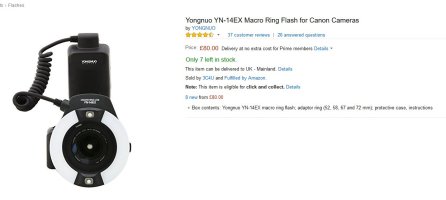
Flash is a must with that lens. I have found a Yongnuo ring flash (not LED) that works a treat.

Is it this one?

Yeap! That's the one. Someone mentioned flat light, which can be an issue on larger subjects, but with this flash you can set the ratio for each side. When something is the size of an ant, for example, having one side of the ring flash brighter than the other adds depth and shadows. I rather love the light actually. Can't beat the price either.
 
Upvote 0