No one sees it like you....

tolusina said:
Try as I could, I could not find a photographic example showing how a tilt-shift lens can be used to get the camera's and operator's reflections out of the image, I did find a few quotes, here are two;

From....
http://photo.net/equipment/canon/tilt-shift
"....If you face a mirror head on, you will be in the shot. If you move to the side, it turns into a parallelogram. With a shift lens mounted, move the camera to the side, turn the film and lens parallel to the mirror, then use shift to get the original composition back (more or less)...."

From....
http://www.luminous-landscape.com/reviews/lenses/nikon_24_pc.shtml
"....One use for this capability to to be able to shoot straight into a mirror, or mirrored surface such as a glass wall, without seeing the camera's reflection....."

So, my suggestion to use tilt-shift was about removing the camera's reflections, nothing about tilt-shift has anything to do with auto focus or anything else in the composition.
Does that help you with your reading comprehension?
- - -
privatebydesign said:
.....Get real. How do you take this panned and auto AF'd in the water shot with a tilt shift? It is CGI. As is the meteor shot, which castes doubt on most, if not all, the others.
Ok, here's real,
(attachment should be here, don't see it in preview)


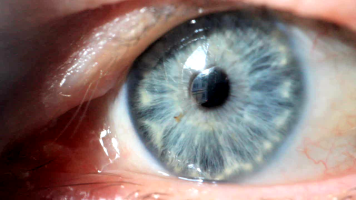
SOC jpg shot handheld on a 10mpx Nikon D80, iso 100, 1/125, f6.7, 300mm (x1.5 crop = 450mm), cheap arse Tamron 28-300 zoom, image tightly cropped, then zoomed to ~240%
Consider everything going against IQ, sharpness, depth of field etc., in the image.
In this image are a primary subject, the model's eye, and the secondary subjects, the reflections.
Depth of field in the primary subject is thin, in the original, the eye and most of the eyelashes are in focus, the eyebrow is quite blurred.
In the secondary, reflected in the curved surface of the eyeball image, the photographer, cars, buildings and horizon are readily apparent. With currently available, top level gear, IQ and clarity will be much greater than what is shown here.

Your auto focus concerns are irrelevant, camera/lens only has to focus on the eye, whatever is reflected in the eye will be in focus.
- - -
The skydiving sequence (00:16) gave me the most trouble imagining how it was done, then I realized the camera was helmet mounted, pre-focused on the eye, whatever the eye looked at ended up in the shot. Likely many takes were required. Wind buffeted the camera on its mount.

At 00:10 there's a hex reflected, no, that's not reflection of aperture blades, it's an umbrella.
At 00:20 following the skydive is a boxer. Notice light changing, flashes popping in the background.

There is a handheld look to most of the sequences, there is motion apparent, camera relative to eye. The sequences could not have been shot handheld, I am quite at a loss to imagine how the handheld look was achieved.

Meteor sequence? Same as the rest, whatever reflects in the eye is captured as the secondary subject. The primary subject must only look towards the desired secondary. Camera follows the primary eye, eye follows the secondary.


Schedule the meteor shoot same as any meteor shoot, google it.
https://www.google.com/#q=meteor%20shower%202014&safe=off
Likely several simultaneous takes using multiple models and gear set ups.
- - -
Panning? Primary subject's head with camera rig pan together, eye stays in focus, reflections stay in focus, done.
- - -
Here's hoping your clients don't suffer from your lack of creative imagination that your post here has shown.
I quite enjoyed this video for it's artistic and entertainment value, that enjoyment has decreased significantly through this technical dis-assembly.
- - -
I'll concede only a maybe regarding the meteor trails, and that concession concerns only light levels as I've never attempted anything similar.
Kudos to those that did even if CGI was involved.


I continue to doubt that Canon would resort to CGI to promote imaging gear, this was not an Adobe, fake what you can't do for real, production.


.

Haha wow, lol, that is all.
 
Upvote 0
Has to be some type of composting -- optical or software. I don't see anyway to have decent focus on the eye itself and the reflection at the same time if it was a straight shot. Focus distance to the eye is very short -- maybe an couple inches max. the reflected image focus distance is the actual distance to the object reflected -- several feet to infinity. (Try this test, take camera and focus on your own reflection in a mirror, then without changing focus, shift sideways so the frame of the mirror is in view. It will be out of focus. Refocus on the mirror edge and your reflection goes out of focus.)

I'm guessing before CGI this might be done by shooting thru a half-silvered mirror mounted at 45 degree angle. A small video monitor would be mounted the same distance from the mirror as the eye. Camera would see both the eye and whatever video was played on the monitor at the same apparent focus distance.
 
Upvote 0
There's also a simple and inexpensive method to make such images without resorting to CGI or editing tricks.
But that would lack the pizzazz of a big CGI crew, even if it got the job done in less time and 1/100th the budget. Tho it might contain some minor reality-flaws someone would eventually complain about.
Still, a nice bit of commercial video to make their point.
 
Upvote 0
old-pr-pix said:
Has to be some type of composting -- optical or software. I don't see anyway to have decent focus on the eye itself and the reflection at the same time if it was a straight shot. Focus distance to the eye is very short -- maybe an couple inches max. the reflected image focus distance is the actual distance to the object reflected -- several feet to infinity. (Try this test, take camera and focus on your own reflection in a mirror, then without changing focus, shift sideways so the frame of the mirror is in view. It will be out of focus. Refocus on the mirror edge and your reflection goes out of focus.)

A flat mirror is the wrong comparison.

You really don't need CGI to have sharp eyes AND sharp reflections see the image below which is a simple proof. The image is made with an APS-C camera, HD video mode, f7.1 @60mm (EF-S Macro). @f/2.8 the same situation.
The cornea is a spherical mirror (in that case) and acts as a second optical element providing more or less sharp images.

The only problems are:
- avoid the reflection of the imaging system
- getting enough contrast (as you can see with my image with blue-gray eyes) - dark (e.g. brown) eyes are
much better but i have to live with what I have.

CGI is much cheaper and using a fisheye will give satisfactory distortions which are well accepted as reflections form the cornea.

So everyone is right - at least a little bit ...

EDIT: Forgotten the attachment - now available ...
 

Attachments

  • augenspiegelung_geht_nicht-2014-03-31-14h07m15s118.png
    augenspiegelung_geht_nicht-2014-03-31-14h07m15s118.png
    486.1 KB · Views: 389
Upvote 0
Roo said:
Sometimes we waste too much time over analyzing everything rather than just appreciating things for what they are...

That depends, if you are an artist type then sure, just look at things as they are and interpret them as you will. If you are an engineer type then it is far more fun working out how things are done. If you are a dillusional type then arguing black is white in the face of far more experienced doubters seems fun. If you are a pro photographer knowing what can, and can't, be shot easily, or created in post with better results, is a professional necessity.

It isn't that I believe my opinion is important, it is that I believe the truth is, particularly when the truth is being denied.
 
Upvote 0
privatebydesign said:
Roo said:
Sometimes we waste too much time over analyzing everything rather than just appreciating things for what they are...

That depends, if you are an artist type then sure, just look at things as they are and interpret them as you will. If you are an engineer type then it is far more fun working out how things are done. If you are a dillusional type then arguing black is white in the face of far more experienced doubters seems fun. If you are a pro photographer knowing what can, and can't, be shot easily, or created in post with better results, is a professional necessity.

It isn't that I believe my opinion is important, it is that I believe the truth is, particularly when the truth is being denied.

Bravo! I can only applaud your ethics in this, because finding out how something has been done is important for many of us on this forum. It is only sensible to point out how things can get done effectively to achieve the wanted results.
 
Upvote 0
Hi Folks.
++1
Or nice and concise, enquiring minds need to know!
Appreciating things for what they are when really they are not is an exercise in futility!

Cheers Graham.

AmbientLight said:
privatebydesign said:
Roo said:
Sometimes we waste too much time over analyzing everything rather than just appreciating things for what they are...

That depends, if you are an artist type then sure, just look at things as they are and interpret them as you will. If you are an engineer type then it is far more fun working out how things are done. If you are a dillusional type then arguing black is white in the face of far more experienced doubters seems fun. If you are a pro photographer knowing what can, and can't, be shot easily, or created in post with better results, is a professional necessity.

It isn't that I believe my opinion is important, it is that I believe the truth is, particularly when the truth is being denied.

Bravo! I can only applaud your ethics in this, because finding out how something has been done is important for many of us on this forum. It is only sensible to point out how things can get done effectively to achieve the wanted results.
 
Upvote 0