Off Brand: Sony Announces the Full-frame a7R III

privatebydesign said:
snoke said:
rfdesigner said:
privatebydesign said:
P.S. How are you supposing they are fitting 15 stops of DR into a 14 bit, at most, file?

Log?

Good bet. Need non-linear raw data.

How does turning linear data into a curve help? There is no more space so something somewhere is crushed. Sure there are theoretical oversampling and averaging computations that haven’t been shown to be practical in this application that can give you more steps within a file. But so far we have been given linear data as linear data, so how are Sony getting, supposedly, well over 14 stops of DR into a 14 bit file? Red moved to 16 bit files to achieve the feat.

I'm not sure if that's the case with the A7r3, but all other Sony cameras starting with the A99 and up to the A9 shoot 14bit only in the single shot (no burst) mode. If you switch to the burst mode - the cameras stores 11bits only.
 
Upvote 0
Sony A7S II: What to expect if you are taking pictures with a Sony camera near the surf and water splashed up from below and /or behind.


https://www.lensrentals.com/blog/2017/10/about-getting-your-camera-wet-teardown-of-a-salty-sony-a7sii/
 
Upvote 0
Jopa said:
I'm not sure if that's the case with the A7r3, but all other Sony cameras starting with the A99 and up to the A9 shoot 14bit only in the single shot (no burst) mode. If you switch to the burst mode - the cameras stores 11bits only.

That's incorrect, I believe:

A9 will capture bursted uncompressed 14-bit RAW shots, but your electronically shuttered capture drops from 20 fps to 12 fps. (See manual, page 80.) 5 fps mechanically shuttered performance I believe would still work as well, but that was not spoken to specifically in the manual.

A99-II will slow down if you go with uncompressed 14-bit RAW + Continuous Hi+ (aka 12 fps) mode. (See manual, page 47.) However, it doesn't slow down that much in the testing I've seen:

http://www.imaging-resource.com/PRODS/sony-a99-ii/sony-a99-iiA6.HTM

They pegged somewhere in the 10.5-11.1 fps neighborhood.

Don't get me wrong, Sony is rife with burst 'terms and conditions' to constant AF vs. first exposure AF only, compressed fps vs. uncompressed fps, etc. but their latest round of camera appears have been hacking away at (some of) those terms and conditions.

- A
 
Upvote 0
ahsanford said:
Jopa said:
I'm not sure if that's the case with the A7r3, but all other Sony cameras starting with the A99 and up to the A9 shoot 14bit only in the single shot (no burst) mode. If you switch to the burst mode - the cameras stores 11bits only.

That's incorrect, I believe:

A9 will capture bursted uncompressed 14-bit RAW shots, but your electronically shuttered capture drops from 20 fps to 12 fps. (See manual, page 80.) 5 fps mechanically shuttered performance I believe would still work as well, but that was not spoken to specifically in the manual.

A99-II will slow down if you go with uncompressed 14-bit RAW + Continuous Hi+ (aka 12 fps) mode. (See manual, page 47.) However, it doesn't slow down that much in the testing I've seen:

http://www.imaging-resource.com/PRODS/sony-a99-ii/sony-a99-iiA6.HTM

They pegged somewhere in the 10.5-11.1 fps neighborhood.

Don't get me wrong, Sony is rife with burst 'terms and conditions' to constant AF vs. first exposure AF only, compressed fps vs. uncompressed fps, etc. but their latest round of camera appears have been hacking away at (some of) those terms and conditions.

- A

My bad. It's 12bit RAW. 11+7 - that's just their lossy RAW compression.
A7r2: http://www.fredmiranda.com/forum/topic/1379163
A9: https://www.dpreview.com/articles/7266455439/sony-a9-real-world-iso-invariance-and-dynamic-range (but DPR say "12-bit in continuous drive comes at no cost", yeah, sure :) )

It's really every single Sony camera, I'm not sure about APS-C, but really even my old A99 had this "quality drop".
 
Upvote 0
Jopa said:
The 12 vs 14 bit difference is actually quite visible: http://blog.kasson.com/the-last-word/sony-a7ii-12-bit-modes-effect-on-shadows/

Re: 12 vs 14 differences, I completely agree.

I'm just saying the days of getting a Canon/Nikon-like full 14 bit RAW files at any burst settings is becoming more and more possible with these most recent Sony rigs. I never would use compressed formats, so I never really took their specs that seriously... until this past year. We now have rigs that can deliver the following numbers with 14 bit RAW files:

A99 II: 42 x 'slower than 12 fps' (manual) --> 42 x 11 (tested)
D850: 45 x 9 (manual) --> haven't seen testing yet
A7R3: 42 x 10 (advertised, no manual yet)

- A
 
Upvote 0
Actually it is quite model specific - I do not see any significant difference: https://www.dpreview.com/reviews/image-comparison/fullscreen?attr346_0=efcs_single&attr346_1=efcs_continuous&attr346_2=electronic_single&attr346_3=electronic_continuous&attr347_0=iso100%2B6ev&attr347_1=iso100%2B6ev&attr347_2=iso100%2B6ev&attr347_3=iso100%2B6ev&normalization=full&widget=519&x=0.289341062&y=0.6311134

Jopa said:
The 12 vs 14 bit difference is actually quite visible: http://blog.kasson.com/the-last-word/sony-a7ii-12-bit-modes-effect-on-shadows/
 
Upvote 0
ahsanford said:
Jopa said:
The 12 vs 14 bit difference is actually quite visible: http://blog.kasson.com/the-last-word/sony-a7ii-12-bit-modes-effect-on-shadows/

Re: 12 vs 14 differences, I completely agree.

I'm just saying the days of getting a Canon/Nikon-like full 14 bit RAW files at any burst settings is becoming more and more possible with these most recent Sony rigs. I never would use compressed formats, so I never really took their specs that seriously... until this past year. We now have rigs that can deliver the following numbers with 14 bit RAW files:

A99 II: 42 x 'slower than 12 fps' (manual) --> 42 x 11 (tested)
D850: 45 x 9 (manual) --> haven't seen testing yet
A7R3: 42 x 10 (advertised, no manual yet)

- A

Adam, are you sure the A7r3 won't fall back to 12bit @ 10fps?
 
Upvote 0
PavelR said:
Actually it is quite model specific - I do not see any significant difference: https://www.dpreview.com/reviews/image-comparison/fullscreen?attr346_0=efcs_single&attr346_1=efcs_continuous&attr346_2=electronic_single&attr346_3=electronic_continuous&attr347_0=iso100%2B6ev&attr347_1=iso100%2B6ev&attr347_2=iso100%2B6ev&attr347_3=iso100%2B6ev&normalization=full&widget=519&x=0.289341062&y=0.6311134

Jopa said:
The 12 vs 14 bit difference is actually quite visible: http://blog.kasson.com/the-last-word/sony-a7ii-12-bit-modes-effect-on-shadows/

You probably mean those images all are noisy as h3ll :) But the colors and noise pattern / grain look different. On Jim Kasson's example (A7-2) the noise is much more obvious on the 12bit RAWs.

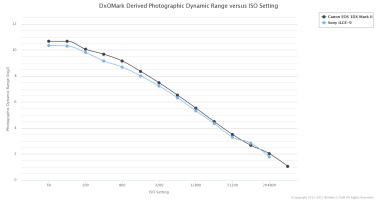
I'm not sure how PhotonsToPhotos measure DR (i.e. what mode), but on their DxO-derived chart the A9 has less DR than the 1dx2.
 

Attachments

  • chart.png
    chart.png
    115.1 KB · Views: 120
Upvote 0
Jopa said:
Adam, are you sure the A7r3 won't fall back to 12bit @ 10fps?

The manual isn't out yet, but if the A99 II has 42 MP sensor, a mechanical shutter capable of 12 fps and the ability to actually move 42 x 11 14 bit RAW files' amount of data, I don't see how the A7R3 wouldn't be able to pull that number off. Neither the mechanical shutter nor the throughput would bottleneck at 42 x 10, right?

So yes, they might say 'speed may go down with 14 bit uncompressed RAW', but that would be design/cost decision more than if than any technical limitation on their part. So I'll place 42 x 10 as 'advertised' until I see a footnote in ads/announcements or an actual manual that qualifies that.

- A
 
Upvote 0
I mean that 12 vs 14 bit does not show any significant difference on A9 camera. So the difference on A7II is model specific not general bitness difference!
(Any camera image pushed 6EV exhibit noise.)

Jopa said:
PavelR said:
Actually it is quite model specific - I do not see any significant difference: https://www.dpreview.com/reviews/image-comparison/fullscreen?attr346_0=efcs_single&attr346_1=efcs_continuous&attr346_2=electronic_single&attr346_3=electronic_continuous&attr347_0=iso100%2B6ev&attr347_1=iso100%2B6ev&attr347_2=iso100%2B6ev&attr347_3=iso100%2B6ev&normalization=full&widget=519&x=0.289341062&y=0.6311134

Jopa said:
The 12 vs 14 bit difference is actually quite visible: http://blog.kasson.com/the-last-word/sony-a7ii-12-bit-modes-effect-on-shadows/

You probably mean those images all are noisy as h3ll :) But the colors and noise pattern / grain look different. On Jim Kasson's example (A7-2) the noise is much more obvious on the 12bit RAWs.

I'm not sure how PhotonsToPhotos measure DR (i.e. what mode), but on their DxO-derived chart the A9 has less DR than the 1dx2.
 
Upvote 0
ahsanford said:
OSOK said:
Different strategies. Canon separates features out to different bodies. Nikon and Sony have provided two, essentially "do all" bodies.

5D4 looks very weak and old in comparison.

Canon was looking good within the industry due to the presumption that you couldn't have your cake and eat it, until Nikon D850 and A7R3 proved otherwise.

42mp @ 10fps w/ 14+ stops of DR and low noise FF for $3,200.

The folks in here can have their fun and bash them all they want, but in reality there is very little answer to this.

Sure there's an answer for this. Canon is in a leading marketing position and has built a terrific reputation of stuff working well. They have to do less to maintain that position than their competitors do to claim that position.

Sony and Nikon are in a following market position and can do a lot of things to change that. One of those things is to follow the Canon model and be efficient and smart about improvements, core technology, improve quality/reliability/service, etc. and the other is to simply offer more per dollar to gain business. Sony and Nikon are choosing the latter. It looks awesome on paper, but one might imagine they are burning through cash to do this -- selling more for less tends to hurt your margins.

But please spare us all the entitlement to an answer from Canon for why they are offering less spec per dollar. They don't owe us anything. Just because Sony and Nikon have a balls out throughput cake-and-eat-it-too camera design approach (a) doesn't mean it will be financially successfully and (b) doesn't mean Canon has to follow suit.

- A

Bingo!

You know, these debates are feeling more and more like they're between people who understand business fundamentals and people who feel entitlement to the latest tech from every company. They feel that if a company doesn't give them all it has, all the time, it must not be capable of doing that (or it's greedily cheating its customers out of their money).

I, for one, am glad that Canon cares not only about building solid, reliable, capable cameras, it also is cares about maintaining a solid, reliable, capable business.

When competition gets stiff enough (read: Canon starts losing market share), I anticipate the company that pumps out patent after patent after patent will respond.
 
Upvote 0
ahsanford said:
Jopa said:
Adam, are you sure the A7r3 won't fall back to 12bit @ 10fps?

The manual isn't out yet, but if the A99 II has 42 MP sensor, a mechanical shutter capable of 12 fps and the ability to actually move 42 x 11 14 bit RAW files' amount of data, I don't see how the A7R3 wouldn't be able to pull that number off. Neither the mechanical shutter nor the throughput would bottleneck at 42 x 10, right?

So yes, they might say 'speed may go down with 14 bit uncompressed RAW', but that would be design/cost decision more than if than any technical limitation on their part. So I'll place 42 x 10 as 'advertised' until I see a footnote in ads/announcements or an actual manual that qualifies that.

- A

You're right, the A99 II is "full" 14bit, but you never know what kind of fine print to expect from Sony... :)
 
Upvote 0
Jopa said:
ahsanford said:
Jopa said:
Adam, are you sure the A7r3 won't fall back to 12bit @ 10fps?

The manual isn't out yet, but if the A99 II has 42 MP sensor, a mechanical shutter capable of 12 fps and the ability to actually move 42 x 11 14 bit RAW files' amount of data, I don't see how the A7R3 wouldn't be able to pull that number off. Neither the mechanical shutter nor the throughput would bottleneck at 42 x 10, right?

So yes, they might say 'speed may go down with 14 bit uncompressed RAW', but that would be design/cost decision more than if than any technical limitation on their part. So I'll place 42 x 10 as 'advertised' until I see a footnote in ads/announcements or an actual manual that qualifies that.

- A

You're right, the A99 II is "full" 14bit, but you never know what kind of fine print to expect from Sony... :)

Actually, check this out... https://books.google.com/books?id=DUEkDwAAQBAJ&pg=PT42&lpg=PT42&dq=A99+II+12bit+mode&source=bl&ots=RebtG1I8Ht&sig=2CRlqbRSL1FU8hdmriNofXcMriU&hl=en&sa=X&ved=0ahUKEwitiKq_t5HXAhUKziYKHWjvDpQQ6AEIOTAC#v=onepage&q=A99%20II%2012bit%20mode&f=false

I don't remember Sony actually ever acknowledge they use 12bit mode. So you probably won't find it in the official manual.
 
Upvote 0
Takingshots said:
Someone on the forum mentioned that Metabones adp. did not work too well with Canon lens vs Sigma. I am ready to switch over to Sony A7Riii but will probably have to wait until someone tested in the field using Canon L lens.

I think that may have been me.
One review I read tested the A9 with the Canon 100-400 and 500mm f4Lii - the Metabones adapter did not do particularly well even when maxed out with firmware updates, but the Metabones V did much better. Unfortunately I can't remember whose review it was. but I am still looking....
 
Upvote 0
Mikehit said:
Jopa said:
I don't remember Sony actually ever acknowledge they use 12bit mode. So you probably won't find it in the official manual.

is there anything in the exif data that would tell you? Or is it one of those things you only find out by extensive technical measurements?

Sorry Mike, I don't know for sure, but my guess is no, it won't be in EXIF. It's not even about encoding itself, but about how much valuable data is encoded. They still can encode 14bit without changing the algorithm, but only 12 out of 14 bits will contain color data.
 
Upvote 0
Jopa said:
Actually, check this out... https://books.google.com/books?id=DUEkDwAAQBAJ&pg=PT42&lpg=PT42&dq=A99+II+12bit+mode&source=bl&ots=RebtG1I8Ht&sig=2CRlqbRSL1FU8hdmriNofXcMriU&hl=en&sa=X&ved=0ahUKEwitiKq_t5HXAhUKziYKHWjvDpQQ6AEIOTAC#v=onepage&q=A99%20II%2012bit%20mode&f=false

I don't remember Sony actually ever acknowledge they use 12bit mode. So you probably won't find it in the official manual.

Sony does not say 14 or 12, they just say compressed RAW and uncompressed RAW in the manual. I believe the files have been looked at after the fact in testing to show that they are indeed 14 and 12, respectively, but I don't have a link handy. (Paging anyone to assist?)

Jopa, you may be conflating what the camera does by default (like your quote, attached, but not from Sony btw) with what the camera will and will not ever allow. From the manual, page 47: "The shooting speed during continuous shooting becomes slower when [ RAW File Type] is set to [Uncompressed] in [Continuous Shooting: Hi+] mode."

So it's possible the camera switches from 14 to 12 bit when you crank up the drive mode, but the manual's verbiage above would imply you can switch it back to 14 bit -- otherwise they would have said 'Drive mode X leads to compressed output only' (which I believe was conditionally the case with the A7R II.)

And the proof is in the testing. Again, from Imaging Resource: http://www.imaging-resource.com/PRODS/sony-a99-ii/sony-a99-iiA6.HTM --> they were clearly able to shoot uncompressed RAW at high speeds.

- A
 

Attachments

  • Screen Shot 2017-10-27 at 12.24.13 PM.png
    Screen Shot 2017-10-27 at 12.24.13 PM.png
    46 KB · Views: 105
Upvote 0