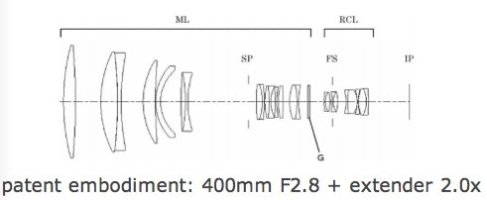
Patent: Canon EF 2.8x Teleconverter

Status
Not open for further replies.
3kramd5 said:
Ellen Schmidtee said:
3kramd5 said:
Canon Rumors said:
<p><strong>Canon’s patent</strong></p>
<li>When doubled, twice the lateral aberration, longitudinal aberration is 4 times greater rate of expansion, because the F-number is also double, longitudinal aberration is twice per depth of focus</li>

I read that as it, like the 2X, adds two stops. So a 2.8 lens -> 5.6, not 8.

Unless Canon have found make a teleconverter that opens the aperture wider, I don't see how the teleconverter could multiply the focal length by 2.8 without (relatively) closing the aperture by three stops.

Maybe they designed it in such a way that it magnifies the apparent aperture (kinda like how constant f zooms work).

Dunno, just speculating based on that single bullet point. What else would it mean?

It may not affect any current lens which it is attached to, as simply increasing f number accordingly by 3 stops. Apperture number comes from dividing focal length by real hole size. If focal length increases I don't see a way to increase the attached lens apperture hole.
 
Upvote 0
3kramd5 said:
Canon Rumors said:
<p><strong>Canon’s patent</strong></p>
<li>When doubled, twice the lateral aberration, longitudinal aberration is 4 times greater rate of expansion, because the F-number is also double, longitudinal aberration is twice per depth of focus</li>

I read that as it, like the 2X, adds two stops. So a 2.8 lens -> 5.6, not 8.

you've read wrong: you loose 2 stops with the 1.4 converter, and tree stops with the 2.0 .
this means 4 stops with the 2.8
 
Upvote 0
Autocall said:
3kramd5 said:
Canon Rumors said:
<p><strong>Canon’s patent</strong></p>
<li>When doubled, twice the lateral aberration, longitudinal aberration is 4 times greater rate of expansion, because the F-number is also double, longitudinal aberration is twice per depth of focus</li>

I read that as it, like the 2X, adds two stops. So a 2.8 lens -> 5.6, not 8.

you've read wrong: you loose 2 stops with the 1.4 converter, and tree stops with the 2.0 .
this means 4 stops with the 2.8

I'm sorry you're not right - you loose 1 stop with 1.4 and two stops with 2.0. Assume you have 400mm f4. It means a hole is 100mm wide (400/100). If you add 1.4 TC, you have 560mm. So it becomes 560/100 = f5.6 and f4 -> f5.6 = 1 stop. Calculate it with TC 2.0 and TC2.8 accordingly and you will find it.
 
Upvote 0
marekjoz said:
Autocall said:
3kramd5 said:
Canon Rumors said:
<p><strong>Canon’s patent</strong></p>
<li>When doubled, twice the lateral aberration, longitudinal aberration is 4 times greater rate of expansion, because the F-number is also double, longitudinal aberration is twice per depth of focus</li>

I read that as it, like the 2X, adds two stops. So a 2.8 lens -> 5.6, not 8.

you've read wrong: you loose 2 stops with the 1.4 converter, and tree stops with the 2.0 .
this means 4 stops with the 2.8

I'm sorry you're not right - you loose 1 stop with 1.4 and two stops with 2.0. Assume you have 400mm f4. It means a hole is 100mm wide (400/100). If you add 1.4 TC, you have 560mm. So it becomes 560/100 = f5.6 and f4 -> f5.6 = 1 stop. Calculate it with TC 2.0 and TC2.8 accordingly and you will find it.

yeap, you're right.
sorry
 
Upvote 0
let's hope Canon will add (again and officially) F8 focus capability in the next bodies, maybe the next 7DII (or 70D) is aimed at birders and will have F8 focus capabilities + high pixel density,
let's hope also next FF model (the overly awaited high resolution one) will have some(more than one) F8 focus points to make the 2.8x extender an usable tool

btw I already can use AF on F5.6 sensitive points staking a kenko dgx 1.4x + 2X tele converters, so also canon must/should be able to make this possible on current and (at least) future bodies

remember that F8 starts to cause some mild diffraction at current aps-c pixel densities, so I'm really surprised canon is working on it
 
Upvote 0
Autocall said:
marekjoz said:
Autocall said:
3kramd5 said:
Canon Rumors said:
<p><strong>Canon’s patent</strong></p>
<li>When doubled, twice the lateral aberration, longitudinal aberration is 4 times greater rate of expansion, because the F-number is also double, longitudinal aberration is twice per depth of focus</li>

I read that as it, like the 2X, adds two stops. So a 2.8 lens -> 5.6, not 8.

you've read wrong: you loose 2 stops with the 1.4 converter, and tree stops with the 2.0 .
this means 4 stops with the 2.8

I'm sorry you're not right - you loose 1 stop with 1.4 and two stops with 2.0. Assume you have 400mm f4. It means a hole is 100mm wide (400/100). If you add 1.4 TC, you have 560mm. So it becomes 560/100 = f5.6 and f4 -> f5.6 = 1 stop. Calculate it with TC 2.0 and TC2.8 accordingly and you will find it.

yeap, you're right.
sorry

I love how you fight about "stops" dudes ... bit of a clue : take F/2,8 or F/4,0 or whatever indeed and just multiply by the number on the extender ... magic ;)
 
Upvote 0
sphax said:
Autocall said:
marekjoz said:
Autocall said:
3kramd5 said:
Canon Rumors said:
<p><strong>Canon’s patent</strong></p>
<li>When doubled, twice the lateral aberration, longitudinal aberration is 4 times greater rate of expansion, because the F-number is also double, longitudinal aberration is twice per depth of focus</li>

I read that as it, like the 2X, adds two stops. So a 2.8 lens -> 5.6, not 8.

you've read wrong: you loose 2 stops with the 1.4 converter, and tree stops with the 2.0 .
this means 4 stops with the 2.8

I'm sorry you're not right - you loose 1 stop with 1.4 and two stops with 2.0. Assume you have 400mm f4. It means a hole is 100mm wide (400/100). If you add 1.4 TC, you have 560mm. So it becomes 560/100 = f5.6 and f4 -> f5.6 = 1 stop. Calculate it with TC 2.0 and TC2.8 accordingly and you will find it.

yeap, you're right.
sorry

I love how you fight about "stops" dudes ... bit of a clue : take F/2,8 or F/4,0 or whatever indeed and just multiply by the number on the extender ... magic ;)

Wow, how did you do that? That's really a case for Penn & Teller
 
Upvote 0
marekjoz said:
sphax said:
Autocall said:
marekjoz said:
Autocall said:
3kramd5 said:
Canon Rumors said:
<p><strong>Canon’s patent</strong></p>
<li>When doubled, twice the lateral aberration, longitudinal aberration is 4 times greater rate of expansion, because the F-number is also double, longitudinal aberration is twice per depth of focus</li>

I read that as it, like the 2X, adds two stops. So a 2.8 lens -> 5.6, not 8.

you've read wrong: you loose 2 stops with the 1.4 converter, and tree stops with the 2.0 .
this means 4 stops with the 2.8

I'm sorry you're not right - you loose 1 stop with 1.4 and two stops with 2.0. Assume you have 400mm f4. It means a hole is 100mm wide (400/100). If you add 1.4 TC, you have 560mm. So it becomes 560/100 = f5.6 and f4 -> f5.6 = 1 stop. Calculate it with TC 2.0 and TC2.8 accordingly and you will find it.

yeap, you're right.
sorry

I love how you fight about "stops" dudes ... bit of a clue : take F/2,8 or F/4,0 or whatever indeed and just multiply by the number on the extender ... magic ;)

Wow, how did you do that? That's really a case for Penn & Teller

apart from the relatively simple ratios, I was concerned by the loss due to the additional elements.
( a polarizing filter doesn't change the focal but causes 1 full stop loss for example)
 
Upvote 0
Autocall said:
marekjoz said:
sphax said:
Autocall said:
marekjoz said:
Autocall said:
3kramd5 said:
Canon Rumors said:
<p><strong>Canon’s patent</strong></p>
<li>When doubled, twice the lateral aberration, longitudinal aberration is 4 times greater rate of expansion, because the F-number is also double, longitudinal aberration is twice per depth of focus</li>

I read that as it, like the 2X, adds two stops. So a 2.8 lens -> 5.6, not 8.

you've read wrong: you loose 2 stops with the 1.4 converter, and tree stops with the 2.0 .
this means 4 stops with the 2.8

I'm sorry you're not right - you loose 1 stop with 1.4 and two stops with 2.0. Assume you have 400mm f4. It means a hole is 100mm wide (400/100). If you add 1.4 TC, you have 560mm. So it becomes 560/100 = f5.6 and f4 -> f5.6 = 1 stop. Calculate it with TC 2.0 and TC2.8 accordingly and you will find it.

yeap, you're right.
sorry

I love how you fight about "stops" dudes ... bit of a clue : take F/2,8 or F/4,0 or whatever indeed and just multiply by the number on the extender ... magic ;)

Wow, how did you do that? That's really a case for Penn & Teller

apart from the relatively simple ratios, I was concerned by the loss due to the additional elements.
( a polarizing filter doesn't change the focal but causes 1 full stop loss for example)

You are right - there is additional lost of light on elements inside TC.
And this can be another win over stacking 2.0 and 1.4 - for sure there will be less elements than sum of 1.4 and 2.0.
 
Upvote 0
marekjoz said:
3kramd5 said:
Ellen Schmidtee said:
3kramd5 said:
Canon Rumors said:
<p><strong>Canon’s patent</strong></p>
<li>When doubled, twice the lateral aberration, longitudinal aberration is 4 times greater rate of expansion, because the F-number is also double, longitudinal aberration is twice per depth of focus</li>

I read that as it, like the 2X, adds two stops. So a 2.8 lens -> 5.6, not 8.

Unless Canon have found make a teleconverter that opens the aperture wider, I don't see how the teleconverter could multiply the focal length by 2.8 without (relatively) closing the aperture by three stops.

Maybe they designed it in such a way that it magnifies the apparent aperture (kinda like how constant f zooms work).

Dunno, just speculating based on that single bullet point. What else would it mean?

It may not affect any current lens which it is attached to, as simply increasing f number accordingly by 3 stops. Apperture number comes from dividing focal length by real hole size. If focal length increases I don't see a way to increase the attached lens apperture hole.

A 70-200 f/2.8 at 70mm has a maximum opening 25mm in diameter, agree?

A 70-200 f/2.8 at 200mm has a maximum opening... 25mm in diameter.

AFAIK, there's no physical mechanism opening the blades wider as the focal length increases. Rather, the zooming in optically magnifies that 25mm aperture such that it appears to be 71mm in diameter (at the 200mm example).

I see no reason they couldn't employ that principle in teleconverters.


That said, sure, I probably I read it wrong, hence me asking what they meant by that bullet point.
 
Upvote 0
3kramd5 said:
A 70-200 f/2.8 at 70mm has a maximum opening 25mm in diameter, agree?

A 70-200 f/2.8 at 200mm has a maximum opening... 25mm in diameter.

AFAIK, there's no physical mechanism opening the blades wider as the focal length increases. Rather, the zooming in optically magnifies that 25mm aperture such that it appears to be 71mm in diameter (at the 200mm example).

I see no reason they couldn't employ that principle in teleconverters.

That said, sure, I probably I read it wrong, hence me asking what they meant by that bullet point.

I don't think you understand the fixed f-number zoom lenses properly. If the 70-200mm had a maximum opening of 25mm at 200mm, then it would only be f/8 zoomed in. There is in fact a physical mechanism opening the blades wider as the focal length increases.
 
Upvote 0
Blaze said:
3kramd5 said:
A 70-200 f/2.8 at 70mm has a maximum opening 25mm in diameter, agree?

A 70-200 f/2.8 at 200mm has a maximum opening... 25mm in diameter.

AFAIK, there's no physical mechanism opening the blades wider as the focal length increases. Rather, the zooming in optically magnifies that 25mm aperture such that it appears to be 71mm in diameter (at the 200mm example).

I see no reason they couldn't employ that principle in teleconverters.

That said, sure, I probably I read it wrong, hence me asking what they meant by that bullet point.

I don't think you understand the fixed f-number zoom lenses properly. If the 70-200mm had a maximum opening of 25mm at 200mm, then it would only be f/8 zoomed in. There is in fact a physical mechanism opening the blades wider as the focal length increases.

No, it has 2.8, because the pupil is magnified by the front element moving relative to the pupil.

If they could make the blades open to 71mm in the same form factor, they sell it as a 70-200f/1-2.8.

Zooming a lens doesn't mechanically widen the pupil. It optically magnifies it.

http://www.dgrin.com/showpost.php?p=523730&postcount=2
There is a lot of mis-information on the Internet about how "constant aperture" zooms work, but the most lucid explanation comes from Bob Shell:

Comments from Bob Shell (January 8, 2003):
"An f-stop is the ratio between the focal length of the lens and the *apparent* size of the lens opening as viewed through the front. It must take into account the magnification factor of all lens elements in front of the diaphragm, because it is the size of the opening that the light "sees" as it passes through the lens, not the actual physical diameter of the diaphragm opening.
It is this fact that allows companies to make constant aperture zoom lenses which maintain a constant f-stop when the focal length changes, because such lenses are designed so that the magnification factor (diopter value) of all elements in front of the diaphragm changes as focal length is changed to hold the aperture value constant."
 
Upvote 0
3kramd5 said:
Blaze said:
3kramd5 said:
A 70-200 f/2.8 at 70mm has a maximum opening 25mm in diameter, agree?

A 70-200 f/2.8 at 200mm has a maximum opening... 25mm in diameter.

AFAIK, there's no physical mechanism opening the blades wider as the focal length increases. Rather, the zooming in optically magnifies that 25mm aperture such that it appears to be 71mm in diameter (at the 200mm example).

I see no reason they couldn't employ that principle in teleconverters.

That said, sure, I probably I read it wrong, hence me asking what they meant by that bullet point.

I don't think you understand the fixed f-number zoom lenses properly. If the 70-200mm had a maximum opening of 25mm at 200mm, then it would only be f/8 zoomed in. There is in fact a physical mechanism opening the blades wider as the focal length increases.

No, it has 2.8, because the pupil is magnified by the front element moving relative to the pupil.

If they could make the blades open to 71mm in the same form factor, they sell it as a 70-200f/1-2.8.

Zooming a lens doesn't mechanically widen the pupil. It optically magnifies it.

http://www.dgrin.com/showpost.php?p=523730&postcount=2
There is a lot of mis-information on the Internet about how "constant aperture" zooms work, but the most lucid explanation comes from Bob Shell:

Comments from Bob Shell (January 8, 2003):
"An f-stop is the ratio between the focal length of the lens and the *apparent* size of the lens opening as viewed through the front. It must take into account the magnification factor of all lens elements in front of the diaphragm, because it is the size of the opening that the light "sees" as it passes through the lens, not the actual physical diameter of the diaphragm opening.
It is this fact that allows companies to make constant aperture zoom lenses which maintain a constant f-stop when the focal length changes, because such lenses are designed so that the magnification factor (diopter value) of all elements in front of the diaphragm changes as focal length is changed to hold the aperture value constant."

That's interesting.... hmm, think I need to do some reading. Thanks for sharing.
 
Upvote 0
3kramd5 said:
No, it has 2.8, because the pupil is magnified by the front element moving relative to the pupil.

If they could make the blades open to 71mm in the same form factor, they sell it as a 70-200f/1-2.8.

Zooming a lens doesn't mechanically widen the pupil. It optically magnifies it.

http://www.dgrin.com/showpost.php?p=523730&postcount=2
There is a lot of mis-information on the Internet about how "constant aperture" zooms work, but the most lucid explanation comes from Bob Shell:

Comments from Bob Shell (January 8, 2003):
"An f-stop is the ratio between the focal length of the lens and the *apparent* size of the lens opening as viewed through the front. It must take into account the magnification factor of all lens elements in front of the diaphragm, because it is the size of the opening that the light "sees" as it passes through the lens, not the actual physical diameter of the diaphragm opening.
It is this fact that allows companies to make constant aperture zoom lenses which maintain a constant f-stop when the focal length changes, because such lenses are designed so that the magnification factor (diopter value) of all elements in front of the diaphragm changes as focal length is changed to hold the aperture value constant."

Learn something new every day.

Yet, Canon's teleconverter are connected behind the diaphragm (between the lens and the camera body), so the bottom line is this TC would make the lens 2.8x longer & three stops slower.
 
Upvote 0
maxxevv said:
3kramd5 said:
Blaze said:
3kramd5 said:
A 70-200 f/2.8 at 70mm has a maximum opening 25mm in diameter, agree?

A 70-200 f/2.8 at 200mm has a maximum opening... 25mm in diameter.

AFAIK, there's no physical mechanism opening the blades wider as the focal length increases. Rather, the zooming in optically magnifies that 25mm aperture such that it appears to be 71mm in diameter (at the 200mm example).

I see no reason they couldn't employ that principle in teleconverters.

That said, sure, I probably I read it wrong, hence me asking what they meant by that bullet point.

I don't think you understand the fixed f-number zoom lenses properly. If the 70-200mm had a maximum opening of 25mm at 200mm, then it would only be f/8 zoomed in. There is in fact a physical mechanism opening the blades wider as the focal length increases.

No, it has 2.8, because the pupil is magnified by the front element moving relative to the pupil.

If they could make the blades open to 71mm in the same form factor, they sell it as a 70-200f/1-2.8.

Zooming a lens doesn't mechanically widen the pupil. It optically magnifies it.

http://www.dgrin.com/showpost.php?p=523730&postcount=2
There is a lot of mis-information on the Internet about how "constant aperture" zooms work, but the most lucid explanation comes from Bob Shell:

Comments from Bob Shell (January 8, 2003):
"An f-stop is the ratio between the focal length of the lens and the *apparent* size of the lens opening as viewed through the front. It must take into account the magnification factor of all lens elements in front of the diaphragm, because it is the size of the opening that the light "sees" as it passes through the lens, not the actual physical diameter of the diaphragm opening.
It is this fact that allows companies to make constant aperture zoom lenses which maintain a constant f-stop when the focal length changes, because such lenses are designed so that the magnification factor (diopter value) of all elements in front of the diaphragm changes as focal length is changed to hold the aperture value constant."

That's interesting.... hmm, think I need to do some reading. Thanks for sharing.

Same thing...
 
Upvote 0
Beside the new 300 F/2.8 or the 400 F/2.8 i don't see any other lens which can afford a TC 2.8 !

I've seen terrific results with a 300 F/2.8 L non IS and a TC 2... And some photographers use the TC 1.4 and 2 combined with the 300 F/2.8 (2 x1.4 = 2.8 ;)) with good results.
 
Upvote 0
Status
Not open for further replies.