
Photography Ethics question. Again.

mackguyver said:
Lots of good discussion on this topic, and I think at the end of the day, it's a personal choice and only matters if you're entering a serious contest or having your work published in venue that requires unretouched work (see this example of a disqualification for a simple clone vs. a crop).
Mac, I am not familiar with natural life or landscape but what are the rules concerning retouching photos in these contests? I simply don't know.

As someone who doesn't know, it seems to me more like rules of a competition, rather than ethic-related.
On news reporting, I was specifically instructed not to do anything, even cropping. They called it "condition" and not ethic.

Thanks,
 
Upvote 0
For most of these contests, minor edits such as cropping, exposure and color adjustments, and subtle dodging and burning are allowed. No cloning or healing brush work is allowed, i.e. no elements can be removed or relocated. They call these traditional dark room techniques, and that is the foundation for their allowance. A RAW file is often required if you are selected as a finalist to ensure you are being honest.

They call it ethics to suggest that the image has not been altered to the point of being a different photo than was captured by the camera. As others have suggested, all photography is a representation of the truth and is distorted by subject selection, lens choice, and other factors. For example, one of this year's World Press winners was disqualified for captioning a photograph as having been taken in a nearby city instead of the actual location.

For me, I strive to capture to cleanest, best photos I can without retouching, but my earnings do not depend on it. The challenge of getting these photos is what I enjoy about wildlife photography. For others, particularly those selling prints or stock photos, cleaner backgrounds will sell better, so minor retouching and cloning is an important way to boost their sales. I can't judge them. People who lure animals in or harm natural feeding and reproduction behaviors are in a different category, and I don't consider that ethical.

It's up to each person to decide what they want to enhance/alter and as long as you are respectful of the wildlife and the resulting image, I think that is what matters most.
 
Upvote 0
mackguyver said:
AvTvM said:
mackguyver said:
_H2B3117_ID_R-M.jpg

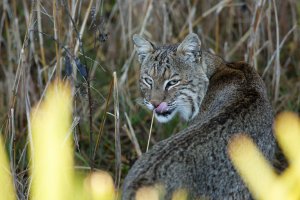
Removed single blade of grass in front that covered part of the bobcat's jaw

hehe, love that shot! That bobcat licks its lips and looks as if it just has seen a keen photographer ... for lunch. ;D
Thanks! And yes, the other guy didn't make it, but I got to keep his gear ;)

Ethical to remove a single blade of grass, my preference would have been to leave it but definitely nothing unethical.

The only ethics I would call in to question is if you represent the shot as wild and it were actually a zoo. As someone who shots wildlife, and has enjoyed the outdoor sports his whole life and pursued kitty cats on occasion I am very impressed if this is a shot in a natural setting, and I say well done. If it is a Zoo shot no so much. So without you saying where it was taken I am left wondering, am I impressed or is this a good Zoo shot. :) Maybe the lack of information was by design to make us guess.
 
Upvote 0
takesome1 said:
mackguyver said:
AvTvM said:
mackguyver said:
_H2B3117_ID_R-M.jpg

Removed single blade of grass in front that covered part of the bobcat's jaw

hehe, love that shot! That bobcat licks its lips and looks as if it just has seen a keen photographer ... for lunch. ;D
Thanks! And yes, the other guy didn't make it, but I got to keep his gear ;)

Ethical to remove a single blade of grass, my preference would have been to leave it but definitely nothing unethical.

The only ethics I would call in to question is if you represent the shot as wild and it were actually a zoo. As someone who shots wildlife, and has enjoyed the outdoor sports his whole life and pursued kitty cats on occasion I am very impressed if this is a shot in a natural setting, and I say well done. If it is a Zoo shot no so much. So without you saying where it was taken I am left wondering, am I impressed or is this a good Zoo shot. :) Maybe the lack of information was by design to make us guess.
Thanks and yes, it was taken in a wild setting at St. Marks National Wildlife Refuge in Florida with my 5DIII and 400 f/5.6. I agree about the captive vs. wild comments as well. I hear about bobcat sightings at this location all of the time, but this is the only time I have seen one (I hear them a lot). The cat crossed the road about 1/4 mile in front of me and after a good while searching, I found it in the briars near the road. It was slowly walking through the thorns and grasses, which made focus near impossible. I kept losing it as well due to the phenomenal camouflage. It finally walked into a semi-clear spot (this is actually a vertical crop), and while it works with the blade of grass, it's very distracting. because it's sunlit and quite bright. This was the only clear shot and the only one in focus out of around 10-15 frames I shot before it slowly walked into the woods. It was quite a thrilling experience and the type of thing I live for with wildlife photography.
 
Upvote 0
mackguyver said:
takesome1 said:
mackguyver said:
AvTvM said:
mackguyver said:
_H2B3117_ID_R-M.jpg

Removed single blade of grass in front that covered part of the bobcat's jaw

hehe, love that shot! That bobcat licks its lips and looks as if it just has seen a keen photographer ... for lunch. ;D
Thanks! And yes, the other guy didn't make it, but I got to keep his gear ;)

Ethical to remove a single blade of grass, my preference would have been to leave it but definitely nothing unethical.

The only ethics I would call in to question is if you represent the shot as wild and it were actually a zoo. As someone who shots wildlife, and has enjoyed the outdoor sports his whole life and pursued kitty cats on occasion I am very impressed if this is a shot in a natural setting, and I say well done. If it is a Zoo shot no so much. So without you saying where it was taken I am left wondering, am I impressed or is this a good Zoo shot. :) Maybe the lack of information was by design to make us guess.
Thanks and yes, it was taken in a wild setting at St. Marks National Wildlife Refuge in Florida with my 5DIII and 400 f/5.6. I agree about the captive vs. wild comments as well. I hear about bobcat sightings at this location all of the time, but this is the only time I have seen one (I hear them a lot). The cat crossed the road about 1/4 mile in front of me and after a good while searching, I found it in the briars near the road. It was slowly walking through the thorns and grasses, which made focus near impossible. I kept losing it as well due to the phenomenal camouflage. It finally walked into a semi-clear spot (this is actually a vertical crop), and while it works with the blade of grass, it's very distracting. because it's sunlit and quite bright. This was the only clear shot and the only one in focus out of around 10-15 frames I shot before it slowly walked into the woods. It was quite a thrilling experience and the type of thing I live for with wildlife photography.

Well done :)
 
Upvote 0
mackguyver said:
For most of these contests, minor edits such as cropping, exposure and color adjustments, and subtle dodging and burning are allowed. No cloning or healing brush work is allowed, i.e. no elements can be removed or relocated. They call these traditional dark room techniques, and that is the foundation for their allowance. A RAW file is often required if you are selected as a finalist to ensure you are being honest.

They call it ethics to suggest that the image has not been altered to the point of being a different photo than was captured by the camera. As others have suggested, all photography is a representation of the truth and is distorted by subject selection, lens choice, and other factors. For example, one of this year's World Press winners was disqualified for captioning a photograph as having been taken in a nearby city instead of the actual location.

For me, I strive to capture to cleanest, best photos I can without retouching, but my earnings do not depend on it. The challenge of getting these photos is what I enjoy about wildlife photography. For others, particularly those selling prints or stock photos, cleaner backgrounds will sell better, so minor retouching and cloning is an important way to boost their sales. I can't judge them. People who lure animals in or harm natural feeding and reproduction behaviors are in a different category, and I don't consider that ethical.

It's up to each person to decide what they want to enhance/alter and as long as you are respectful of the wildlife and the resulting image, I think that is what matters most.
Thanks,
It looks like that was what the OP had in mind, while many, including myself, considered it in a broader sense.
 
Upvote 0
monkey44 said:
.... Sometimes, editors will crop, manipulate minor corrections, but generally it's always assumed that the image in any journal or newspaper, magazine is direct from the camera, a recording of history. Journalists have been fired for changing an image -- one in particular in the news last year - cropped (or cut) a piece of his assistant's camera out of the corner of an image shot in Afghanistan during a conflict -- and he was immediately fired.

I have difficulty being sympathetic with this amount of political correctness re. photography "rules"

The subject matter of the image presumably was NOT the assistant's camera (or existence).

The assistant's camera could contribute nothing to the intended visual communication other than distraction.

Had the photographer used a slightly longer lens, or "zoomed" by lens or foot a bit closer, the assistant's camera would not have shown.

Instead he zoomed by cropping (one possibility mentioned, or by cutting) and simply offered less (not DIFFERENT!) content than he might have included by using an even wider lens, etc.)

So, patently extraneous material was excluded from the image with nothing "changed" regarding the intended subject.

The result, still an accurate recording of history, less all the other surrounding "history" that might have been/could have been/ thank heavens was not (confusingly) shown.

Who cares?

Fired? Nose-in-the-air hall monitor mentality, ..."It's against the rule!"

Sheese! ::)

Question authority.
 
Upvote 0
Not all photography is or should be documentary. This is supposed to be an art. I see nothing wrong with cleanup, cloning, colorizing, as long as it is not claimed that the image is straight out-of-camera (even there, I would venture that most photographers color-adjust, sharpen, etc.).

As previously mentioned, many competitions disallow this kind of modification and, in that situation, it would be unethical to enter this and claim that it was not modified.

Documentary photography is different - in that case, one would not accept this kind of modification.
 
Upvote 0
I do not care about input, i care about output, the "final images" we present to our viewers.
I like sanj's lion pics, i like mcguyvers bobcat image. While i recognize and respect the immense difference in effort to capture such images in the wild vs. people like myself clicking aeay in a zoo ... At the end it is an image that i judhe on its own merits. To me it dors not matter whether Picasso or fa Vinci labored many hours, weeks or months over a given painting (image) and whether they used narrow or wide brushes or whether they just finished it withon half an hour on the quick or whether they used brushes or rollers or spatulas ... Or whether they smoked some grass or drank some wine in their creative process, or if they created it in their studio or out in the landscape.

As viewer all i consider is the final image. I don't care how much effort it took to create it. Or whether it was in the wild or in a zoo, staged or ubstagrd, captured "as seen" or modified post capture. It is the image, that counts. The lion crouching. The lipsmacking bobcat. Dont care whether the photographer got the shot after half an hour or after 2 painful weeks in a camouflage tent.
 
Upvote 0
AvTvM said:
As viewer all i consider is the final image. I don't care how much effort it took to create it. Or whether it was in the wild or in a zoo, staged or ubstagrd, captured "as seen" or modified post capture. It is the image, that counts. The lion crouching. The lipsmacking bobcat. Dont care whether the photographer got the shot after half an hour or after 2 painful weeks in a camouflage tent.
If the purpose of a picture is to tell a story, if the story is a trip to the Zoo to take lip smacking pics of a bobcat then it isn't much of a story.

I like mackguyver's story, it makes the picture. The blade of grass in front of the bobcats face is a situation many of wildlife photographers face. We all have those near perfect pictures, but there is the one little element he could not control. It is a minor touch to the picture that means little. His picture has meaning once you know the story behind it.

On the contrary no matter how many pictures you get of the Bobcat at the Zoo, it is still a picture of a Bobcat at the Zoo. Given enough time many could take similar, no matter how well it was taken.
 
Upvote 0
mackguyver said:
Here's the totally RAW file (No correction setting in DxO), for reference:

O wow, that is a hell of a kitty! I like this version even better - it does look a lot more "in the wild". Even if i'd not know the story behind it.

If it were my image - i wish ;) - I might just shorten that offending "drinking straw" a bit so it does not touch the jaw. How about that for a compromise. Of course it would still not qualify to compete under analog old-schooler nat geo competition rulez. :)
 
Upvote 0
AvTvM said:
I do not care about input, i care about output, the "final images" we present to our viewers

<snip>

As viewer all i consider is the final image. I don't care how much effort it took to create it.

If you're not submitting to a contest or selling the image there's nothing wrong with that. If you're selling or have a "client" or "customer" then it does matter. Think of it this way: we're at the very beginnings of 3D printing. Let's say in 20 years 3D printing has advanced to the point where you could print reproductions of Picassos that were indistinguishable from the originals. Does it matter how the copy was made? The answer is that it depends: if it's for yourself, or for a customer who is aware it's a copy and just loves the painting then it's not a problem. If you allow it to be sold as the real thing then it is a problem, regardless of whether the specific claim of authenticity is made.

The example above is just an illustration: I readily admit that any such buyer needs to insist on specific language in the sale contract where the seller specifically asserts authenticity. If "authenticity" is important to the buyer then it should be important to an honest seller. I do not believe in the P.T. Barnum school of business ethics.
 
Upvote 0
There have been at least two incidents in Finland where a nature photographer has resorted to using a stuffed wolf or a stuffed bear to win a contest. THAT is unethical. In both cases it was a well known nature photographer. In both cases, they intially won the first prize. Both cases ended in shame and mockery.
 
Upvote 0
mackguyver said:
Here's the totally RAW file (No correction setting in DxO), for reference:

This issue is really difficult. I do what you did with this image all the time as I'm often lying flat on the ground and there is very often a single disturbing leaf of grass near or even over the subject. Mostly I try to remove them, but sometimes 'no can do'. However...

... it could be argued that the *amount* of plain wildlife shots around implicates that you can just walk up to wildlife, i.e. it's not "wild" but a glorified version of "zoo". If people never see objects being in the way no one realizes that you have to be lucky and take cover.

I recently encountered resistance with my wild horse shots, they look too "tame" to some people insisting wild animals have to flee in panic. People would get the wrong impression about the animals. They don't realize they're seeing 10 calm images out of 40.000 shots, so I'm "cleaning up" shots simply by selecting them. Arguably, removing clutter makes this confusion even worse.

Do note I'm not arguing about "ethical" or not here, but just what the consequences of "cleaning up" an image can be.
 
Upvote 0
Fundamentalists are not easy to please. The point of fundamentalism is exactly that. Another thing is that a lot of stuff which for the'infidels' is a mortal sin, is quite OK when it is one of the selected few doing the exact same thing.
"Your wild horses do not look wild enough!" It is funny...are you supposed to just show the backsides of wild horses vanishing in the horizon in a cloud of dust? And an occasional roadkill?
 
Upvote 0
martti said:
Fundamentalists are not easy to please. The point of fundamentalism is exactly that.

Indeed - and lacking any option for compromise, this leaves basically two options: "anything goes" or the current magazine-style zero tolerance. It is awkward, but probably there's really no define anything between these two.

martti said:
"Your wild horses do not look wild enough!" It is funny...are you supposed to just show the backsides of wild horses vanishing in the horizon in a cloud of dust? And an occasional roadkill?

Actually, this is direct consequence of manipulated images!

Most "wild" horses are seen galloping around in a tight herd, ideally towards the photog or in a pleasant angle. But: The horses I know would only do that when they're chased (by a buddy of the photog), too much danger of injury in tight formation and w/o being able to look for holes in the ground. Real wild horses conserve energy, aren't frightened of humans that don't pose a direct threat or are very close, and run along the paths they know with ample space between individual animals.

But "real" horse behavior isn't considered "real", because by now "fake" has become the "real" thing. Argh.
 
Upvote 0
Marsu42 said:
mackguyver said:
Here's the totally RAW file (No correction setting in DxO), for reference:

This issue is really difficult. I do what you did with this image all the time as I'm often lying flat on the ground and there is very often a single disturbing leaf of grass near or even over the subject. Mostly I try to remove them, but sometimes 'no can do'. However...

... it could be argued that the *amount* of plain wildlife shots around implicates that you can just walk up to wildlife, i.e. it's not "wild" but a glorified version of "zoo". If people never see objects being in the way no one realizes that you have to be lucky and take cover.

I recently encountered resistance with my wild horse shots, they look too "tame" to some people insisting wild animals have to flee in panic. People would get the wrong impression about the animals. They don't realize they're seeing 10 calm images out of 40.000 shots, so I'm "cleaning up" shots simply by selecting them. Arguably, removing clutter makes this confusion even worse.

Do note I'm not arguing about "ethical" or not here, but just what the consequences of "cleaning up" an image can be.
Marsu, those are good points and I'll add that these "too clean" shots also make amateur photographers very frustrated with their work as they believe that the photographer found a perfect subject on a perfect background. That's not to say that these shots aren't possible, just that they are rather rare and difficult. As I said, I have only retouched 3 wildlife photos, and most of my photos are left with what some photographers might consider unclean or distracting elements like these:

_MG_1772-M.jpg


_MG_3729_DxO-M.jpg


_MG_0702-M.jpg
 
Upvote 0