PhotoZone Review: 16-35 f/2.8L III

ahsanford said:
LordofTackle said:
hendrik-sg said:
Despite i am a technician with some physical knowledge, i can not judge about the compromises which have really been done, but if it has to be stopped down only one stop (to adjust the brightness of the center to the brightness of the corners) the lens becomes obsolete

I buy fast lenses for their light gathering capabilities and i do not want to have to push the corner by this amount

Well, in that case almost every fast lens ever made is obsolete (by your definition) and you can throw them out of the window ;)

I catch the ;) and appreciate the reality of wide aperture lenses, but can you honestly tell me of a lens that was 'sequeled' by Canon (same FL range, same max aperture) that got this much worse in one metric?

- A

I can't (or in other words are too lazy to take a look :D) and I'm totally with you concerning the atrocious 4 stops vignette of that lens!
But he was saying that every lens that has one or more stop vignette is obsolete (at least thats how I read his post). And by that argumentation every fast lens that I know of is obsolete (including Otus 28, 55 and 85, Sigma Art 1.4 35 and 50, Ef 35 1.4 II, etc...)
 
Upvote 0
hendrik-sg said:
-4EV means, it's a T>5.6 lens at the corners, this should not cost 2k$ :(

No it doesn't it's much much worse than that.

-4.6ev means the light in the corners is 4.6 stops less than the light in the middle.

that means f2.8 in centre, so 4.6 stops beyond from that is.... ~ F13


What I want to see is corner Boke at 16mm wide open.. I think it might be missing.
 
Upvote 0
rfdesigner said:
hendrik-sg said:
-4EV means, it's a T>5.6 lens at the corners, this should not cost 2k$ :(

No it doesn't it's much much worse than that.

-4.6ev means the light in the corners is 4.6 stops less than the light in the middle.

that means f2.8 in centre, so 4.6 stops beyond from that is.... ~ F13


What I want to see is corner Boke at 16mm wide open.. I think it might be missing.

this i thougt myself, but it seems 2 EV vignetting is 50% or 1 stop loss, if you do the maths at lenstip's results. You can see this on TDP as well, if you stop down a lens 2.8 > 4.0, it can improve almost 2 stops, which would mean it has more transmission at 4.0 than at 2.8, which would be really weird. (this is the way how i found out)
 
Upvote 0
hendrik-sg said:
rfdesigner said:
hendrik-sg said:
-4EV means, it's a T>5.6 lens at the corners, this should not cost 2k$ :(

No it doesn't it's much much worse than that.

-4.6ev means the light in the corners is 4.6 stops less than the light in the middle.

that means f2.8 in centre, so 4.6 stops beyond from that is.... ~ F13


What I want to see is corner Boke at 16mm wide open.. I think it might be missing.

this i thougt myself, but it seems 2 EV vignetting is 50% or 1 stop loss, if you do the maths at lenstip's results. You can see this on TDP as well, if you stop down a lens 2.8 > 4.0, it can improve almost 2 stops, which would mean it has more transmission at 4.0 than at 2.8, which would be really weird. (this is the way how i found out)

I hate to quote DxOmark at anyone but here goes

"What does DxOMark measure?

DxOMark measures light vignetting by imaging an evenly-lit white target. Pixel values are retrieved from all parts of the image. The ratio of these values over the maximum value (usually the value at the image center) found in the image gives the vignetting measurement for each pixel. Vignetting is expressed in exposure value (EV): a variation of 1EV is an attenuation of a factor of 2."

i.e. for 4.6EV you have an attenuation factor of 2^4.6 or 96% fall off.

There should be no square roots going on, if half the photons fall in the corner relative to the centre the ADC will see this as half the reading and that equates to a 1EV fall off.

I also agree the [email protected] and the 2.77EV@f4 don't look at all possible which is why I suspect that there is something else going on.. perhaps something to do with fall off caused by oblique lighting in the corners, or even some hidden pre-processing.

To prove this to myself I measured the vignetting on my own 50STM the other day: I used DPP, set all processing to off (no vignetting correction), set it to "linear" then measured the pixel values in the centre and all corners.

I measured a fall off of ~75% or -2EV. Photozone has it as -2.56, DxO is at ~-2.5 (in the data for wide open, their headline figure is different)

I think that's close enough to prove it's not 2EV for 50% fall off, in other words 4.6EV really is 96% fall off.. and for whatever strange reason the data suggests it gets more signal at f4.0 in the corners.. which can't be right, but that's what the data says
 
Upvote 0
Regarding everyone getting up in arms about the vignetting, why would this be a dealbreaker for astro when according to TDP, the go-to lens for astrophotographers these days, the Samyang 14mm f/2.8 has about the same amount? Link

Sure, the Samyang costs a fraction of the new Canon L lens, but if we ignore price for a moment and just look at real world usage, the end result is the same with both lenses: having to push the corners by several stops. From what I've seen so far, the coma performance of the L is pretty impressive, on par with or maybe even surpassing the Samyang. You also get better overall IQ, less distortion, AF, L-grade build quality and the versatility of a zoom.

Now I haven't used either of these lenses myself, but was planning on the 16-35 III to be my next lens purchase until I learned of the massive vignetting. However, as already explained, if it's not an issue for astro with the Samyang, why would it be with this lens?
 
Upvote 0
kaffikopp said:
Regarding everyone getting up in arms about the vignetting, why would this be a dealbreaker for astro when according to TDP, the go-to lens for astrophotographers these days, the Samyang 14mm f/2.8 has about the same amount? Link

It's interesting that TDP, Lenstip, and Photozone all have very different measurements for vignetting on the Samyang 14 2.8 at ~4ev, ~2.3ev, and ~3.3ev respectively. Seems like some sort of methodology issue.
 
Upvote 0
raptor3x said:
kaffikopp said:
Regarding everyone getting up in arms about the vignetting, why would this be a dealbreaker for astro when according to TDP, the go-to lens for astrophotographers these days, the Samyang 14mm f/2.8 has about the same amount? Link

It's interesting that TDP, Lenstip, and Photozone all have very different measurements for vignetting on the Samyang 14 2.8 at ~4ev, ~2.3ev, and ~3.3ev respectively. Seems like some sort of methodology issue.

see: http://www.canonrumors.com/forum/index.php?topic=31337.0
 
Upvote 0
rfdesigner said:

maxresdefault.jpg


Thanks, good catch.
 
Upvote 0
kaffikopp said:
Regarding everyone getting up in arms about the vignetting, why would this be a dealbreaker for astro when according to TDP, the go-to lens for astrophotographers these days, the Samyang 14mm f/2.8 has about the same amount? Link

Sure, the Samyang costs a fraction of the new Canon L lens, but if we ignore price for a moment and just look at real world usage, the end result is the same with both lenses: having to push the corners by several stops. From what I've seen so far, the coma performance of the L is pretty impressive, on par with or maybe even surpassing the Samyang. You also get better overall IQ, less distortion, AF, L-grade build quality and the versatility of a zoom.

Now I haven't used either of these lenses myself, but was planning on the 16-35 III to be my next lens purchase until I learned of the massive vignetting. However, as already explained, if it's not an issue for astro with the Samyang, why would it be with this lens?
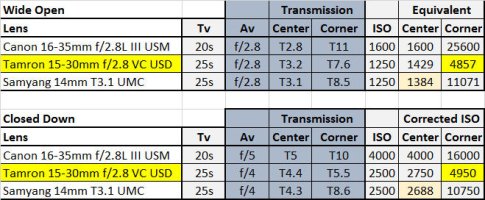
Samyang's vignette is not as bad and it is a wider focal length so enables a longer exposure before trailing. The goto lens is in fact the Tamron 15-30mm f/2.8:
 

Attachments

  • table.jpg
    table.jpg
    74.5 KB · Views: 222
Upvote 0