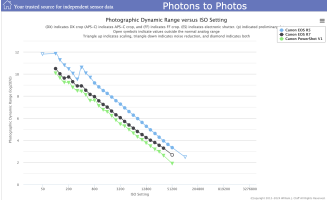
Powershot V1 shows Impressive Dynamic Range Results

Richard CR

Canon Rumors Premium
Dec 27, 2017
2,316
3,607
17,629
Canada
www.canonnews.com
Photonstophotos dropped a new camera into its analysis, and to be honest, the results surprised me a bit. Now, if you weren't aware, the V1 has a slightly larger than Micro Four Thirds sensor. I expected the PowerShot V1 to fare worse than Canon's own APS-C sensors because of the higher pixel density and the […]

See full article...
 
Your central thesis that dynamic range is proportional to pixel density is a very common misconception. Dynamic range is proportional to sensor area, not pixel size (pixel density). This is made quite clear on the photonstophotos site in the Notes under the graph he plots of dynamic range vs sensor area. https://www.photonstophotos.net/Charts/PDR_Area_scatter.htm
"Notes:
Photographic Dynamic Range increases as sensor area increases.
This is because the Signal to Noise Ratio (SNR) increases roughly by the square root of area.
Therefore the x-axis on this chart is the square root of the sensor area.
Note that pixel size does not enter into this relationship.
"

The dynamic range of the V1 sensor is what you expect from that relationship. The V1 sensor 18.4mm x12.3mm = 226mm^2, the R7 22.3mm x 14.9mm = 332mm^2, and FF = 36mm x 24mm = 864mm^2. The photonstophotos plot of the dynamic ranges of the V1, R7 and R5 fits nicely to that pattern

Screenshot 2025-11-23 at 14.10.12.png
 
  • Like
Reactions: 1 users
Upvote 0