Question about the diffraction limit of sensors

Status
Not open for further replies.
Sep 20, 2012
98
0
5,181
So i was looking up diffraction limits and i noticed that on my crop body, 60D the diffraction limit is f/6.9.

What does this mean in practical terms? If a lens i have is sharpest between f/8-f/11 should i still keep the aperture greater than f/6.9 because of this limit?

Thanks guys
 
It's not a hard limit at all. For the 60D, f/6.9 is the point at which diffraction just begins to affect sharpness. If your lens is sharpest at f/8-11, then f/9 will likely not look too different from f/6.3.
 
Upvote 0
Lens softness is far more noticable than diffraction at medium apertures (i.e. ~f/5.6 - f/8 on APS-C). You'll need very sharp lenses to see the benefit of using larger apertures and you'll certainly notice the softness caused by inadequate depth of field more than diffraction. I'd recommend reading this article by Ctein, which helps put it all in perspective:

http://theonlinephotographer.typepad.com/the_online_photographer/2011/08/nex-7-diffraction-effects.html

If you're really going to get anal, you'll need a tilt shift lens or a view camera and learn to focus using Scheimpflug principle.

P.S. - link for a good diffraction calculator (and website in general):

http://www.cambridgeincolour.com/tutorials/diffraction-photography.htm
 
Upvote 0
BruinBear said:
So i was looking up diffraction limits and i noticed that on my crop body, 60D the diffraction limit is f/6.9.

What does this mean in practical terms? If a lens i have is sharpest between f/8-f/11 should i still keep the aperture greater than f/6.9 because of this limit?

Thanks guys
Diffraction is a property of lenses, not sensors as your title suggests. Therefore, a 60D does not have a diffraction limit.
Resolution of a lens depends on the lens design, and will be highest at different apertures for different lenses. However, having a high resolution is only one part of a high IQ. As you stop down, most lenses have reduced distortion, and reduced CA's.
Where a sensor comes in, is that sensors with more resolution can see diffraction better, but it is caused by the lens.
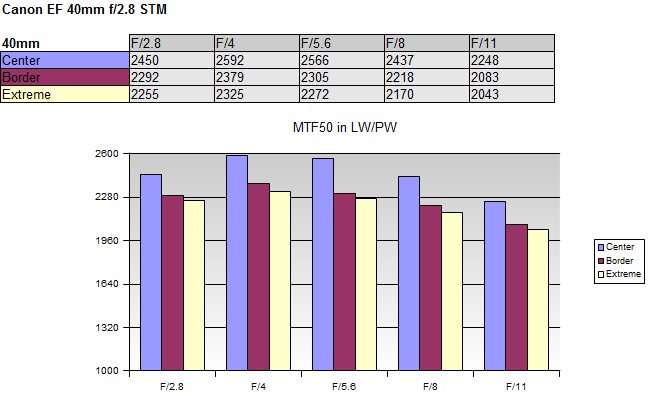
As you can see in this chart with a 15mp Canon 50D and 40mm f/2.8 lens, the resolution does not vary greatly out to f/8. The Chart below it shows basically the same pattern for the 5D MK II

40mm on 50D
mtf.png


40mm on 5D Mark II
mtf.png


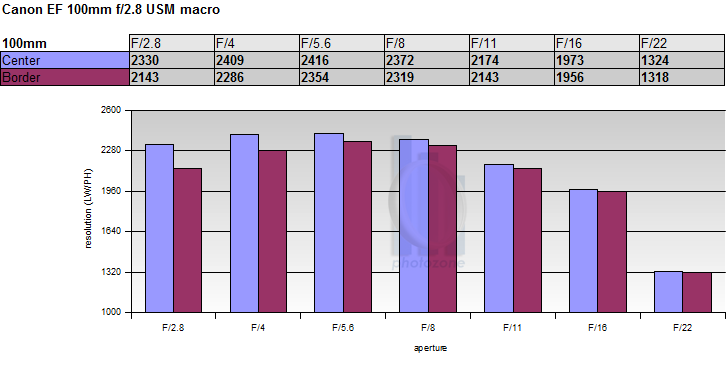
Now, here is the Canon EF 100mm f/2.8 USM Macro lens. It shows the effects of diffraction really taking hold at f/16 and f/22.

100mm on 50D
mtf.png
 
Upvote 0
Status
Not open for further replies.