Review: Canon EF 35mm f/1.4L II at DXOMark

ahsanford said:
PureClassA said:
Yes. I checked and the list of Cameras they have tested it with is EVERY camera Canon has ever made... except the 5DS and 5DSR. That's absurd.

I'm stepping off the gas on my anger on the timing aspect of things. Some others have pointed out that other cameras (including Sony and Nikon) had similar time lags in lens data being offered after launch. I count some 120 lenses having been tested on the 5D3, so repeating that on a 5DS would not be a quick effort at all.

This is also presuming they actually physically retest each older body with a new lens, which they may not... I suppose they could interpolate/downsample their sharpness testing based on pixel count for lower res rigs, but I'm admittedly not well read on that.

- A

If someone offered me even odds that they extrapolate for higher resolution bodies, I'd take the bet.
 
Upvote 0
I was sceptical at first regarding this review for Dx0...but found to be true.

Just check this test here:
http://www.the-digital-picture.com/Reviews/ISO-12233-Sample-Crops.aspx?Lens=994&Camera=453&Sample=0&FLI=0&API=5&LensComp=829&CameraComp=453&SampleComp=0&FLIComp=0&APIComp=5

The Canon is sharper from 1.4 up to f2.8, kind of the same at f4 and the sigma becomes sharper at f5.6
Now depending on the copy they tested...maybe the average sigma sharpness was indeed greater by 5%. However at 1.4-2.8 where it actually counts for this lens...the canon is clearly way better(Dx0 & the-digital-picture)...it's brilliant actually. And if I may say... it's on par with the Otus 55...maybe sharper in the center @1.4.

So no point in waiting for a 35mm Otus... canon did it :)
I don't know why but I think we have to thank sigma for this amazing canon 35mm II :)
 
Upvote 0
tomapaul said:
I was sceptical at first regarding this review for Dx0...but found to be true.

Just check this test here:
http://www.the-digital-picture.com/Reviews/ISO-12233-Sample-Crops.aspx?Lens=994&Camera=453&Sample=0&FLI=0&API=5&LensComp=829&CameraComp=453&SampleComp=0&FLIComp=0&APIComp=5

The Canon is sharper from 1.4 up to f2.8, kind of the same at f4 and the sigma becomes sharper at f5.6
Now depending on the copy they tested...maybe the average sigma sharpness was indeed greater by 5%. However at 1.4-2.8 where it actually counts for this lens...the canon is clearly way better(Dx0 & the-digital-picture)...it's brilliant actually. And if I may say... it's on par with the Otus 55...maybe sharper in the center @1.4.

So no point in waiting for a 35mm Otus... canon did it :)
I don't know why but I think we have to thank sigma for this amazing canon 35mm II :)

+100
Like I said above..I own the Sigma....but there is enough info out there to see that this new Canon Lens is an amazing achievement and CLEARLY surpasses the Sigma. DXSchmo is a sham. No doubt. It's just so obvious.
 
Upvote 0
I refer the honerable gentleman to my earlier comment

http://www.canonrumors.com/forum/index.php?topic=27981.0

But for the record, I am tempted find the raw DXO data to hold just a little bit of water but due to their clearly made up numbers in some regards I am forced to disregard all their data. The DxO ONE test was blatantly biased, averaging frames in a "raw" test is the clearest case of cheating.

What is also beginning to stink is the TOTAL lack of ANY lens data on the 5Ds/r. One would have thought they could publish data on NEW canon lenses on the 5Ds/r as they are released, after all they're going to have to do that in due course, and if their software recognises the 5Dsr then they are clearly capable of measuring this.
 
Upvote 0
There is a key point to understand in their lens testing methodology which can be found here: http://www.dxomark.com/About/Lens-scores/Metric-Scores

"The DxOMark resolution score shows sharpness performance of a lens-camera combination averaged over its entire focal length and aperture ranges."

For the Canon 35mm measurements were taken at the following f-stops: 1.4, 1.8, 2, 2.8, 4, 5.6, 8, 11, 22
For the Simga 35mm measurements were taken at the following f-stops: 1.4, 1.8, 2, 2.8, 4, 5.6, 8, 11, 16

From f/1.4-f/2.8 the Canon has some advantage. For a f/1.4 prime this is the key performance range.

At f/4 they are essentially the same. At f/5.6 and f/8 the Sigma has a slim advantage. By f/11 diffraction has already become apparent and they are essentially the same. At f/22 vs f/16 it is not a apples to apples comparison. (See attached)

So by averaging over the whole aperture range lenses which close down more are being disadvantaged. This is the methodology that DxOMark use and explains why the Canon has a lower "sharpness" rating despite its superior wide open performance.

From various sources it is quite obvious that the 35L II is pretty much an autofocus Otus. I'm looking forward to getting a hands-on an evaluation copy towards the end of the month. When you dig into the DxO data and understand their methodology then their ratings have meaning. On the other hand, if you look at their ratings at face value then you don't get a true reflection of the situation.
 

Attachments

  • Shaaaaarpness.jpg
    Shaaaaarpness.jpg
    96.1 KB · Views: 246
Upvote 0
Rahul said:
Ever since the DXOMark fiasco over their "score" of 70-200 IS II, I lost respect for them.

BTW, while I own the Canon 70-200mm IS II, it is their "score" of the 100mm macro L lens that really worries me.

In independent measures of MTF plots higher-end macro lenses almost invariable perform extremely well in lab. Yet, according to DXO Mark the Canon 100mm L macro allegedly has an acutance no better than the Canon 24-70mm L zoom lens. I would regard this as most improbable.

I am sure there are those reading this thread, and thinking that we're a bunch of Canon fanboys sour over the fact that our pet lens has been slighted. However, I also shoot on a Sony a7. I made the BIG mistake of being swayed by the stellar ratings given by DXO Mark to the new Sony 90mm macro G lens. It allegedly rivals the Zeiss Otus for sharpness. So I went and bought the Sony macro, and while it is a nice enough a lens, it is nowhere near as outlandishly spectacular as DXO Mark allege it is. Here is the proof:

http://www.lensrentals.com/blog/2015/10/sony-e-mount-lens-sharpness-bench-tests

The Lens Rental tests show that the new Sony macro G is just slightly behind on acutance compared to the Canon 100mm L macro, although both measure up well, as you'd expect of quality macro lenses. Yet according to DXO Mark we are lead to believe that the Sony is almost twice as sharp as the Canon, which, astonishingly for a macro lens, only rates as highly on acutance as a zoom lens.

I can assure you that when you shoot both the Canon 100mm L macro (which I also own) on a Sony a7II (with Metabones adapter) alongside the Sony 90mm macro G, they are equally as sharp, and neither is obviously better. What my eyes see is well reflected in the MTF plots published on Lens Rental.

So that means, irrespective of brand, whether DXO Mark rate something highly, mediocrely, or poorly, none of it seems to make even the slightest of sense. They seem to post what are little more than random numbers on their website without the slightest of explanation as to how they arrived at them.

It's like the end of the Hitchhiker's Guide to the Galaxy where we are told that the meaning of life is some seemingly random number like "42". We are expected to credulously believe these absurd magic numbers that miraculously pop up on their website like "ex cathedra" pronouncements with little more explanation than "God said so".

 
Upvote 0
StudentOfLight said:
There is a key point to understand in their lens testing methodology which can be found here: http://www.dxomark.com/About/Lens-scores/Metric-Scores

You should not have to dig through their website to fish this stuff up. They need to explain their application of their methodology in each lens/sensor etc including a discussion of the strengths and shortcomings of their methods in each particular instance. Nor do you get any info on sample size (preferably with data about power, mean, standard deviation, or even p values and what statistical method they used to calculated these).
 
Upvote 0
Sator said:
Rahul said:
Ever since the DXOMark fiasco over their "score" of 70-200 IS II, I lost respect for them.

BTW, while I own the Canon 70-200mm IS II, it is their "score" of the 100mm macro L lens that really worries me.

In independent measures of MTF plots higher-end macro lenses almost invariable perform extremely well in lab. Yet, according to DXO Mark the Canon 100mm L macro allegedly has an acutance no better than the Canon 24-70mm L zoom lens. I would regard this as most improbable.

I was not aware of DxO's complete and utter disservice to the Canon Macro. I own that lens if you are talking about the modern f/2.8 IS version. It is among the sharpest lenses that I own. When I open the files in LR I am always stunned by the sharpness WOW factor. I am begining to believe the Sony/DxO conspiracy theories...Many of DxO's reviews are just not balanced or credible. At least DxO makes website like the TheDigitalPicture seem soooo soooo vital!
 
Upvote 0
DLD said:
I am currently using Canon (came from Nikon) the digital picture is far off on a lot of Nikon lenses... their results favor Canon heavily... so I don't think they are any better than dxo mark in regard to favoring brands..

interesting, when you say "far off on a lot of Nikon Lenses" do you mean the reviews or are you talking about the "lens image quality" tool?
 
Upvote 0
ahsanford said:
Canon Rumors said:
Chaitanya said:
GMCPhotographics said:
More DXO fiction...

The more we laugh at them, the more likely they are to take down their appalling and misleading web site.

Remember when Dxo posted a review of their camera for Crapple idevice?

I missed that they reviewed their own device. I wonder if they liked it....

Or that they offered two ratings for their DXO One product -- one for single stills and another for their higher res 4-shot composite format which they rate on par with FF sensors:

  • No other manufacturer with a multi-shot hi-res mode (H'Blad, Olympus, etc.) has been afforded the same lattitude with their ratings. They only report single shot performance for everyone but their own product.

  • Multi-shot modes (for resolution) absolutely require tripods, no matter how good the IS is. Who the hell is putting an iPhone on a tripod?!

#dxo #fairandbalanced

- A

Words like compromised, sophistry, corrupt, immoral, twisted, devious, distorted, destitute of truth or trust....come to mind when ever I view their torrid "we love Nikon" site. Every lens which I hold in high regard (which I own and use on a professional basis) and others seem to agree with my opinion of the lenses I use and own...seem to only fare as mediocre on their testing scale. Lenses like the 100mm LIS macro, 70-200 f2.8 LIS II, 85mm f1.2 IIL, 135mm f2.0 L and a 200mm f2.8 IIL.
 
Upvote 0
DLD said:
I am currently using Canon (came from Nikon) the digital picture is far off on a lot of Nikon lenses... their results favor Canon heavily... so I don't think they are any better than dxo mark in regard to favoring brands..

I've heard this once before but I'm not sure how the way he's testing can really favor one brand over another. There's no real interpretation of the results going on like with DxO, he's justing taking pictures of a test chart with the lenses and then posting them. Unless the suggestion is that he's sorting through multiple copies of Nikon lenses to find lemons and/or dropping the Nikkors down a flight of steps then I don't see how he's favoring one brand over the other.
 
Upvote 0
rfdesigner said:
DLD said:
I am currently using Canon (came from Nikon) the digital picture is far off on a lot of Nikon lenses... their results favor Canon heavily... so I don't think they are any better than dxo mark in regard to favoring brands..

interesting, when you say "far off on a lot of Nikon Lenses" do you mean the reviews or are you talking about the "lens image quality" tool?

Compare the 85mm 1.8 from both Canon and Nikon in the image quality tool. That is a real result. Then look at DxO and see numbers that are comically wrong for the Nikon 85mm...its apparently one of the sharpest lenses in the world for $450 and no CA to boot!!

The Digital Picture has a bias to Canon, yes. But that's to be expected by a Canon site. With the lens comparison tool you're usually looking at the best results from two, three, sometimes four copies of a lens. Nikon lenses aren't tested for multiple copies, so the results are just a drop in the bucket.

They're still real results. Nikon still makes inferior lenses to Canon.
 
Upvote 0
DLD said:
I am currently using Canon (came from Nikon) the digital picture is far off on a lot of Nikon lenses... their results favor Canon heavily... so I don't think they are any better than dxo mark in regard to favoring brands..
The lens image quality tool relies on a Nikon D3X for Nikon lens tests. The Nikon D3X is definitely an older body with a strong AA filter so images would definitely look better with a modern body like the D750, which has a weaker AA-filter. I mail them regarding this issue and their reply was that testing the Nikon lenses "on a D810 is definitely something they want to do at some point."

Now on the other hand, the default Canon camera used in comparisons is the 1Ds Mark-III, which is lower resolution than the D3X and of the same generation, so its has similar AA-filter strength characteristics. So if you want to compare lenses head to head the 1Ds Mark-III vs D3X seems fair enough.

A fair criticism is that TDP do not test a large sample of lenses so sample variation comes into play. They haven't even tested multiple copies of all the Canon lenses. If that is your concern then you can refer to the Lensrentals MTF data (http://www.the-digital-picture.com/Reviews/MTF.aspx) which averages (at the very least) 10 samples of each lens and also includes sample variation graphs. Lensrentals is independent of TDP and it is definitely not in Lensrentals interest to favor one brand over another as they rent to a wide range of users on different systems.
 
Upvote 0
tomapaul said:
I was sceptical at first regarding this review for Dx0...but found to be true.

Just check this test here:
http://www.the-digital-picture.com/Reviews/ISO-12233-Sample-Crops.aspx?Lens=994&Camera=453&Sample=0&FLI=0&API=5&LensComp=829&CameraComp=453&SampleComp=0&FLIComp=0&APIComp=5

The Canon is sharper from 1.4 up to f2.8, kind of the same at f4 and the sigma becomes sharper at f5.6
Now depending on the copy they tested...maybe the average sigma sharpness was indeed greater by 5%. However at 1.4-2.8 where it actually counts for this lens...the canon is clearly way better(Dx0 & the-digital-picture)...it's brilliant actually. And if I may say... it's on par with the Otus 55...maybe sharper in the center @1.4.

So no point in waiting for a 35mm Otus... canon did it :)
I don't know why but I think we have to thank sigma for this amazing canon 35mm II :)

Who on earth would buy a 35/1.4 lens to use it @F5.6? Just get a pancake and be done with it.
http://www.the-digital-picture.com/Reviews/ISO-12233-Sample-Crops.aspx?Lens=810&Camera=453&Sample=0&FLI=0&API=3&LensComp=829&CameraComp=453&SampleComp=0&FLIComp=0&APIComp=5
 
Upvote 0
LSXPhotog said:
Compare the 85mm 1.8 from both Canon and Nikon in the image quality tool. That is a real result. Then look at DxO and see numbers that are comically wrong for the Nikon 85mm...its apparently one of the sharpest lenses in the world for $450 and no CA to boot!!

DxO only measures lateral chromatic aberration which is indeed reasonably well controlled on the 85 1.8G. It's the longitudinal chromatic aberration that's quite bad on that lens but DxO doesn't bother measuring that at all.
 
Upvote 0
StudentOfLight said:
"The DxOMark resolution score shows sharpness performance of a lens-camera combination averaged over its entire focal length and aperture ranges."

For the Canon 35mm measurements were taken at the following f-stops: 1.4, 1.8, 2, 2.8, 4, 5.6, 8, 11, 22
For the Simga 35mm measurements were taken at the following f-stops: 1.4, 1.8, 2, 2.8, 4, 5.6, 8, 11, 16

Great catch on f/16 vs. f/22 with the two lenses. Surely that's why the Canon got the lower sharpness score -- every other aperture (other than where the Canon outperformed) the plots were neck and neck.

- A
 
Upvote 0
ahsanford said:
StudentOfLight said:
"The DxOMark resolution score shows sharpness performance of a lens-camera combination averaged over its entire focal length and aperture ranges."

For the Canon 35mm measurements were taken at the following f-stops: 1.4, 1.8, 2, 2.8, 4, 5.6, 8, 11, 22
For the Simga 35mm measurements were taken at the following f-stops: 1.4, 1.8, 2, 2.8, 4, 5.6, 8, 11, 16

Great catch on f/16 vs. f/22 with the two lenses. Surely that's why the Canon got the lower sharpness score -- every other aperture (other than where the Canon outperformed) the plots were neck and neck.

- A
That's pretty freaking lame on their part. So a lens gets a lower P-MP score just because it happens to stop down to a smaller aperture? How idiotic does one have to be to think that is in any way going to be of use to people buying gear and deciding what to get?

I can now see why some of you guys on this forum who are more scientifically minded have steam coming out of your ears when stuff like this is discovered. :(

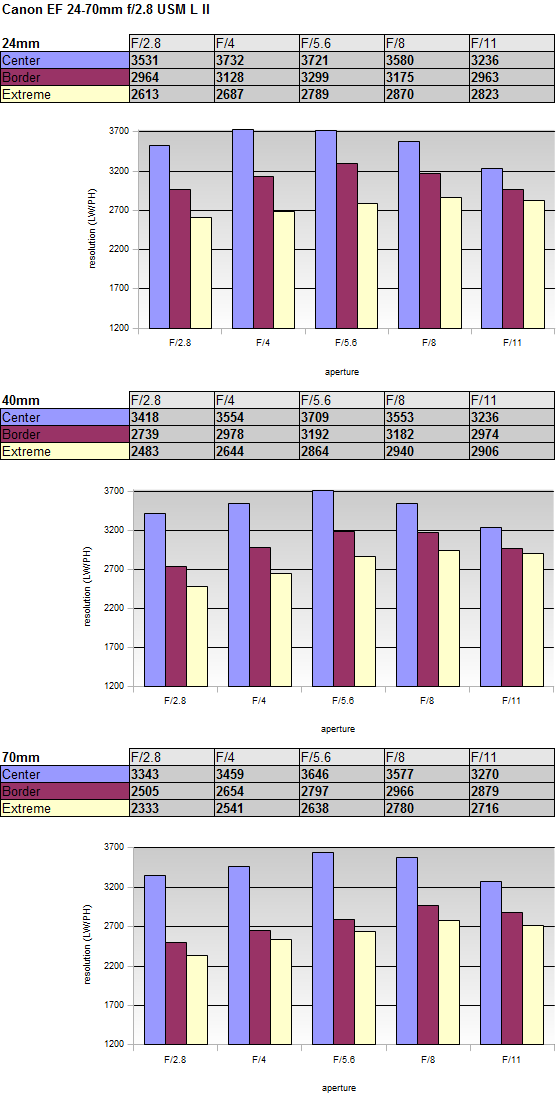
How hard is it to make some visuals like Photozone does? Is DXO making an extra effort to pander to people who have far more money than intelligence? "Duh... 20 is a bigger number than 18! I'm getting the one with a number 20 cause it's better! Duh... Drool..." ;)

Photozone graphs are pretty easy to read and show the whole story for different apertures and focal lengths.

mtf.png
 
Upvote 0