Rumors on Nikon MLS.... A chance for us Canonians too?

xps

Oct 19, 2011
1,056
145
18,153
Middle Europe
As I read on an Sony alpha rumorsite, ( ++++++++++++.com) shares an article on an interview with Nikon CEO (http://newswitch.jp/p/9613).
Nikon - maybe - is working on an well designed MLS camera.

An chance for my hope, Canon will produce an A7RII like body too..... :)
 
xps said:
As I read on an Sony alpha rumorsite, ( ++++++++++++.com) shares an article on an interview with Nikon CEO (http://newswitch.jp/p/9613).
Nikon - maybe - is working on an well designed MLS camera.

An chance for my hope, Canon will produce an A7RII like body too..... :)

Canon is working on a full frame mirrorless camera. However, the general consensus amongst people that possibly know things, is that EF lenses will have to work natively and not via an adaptor, and this is a big challenge.
 
Upvote 0
Canon Rumors said:
However, the general consensus amongst people that possibly know things, is that EF lenses will have to work natively and not via an adaptor, and this is a big challenge.

that would mean losing any size advantage and never having a dedicated mirrorless lens line

what would be wrong with having and adapter simply like an extension tube until they bring dedicated lenses to market?

same goes for nikon...simply make the mount on the ML a bit different so that idiots wouldn't mount an SLR lens directly and supply an adapter with every camera..
 
Upvote 0
Canon Rumors said:
Canon is working on a full frame mirrorless camera. However, the general consensus amongst people that possibly know things, is that EF lenses will have to work natively and not via an adaptor, and this is a big challenge.

CR Guy, that's an 'enticing discussion piñata' if I ever saw one. :D

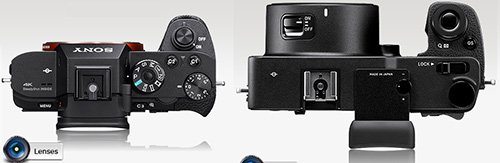
If you mean "EF lenses will have to work natively and not via an adaptor" at the current EF flange distance, that's a market challenge. The lenses should work brilliantly in that setup, but you'd have either a built-in 'lens tube' design like the Sigma (pictured below) or you'd literally just pull the mirror out of a current body. Both are functionally attractive to existing EF users, but both are also form-factor unattractive to competitive users and the mirrorless market in general, who associate mirrorless with 'small'.

If you mean "EF lenses will have to work natively and not via an adaptor" at a svelte, thinner-than-EF flange distance, then yes, that's a technical challenge -- a nearly impossible ask of Canon's engineers.

Which one did you mean?

- A

 

Attachments

  • a7 vs Sigma Quattro H.jpg
    a7 vs Sigma Quattro H.jpg
    46.1 KB · Views: 647
Upvote 0
ahsanford said:
Canon Rumors said:
Canon is working on a full frame mirrorless camera. However, the general consensus amongst people that possibly know things, is that EF lenses will have to work natively and not via an adaptor, and this is a big challenge.

CR Guy, that's an 'enticing discussion piñata' if I ever saw one. :D

If you mean "EF lenses will have to work natively and not via an adaptor" at the current EF flange distance, that's a market challenge. The lenses should work brilliantly in that setup, but you'd have either a built-in 'lens tube' design like the Sigma (pictured below) or you'd literally just pull the mirror out of a current body. Both are functionally attractive to existing EF users, but both are also form-factor unattractive to competitive users and the mirrorless market in general, who associate mirrorless with 'small'.

If you mean "EF lenses will have to work natively and not via an adaptor" at a svelte, thinner-than-EF flange distance, then yes, that's a technical challenge -- a nearly impossible ask of Canon's engineers.

Which one did you mean?

- A

I don't know. There has been suggestions that the flange distance does have a solution via sensor tech, unfortunately I have nothing at this time to back that claim up. As much as I try to understand patents, this sort of thing may have slipped through.
 
Upvote 0
andrei1989 said:
Canon Rumors said:
However, the general consensus amongst people that possibly know things, is that EF lenses will have to work natively and not via an adaptor, and this is a big challenge.

that would mean losing any size advantage and never having a dedicated mirrorless lens line

what would be wrong with having and adapter simply like an extension tube until they bring dedicated lenses to market?

same goes for nikon...simply make the mount on the ML a bit different so that idiots wouldn't mount an SLR lens directly and supply an adapter with every camera..

Adaptors aren't sexy or user friendly. I wouldn't buy any full frame mirrorless camera from Canon that required an adaptor to mount an EF lens. I detested it when I went through my Sony phase.
 
Upvote 0
Canon Rumors said:
Adaptors aren't sexy or user friendly. I wouldn't buy any full frame mirrorless camera from Canon that required an adaptor to mount an EF lens. I detested it when I went through my Sony phase.

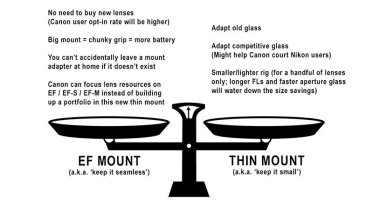
I'm torn on this. I'd really like an EVF-based irrespective of form factor -- handheld large aperture MF lens use is a big thing I'd like to dabble with, but my 5D3's fixed focusing screen locks me out from doing that. So simply sticking with EF would be gold for that need.

But I'd also enjoy a smaller form factor 2nd FF rig. That means new 1-2 new lenses for the skinny mount (a thin-ish 28 f/2 or 35 f/2 come to mind) and an adaptor for my EF glass.

There are pros and cons for both mounts.

- A
 

Attachments

  • mirrorless mount options.jpg
    mirrorless mount options.jpg
    46.1 KB · Views: 148
Upvote 0
Canon Rumors said:
Adaptors aren't sexy or user friendly. I wouldn't buy any full frame mirrorless camera from Canon that required an adaptor to mount an EF lens. I detested it when I went through my Sony phase.

Absolutely, I'm not interested in purchasing a whole new series of lenses. I see no oversll size advantage from mirrorless, simply because FF lenses do not get smaller with a mirrorless camera.

Sure, you can use a 40mm pancake lens, but thats not what pro level cameras are about, we want fast and long lenses as well as wide zooms. Those lenses would only get longer and heavier with a adapter attached.

I understand that some want a small camera, but it is only as small as the lens, and high quality fast lenses are big.
 
Upvote 0
Just to be fair to MILC crowd:

the short flange distance does allow for creative and smaller designs on wide and UWA lenses for e mount, for an instance.

example: Sony FE 12-24mm f/4 G

"... Most impressive to me is it’s a reasonably small lens, around 4.5 inches long and weighing about 1.25 pounds (565 grams for those of you who have a logical measuring system). That’s a full pound lighter than the Sigma 12-24mm f/4 Art and Canon 11-24mm f/4 L lenses..."

https://www.lensrentals.com/blog/2017/06/sony-fe-12-24-f4-g-mtf-tests/


Mt Spokane Photography said:
Canon Rumors said:
Adaptors aren't sexy or user friendly. I wouldn't buy any full frame mirrorless camera from Canon that required an adaptor to mount an EF lens. I detested it when I went through my Sony phase.

Absolutely, I'm not interested in purchasing a whole new series of lenses. I see no oversll size advantage from mirrorless, simply because FF lenses do not get smaller with a mirrorless camera.

Sure, you can use a 40mm pancake lens, but thats not what pro level cameras are about, we want fast and long lenses as well as wide zooms. Those lenses would only get longer and heavier with a adapter attached.

I understand that some want a small camera, but it is only as small as the lens, and high quality fast lenses are big.
 
Upvote 0
SecureGSM said:
Just to be fair to MILC crowd:

the short flange distance does allow for creative and smaller designs on wide and UWA lenses for e mount, for an instance.

...and that whole 'adapt other peoples' lenses' trick. If I'm photographer that doesn't rely heavily on AF (landscape, astro, product, macro, etc.), all my chips are on a thin flange distance so I can use so many more lenses.

- A
 
Upvote 0
by the sound of it, You may consider picking up a used A7RII body once the A7RIII was released and the price of the original one dropped low enough to consider the purchase.
If I were you, I would not bother looking at a brand new Sony camera though due to it's rapid value decline.

ahsanford said:
SecureGSM said:
Just to be fair to MILC crowd:

the short flange distance does allow for creative and smaller designs on wide and UWA lenses for e mount, for an instance.

...and that whole 'adapt other peoples' lenses' trick. If I'm photographer that doesn't rely heavily on AF (landscape, astro, product, macro, etc.), all my chips are on a thin flange distance so I can use so many more lenses.

- A
 
Upvote 0
Nikon launching a competitive mirrorless system would be a huge spur for Canon to get serious in this sector. That being said, many are assuming that Nikon will announce a full frame mirrorless system, whereas Kazuo Ushida seems to suggest (caveat: I'm trusting an unknown translation) that this will be a system "...For a smartphone generation..." [https://petapixel.com/2017/07/10/nikon-new-mirrorless-camera-sleeve-president-says/]

I believe that Canon and Nikon have left it too late to introduce a new mirrorless full frame mount. Sony is now years ahead with the FE mount and is closing in on a complete lineup. Changing over to a short-flange back mount hands a huge advantage to Sony: it's fine offering an adapter for your previous lens line, but I think that this only really appeals to existing customers. Sony have this problem themselves with the A-mount adapters: would you want to buy into A-mount lenses if you were a new-to-Sony FE mount user? Canon and Nikon could end up alienating their existing customers, whilst not attracting enough new users.

Better (for Canon at least) to have a more seamless transition to mirrorless by keeping the existing lens mount and removing the mirror -the styling needn't be as awkward as Sigma's (who have plenty of previous form with unnecessarily weird ergonomics!). This approach also allows them to retain the mirror in a parallel model for as long as there is market demand for DSLRs. Taking it to the logical conclusion, eventually Canon could introduce a variant of the EF mount (EF-I?) that has elements projecting back into the now empty mirror box to enable greater design freedom for wide-angle lenses.
 
Upvote 0
traveller said:
Nikon launching a competitive mirrorless system would be a huge spur for Canon to get serious in this sector. That being said, many are assuming that Nikon will announce a full frame mirrorless system, whereas Kazuo Ushida seems to suggest (caveat: I'm trusting an unknown translation) that this will be a system "...For a smartphone generation..." [https://petapixel.com/2017/07/10/nikon-new-mirrorless-camera-sleeve-president-says/]

I believe that Canon and Nikon have left it too late to introduce a new mirrorless full frame mount. Sony is now years ahead with the FE mount and is closing in on a complete lineup. Changing over to a short-flange back mount hands a huge advantage to Sony: it's fine offering an adapter for your previous lens line, but I think that this only really appeals to existing customers. Sony have this problem themselves with the A-mount adapters: would you want to buy into A-mount lenses if you were a new-to-Sony FE mount user? Canon and Nikon could end up alienating their existing customers, whilst not attracting enough new users.

Better (for Canon at least) to have a more seamless transition to mirrorless by keeping the existing lens mount and removing the mirror -the styling needn't be as awkward as Sigma's (who have plenty of previous form with unnecessarily weird ergonomics!). This approach also allows them to retain the mirror in a parallel model for as long as there is market demand for DSLRs. Taking it to the logical conclusion, eventually Canon could introduce a variant of the EF mount (EF-I?) that has elements projecting back into the now empty mirror box to enable greater design freedom for wide-angle lenses.

Canon has DPAF, which is a really good AF for mirrorless. They could even retain their DSLR form factor and even keep the mirror, while adding hybrid OVF/EVF. So you can either use DSLR with mirror or use DPAF on sensor with EVF bulit into OVF. I'm not sure, what would be added costs, as to make those cameras too expensive would effectively killed such idea and also not sure about technical problems it could pose. But it would be an interesting hybrid camera nontheless :)

Canon has a good range of lenses, no need to introduce another mount. Longer lenses don't benefit from mirrorless smaller footprint anyway. If you look at Sony A7/A9 recent models, they are comparably heavy as smaller DSLRs and almost as big. And fast prime lenses e.g. 35/1.4 or 85/1.4 for FF are always large, mirror or not, so size and weight is no longer advantage in FF mirrorless anyway. if you look at Sony GM 2.8 trinity lenses, they are as heavy as DSLR counterparts.
 
Upvote 0
DPR followed up with Nikon and got additional comment from them on this:

https://www.dpreview.com/news/9148147105/official-statement-nikon-currently-developing-new-mirrorless-cameras

In a statement sent to DPReview this morning, a Nikon spokesperson said:

"While details are confidential, we can say that we are currently developing new mirrorless products that build upon Nikon's strengths, and offer the performance prospective customers expect, including the ultimate optics performance, image-processing technologies, strength and durability, and operation."


- A
 
Upvote 0
Mt Spokane Photography said:
Canon Rumors said:
Adaptors aren't sexy or user friendly. I wouldn't buy any full frame mirrorless camera from Canon that required an adaptor to mount an EF lens. I detested it when I went through my Sony phase.

Absolutely, I'm not interested in purchasing a whole new series of lenses. I see no oversll size advantage from mirrorless, simply because FF lenses do not get smaller with a mirrorless camera.

Sure, you can use a 40mm pancake lens, but thats not what pro level cameras are about, we want fast and long lenses as well as wide zooms. Those lenses would only get longer and heavier with a adapter attached.

I understand that some want a small camera, but it is only as small as the lens, and high quality fast lenses are big.

Yup. If I have to have a choice between "buy some native lenses to gain size advantage, and use an adapter for everything else that destroys the size advantage" vs "just leave it the same size and use all my lenses natively", I'm taking the latter. Every. Single. Time. Adapters suck. If I'm really after size, I'll go ahead and use an M5 & 22/2. Or a Rebel & pancakes.

It's one of the things I hate about Apple: "Look at this really cool port we made! Sure almost nothing uses it, but you can adapt it into whatever you need for $40 per port!"
 
Upvote 0
Mt Spokane Photography said:
Canon Rumors said:
Adaptors aren't sexy or user friendly. I wouldn't buy any full frame mirrorless camera from Canon that required an adaptor to mount an EF lens. I detested it when I went through my Sony phase.

Absolutely, I'm not interested in purchasing a whole new series of lenses. I see no oversll size advantage from mirrorless, simply because FF lenses do not get smaller with a mirrorless camera.

Sure, you can use a 40mm pancake lens, but thats not what pro level cameras are about, we want fast and long lenses as well as wide zooms. Those lenses would only get longer and heavier with a adapter attached.

I understand that some want a small camera, but it is only as small as the lens, and high quality fast lenses are big.
Very fair and accurate points regarding lens sizes relative to speed. It can make a difference for wide-angle lenses with a concentric design which is the whole point of a shorter back-focus but will be minimal with telephotos just look at Sony G star lenses.
 
Upvote 0