Sigma 20mm f/1.4 DG HSM Art Appears

PhotographyFirst said:
If the new 20 f1.4 isn't a rockstar for astro work, then it pretty much has little to no other market that will buy it up. Not great for daytime landscapes, and not great for portraits either.

I hear you. Astro is the first thing that comes to my mind with this, but I'm sure this forum may have other designs for it.

I could also see this being used as a flash-prohibited low-light event lens, where the subjects might be moving such that IS doesn't do you much good -- concerts, perhaps?

- A
 
Upvote 0
ahsanford said:
PhotographyFirst said:
If the new 20 f1.4 isn't a rockstar for astro work, then it pretty much has little to no other market that will buy it up. Not great for daytime landscapes, and not great for portraits either.

I hear you. Astro is the first thing that comes to my mind with this, but I'm sure this forum may have other designs for it.

I could also see this being used as a flash-prohibited low-light event lens, where the subjects might be moving such that IS doesn't do you much good -- concerts, perhaps?

- A

Dunno. 20mm is an odd focal length. For how many people will the 20mm displace a 24 f/1.4?
 
Upvote 0
Now live on Sigma's site:

http://sigma-global.com/en/lenses/cas/product/art/a_20_14/index.html

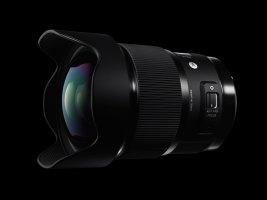
The press photos show a protruding front element, so almost certainly no support for screw-on filters.
 

Attachments

  • detail_img02.jpg
    detail_img02.jpg
    89.7 KB · Views: 285
Upvote 0
Another Sigma first is that this must be the world's first lens for which the lens cap is an extra-cost option. ;D

The thing about Sigma's Art line is that before the 24mm was released, we had come to expect optical excellence across the frame at all apertures. The 24mm Art shows that, even for Sigma, the practical limitations of optical design still apply. Much as I would love to imagine this 20mm will be the perfect astro lens, I'm not expecting miracles from it.

EDIT: apparently there is a standard lens cap included. The extra-cost option is for a metal version. Still, a lens cap upgrade option may be a world first. ???
 
Upvote 0
dilbert said:
PhotographyFirst said:
...
I don't know of a single landscape shooter who would use a 20mm f1.4 lens for anything other than astro landscapes. It would be pretty silly to go around with a 20 f1.4 lens for shooting daytime landscapes even if it did take filters.
...

Why?

What if I told you that the 14/2.8 is commonly used to shoot at sporting events?
Or that the 16-35/f2.8 II is used to shoot models?

The preconceptions people have about what lenses are used when, where and how are amazing. Some of you need to get out more. Get away from your computer and the Internet.

I've used a 19mm to shoot landscape and could just as easily use a 20mm - in the right location of course.
Might as well pull up your down riggers. There's nothing to troll for in my waters. :)

My post was about f1.4 on 20mm, not 20mm alone.
 
Upvote 0
ahsanford said:
PhotographyFirst said:
If the new 20 f1.4 isn't a rockstar for astro work, then it pretty much has little to no other market that will buy it up. Not great for daytime landscapes, and not great for portraits either.

I hear you. Astro is the first thing that comes to my mind with this, but I'm sure this forum may have other designs for it.

I could also see this being used as a flash-prohibited low-light event lens, where the subjects might be moving such that IS doesn't do you much good -- concerts, perhaps?

- A

That's a good point. I could see this being useful for low light event work. It would need some Hulk arms to carry around with complimentary lenses and cameras, but having such speed and width would be unmatched. Hopefully the vignetting is very well controlled to make it a true f1.4 transmission lens.
 
Upvote 0
What do they mean with this? Is the lens hood detachable or not?
"The included lens hood can be attached to block out extraneous light, which can have a negative effect on rendering performance."

Read under "flare and ghosting reduction".
http://sigma-global.com/en/lenses/cas/product/art/a_20_14/features.html


9VIII said:
I hate to say it (after reading the comments on how much Landscape shooters need filters) but one of my first thoughts looking at this lens was that it has a built in lens hood.
Sorry.

Hopefully that means it performs well enough for people to want to use it regardless.
 
Upvote 0
NNature said:
What do they mean with this? Is the lens hood detachable or not?
"The included lens hood can be attached to block out extraneous light, which can have a negative effect on rendering performance."

Read under "flare and ghosting reduction".
http://sigma-global.com/en/lenses/cas/product/art/a_20_14/features.html


9VIII said:
I hate to say it (after reading the comments on how much Landscape shooters need filters) but one of my first thoughts looking at this lens was that it has a built in lens hood.
Sorry.

Hopefully that means it performs well enough for people to want to use it regardless.

I believe that's a typo, because I can't find info about the filter size
 
Upvote 0
meywd said:
NNature said:
What do they mean with this? Is the lens hood detachable or not?
"The included lens hood can be attached to block out extraneous light, which can have a negative effect on rendering performance."

Read under "flare and ghosting reduction".
http://sigma-global.com/en/lenses/cas/product/art/a_20_14/features.html


9VIII said:
I hate to say it (after reading the comments on how much Landscape shooters need filters) but one of my first thoughts looking at this lens was that it has a built in lens hood.
Sorry.

Hopefully that means it performs well enough for people to want to use it regardless.

I believe that's a typo, because I can't find info about the filter size


1) As surmised from the leaked photos, the hood is permanent + front element is bulbous = no front filtering via threads. Confirmed at B&H. You have to hand-hold your filters or wait for Lee / Wonderpana to bail you out on that front.

2) Lens cap comes in the box with the lens, but apparently there is another lens cap (different SKU) you can optionally buy.

- A
 
Upvote 0
dilbert said:
meywd said:
dilbert said:
Correct me if I'm wrong but this is the first modern auto-focus lens to be released with an EF mount that is wider than 24mm. What do I mean by "modern"? Released since DSLRs became widely available (i.e. post Y2K.)

Did you mean prime? fastest instead of first? what about the 14mm f2.8 II?

I forgot about him!

Canon's AF primes are 14/1.4L, 24/1.4L, 28/1.8, 35/(1.4L,2), 50/(1.2L,1.4,1.8)

Sigma's AF primes (Art) are 20/1.4, 24/1.4, 35/1.4, 50/1.4

You're quite new to canon, aren't you? :) Just kidding... but you forgot a few primes for your searchfilter:
- 15mm fisheye
- 20mm 2.8 USM

The 20mm is really quite uncommon.
 
Upvote 0
JMZawodny said:
So what is currently the best 20-ish mm, fast, full frame lens for astrophotography? I'm just curious to see how hard it will be for this Sigma to become top dog.

I've heard the RokiBowYang glass does well with astro, but it's not something I typically shoot.

- A
 
Upvote 0
JMZawodny said:
So what is currently the best 20-ish mm, fast, full frame lens for astrophotography? I'm just curious to see how hard it will be for this Sigma to become top dog.
The Tamron 15-30 f2.8 VC is probably the all-around best Astro lens out there currently in the wide end and f2.8, IMO. Very well controlled coma, even compared to prime lenses. Plus, you get a wide focal range to use. Keep it at 15mm for wide shots, or zoom in a stitch multiple images together. Tons of options without swapping lenses all day and night.

Even though it is a Nikon, I personally like the nearly non-existent vignetting of the 14-24 f2.8 lens. More coma than the Tamron, but the lack of vignetting in the Nikon is just outstanding for a wide and fast lens. When applying vignetting correction to lenses with dark corners, it can be brutal, especially if there is some amp glow added to the mix. My old 16-35L II f2.8 had bad coma, but it was the 3+ stops of vignetting that really became a huge issue.

Many people like the Sammy 14mm f2.8 due to low coma, but it does have horrendous distortion and vignetting wide open. Distortion can be an issue for panoramas. It's cheap and that's the largest reason it's an astro favorite.

 
Upvote 0
PhotographyFirst said:
JMZawodny said:
So what is currently the best 20-ish mm, fast, full frame lens for astrophotography? I'm just curious to see how hard it will be for this Sigma to become top dog.
The Tamron 15-30 f2.8 VC is probably the all-around best Astro lens out there currently in the wide end and f2.8, IMO. Very well controlled coma, even compared to prime lenses. Plus, you get a wide focal range to use. Keep it at 15mm for wide shots, or zoom in a stitch multiple images together. Tons of options without swapping lenses all day and night.

Even though it is a Nikon, I personally like the nearly non-existent vignetting of the 14-24 f2.8 lens. More coma than the Tamron, but the lack of vignetting in the Nikon is just outstanding for a wide and fast lens. When applying vignetting correction to lenses with dark corners, it can be brutal, especially if there is some amp glow added to the mix. My old 16-35L II f2.8 had bad coma, but it was the 3+ stops of vignetting that really became a huge issue.

Many people like the Sammy 14mm f2.8 due to low coma, but it does have horrendous distortion and vignetting wide open. Distortion can be an issue for panoramas. It's cheap and that's the largest reason it's an astro favorite.

+1. this almost perfectly echoes my thoughts.
 
Upvote 0
PhotographyFirst said:
JMZawodny said:
So what is currently the best 20-ish mm, fast, full frame lens for astrophotography? I'm just curious to see how hard it will be for this Sigma to become top dog.
The Tamron 15-30 f2.8 VC is probably the all-around best Astro lens out there currently in the wide end and f2.8, IMO. Very well controlled coma, even compared to prime lenses. Plus, you get a wide focal range to use. Keep it at 15mm for wide shots, or zoom in a stitch multiple images together. Tons of options without swapping lenses all day and night.

Even though it is a Nikon, I personally like the nearly non-existent vignetting of the 14-24 f2.8 lens. More coma than the Tamron, but the lack of vignetting in the Nikon is just outstanding for a wide and fast lens. When applying vignetting correction to lenses with dark corners, it can be brutal, especially if there is some amp glow added to the mix. My old 16-35L II f2.8 had bad coma, but it was the 3+ stops of vignetting that really became a huge issue.

Many people like the Sammy 14mm f2.8 due to low coma, but it does have horrendous distortion and vignetting wide open. Distortion can be an issue for panoramas. It's cheap and that's the largest reason it's an astro favorite.
I love my 15-30.

I agree with your comments completely.

However... this 20mm intrests me for the purpose of portraits. Kinda unusual huh.
 
Upvote 0
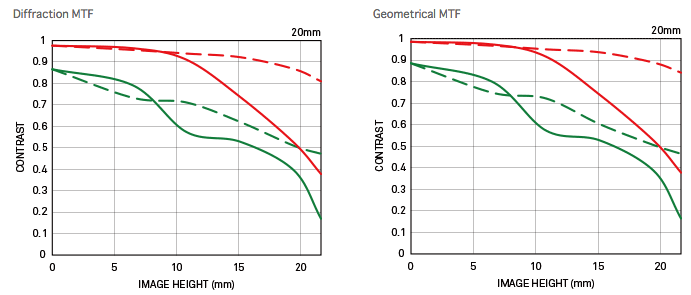
The MTF charts do not inspire much confidence personally.
Sigma-20mm-f1.4-DG-HSM-Art-lens-MTF-chart.png


At maximum aperture there is a massive astigmatism at MTF-10 and significant dropoff in performance for the outer third of frame. MTF-30 also drops to poor levels in the outer third of the image circle. The lens will have to do better than that to earn my dollar. If I need to crop to APS-H to get a usable image then what good is it really?

I guess I'll have to see how much it improves on stopping down. If there's no big improvements by f/2.8 (especially in the outer third of the frame ) then there's no real threat of me selling my 24L II. Just my personal take...

Looking forward to seeing some tests.
 
Upvote 0