Sony switchers face development limbo!

jolyonralph said:
Don Haines said:
If Sony comes to the conclusion that their (pick your format) cameras are not profitable and never will be again, they will drop them so fast that if you blink you will miss it!

That's the same with any corporation, Canon included! I really don't see what your point is.
Products get dropped, but Canon drops individual models and continues to service them for ~ 10 years and service prices are reasonable.
Sony drops entire product lines and charges extremely high prices for service, and stops servicing products shortly after they are discontinued. Thats the difference.
 
Upvote 0
So Sony is focussing on high end high margin mirrorless and Nikon is focussing on high end high margin DSLR's (at least for now). Plenty of fuel for internet chatter, but they are going to have to convince a lot of people to upgrade from somebody else's entry level cameras.
 
Upvote 0
BillB said:
So Sony is focussing on high end high margin mirrorless and Nikon is focussing on high end high margin DSLR's (at least for now). Plenty of fuel for internet chatter, but they are going to have to convince a lot of people to upgrade from somebody else's entry level cameras.

Given that entry level cameras represent the largest segment of the ILC market (by volume), and Canon has dominated the ILC market for the past 15 years, I suspect that if Sony or Nikon announced that they were focusing on the entry-level segment, their shareholders would grab their torches and pitchforks.
 
Upvote 0
Mt Spokane Photography said:
jolyonralph said:
Don Haines said:
If Sony comes to the conclusion that their (pick your format) cameras are not profitable and never will be again, they will drop them so fast that if you blink you will miss it!

That's the same with any corporation, Canon included! I really don't see what your point is.
Products get dropped, but Canon drops individual models and continues to service them for ~ 10 years and service prices are reasonable.
Sony drops entire product lines and charges extremely high prices for service, and stops servicing products shortly after they are discontinued. Thats the difference.

I agree that there should be brands that stay steadfast in their direction, refusing to move in or test uncharted waters. Companies that choose this direction brings familiarity, and a sense of clarity with its products. This is why there are Canon shooters that love Canon, along with their support programs and equipment. Sony simply took a different direction yielding different benefits. Sure, I'm taking some risks when I bought into Sony, but the opportunity cost of staying with Canon now just didn't make sense for me.

OTOH, sometimes we need companies to move the bar forwards. Tesla is a great example. Tesla's financial picture is quite bleak at the moment, but they pushed forward things that define the emerging fourth industrial revolution such as AI and IoT. Even if Tesla fails, over-the-air fixes and autonomous drive is definitely in our near future. I'm shopping for a car this year and almost all of the models I'm cross shopping have some form of semi-autonomous drive and upcoming electrified models. Yes, I understand moving from a combustion engine to a full electric drive is a real innovation shift, unlike DSLRS to Mirrorless, but some of tech that comes from this will be the bar that will be measured among all of its competitors. We don't even think twice today whether a car has cruise control, abs and traction control.

So if Sony "never really makes it," but Canon's future cameras eventually adopt full 4K DPAF with high speed global shutters and OVF beating EVFs, matching Sony specs to stay current, we can appreciate that companies like Sony (and others) did move the bar forwards for the benefit of everyone involved.
 
Upvote 0
Sony is being very aggressive with the A7III - at $2000 it's priced to compete with the 6DII rather than the 5DIV, and, if you haven't already invested in any particular lens lineup, and you haven't got a specific phobia of electronic viewfinders, the A7III is clearly the better purchase. 10fps vs 6.5fps for the 6DII, 14.7 dynamic range compared to 11.9, better low light iso performance, 4K video, 2 card slots, more focus points etc etc etc.

You don't have to be a genius to realise that this was a deliberate price positioning to try and scupper Canon and Nikon's plans to move into the mirrorless market. Canon can't bring out a FF mirrorless camera now for much more than $2000 unless it has some spectacular surprise.
 
Upvote 0
jolyonralph said:
Sony is being very aggressive with the A7III - at $2000 it's priced to compete with the 6DII rather than the 5DIV, and, if you haven't already invested in any particular lens lineup, and you haven't got a specific phobia of electronic viewfinders, the A7III is clearly the better purchase. 10fps vs 6.5fps for the 6DII, 14.7 dynamic range compared to 11.9, better low light iso performance, 4K video, 2 card slots, more focus points etc etc etc.

You don't have to be a genius to realise that this was a deliberate price positioning to try and scupper Canon and Nikon's plans to move into the mirrorless market. Canon can't bring out a FF mirrorless camera now for much more than $2000 unless it has some spectacular surprise.

And what about aggressively priced high quality zooms?
 
Upvote 0
jolyonralph said:
You don't have to be a genius to realise that this was a deliberate price positioning to try and scupper Canon and Nikon's plans to move into the mirrorless market. Canon can't bring out a FF mirrorless camera now for much more than $2000 unless it has some spectacular surprise.

This is where it will get interesting. Has the A9 made a significant dent in the 1Dx sales? Has the cheaper A7R3 made significant dent in 5D4 sales? Or are buyers of the A9/A7r3 buying them and keeping their 1Dx2/5D4 ? I suspect a lot of it is the latter - but it is very hard to tell how much the high-profile youtube gear heads actually represent the real market.

I think the first Canon FF mirrorless could withstand a price of about 2,500 and still be competitive based on brand loyalty and also the features that really matter - the ones that make a real difference to the shooting experience. I read more comments lately about how Sony is a great picture taking machine but the act of using it is less 'fun' than CaNikon - and for the enthusiast, that 'fun' is what makes us keep coming back for more.

So with the right haptics I think Canon could do a decent job of their first entry and although the internet will be a-buzz with comments about how much of a disappointment it is (they do after all have to keep people reading their blogs), it will in the real world likely check a lot of boxes like the M series has started to do.

And once that starts biting into Sony's bottom line (brand switching has been their customer source for years) we will see what strategy they have, and if it turns out the A7iii is priced too aggressively where the margins are
unsustainable for future models to meet expectations, there could be big shake-ups a-coming.
 
Upvote 0
neuroanatomist said:
3kramd5 said:
old-pr-pix said:
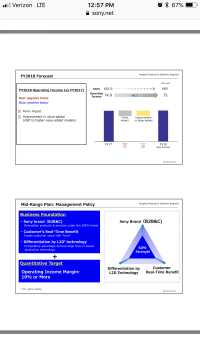
For 2018 CIPA forecasts an overall market decline in unit sales of just over 6%... Sony's graph shows their digital camera units are expected to drop from 4.4 million units to 3.8 million - a 14% decline or more than double the market drop! Not exactly a formula for share increase.

No, but as indicated above they aren’t interested in volume, they’re interested in reaping profit in premium markets.

Fine. Sony is predicting that profits will be flat for 2018, i.e. no change from 2017. Canon is predicting a 17% increase in profits. So Sony's formula isn't working as well for what they are interested in, either.

No comment from me on whether their strategy is effective, I’m only commenting on the implication (or perhaps my incorrect inference) from the OP that Sony may stop making cameras (“gadgets”) in favor of a recurring service market, and that buyers face a risk decision due to the strategy.
 
Upvote 0
jolyonralph said:
Sony is being very aggressive with the A7III - at $2000 it's priced to compete with the 6DII rather than the 5DIV, and, if you haven't already invested in any particular lens lineup, and you haven't got a specific phobia of electronic viewfinders, the A7III is clearly the better purchase. 10fps vs 6.5fps for the 6DII, 14.7 dynamic range compared to 11.9, better low light iso performance, 4K video, 2 card slots, more focus points etc etc etc.

I love when spec lovers keep repeating the same BS. "The A7III is clearly the better purchase." Clearly? By your definition perhaps. And yet users on this forum such as Talys have repeatedly been disappointed in the Sonys and have revealed their many shortcomings including lousy AF in many circumstances. Add in lousy ergonomics, lousy color, lousy kit lenses (the worst I have ever seen) and lousy exposure metering (in my opinion based on my experience), and Sony is no longer "clearly the better purchase".

Why people can't just say, the Sony is the clearly the better purchase FOR ME and realize that the rest of us are smart enough to decide for ourselves what the better purchase is. Having owned Canon, Olympus and Sony cameras, there is no question in my mind which companies have the cameras that work best for me - and Sony is a distant third.
 
Upvote 0
neuroanatomist said:
3kramd5 said:
...buyers face a risk decision due to the strategy.

Sony buyers do face a risk. Remember Vaio? Remember that was the second time Sony exited the PC market?

Yah, all buyers face that risk ultimately, but does this strategy increase it? Especially given the further detail about their focus on branded hardware from Imaging Products & Solutions, among other business units, as the growth engine?

I don’t buy it. That’s YOPODFC level stuff.
 
Upvote 0
3kramd5 said:
Yah, all buyers face that risk ultimately, but does this strategy increase it? Especially given the further detail about their focus on branded hardware from Imaging Products & Solutions, among other business units, as the growth engine?

I don’t buy it. That’s YOPODFC level stuff.

A strategic focus on a 'growth engine' where their own projections indicate zero profit growth next year. You're right, nothing to be at all concerned about there in any way, shape or form...everything's rosy and bright. ::)
 
Upvote 0
neuroanatomist said:
3kramd5 said:
Yah, all buyers face that risk ultimately, but does this strategy increase it? Especially given the further detail about their focus on branded hardware from Imaging Products & Solutions, among other business units, as the growth engine?

I don’t buy it. That’s YOPODFC level stuff.

A strategic focus on a 'growth engine' where their own projections indicate zero profit growth next year. You're right, nothing to be at all concerned about there in any way, shape or form...everything's rosy and bright. ::)

I agree with your sarcastic “nothing to be concerned about there” comment.

I’m not a Sony user but this wouldn’t concern me if I were. Nor should it concern PlayStation users. It maybe should concern investors. They aren’t looking for growth in the camera market, they’re specifically looking for “sustainable cash flow” from these business units (including Imaging products) with which to fund growth for Sony at large (hence engine). If they’re looking at cameras as a piggy bank, they’re not likely to abandon cameras. In fact, their goal as stated to investors is to be the top brand in the camera market (however lofty that is). Perhaps the flat projected profit for 2018 is due to investment needed, not poor sales, and note that in 2020 they’re targeting 13%-40% revenue increase (relative to 2018 projections) with the 2017 level of product sales. Regardless, nothing for camera users to worry about.
 

Attachments

  • 18572E5B-9A1E-4321-A26B-FB737B5BF9B6.png
    18572E5B-9A1E-4321-A26B-FB737B5BF9B6.png
    495.2 KB · Views: 94
  • 2B2DE537-915A-4572-B111-359E81459C89.png
    2B2DE537-915A-4572-B111-359E81459C89.png
    1.1 MB · Views: 98
Upvote 0
3kramd5 said:
neuroanatomist said:
3kramd5 said:
...buyers face a risk decision due to the strategy.

Sony buyers do face a risk. Remember Vaio? Remember that was the second time Sony exited the PC market?

Yah, all buyers face that risk ultimately, but does this strategy increase it? Especially given the further detail about their focus on branded hardware from Imaging Products & Solutions, among other business units, as the growth engine?

I don’t buy it. That’s YOPODFC level stuff.

The painful part about Vaio notebooks wasn't that Sony exited the market, because in the PC world, you don't expect your computer to last forever anyways. The main problem was that Vaio notebooks were great, until Sony decided they weren't interested in making them anymore. Then, the last generation were garbage.

I fell into the idiot class that loved their earlier notebooks enough to lay down $3000+ for their last carbon-fiber Z class notebook on launch day that ended up literally going in the trash, because it had terrible heat and stability problems. I also despised the trackpad, they keyboard had way too much flex, and I got sick of sending it in only to have it come back still defective.

The worst thing Sony could do for its photography customers would be to decide that the division isn't making enough money to invest big bucks into future R&D. But to be honest, I don't see that as likely, because Sony is definitely in it for the long haul in the pro camcorder and other imaging businesses, and there's a lot of overlap.

However, it is possible that you never end up seeing big telephotos or tilt-shift lenses, or other low-volume, more specialty stuff. You might never even see a decent first-party flash system ::)
 
Upvote 0
Talys said:
However, it is possible that you never end up seeing big telephotos or tilt-shift lenses, or other low-volume, more specialty stuff. You might never even see a decent first-party flash system ::)

Tilt shift? Maybe not; many EVF users are happy to have in-camera digital corrections rather than optical. However, “light source” and “lens” were two of the inputs they presented in their product dev strategy.
 
Upvote 0
3kramd5 said:
Talys said:
However, it is possible that you never end up seeing big telephotos or tilt-shift lenses, or other low-volume, more specialty stuff. You might never even see a decent first-party flash system ::)

Tilt shift? Maybe not; many EVF users are happy to have in-camera digital corrections rather than optical. However, “light source” and “lens” were two of the inputs they presented in their product dev strategy.

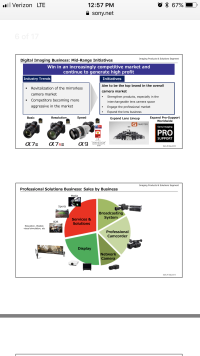
One thing I found interesting in their slide was the way Sony is dividing their product mix: basic, resolution, and speed.

A problem with their "speed" is that they're talking almost exclusively about drive speed. But in order for Sony to achieve their goal of being the "top brand" they'll need to be competitive with Canon and Nikon's DSLRs in autofocus speed, particularly with the long telephotos and extenders.

Which means they'll need the big lenses and big apertures, of course, but even putting that aside lens availability, the 100-400mm + 1.4TC on any Sony is miserably slow compared to a 5D4 in any lighting situation, and in a whole other universe when compared to 400 + 1.4 on a 1DXII.
 
Upvote 0
3kramd5 said:
I agree with your sarcastic “nothing to be concerned about there” comment.

I’m not a Sony user but this wouldn’t concern me if I were. Nor should it concern PlayStation users. It maybe should concern investors. They aren’t looking for growth in the camera market, they’re specifically looking for “sustainable cash flow” from these business units (including Imaging products) with which to fund growth for Sony at large (hence engine). If they’re looking at cameras as a piggy bank, they’re not likely to abandon cameras. In fact, their goal as stated to investors is to be the top brand in the camera market (however lofty that is). Perhaps the flat projected profit for 2018 is due to investment needed, not poor sales, and note that in 2020 they’re targeting 13%-40% revenue increase (relative to 2018 projections) with the 2017 level of product sales. Regardless, nothing for camera users to worry about.

The question is how it will be able to maintain margins when CaNikon get into the mirrorless game. Sony plans to "Win in an increasingly competitive market and continue to generate high profit." while "Competitors [are] becoming more aggressive in the market." Usually competition leads to a reduction in margin and the total pie is still shrinking...
 
Upvote 0
4D said:
"Sony is proving that it can evolve with the landscape ... with a shift from a hardware-to content-driven profit model,” SMBC Nikko Securities Inc. analyst Ryosuke Katsura wrote after the company’s latest earnings report last month. “The real key is whether it provides investors with a clear road map.”

Interesting, since Sony attributed good results from hardware in addition to Playstation revenue.
 
Upvote 0
Random Orbits said:
3kramd5 said:
I agree with your sarcastic “nothing to be concerned about there” comment.

I’m not a Sony user but this wouldn’t concern me if I were. Nor should it concern PlayStation users. It maybe should concern investors. They aren’t looking for growth in the camera market, they’re specifically looking for “sustainable cash flow” from these business units (including Imaging products) with which to fund growth for Sony at large (hence engine). If they’re looking at cameras as a piggy bank, they’re not likely to abandon cameras. In fact, their goal as stated to investors is to be the top brand in the camera market (however lofty that is). Perhaps the flat projected profit for 2018 is due to investment needed, not poor sales, and note that in 2020 they’re targeting 13%-40% revenue increase (relative to 2018 projections) with the 2017 level of product sales. Regardless, nothing for camera users to worry about.

The question is how it will be able to maintain margins when CaNikon get into the mirrorless game. Sony plans to "Win in an increasingly competitive market and continue to generate high profit." while "Competitors [are] becoming more aggressive in the market." Usually competition leads to a reduction in margin and the total pie is still shrinking...


Perhaps with segmentation (>$2000 stills cameras, >$1500 lenses, >$4000 camcorders, etc). Aggressive competition is likely to come in a lower market segment, and margins are higher in premium markets.

But who knows?
 
Upvote 0