
T6i / T6s Dynamic Range Test vs Nikon D5500

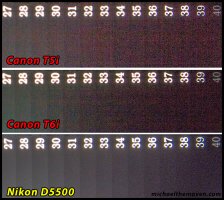
I received my T6i yesterday, and was extremely curious about the Dynamic Range of the new 24 MP sensor being used in it and the T6s, so I put it through my DR test which is essentially firing a strobe through a 13.7 stop ND filter strip. Long story short, it is very comparable to the T5i Dynamic Range wise (I was hoping for something much better). Take a look and compare with the Nikon D5500.

That said, I have actually been very happy about it in regards to the other tests I have done. What stands out to me:

- The focusing systems, both optically and in Live View have been very good. Reminds me of a 7D or 70D. For the price, it'll be hard to beat.
- Ergonomically, a deeper grip. Feels more substantial.
- The ISO performance appears to be much better than previous Rebels.

Overall, I would say this is a significant improvement over the T5i, just was wishing for more DR.

Best wishes

MM
 

Attachments

  • T6i-T5i-D5500-Web.jpg
    T6i-T5i-D5500-Web.jpg
    443.1 KB · Views: 1,635
That's actually very nice to see. Not brilliant, but to see them get rid of that much pattern noise while increasing resolution 33% means they're definitely not ignoring the issue, even if they kept some inherently flawed design.

I may actually want that sensor more than the 5Ds for macro, but we'll have to wait and see if the 5Dsr gives better per-pixel IQ or not, and how crippled the high ISO really is.
 
Upvote 0
I realize that lots of people are wishing for more DR. Mainly out of curiosity, I bought a Sony A7 to compare it with my 6D. I tested it for a few days. Shooting mostly landscapes in daylight, there was not much difference in many of my shots. The added DR was noticeable in some of the shots - but not in a positive way. In comparing the pics, the main difference was the Sony seemed more "washed out' and had less "punch" than the Canon pics. This was because there was less contrast. Was this lesser amount of contrast due to the greater DR or was it due to a different processing tone curve of the two cameras, I can't be sure. But more DR means less contrast. I understand that there are circumstances and type of photography where more DR is helpful. In my case, even some sunset shots I took were not helped by the additional DR of the Sony. Would I sacrifice contrast for more DR? I decided not to and returned the Sony for a refund. So for those who clamor for more DR - be careful. Someday, you may just get you want!
 
Upvote 0
dak723 said:
I realize that lots of people are wishing for more DR. Mainly out of curiosity, I bought a Sony A7 to compare it with my 6D. I tested it for a few days. Shooting mostly landscapes in daylight, there was not much difference in many of my shots. The added DR was noticeable in some of the shots - but not in a positive way. In comparing the pics, the main difference was the Sony seemed more "washed out' and had less "punch" than the Canon pics. This was because there was less contrast. Was this lesser amount of contrast due to the greater DR or was it due to a different processing tone curve of the two cameras, I can't be sure. But more DR means less contrast. I understand that there are circumstances and type of photography where more DR is helpful. In my case, even some sunset shots I took were not helped by the additional DR of the Sony. Would I sacrifice contrast for more DR? I decided not to and returned the Sony for a refund. So for those who clamor for more DR - be careful. Someday, you may just get you want!

I'm not sure i understand this. If you are shooting raw then more DR does matter when it comes to processing. More punch or contrast is personal preference you add in post processing.
 
Upvote 0
JohnBran said:
dak723 said:
I realize that lots of people are wishing for more DR. Mainly out of curiosity, I bought a Sony A7 to compare it with my 6D. I tested it for a few days. Shooting mostly landscapes in daylight, there was not much difference in many of my shots. The added DR was noticeable in some of the shots - but not in a positive way. In comparing the pics, the main difference was the Sony seemed more "washed out' and had less "punch" than the Canon pics. This was because there was less contrast. Was this lesser amount of contrast due to the greater DR or was it due to a different processing tone curve of the two cameras, I can't be sure. But more DR means less contrast. I understand that there are circumstances and type of photography where more DR is helpful. In my case, even some sunset shots I took were not helped by the additional DR of the Sony. Would I sacrifice contrast for more DR? I decided not to and returned the Sony for a refund. So for those who clamor for more DR - be careful. Someday, you may just get you want!

I'm not sure i understand this. If you are shooting raw then more DR does matter when it comes to processing. More punch or contrast is personal preference you add in post processing.

I think dak723 meant that the files from the Canon are closer to what his style is and requires less work in post than the A7. It requires work to add that contrast in but with the Canon it's close to where he needs it to be or where he likes it to be.

I get that part of it. I also get that starting out with as much DR as possible can be advantageous. I guess it depends what you shoot.

I'll also add that I'd prefer the overall contrast to be close to where I need it as messing with curves can be laborious when dealing with multiple images as syncing doesn't always work with curves due to minute differences from one image to another. The 6D with 135L is a good combo where I tend to get results that need minimal contrast adjustment.

Moving a shadow slider over a bit is easier in comparison to adding local contrast adjustments, in my opinion (several years of using LR).
 
Upvote 0
Michael, first and foremost - thank you the test results. It is very appreciated.


***


One thing to note is, the Nikon sample looks softer and brighter over all. The Canon is sharper and darker. The white point is also different. I know it is very difficult to make a 100% apples to apples comparison, but even small differences can make a large difference when comparing minute aspects of sensor quality.
 
Upvote 0
Zv said:
JohnBran said:
dak723 said:
I realize that lots of people are wishing for more DR. Mainly out of curiosity, I bought a Sony A7 to compare it with my 6D. I tested it for a few days. Shooting mostly landscapes in daylight, there was not much difference in many of my shots. The added DR was noticeable in some of the shots - but not in a positive way. In comparing the pics, the main difference was the Sony seemed more "washed out' and had less "punch" than the Canon pics. This was because there was less contrast. Was this lesser amount of contrast due to the greater DR or was it due to a different processing tone curve of the two cameras, I can't be sure. But more DR means less contrast. I understand that there are circumstances and type of photography where more DR is helpful. In my case, even some sunset shots I took were not helped by the additional DR of the Sony. Would I sacrifice contrast for more DR? I decided not to and returned the Sony for a refund. So for those who clamor for more DR - be careful. Someday, you may just get you want!

I'm not sure i understand this. If you are shooting raw then more DR does matter when it comes to processing. More punch or contrast is personal preference you add in post processing.

I think dak723 meant that the files from the Canon are closer to what his style is and requires less work in post than the A7. It requires work to add that contrast in but with the Canon it's close to where he needs it to be or where he likes it to be.

I get that part of it. I also get that starting out with as much DR as possible can be advantageous. I guess it depends what you shoot.

I'll also add that I'd prefer the overall contrast to be close to where I need it as messing with curves can be laborious when dealing with multiple images as syncing doesn't always work with curves due to minute differences from one image to another. The 6D with 135L is a good combo where I tend to get results that need minimal contrast adjustment.

Moving a shadow slider over a bit is easier in comparison to adding local contrast adjustments, in my opinion (several years of using LR).
Thanks for detailed explanation , much appreciated. I get it now. :)
 
Upvote 0
Assuming you're shooting in RAW modes on both, yes a higher DR capture will often produce a much flatter looking jpg preview, which you would then correct to your liking in post. What you see on the camera LCDs are the small embded in the RAW file jpg previews. Canon has several picture styles that while they do not affect the RAW image at all, DO affect the jpg preview (Standard, Portrait, Neutral, etc...) I don't know Sony does it, never used one. But if you shoot with Canon Neutral (what I always use) the image you see in preview of the RAW will look very flat by comparison to say Standard. Check each camera's settings. If you are actually shooting IN jpg (not RAW) you are baking in whatever style mode you have selected, limiting your potential to grade it in post. If the default selection of Sony is Neutral and Canon is Standard, then that would explain much of what you're getting.

dak723 said:
I realize that lots of people are wishing for more DR. Mainly out of curiosity, I bought a Sony A7 to compare it with my 6D. I tested it for a few days. Shooting mostly landscapes in daylight, there was not much difference in many of my shots. The added DR was noticeable in some of the shots - but not in a positive way. In comparing the pics, the main difference was the Sony seemed more "washed out' and had less "punch" than the Canon pics. This was because there was less contrast. Was this lesser amount of contrast due to the greater DR or was it due to a different processing tone curve of the two cameras, I can't be sure. But more DR means less contrast. I understand that there are circumstances and type of photography where more DR is helpful. In my case, even some sunset shots I took were not helped by the additional DR of the Sony. Would I sacrifice contrast for more DR? I decided not to and returned the Sony for a refund. So for those who clamor for more DR - be careful. Someday, you may just get you want!
 
Upvote 0
Thanks so much for doing this test. I pre-ordered the T6I recently (upgrading from a Canon 50D, but with a budget)... And I have been searching every hour to find someone who's done a test so far since their release. Dynamic range was definitely something that I was interested in seeing if it would be superior to my 50D. Hopefully more comparisons with these cameras come soon... (Especially noise levels at higher ISO)
 
Upvote 0
Yes, these are screen grabs of RAW images in Camera RAW from respective cameras. Initially I was mainly interested in the comparison with the T5i to see how much it had improved (or not). The take away for me on it was basically more of the same, just at 24mp instead of 18mp. That said, the focusing and ISO performance so far has been quite impressive to me.

ISO 6400 - Full Res if you guys want to inspect it. Enjoy!

M
 

Attachments

Upvote 0
people always talk about DR difference between Nikon and Canon sensors. I had slightly dismissed it until that test photo. That is a marked difference. 5500 is a slightly different price point than t6i (more like 3300 vs. t6i), but I believe they have the same sensor so who cares.

jeepers
 
Upvote 0
I think the main lesson learned here that many tend to miss is -

While the Nikon shows to be the clear winner in DR and Noise based on these kinds of tests -

In real photography of real subjects - whatever it may be, this kind of advantage does not become a factor.

Take a D5500 and this T6S - make all things as equal as possible, shoot a series of identical photos - then go pixel peeping.

You will not find any real practical differences. There will be no ISO and DR differences visible at print size. At 100%, 1:1 -- you may see some minor differences only in less than 5% of the total image (the most extremely dark spots, or brightest spots). The areas where the DR is coming into play. The difference is small. And of that, the difference will not be visible in any kind of practical output.

Nikon sensor is better in those regards. Whether you can actually make use of that is another story.

Will the user crop down into the worst shadow area, then blow it up 100% and then print at that size? No.


On the other hand, Canon's color is better. That factor DOES matter in real photography.

When Michael does the quizzes at the end of his videos between Canon vs Nikon, I repeatedly score 80% or more. Nikon has that "look" to it, and the giveaway is almost always:

1. Inaccurate skin tone
2. Over saturated

Look at enough Canon vs Nikon images that come straight from camera, and it isn't hard to tell after a while.

However, if they are color matched exactly - and the test was "which image is Canon or Nikon based on noise / DR" - there is no question at all that no one will score better than random. The DR and Noise advantage just isn't visible to anyone not pixel peeping.


Nikon has this type of look to it across their entire camera range. Yet, across their camera line-up, they aren't using the same sensor made by the same manufacturer. This to me is evidence, proof in opinion, that Nikon's processing is doing this - regardless of whether the file is RAW or not. RAW image data does have some processing done to it before it is written to the CR2 or NEF format. This of course is Canon and Nikon's secret. But they are both applying noise reduction, color corrections and tone curve to it. We're not really getting a RAW image date dump as the sensor truly saw it. If we did, the image would be much lower in quality than we come to expect.

I like Michael's videos, because after he does all the tests, shows all the pixel peeing nonsense - he then brings people back to the practicality and reality with a photo vs photo test, and there all that nonsense goes away and it becomes more about the overall look of the image. Something that is a factor.

This goes over most people's head as they are obsessed with the most minute tech details, and less into photography.
 
Upvote 0
K said:
Michael, first and foremost - thank you the test results. It is very appreciated.


***


One thing to note is, the Nikon sample looks softer and brighter over all. The Canon is sharper and darker. The white point is also different. I know it is very difficult to make a 100% apples to apples comparison, but even small differences can make a large difference when comparing minute aspects of sensor quality.
d5500 test samples are soft even in dpr comparison tool. Not sure what is the issue. May be it is lens.
 
Upvote 0
MichaelTheMaven said:
I received my T6i ..it is very comparable to the T5i Dynamic Range wise..

Y'otta know better than to wish for sudden massive improvement in this area from Canon.. ;)
At least there appears to be SOME improvement, tho still has FPN.
Bears repeating; Canon makes cameras that are, in this regard, "good enough" for most requirements.
Fill 'em full of gimmicks and features that make people smile and you have a repeat customer.
Give me FPN and other poor raw file quality and my fellow minority dwellers (here) & I will raise a ruckus about how lousy they are. :)
 
Upvote 0