
You are using an out of date browser. It may not display this or other websites correctly.
You should upgrade or use an alternative browser.
You should upgrade or use an alternative browser.
Teleconverter
- Thread starter wdh777
- Start date
- Status
- Not open for further replies.
I just bought a Canon EF2Xmk3 Teleconverter last week and have tried it on my 300F4L and 70-200 2.8Mk2 lens. The EF2Xmk3 converter does reduce the image quality of these 2 lens more so than compared to the 1.4Xmk2 which I have also. If you do not need the additional reach, the 1.4Xmk2 or mk3 will be better.
Upvote
0


Even air reduces the IQ, the further away you are, the more are between you and the subject, and the IQ is lowered.
Now imagine 7 elements of glass as in a TC. There is a definite loss of IQ, and the TC is also a magnifier, so the faults that exist in a lens are magnified.
This does not mean a TC is bad, the end result might be better than cropping, but that depends on the lens, TC, and camera body.
Now imagine 7 elements of glass as in a TC. There is a definite loss of IQ, and the TC is also a magnifier, so the faults that exist in a lens are magnified.
This does not mean a TC is bad, the end result might be better than cropping, but that depends on the lens, TC, and camera body.
Upvote
0

I'm using both the 1.4 and 2X Teleconverter with a 70-200 F4 IS USM Lens. The 1.4 works fine and I have gotten some really nice BIF pics with this combo. Using the 2X is harder for me and I am still trying to get the results I would like.
With my 40D the pics were fuzzy handheld. With the 7D they're a little better. As it's early in the year, I might get better results when the weather gets better. I would like to shoot with the sun and me in the West looking back at the Eagle.
This is handheld shooting from the North which is better than shooting from the south. The 2X makes my lens an F8 Manual Focus.The 2.8 would become a F5.6 auto focus lens. I have seen good results on the web. You may or not get results that make you happy.
With my 40D the pics were fuzzy handheld. With the 7D they're a little better. As it's early in the year, I might get better results when the weather gets better. I would like to shoot with the sun and me in the West looking back at the Eagle.
This is handheld shooting from the North which is better than shooting from the south. The 2X makes my lens an F8 Manual Focus.The 2.8 would become a F5.6 auto focus lens. I have seen good results on the web. You may or not get results that make you happy.
Attachments

Upvote
0

RGF said:Any piece of glass, not intergal to the lens, will reduce IQ. If it improved IQ, then it would be part of the lens
This and the other dogmatic replies and all those who have answered yes that IQ is always lowered by by a TC have answered a very badly phrased question and are only half right and are also half wrong. If you compare the IQ of the native lens at half the distance from the subject as the lens +2xTC, then the native lens will give better IQ since the image has the same size in both cases. But, if you compare the IQ when both native lens and the 2xTC combo at the same distance, then a good lens with a good TC will give better IQ than the native lens rezzed up. Look at comparisons on the The-digital-Picture site, for example. Of course, a bad combination could give worse results.
Upvote
0

I have the 70-200L IS II with the 2x canon and its great for video (on 5d mk2)
Heres one i took last year
http://footage.shutterstock.com/clip-2260261-stock-footage-young-deer-walking-in-spring-bluebells.html
Heres one i took last year
http://footage.shutterstock.com/clip-2260261-stock-footage-young-deer-walking-in-spring-bluebells.html
Upvote
0
OCwildlife
10 year Canon shooter, 1dmkIV
Some hesitation on BIFs, could be frustration on the focus for you. No comparison on that part. The extra glass is usable, but not for everything. I would say using auto ISO is a good idea to insure enough shutterspeed for moving birds. Posed birds take pretty well with the new 2x. I am happy with it on my 500mmf4IS II. I won't use it, for instance if the shoot is important like one of a kind birds like Golden Eagles, etc. Your keeper rate goes down.
But in good light and with good shutterspeed control and posing targets you may have some fun with it. Your DOF will be smaller area of the target also. I use mine occasionally. The newer model is the only way to do it right. What camera do you have?
But in good light and with good shutterspeed control and posing targets you may have some fun with it. Your DOF will be smaller area of the target also. I use mine occasionally. The newer model is the only way to do it right. What camera do you have?
Upvote
0
I have the 70-200 IS2 and the 1.4 TC3 and very pleased with that combo. But that keeps me at f/4 wide open so still useable in less than ideal light. IQ hit is barely even perceptable. I realize you are asking about the 2x but chimed in anyway in case you decide to consider going "shorter".
Upvote
0
AlanF said:RGF said:Any piece of glass, not intergal to the lens, will reduce IQ. If it improved IQ, then it would be part of the lens
This and the other dogmatic replies and all those who have answered yes that IQ is always lowered by by a TC have answered a very badly phrased question and are only half right and are also half wrong. If you compare the IQ of the native lens at half the distance from the subject as the lens +2xTC, then the native lens will give better IQ since the image has the same size in both cases. But, if you compare the IQ when both native lens and the 2xTC combo at the same distance, then a good lens with a good TC will give better IQ than the native lens rezzed up. Look at comparisons on the The-digital-Picture site, for example. Of course, a bad combination could give worse results.
Since he mentioned a specific lens, the 70-200mm f/2.8, which does not take TC's particularly well, our answers seem to be fine.
Many of us have extensively tested TC's with our lenses as well as viewed TDP.
Here is a crop from TDP of the 70-200mm f/2.8L and no TC
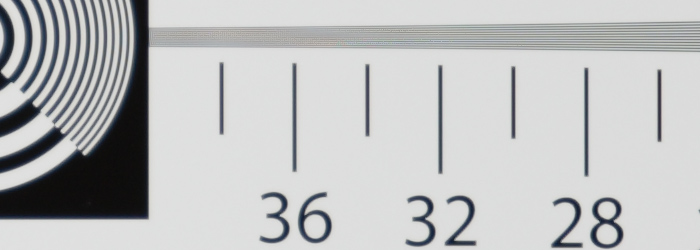
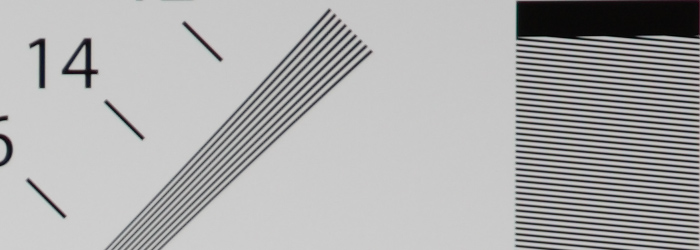
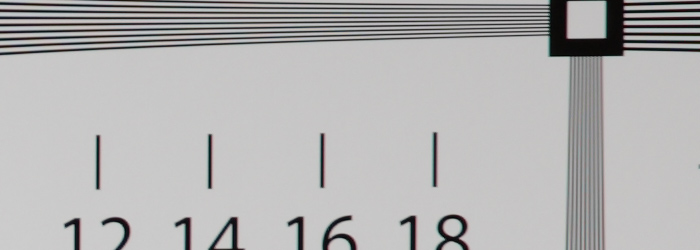
Now, with the Canon 2X TC III


Its pretty obvious what the best TC does to the images from the lens indicated by the OP.
Upvote
0
The TDP iso chart tests are just what we want for comparing the 70-200 mm with a 2xTC at 400 mm with say the 100-400 mm at 400 mm. But, the pair you show compares the 70-200 mm with the 2xTC at twice the distance from the chart as the same lens without the TC. What we also want to know is it worth using a TC compared with the native lens. To answer this, elsewhere in the TDP site he compares the same lens at the same distance from a target (a flower) with the lens plus 1.4xTC and 2xTC. In each case, the image without the TC is rezzed up to the same pixels as with the TCs, and the TCs give better images.
I have done the same tests with my 3 TCs and a variety of lens. For the 300 mm series II with the series III TCs, the combos are better than the rezzed up native lens, just as on the TDP site. So, I use the TCs whenever necessary. But, for the 100-400 mm, the addition of a 1.4 TC is no better than rezzing up the native 1.4x. So, I leave the TC at home for that lens.
Now do you see what I am getting at.
I have done the same tests with my 3 TCs and a variety of lens. For the 300 mm series II with the series III TCs, the combos are better than the rezzed up native lens, just as on the TDP site. So, I use the TCs whenever necessary. But, for the 100-400 mm, the addition of a 1.4 TC is no better than rezzing up the native 1.4x. So, I leave the TC at home for that lens.
Now do you see what I am getting at.
Upvote
0
I used the Canon 1.4 II and the Kenko DGX MC4 1.4x with my 300 4L IS and my 70-200 4L IS.
The result is pretty much the same. Contrast ist missing. Images get hazy.
I also tried a KENKO MC7 DGX 2.0x once, but this was not acceptable.
Finally 1.4x does not give enough magnification and 2.0x creates unacceptable results.
So I stopped using TCs and started using crops from the original images.
The result is pretty much the same. Contrast ist missing. Images get hazy.
I also tried a KENKO MC7 DGX 2.0x once, but this was not acceptable.
Finally 1.4x does not give enough magnification and 2.0x creates unacceptable results.
So I stopped using TCs and started using crops from the original images.
Upvote
0
Here are the links to the TDP TC reviews with the great Canon primes;
http://www.the-digital-picture.com/Reviews/Canon-Extender-EF-1.4x-III-Review.aspx
So, if you are stuck at 100 m from a bird or a flower, then you will get better IQ by adding a TC to the high quality lens. So, in this case the TC increases IQ.
If, on the other hand you can stand anywhere you want, you will get better IQ by moving closer and removing the TC. In this case, the TC lowers the IQ of the same lens.
For Yablonsky's two zooms and for my 100-400 mm L, the IQ is decreased to the extent it is lowered at all distances.
http://www.the-digital-picture.com/Reviews/Canon-Extender-EF-1.4x-III-Review.aspx
So, if you are stuck at 100 m from a bird or a flower, then you will get better IQ by adding a TC to the high quality lens. So, in this case the TC increases IQ.
If, on the other hand you can stand anywhere you want, you will get better IQ by moving closer and removing the TC. In this case, the TC lowers the IQ of the same lens.
For Yablonsky's two zooms and for my 100-400 mm L, the IQ is decreased to the extent it is lowered at all distances.
Upvote
0
I agree with Alan F, the question posed has to wide a gambit. An extender on a lens such as the 100-400 will degrade IQ. If the native lens has flaws this will be replicated with the addition of an extender. On my 300f2.8mkii the addition of the new 1.4mkiii extender does not degrade image quality, I am constantly amazed at the images this combo can achieve. I have yet to try the new mkiii 2 x extender.
From a personal point of view I think to much is made of so called bench tests, yes they have their place but real world photography is where it counts. Wherever possible I will always use a sturdy tripod when mounting long lenses and extender, whilst I may loose some control over composition, images in the main tend to be very sharp.
I have recently conducted some tests where I have compared the 300/1.4 combo mounted on a tripod as well as hand held at shutter speeds exceeding 1/2000 of a second. The images taken with the help of the tripod always look sharper.
So many people complain that their images are not sharp and has poor IQ, they blame the equipment, the environment but never themselves. If my images are poor then it is my technique that needs to be looked at and not the equipment used.
From a personal point of view I think to much is made of so called bench tests, yes they have their place but real world photography is where it counts. Wherever possible I will always use a sturdy tripod when mounting long lenses and extender, whilst I may loose some control over composition, images in the main tend to be very sharp.
I have recently conducted some tests where I have compared the 300/1.4 combo mounted on a tripod as well as hand held at shutter speeds exceeding 1/2000 of a second. The images taken with the help of the tripod always look sharper.
So many people complain that their images are not sharp and has poor IQ, they blame the equipment, the environment but never themselves. If my images are poor then it is my technique that needs to be looked at and not the equipment used.
Upvote
0
wdh777 said:I'm considering getting a 2.0 teleconverter for my 70-200 2.8. Other than going to 5.6 does it also reduce the iq? Thanks I'm still learning here.
1 A TC reduces the IQ systematically because it blows up the image of the naked lens by a factor of 2 (for a 2x converter you are considering) - lens flaws are scaled too. The upscaling by a factor of 2 means that the same light is distributed to a 4 times larger area reducing in 2 stops light reduction.
2 A TC introduces additional glas elements and reflects/scatters light. Modern zooms have 10-20 lens groups, the 4-6 lens groups of a TC will have some effect in this department, but it will be moderate.
3 Some TCs are co-optimized with one ore a few lenses. I am shure that Canon optimizes them for the 2.8 300 and the 2.8 400 lenses and that different TC series are optimized for the corresponding lens series. If you have an old 2.8 300 the 2x TC of the first series MIGHT match better.
I have the 2x TC version I (170 bucks 2nd hand) and it works well with my 4.0/70-200 L 4.0 non-IS and the 5.6/400. I decided to get the 5.6/400 because it's IQ is very fine from f/5.6 and I have a longer reach with TC.
Best you can do: Try your telezoom with a 2x TC (optimum: I + II + III series) and check the results for YOUR PHOTOGRAPHIC APPLICATION)
ADD (just seen): Kerry B's remarks about the 300 support my 3rd point!
Upvote
0
bycostello said:every extra bit of glass will reduce iq
O.k. so I will put my eye glasses down ... asüdü aüfbis fiasbfsl lxc ... no, with eye glasses IQ is better and I see what I am typing!
Upvote
0
L
Loswr
Guest
mb66energy said:bycostello said:every extra bit of glass will reduce iq
O.k. so I will put my eye glasses down ... asüdü aüfbis fiasbfsl lxc ... no, with eye glasses IQ is better and I see what I am typing!
LOL. Ok, now put on two pair of glasses. Is that better than one?
Upvote
0
- Status
- Not open for further replies.
Similar threads


- Replies
- 2
- Views
- 486
