What does a teleconverter do for you if you wish to resolve fine details on a distant object?
The point that I am trying to make is that unless you have a really sharp lens, you are better without teleconverters.
My past experience is that using a crop body, if you have an ultra-sharp lens (like the series 2 big whites) a teleconverter will improve your resolving power, if you have a sharp lens (quality of 70-200F4) it is neutral, and if you have a soft lens it will hurt you.
The test is to capture photos of a small bird from 25 feet away. Since I can not get a bird to pose for me as I change lenses, I substituted a bird sized stuffed animal. All shots were cropped to the same portion of the bird's head and all images resampled to 500 pixels wide. unfortunately, I do not have a "big white" at home so that part of the test is left out... so the sharp lens used is a 70-200F4 and the soft lens is a Sigma 120-400F5.6. To make things interesting, a SX50 was thrown in as well.
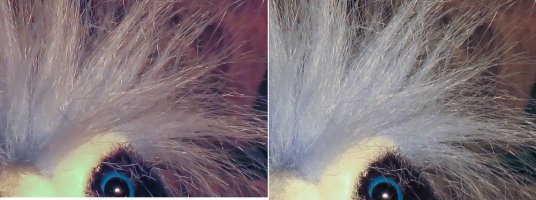
The first pair of pictures is the SX50 at 50X zoom and then at 200X zoom (digital zoom enabled).
The second trio of pictures is of the 70-200 at 200mm, with a 1.4X teleconverter, and then with a 2X teleconverter. The third trio of pictures is of the 120-400 at 400mm, with a 1.4X teleconverter, and then with a 2X teleconverter.
In the first set, we find the image with digital zoom turned on is better than without. This came as a surprise to me as I had always assumed that digital zoom was an evil to be avoided......
In the second set, we see that the addition of the 1.4X teleconverter makes the image slightly better and that the 2X teleconverter makes things worse.
In the third set the teleconverters just degrade the images.
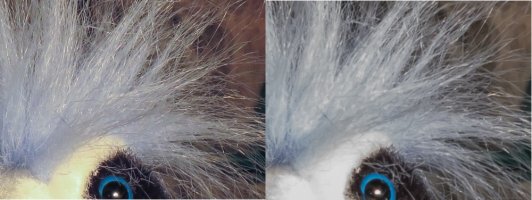
Something particularly important here is that a sharp 200mm lens provides more detail of that distant object than the soft 400mm lens.... but the most shocking conclusion is that a p/s camera (the SX50) can out-resolve both.
The last picture is the SX50 at 200X on the left and the 70-200 at 200mm on the right....
The point that I am trying to make is that unless you have a really sharp lens, you are better without teleconverters.
My past experience is that using a crop body, if you have an ultra-sharp lens (like the series 2 big whites) a teleconverter will improve your resolving power, if you have a sharp lens (quality of 70-200F4) it is neutral, and if you have a soft lens it will hurt you.
The test is to capture photos of a small bird from 25 feet away. Since I can not get a bird to pose for me as I change lenses, I substituted a bird sized stuffed animal. All shots were cropped to the same portion of the bird's head and all images resampled to 500 pixels wide. unfortunately, I do not have a "big white" at home so that part of the test is left out... so the sharp lens used is a 70-200F4 and the soft lens is a Sigma 120-400F5.6. To make things interesting, a SX50 was thrown in as well.
The first pair of pictures is the SX50 at 50X zoom and then at 200X zoom (digital zoom enabled).
The second trio of pictures is of the 70-200 at 200mm, with a 1.4X teleconverter, and then with a 2X teleconverter. The third trio of pictures is of the 120-400 at 400mm, with a 1.4X teleconverter, and then with a 2X teleconverter.
In the first set, we find the image with digital zoom turned on is better than without. This came as a surprise to me as I had always assumed that digital zoom was an evil to be avoided......
In the second set, we see that the addition of the 1.4X teleconverter makes the image slightly better and that the 2X teleconverter makes things worse.
In the third set the teleconverters just degrade the images.
Something particularly important here is that a sharp 200mm lens provides more detail of that distant object than the soft 400mm lens.... but the most shocking conclusion is that a p/s camera (the SX50) can out-resolve both.
The last picture is the SX50 at 200X on the left and the 70-200 at 200mm on the right....