

Oh yes, I miss that so much!Of course, I do miss the AFMAing of my DSLR lenses to get spot on AF.
Upvote
0
Oh yes, I miss that so much!Of course, I do miss the AFMAing of my DSLR lenses to get spot on AF.


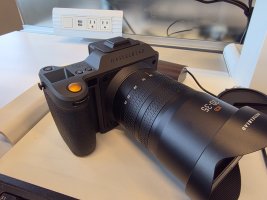


Have fun!. But surely, after spending your money on your new Hassy, Canon will announce the RF 35mm f1.2 L in a few daysIn the meantime, as mentioned time ago...
I've bought another important camera
Well maybe it is not that important, but it is definitely the most beautiful camera on the market nowadays
Now will have to slowly migrate the lenses
 .
.

AFMA...oh my God! That alone was worth it for me...and spot on focus.Maybe for you if you are not using the major technological advantages. For me, the IQ of the R5 is far better, and the AF is a completely different league for nature photography, being faster to latch on, tracking and subject recognition, far higher frame rates etc. I would strongly recommend the upgrade to the R5, which is now very cheap, or the more expensive R5ii for state of the art.
Of course, I do miss the AFMAing of my DSLR lenses to get spot on AF.
AFMA...oh my God! That alone was worth it for me...and spot on focus.
AFMA!
I've never done AFMA with my DSLRs... there must be something wrong with me!
It was so wonderful having to AFMA all my lenses every few months on at least 2 different bodies. Such fun spending hours trying to achieve a precise focus!
Thinking of how lucky I'd be in a few months while doing it over and over again...What shall I do with all my free time?
Thanks God, I still own a 5D IV!
Just eyesight! My EF 300mm f/2.8 ii required about 6-8 units, I recall, and according to the data accumulated by Reikan Focal, it was average for that lens. It was needed for most of my telephotos.I've never done AFMA with my DSLRs... there must be something wrong with me!
And with the telephotos, an extra two goes for each with the 1.4x and 2xTCs. The zooms also at wide and long as well. Still, you knew you were real macho when your lens were the sharpest.
It was so wonderful having to AFMA all my lenses every few months on at least 2 different bodies. Such fun spending hours trying to achieve a precise focus!
Thinking of how lucky I'd be in a few months while doing it over and over again...What shall I do with all my free time?
Thanks God, I still own a 5D IV!
For many many weeks, I was dissatisfied with the 24mm TSE, even though everybody spoke of it as a very sharp lens. I was still absolutely inexperienced when, for the first time, I heard of AFMA.Just eyesight! My EF 300mm f/2.8 ii required about 6-8 units, I recall, and according to the data accumulated by Reikan Focal, it was average for that lens. It was needed for most of my telephotos.
And yet I have tons of in focus photos taken with DSLRs.Just eyesight! My EF 300mm f/2.8 ii required about 6-8 units, I recall, and according to the data accumulated by Reikan Focal, it was average for that lens. It was needed for most of my telephotos.

I had a long play with a EOS R shortly after it was launched. I liked it a lot but it was too immature / beta for me to go "all in" with it and it felt like a toy in comparision to my 5DIII's. The Eos R was certainly groud breaking and a strong indicator of the direction that Canon tech was going. I supect that Canon were very aware of the EOS R's pro-sumer feed back and the camera's limitations and decided to go "all in" with the EOS R5. Canon rarely goes "all in", usually small incremental changes are their usual approach. Looking at the RAW bit depths at different shutter speeds, it's clear that Canon gave us a camera that was THE very cutting edge of their technology. The R5ii effectively is a polished R5. It's a camera that doesn't have throughput / processing limitations and is a more rounded camera. Cameras like the R6ii will never make this "best of list" because it's an evolutionary nature. Although compared to a R5, it's a far more effective, capable and rounded camera. In some respects, apart from the stacked sensor, the R6iii is a better camera that the R5ii. It is practically bufferless if you shoot CRAW and it can do 40fps in ES (with potential wobbles and artifacts). It can also do 12fps in 1st Curtain Shutter, whihc is only a little bit slower than the R5ii's max 20fps in ES. It's not a bad trade off. The R6iii is percieved as less glamourous because there were two cameras that preceeded it.I traded mine for an R5 back in September 2020. The R5 was the breakthrough body for Canon as it could take on Sony head to head for AF and tracking and beat it in for animal/bird recognition. I still have it alongside the R5ii. However, the images from my 5DSr are as good as get from the R5 under suitable conditions.
Curious: How does AFMA work for manual focus lenses like the TSE 24mm?For many many weeks, I was dissatisfied with the 24mm TSE, even though everybody spoke of it as a very sharp lens. I was still absolutely inexperienced when, for the first time, I heard of AFMA.
I AFMAed the TSE, 20 units, no kidding, and suddenly I had a sharp lens... Using this lens on an R5 is a dream, its focus help is very reliable.

could get a R6iii instead, but the differences between the R6ii are slight for my use case scenario.
Focus help didn't help until I AFMAed the 24 TSE.Curious: How does AFMA work for manual focus lenses like the TSE 24mm?
I had the same issue with a Zeiss Classic (Makro Planar 50mm), until AFMAed.Focus help didn't help until I AFMAed the 24 TSE.
I don't understand. AutoFocusMicroAdjustment helps with adjustment to improve autofocus. TSE is manual focus by using the ring. You can use the LCD and magnify to get the manual focus very precise.Focus help didn't help until I AFMAed the 24 TSE

I believe that @Del Paso is referring to the ‘focus confirmation’ icon in the viewfinder. However, I have found, and I think Canon also confirms that the focus confirmation is not in itself accurate for precise focus on manual lenses. Not that an f/3.5 24mm lens would fall into the same category of required accuracy as say an 50mm f/1.8I don't understand. AutoFocusMicroAdjustment helps with adjustment to improve autofocus. TSE is manual focus by using the ring. You can use the LCD and magnify to get the manual focus very precise.
Both the Canon EOS R and the Nikon Z7 were stopgap cameras to get into the FF MILC market. The Nikon was its D850 and Canon its 5Div without mirrors. The nature photographers advised to stick with the parent DSLRs as the mirrorless had poorer AF for tracking. @neuroanatomist, I recall, wrote early on it was difficult to track a bird in flight with his R. Sony was far ahead. It wasn't until the R5 that Canon became competitive. I appreciate your comments as a working pro about the R6ii and the R5. (It took Nikon until a year after the R5 to introduce the Z9 with first rate AF and subject recogntion and a further 2 years to bring out the Z8 of similar size to the R5.)I had a long play with a EOS R shortly after it was launched. I liked it a lot but it was too immature / beta for me to go "all in" with it and it felt like a toy in comparision to my 5DIII's. The Eos R was certainly groud breaking and a strong indicator of the direction that Canon tech was going. I supect that Canon were very aware of the EOS R's pro-sumer feed back and the camera's limitations and decided to go "all in" with the EOS R5. Canon rarely goes "all in", usually small incremental changes are their usual approach. Looking at the RAW bit depths at different shutter speeds, it's clear that Canon gave us a camera that was THE very cutting edge of their technology. The R5ii effectively is a polished R5. It's a camera that doesn't have throughput / processing limitations and is a more rounded camera. Cameras like the R6ii will never make this "best of list" because it's an evolutionary nature. Although compared to a R5, it's a far more effective, capable and rounded camera. In some respects, apart from the stacked sensor, the R6iii is a better camera that the R5ii. It is practically bufferless if you shoot CRAW and it can do 40fps in ES (with potential wobbles and artifacts). It can also do 12fps in 1st Curtain Shutter, whihc is only a little bit slower than the R5ii's max 20fps in ES. It's not a bad trade off. The R6iii is percieved as less glamourous because there were two cameras that preceeded it.
I use two camera bodies, I don't have a main camera and a dusty unused spare, I need two fully functional and capable cameras. So what prevented me from getting a R5 was the cost of two bodies. It was really expensive and I would need two. The original R6 was a bit too low rez for me and a bit too R5 lite for my needs.
However, for me, the R6ii was a totally different story. The R6ii was a camera I could afford multiples of. I chose a late model R5 as my 2nd camera to see what all the R5 fuss was about. Now that I have a R6ii and a R5, I can say that I really like the R5. However, the R6ii is a superior camera in nearly every regard except for peak resolution. The R5 is certainly great fro cropping more, but a lot of my photography I try to get right in camera. Sure, my birding and wild life stuff helps to have tha ability to crop in more. For me, my R6ii is my primary camera and my R5 is my higher resolution camera that I generally put a prime on so I get to use lower iso > better DR. That's mainly because the AF in the R5 seems to respond better to more light hitting the sensor. The AF in my R6ii is way better in lower light. I also like the colour science / WB a lot more with my R6ii. I'm sure that when I upgrade my R5 to a R5ii (later this year) I will see a dramatic improvement in the AF, I get things like pre-capture and the joys of the stacked sensor in ES. But again, it's an expensive camera and i ca't afford a pair of them. I could get a R6iii instead, but the differences between the R6ii are slight for my use case scenario.


