stevelee said:Several thoughts:
The histogram you see on the screen is based on the theoretical resultant JPEG rather than the linear RAW file, so it is difficult to judge how to adjust the exposure, particularly ETTR, from that readout. In a very low contrast situation, though, you can probably get away with it. I think there is a lot of value in trying things and gaining experience, the more of which you have with your particular camera, the better your judgment of what you can get away with should become.
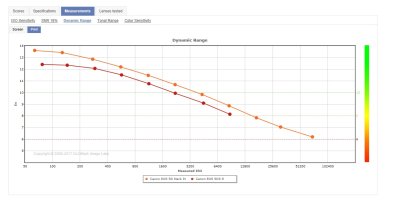
I have read that ETTR is pointless except at base ISO. That might not be quite literally true for near-base settings, but maybe it is. Anyhow, if ETTR means you are doubling the ISO and quintupling the noise, then you've introduced a lot more problems than you've solved.
My experience has been that if there is any information at all in any channel of the brightest parts of the scene, then the Highlights slider in ACR (and presumably the same in LR) does a good job faking details in the other channels. The main need I've had for this, as I recall, is when I want some detail in clouds. Moving the slider way to the left can make the sky look downright threatening sometimes, which is vastly beyond the tweaking I need. So for my purposes, highlight recovery usually works better than boosting the shadows more than one stop. I'm usually not interested in bringing out the spider webs in the dark corners for interiors, and indeed I find too much attention to insignificant detail to be more of a distraction in the picture. I do however like to have detail in windows, particularly stained glass, while giving a good view of architectural details. The Highlights slider is usually not sufficient for that, for me anyway, so I shoot separate exposures for the windows and merge, such as in this picture of a chapel in Edinburgh, shot with my G7X II. I preferred the as-shot convergence over a corrected perspective. My goal is usually to make the picture look like what I saw when I was there. This printed up nicely on 13" x 19" paper, and I plan to frame it to hang in my hallway gallery when I get around to it.
Once you've been shooting Canon for sometime you understand it has highlight detail more than shadow and you expose with that in mind. I do, and I too recover.
I have been shooting Canon for about 10 years, currently using the 5Dm3 and just a year or so ago I purchased the A7RII and a Metabones adapter for my Canon lenses. I also shoor Phase One MF digibacks.
I have to say I love this Sony sensor without AA filter.
I have to say I hate this Sony smartphone.
Now if Sony ironed out the delay and lag in Mode changes, and startup time, and some of the glitchy behavior I have had (And it took a LONG time for them to make a firmware update to address a number of glitches), I would say Canon has their plate full to meet or beat the A7R3. They took care of the battery, so...
I will say the mechanical reliability is my strongest pull towards Canon.
The rest falls mostly on what you shoot.
Product: its not hard to pick the mirrorless Sony or a Phase One. which is what I shoot.
Landscape/Architectural: its not hard to pick the Sony again.
Events: This is Canon reliability, and a slight risky path for Sony shooters.
Portraits: Either one would be fine
Sports: Either one or Sony perhaps.
mirrorless makes focus MUCH nicer for the strong points above.
The sensor needs all AA removed, not a effect. It gives more 3D dimension and sharpness. Also, the way the Sony renders is really nice. I don't know if Sony makes the MFormat sensors that Hasselblad and Phase One use in their 50mpixel backs, as they ARE Sony sensors, and I do like they way the images expose.
But, its often left to indoor still use sometimes, and takes a back seat on event shoots.
Upvote
0