The Canon EOS R7 Mark II is Getting Closer

The R7 manual has a paragraph “Shooting Conditions That Make Focusing Difficult” that contains: “Subject with low-contrast such as the blue sky, solid-color flat surfaces or when highlight or shadow details are clipped” and “Extremely small subjects” that might apply, but that is not explicit about photographing birds in flight. Depending on the size of the bird in the image, one would expect the AF to focus on the bird.

See: https://cam.start.canon/en/C005/manual/html/UG-05_AF-Drive_0070.html
You are correct, I had that footnote not correctly in my mind, thank you. But I did frequently experience focusing problems in certain light conditions, in particular with overcast skies, less with blue skies, and with birds getting close enough to fill a substantial part of the image frame (usually I want to have a birds head really sharp, not other body parts). I found out that focusing improves much when I switch off eye recognition, this seems to irritate the AF system sometimes. Plus, with a long lens such as my EF 600mm it is really important to switch to 16m closest distance for typical BIF settings, because if the R7 misses the object, it tends to drive the focus to the closest distance. Then, the bird is potentially so blurred that it is no longer recognizable for the system and it completely loses any track of it. In fact, it would be great to have an additional option in which you could switch between the two directions the AF system can move when seeking an object: "infinity" or "closest distance".
 
Upvote 0
It obviously means something on the R5ii level of specs with an APS-C sized sensor. And he says that the details are not yet known.

I take it to mean similar control layout and menu arrangement, like the 5D Mark II and IV were compared to the 7D Mark II. Swapping from either of the 5D III or IV to the 7D II was seamless. A time or two I've even caught myself shooting with my 70-200/2.8 mounted on the 5D III thinking it was the 7D II because I'd forgotten I had swapped the bodies on that lens the previous shoot. :D :ROFLMAO:
 
Last edited:
Upvote 0
I wonder if they will bring back battery grip compatibility? Any 7 series should definitely have that option in my opinion.

It will be interesting to see how much faster and improved the new sensor will be over the almost 6 year old sensor in the 90D/M6 II/R7.

Hopefully version 1 of the firmware is not too buggy, they need to get a wide variety of real photographers shooting different subjects to test it out before release.

I definitely would want a way to use vertical controls. My worn out right shoulder makes it difficult to shoot vertical with the main controls.

As for a wide variety of use cases, though, that's not so much a concern for me.

I use 7-Series cameras to shoot field sports or other subjects that require shooting from a good distance with a 70-200/2.8 while also using a FF body with a wider lens in a two camera setup. The APS-C body plus 70-200/2.8 works better for me than a FF body with a 300/2.8. I used a Sigma 120-300/2.8 on both FF and APS-C strictly for field sports for a while, but got tired of the bowling ball weight on the end of my monopod. When I stopped shooting football after 15+ years I sold the heavy lens.
 
  • Like
Reactions: 1 user
Upvote 0
Diffraction kick with sensor of 32.5 megapixels of resolution is f/5.2

Ultimately it's about pixel pitch, not sensor resolution.

A 32.5MP APS-C sensor with pixel pitch of 3.2 µm has a DLA of f/5.2.

A 32.5MP FF sensor would have a larger pixel pitch of 5.12 µm and a DLA of around f/8.3.

An 83MP FF sensor will have the same DLA as a 1.6X APS-C 32.5MP sensor because both will have the same 3.2µm pixel pitch. Diffraction is based on the mechanics of the way photons vibrate in waves as they move through space. At the DLA diffraction will only be detectable when viewing at 100% magnification (one screen pixel set per one image pixel), so the difference in enlargement ratio to the same viewing size between FF and APS-C does not apply in the same way it does for considering depth of field. If an APS-C sensor and a FF sensor have the same pixel pitch, BOTH are being enlarged by the same factor to view at 100% on a monitor. It's just that the portion of the image seen from the FF sensor is a lower percentage of the entire image than the portion of the image seen from the APS-C sensor.
 
  • Like
Reactions: 1 user
Upvote 0
Agreed. Just want it to be a worthy 7DII successor. Lots of my stuff is fast flying aircraft, and the R7 loses focus way more than my 7DII. Also like the idea of an RF 15-85. Its my go to lens for static shots.

I miss going to airshows, but all of that walking is more than my old body can handle any more. Especially if it is in heat that is typical for most air shows.

When did go to them I used to put a telephoto zoom on my "long" APS-C body for the flying stuff and a 24-70mm on my "short" FF body for the static displays. I always felt there was too much dust flying around to change lenses at an air show.
 
Upvote 0
Theoretically true but has there been significant softening of images due to diffraction?
Sony has higher mp sensors for A1 for instance and it hasn't stopped them being used for professional sports/action shots.
Has diffraction been a big issue with 100/160mp medium format sensors for landscape shots? Although focus stacking is an option.

Diffraction only begins to be detectable at the DLA if one is viewing an image at 100% on a monitor. That is, one image pixel is displayed per monitor pixel group (one red, one green, and one blue sub-pixel). Apertures well beyond the DLA can be used and show additional detail on the edges of expanded depth of field before diffraction is noticeable at more typical display conditions.
 
Upvote 0
I've never personally understood the 7 lineup. If you exclusively shoot crop, seems you'd typically have less expensive lenses (most of the crop lenses are lower end). If you're using full frame lenses, surely you'd want a full frame camera? You can buy the R5ii, and crop to basically the same resolution and zoom as an R7 will give you. But on the days when you don't need that much crop, you still have full frame to take advantage of that expensive glass.

I get that some people do exclusively crop, and use full frame glass - they only shoot wildlife or whatever. But I would have thought the number who'd drop close to R5 money but not take that step and just get an R5 would be reasonably small.

I'm obviously wrong because the R7 sells quite well. I just don't really understand why.

You're assuming everyone only shoots with a single body. Many of us shoot with a two body (or more) setup for sports, concerts, and events.

I use FF for all of my wide angle and "normal" focal length stuff. Many of my shoots only involve FF cameras. (Those shoots typically involve fewer total frames than what I describe below)

I use APS-C for when I need more than 200mm at f/2.8. In that use case I'm almost always shooting with both bodies at the same time. Wide angle on FF body, telephoto on APS-C body. If the shooting environment is very dim, I'll use a 2nd FF body instead of the APS-C body with a telephoto prime , typically a 135/2 or 85/1.8, instead of an APS-C body with a 70-200/2.8 zoom. I'm also using a 35/2 or 50/1.4 on the other body instead of a 24-70/2.8.

For youth/high school/small college field sports at night and gym sports indoors, a 70-200/2.8 ($2,200) on an APS-C body ($1,700) make a whole lot more sense from a return on investment point of view than a 300/2.8 ($6,500) or even something like a Sigma 120-300/2.8 ($3,600) - which I once owned but got tired of hauling it around like a bowling ball on the end of my monopod - on a FF body ($3-4K). At 100% pixel peeping I could see the slight difference between the 7D Mark II + EF 70-200mm f/2.8 L IS II and the 5D Mark IV + Sigma 120-300mm f/2.8 | Sports, but once resized for web sized display, there's virtually zero difference. Well, except that the Canon 70-200/2.8 focuses a little more consistently than the Sigma 120-300/2.8 did.

Another advantage of using a considerably less expensive APS-C body with a less expensive telephoto lens for sports and action is that the high number of frames for a typical event are not putting high "mileage" on my more expensive FF bodies. This extends their life cycle in terms of years. At a Friday night football game I typically shot 2,500-3,000 frames between the pre-game stuff, game, and the bands at halftime. All but a couple of hundred of those were with telephoto lenses on an APS-C body. Most of the wider angle FF shots were during halftime. So I'm wearing out a 7D Mark II (roughly $1,600 when new) instead of a 5D Mark IV (roughly $3,400 when new) for what are typically less likely per shot frame to sell.
 
Upvote 0
My partner has an R6. We moved to it from the M6ii. The M6 was a great transportable camera with good image quality. The lenses were surprisingly good, and the overall kit was tiny. But she was never happy.

The R6 is a massive step up, and a big part of that is the lenses. The camera is good, the auto focus is a game changer for her (she photos her dogs a lot and was having focus issues). But the light that comes in the lenses is the difference - she has the 70-200L and a couple of primes. I rudely refused to also buy the 24-70 F2.8, so she has the 24-105 F4L. That was a stupid thing for me to do, because whilst it was cheaper, she doesn't like it and doesn't use it much - I should have just got her the 24-70 and been done with it. I'll end up buying it anyway, and then we'll have a spare 24-105F4.

And that's why I struggle a bit with the crop lenses, even in the Sigmas. The high end L lenses are just so much better. Sure, not everyone can afford them. But people who are buying an R7 presumably can - it's not a cheap camera.

Again, obviously that's not true of everyone, and there's a niche for it. I'm just still surprised at how big that niche is. If you're buying a few L lenses, particularly big ones like a 100-500, then most of your money is in the glass. Why would you pinch a few dollars on the difference between the R5 and the R7? It always seems to me that the R5 does everything the R7 does - but perhaps there's something you can do with an R7 that you can't do with an R5?

The R7 is 32.5MP.
The R5 and R5 Mark II cropped to APS-C are 17.6 MP.

You'd need an 83.2MP FF sensor to have the same pixel pitch as the R7.

The greater pixel density of the R7 allows deeper cropping without losing as much resolution. If one is shooting wildlife at a distance, when one never seems to have enough focal length, it's more about the number of pixels you can put on the bird than anything else.
 
Upvote 0
My hope is if it has no shutter, that it will do focus stacking, with flash like I believe the R5 mkII does, and the OM-D cameras. However, whilst this would give Canon kudos in the macro photography world they would ideally need a lens that goes to at least 2:1, like the OM 90mm macro. Okay, the RF 100mm does 1.4:1 (I still have the EF 100mm L). I'm also looking forward to better AF and proper pre-shooting. I'm not so interested in the R6 mkIII, unless it offers something fantastic over the R6 mkII, as I'd look to getting the R5 mkII in the future, if I wanted to update my FF.

Have you ever tried the MP-E 65mm 1-5X Macro? It tops out at 5X (5:1), though it only focuses at the MFD at any particular magnification.
 
Upvote 0
Couldn't agree more. My 7DmkII still serves better than my R7 in all respects despite all the attention it has has from Canon services. I still get focus lock for no reason and the eye focus feature does not work. Its fast - when it works but still needs improvement. Hopefully the R7mk II will really be the natural successor to the 7DmkII, like it should have been in the first instance. Canon could have and should have taken more time to iron out the bugs before releasing the R7 to begin with. A race to the bottom serves no one. My 7Dmk II has always been brilliant so maybe a mark III of that should have occurred as well way back in the day. Mirrorless is fine but EVF isn't. You cannot and will not beat an optical viewfinder ; don't care what anybody says. I have looked through all the high spec mirrorless cameras and still think optical is sharper, clearer and more accurate. The shutter changes I can appreciate as the mechanical shutter is atrocious and noisy. Whose daft idea was that to make it so loud? You would hope that by now Canon will have got the message about the myriad shortcomings of the Mk I and respond with a truly excellent R7MkII that IS a natural successor to the 7DMkII. We can dream eh?

I shot extensively with a 7D for several years, then replaced it with a 7D Mark II a few months after the II was released.

The 7D Mark II was what the 7D should have been. We can hope history repeats itself with the R7 Mark II.
 
Upvote 0
Specs sound nice and reasonable.
Let's see how many MP it will be in the end...
If you haven't noticed already, Canon isn't as much focus on megapixels as they are on performance. Don't expect them to compromise resolution for dynamic range and processing power especially in a camera aimed at spots and wildlife. Canon's best sporting/wildlife cameras outside of the R5 cameras are all low megapixels for that very reason.
 
Upvote 0
If you haven't noticed already, Canon isn't as much focus on megapixels as they are on performance. Don't expect them to compromise resolution for dynamic range and processing power especially in a camera aimed at spots and wildlife. Canon's best sporting/wildlife cameras outside of the R5 cameras are all low megapixels for that very reason.
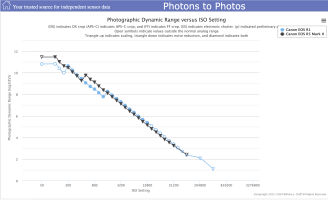
Resolution has minimal effect on dynamic range. Go to photons to photos and you will see this. Here is an example, which has been posted here many times. There is no compromise between dynamic range and number of mpixels on sensors of the same size.

Screenshot 2025-08-13 at 16.37.23.png
 
Upvote 0
The only thing i need from R7II if it can be true is more mp resolution and higher fps, i don't care about other things, and if i have to wish more then maybe i wish if it can be slightly larger sensor but not full frame, i mean APS-H, in the past i was using 1 series, there i only used full frame and APS-H, the only APS-C i have used were 350D and 30D, and both never have enough use at all once i bought 5D1 and 1 series, and i stopped photography since a while, so i am not demanding too much from previous bodies available currently, for example R7 and R8 and R5 and R5ii and R3 or R1 all of them outperforms anything i had in the past, and i won't do it again like it was yesterday, i want only to replace my 1DX/1D3 and Sony A7R for something new current generation, sure i won't get the least model and not most expensive as well, and i will try to go with a model that is about 1 year or less old released and not 2-4 years that is still flawless, when i buy something today i buy "Up-to-Date" release, i will wait and see what R7II and R6III will bring, and funny that i was waiting R7 and R6II in particular to be upgraded, R5II is already new alongside with R1 but i can't afford R1, and R3 is becoming old despite it is amazing for sports but i don't think i will get that over my 1DX unless i can sell my 1DX and 1D3 first.
 
Upvote 0
Resolution has minimal effect on dynamic range. Go to photons to photos and you will see this. Here is an example, which has been posted here many times. There is no compromise between dynamic range and number of mpixels on sensors of the same size.

View attachment 225549


Unless one is pixel peeping at 100%. Then the smaller sensels mean the image is being enlarged by a greater factor at "100%" viewing and thus noise is easier to see.

But yes, if images are viewed at the same normalized size from the same sized sensor and are from the same manufacturer/generation of technology, they'll have comparatively the same S/N ratio. Obviously in the example you showed, there's some different processing going on between ISO400 and ISO1600.
 
Upvote 0
Its APSC so like the 7D was a fast APSC version of the 5D so ye.

At the time it came out, the original 7D was supposed to be an APS-C version of the 1D Mark IV. It had mixed success at fulfilling that.

When the 7D Mark II came out in late 2014 it was supposed to be an APS-C version of the (2012) 1D X, which it largely succeeded in doing. But then the 1D X Mark II was released 18 months later in early 2016 and the 7D Mark II didn't compare as favorably to the 1D X Mark II as it did to the 1D X.
 
  • Like
Reactions: 1 user
Upvote 0