The danger of high resolution and sharpness

Don Haines said:
I think that this is my best digital picture... once again, not for technical reasons, but because of the three days of paddling and portaging to get there.... and because it evokes the memory of paddling on a mirror surrounded by fantastic fall colours.

shot with a 1.3Mpixel P/S camera.....
Beautiful shot Don :)

Your photo reminded me one of photos I took at Yulong River, Guilin, China - Quiet, Calm and relaxing ;)
_Y1C5849-X3.jpg
 
Upvote 0
You make a good point - a point that I and very few others on this forum have been trying to make for a while in response to the pixel peepers and techies. Most of what they want in each new camera generation is driven by advances in technology - in some cases, in my opinion, at the expense of photographic quality.

Many photographers will tell you that 18 or 20 MPs for a full frame camera are plenty - so why the "advances" to 50 MP or ultimately higher? Because the "techies" demand it. Even though the higher the MPs and the smaller the pixels, the harder it gets to get a sharp image. Even though, as an artist and art teacher for 35 years, I have learned that over abundant detail takes away from most compositions and is to be avoided. Would we enjoy the painted portrait if the painter painted every pore? I think not. Don Haines beautiful photo of China is a great example of how the larger shapes and masses make the photo - not the details.

The obsession over noise is a real mystery to me. Perhaps because I come from the age of film and we just accepted that some pics were "grainy." The techies pixel peep into the shadows and see noise and think that their Cameras are crap and the images not worth saving. It makes me sad. I want to shout out - "Why in the world are looking into the shadows in the first place?" You are missing the forest for the trees, so to speak. Look at the entire photo - not the noise!

Unfortunately, camera reviewers need (and want) hard numbers so they can compare cameras. Techies begin to believe that these measurable categories define what is important and what photographers should aim for. So they zoom in on noise, DR, resolution. None of those things would make my list of what makes a good photo. Composition, color, contrast, mood, subject matter is what makes a photo, in my opinion. To see those things, you look at the photo, not the pixels. Pixels tell you nothing.
 
Upvote 0
After all the recent Canon/Sony full frame camera discussion, people must be in a more reflective mood. Thom Hogan just posted an article on dslrbodies (see the Measurbators Conundrum) that echo a lot of the sentiments expressed in this thread. As for myself, I plan on using my 5DIII until the 5DV comes out (upgrade every other generation) as I don't foresee anything coming in the near term that I will view as a "must have." Having just said that, my plans are always flexible ::)
 
Upvote 0
I too like this thread. A bit like "Zen and the Art of Photography".

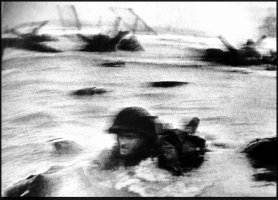
When I think of a single photo, I think of Robert Capa's photo of the Normandy landing:


This is the antithesis of "quality".
What makes it more incredible is the story about how the negatives were almost lost.

The problem with photographic "quality" (resolution, etc.) is that it is not free - it costs money to upgrade to the latest body. "Quality" in terms of composition, light, etc. is also not free - it takes time and location.
As Neuro noted, many of us are time limited.
I just upgraded my 5DII to a 6D. I deliberately chose not to get a 5DS at introductory price (not the least here in New Zealand!). The 6D corrects many frustrations I had with the 5DII and 20MP is fine for most of my needs.
I'll invest the $3k (NZD) in time and location. For trip to Antarctica.
 

Attachments

  • Capa.jpg
    Capa.jpg
    332.3 KB · Views: 231
Upvote 0
My problem is, I try to take pictures in every conceivable situation. I do a lot of photography where lighting is very tricky: concerts, theater, circus acts, etc... I shoot a Nikon D3s and a Canon 5D3 for these, but I can't help but think a 1DX would handle the low light or focus better in challenging light than these other cameras. I do portraits, and the 5D3 is great for those (although the 1Ds3 might be a smidge better), and when I need to take photos in a dark, quiet environment, the 5D3 is really the only game in town. For birds & wildlife in good light, my 7D2 is great, or in sports it's a great companion to my D3s. I'd just really love a good high-res landscape camera, and I think the A7r II would be perfect, and could use the best of both my Nikon & Canon lenses.

So, I use what I have, and fantasize about how much better those images might have turned out if only I had a better lens / body for the situation.
 
Upvote 0
Don Haines said:
Eldar said:
:P
msm said:
Nice shots Don!
Indeed! Proves my point, I think.

Kjetil Bjørnstad, a great Norwegian composer, musician, writer and music critique, reviewed Steely Dan's Gaucho (for those of you who remember that album. His headline was "The professional emptiness". You can listen through it for days, without finding a single note or tone out of position. But where is the soul?

And, Sporgon, it's easy to become philosophical in this place
It's not technical excellence that makes a great photo, it's how the image interacts with your soul. As an example, look at shadows... yes, more DR or HDR can bring out more detail in the shadows, but sometimes doing so ruins the mood or the feel of the image. Sometimes it is your imagination that makes an image great and bringing out the details ruins that feeling.

I agree with this in principle... but the second I click "print" most of the "soul" of the photo actually has to be in the digital bits, or the photo won't have much "soul" on paper. There's a lot to be said for technology improvement as far as the ability to preserve "soul" from the original photographic intent. I've participated in a few photography contests of late... most of which were won by photos so heavily manipulated that they don't even remotely appear to be something that could have occurred in nature. It's not really a photo at that point as much as it is a digital painting or a piece of graphic art. Both of which are perfectly fine media/presentation methods... just not in "photography".

Caveat: I'm looking to print my photos, usually at a high enough resolution to be able to share them as gifts in photo books, printed canvas, background images for 3D renderings for actual career work, etc... if your thing is archiving for personal libraries, sharing electronically via Canonrumors, flickr, facebook etc, then more power to you.

In no way am I taking away from the images you've captured. I'm merely stating that the image needs to stand the up to the test of why it was captured and it's true end-use. That may be simply to capture a memory in a rectilinear format. I get what you're saying - the subject, composition, depth of field etc are what the photo is about. A cameraphone can do this handily... can a 1DX do it better? almost definitely... but that's like saying what's the difference between 90% and 95% on the asymptotic and yet still infinite line of perfection. They're both pretty close... but one is closer.
 
Upvote 0
Good tools help you build a house. Some tools are completely necessary. But without knowledge, vision, and a design...it wouldn't be a very good house.

While I admit to being somewhat gear obsessed, I am reaching the point where I am almost "set" with my kit and am beginning to look for work shops and photo destinations as a better place to place to invest my money. But, I do not regret building a good kit. I am also sure I will occasionally buy something new or add to my kit. But I enjoy photography both for the art and practice itself, but also because it gives me another way to enjoy many other things I do. Hiking to the top of a mountain has more purpose if I am going to take a photo of a valley below at sunset. Photography both records and enhances the experience.

Good thread. Couldn't agree more with the overall sentiment.
 
Upvote 0
Eldar said:
But the picture is still a great picture. Firstly because the composition is good and secondly because it has great light. (It is very private, so you can´t see it ;) )

So the question is; Are we losing track of why we are doing this, in all this technical progression? Are we losing our ability to see a good picture in our strive for technical perfection?
It is at the point where you realize that gear is merely an enabler and that all good photos come from your own skills, artistic and creative talents, drive, passion and determination that you make the biggest leap in advancing your photography. I hope to get to that point one day myself. I think it would be very empowering.
 
Upvote 0
dilbert said:
I know what I'm after with more megapixels: more inches at 300dpi.

Having said that, 270MP is too much - somewhere between 150MP -200MP seems about right. 150MP is 4'x3' at 300dpi, 5'x3' is getting close to 200MP and 6'x3' is ~233MP. At 6'x4', 311MP is required. At 6'x4', the cost to print is getting a bit on the high side.

Since stitching is required, it is normal for there to be some loss in the process. Looking at one of the larger stitches I've done, over 270MP in raw images down to about 200MP stitched and closer to 120MP when ready to print.

Do you really?

The resolution in the final print depends a large degree on the size of the print. I look at images in NatGeo from about a foot or so away and need the images to be 300 dpi. A three foot image is not viewed from one foot distance, more like six feet. So it seems to me that there is a limit to the number of MP actually needed. And this seems to be way less than 200MP.

Sure there will be exceptions, but it seems that at some point there will be diminishing returns in terms of print resolution.
This is different from camera (sensor/lens) resolution that we tend to focus on.
 
Upvote 0
Some of my favorite pictures are blurry and go flat any bigger than about 5x7. It's all about the content and context with those.
Doesn't stop me from wanting to have equipment that doesn't handicap my creativity.
That said... counting down the hours for my turn to try a Phase One XF.
 
Upvote 0
msm said:
Eldar said:
So the question is; Are we losing track of why we are doing this, in all this technical progression? Are we losing our ability to see a good picture in our strive for technical perfection?

The way I see it, this forum is full of gear collectors obsessed with owning "the best" gear but not so concerned about taking the best picture. I shoot for fun and have no ambition of winning awards etc and I find it more fun with the right gear so I guess I am one of them...

+1, better gear helps but it doesn't necessary offer the best image. Composition and light use is what most of the people care rather than pixel peepers
 
Upvote 0
Eldar said:
So the question is; Are we losing track of why we are doing this, in all this technical progression? Are we losing our ability to see a good picture in our strive for technical perfection?

There is imaging as a science, and imaging as an art.

For some, "technical perfection" is really all you need and aim for. For example, if you're an astronomer, you're not really interested most of the time in pleasing and artistic images - although sometimes they work well to get more funds :) You really need to extract the last bit of data from an image, and ensure you can avoid, or at least identify, any artifact that may deceive you. The same may apply to other sciences, reconnaissance, surveillance, etc.

Then there is imaging as an art. Here what you're able to tell is more important than pure technical perfection. Sure, if you need to show your images 3mx2m or more. you need to ensure they still look good enough not to ruin what they say. But here the obsession with DR, noise, corner sharpness, etc. is probably going too far - although it's not anything new, it happened in the film era as well (fine grained development, zone system, Kodachrome vs. Velvia, etc.).

"Commercial photography" - fashion, advertising, art reproduction and the like, is probably something between the two extremes - you need a pleasant image, still you need enough "technical perfection" for proper and pleasant display, often on good "output devices".

I've read somewhere (IIRC, it was a Feininger book) most photographers go through three stage. Stage one is when you're trying to master the technique, so you're obsessed with it. Stage two is when you master the technique, and become obsessed with "technical perfection" - and often become obsessed with possessing the "best gear" to achieve it.
Stage three is when you become aware photography is a communication and artistic medium, and start to aim at expressing yourself through it (and sometimes - it's a thought of mine - became obsessed about it too ;) ). Some photographers skip stage two, others never leave it, and are the perfect target for photo gear marketing (there are also those who never leave stage one, sure).

IMHO stage two is not negative per se, even great painters went through a stage when they imitated previous great ones, and meanwhile sharpened their skills. Being able to master techniques may be important, and you may need to focus on it sometimes. Musicians too need to perform some boring exercises. Just, owning a Stradivari and a perfect tuning of it through an hi-res sound analyzer won't make you a good performer.

Yet if someone is happy collecting gear, buying/selling it, and peeping pixels, well, there are worse things you can do in life :) Simply ignore them, if you like.

I have a physicist education, and thereby I'm usually also interested in the technical side, that's why I follow this forum - it's fun, nothing more :) But I'm not worried at all the next yet-to-be-announced camera or lens will put my images to shame (technically speaking), so I need to avoid to take any image until I get it... ;D

 
Upvote 0
My father is an FIAPS, as well as being an accredited photo judge, and while he had excellent equipment, he often told me about many prize winning photograpers that just used very basic equipment - but they had a great eye for composition and light.
To me, a photo should evoke instant emotions, wether they be an inward breath, a smile or wonderment, but really, when looking at a photo, the dr, perfect focus etc. is NOT the first thing you see, or should see, when looking at a photo for the first time.
The instant impact that photo had on you is THE most important thing.
 
Upvote 0
I think its great so many people are agreeing with Eldar.
I'm sure there are quite a few more of us who would have liked to have been taking a panorama with a 5DSR and then discovering this too.
It think its good to be reminded every so often that the gear isn't everything.
Composition and Light are probably always the two most important aspects of a great photograph.
However the technology we have at our disposal these days is incredible.
It allows to recompose after capture by cropping and allows leeway to play with the light afterwards to get certain effects.
With photoshop you can almost create your own light because the camera capture so much detail and dynamic range. A few days ago there were a few people here helping with a question about how to learn a bit more about photoshop (layers , compositive, luminosity masks). The pointed me in the way of a few websites and Youtube videos.
What has amazed me is that some of the tutorials they are starting with such a flat looking file. Its sharp but the light very flat looking. They then create lighting effects within the photograph to create the image they are visioning. Often it's unrelated to the actual scene on the day.
For me still though there is nothing that beats the satisfaction of being in the right place at the right time with a beautiful light and capturing the scene straight out of the camera with no need for any processing. Those types of photos only need the very basic of gear (that wouldn't stop me wishing I had a 5DSR with me at the time).
 
Upvote 0
Hector1970 said:
What has amazed me is that some of the tutorials they are starting with such a flat looking file. Its sharp but the light very flat looking. They then create lighting effects within the photograph to create the image they are visioning. Often it's unrelated to the actual scene on the day.
For me still though there is nothing that beats the satisfaction of being in the right place at the right time with a beautiful light and capturing the scene straight out of the camera with no need for any processing. Those types of photos only need the very basic of gear (that wouldn't stop me wishing I had a 5DSR with me at the time).
Sometimes people shoot to create the perfect file in camera, others shoot a deliberately flat file knowing that they can push it in post if they can preserve the most amount of detail. Both are valid techniques. I agree with you though, being in the right place at the right time is great. Not only do you get to experience magic when you are there but every time you look at your image it'll remind you of those feelings.
 
Upvote 0
benperrin said:
Hector1970 said:
What has amazed me is that some of the tutorials they are starting with such a flat looking file. Its sharp but the light very flat looking. They then create lighting effects within the photograph to create the image they are visioning. Often it's unrelated to the actual scene on the day.
For me still though there is nothing that beats the satisfaction of being in the right place at the right time with a beautiful light and capturing the scene straight out of the camera with no need for any processing. Those types of photos only need the very basic of gear (that wouldn't stop me wishing I had a 5DSR with me at the time).
Sometimes people shoot to create the perfect file in camera, others shoot a deliberately flat file knowing that they can push it in post if they can preserve the most amount of detail. Both are valid techniques. I agree with you though, being in the right place at the right time is great. Not only do you get to experience magic when you are there but every time you look at your image it'll remind you of those feelings.

I don't think that is what hector is saying. I believe he is referring to a flat lit scene (ie a flat cloudy day with no relief) and then adding specific light and shade, saturation and non saturation etc etc to areas of the picture to make it look as if it was actually lit this way in the first place.

This gets into the 'ethics' minefield. The scene was not actually like that when the photographer pressed the shutter. But then neither is the contrast and colour that we put into a picture anyway.

With a photograph, unlike a painting, people often want to trust that this is a 'true' representation of the actual scene, as you would remember seeing it. I think this is how National Geographic now describe their images. No artificial manipulation other than moderate curves, levels, saturation, so the scene is represented as you saw it. Obviously we didn't see an overcast scene and no sun as sun streaming through the clouds, lighting a distant hill, at least not unless we'd been smoking something we shouldn't.

Cutting different skies back in has the same 'ethic' questions over manipulation. Not a problem if you are just wanting to produce a picture, but for say National Geographic readers, they want to see the beauty of what was really there, at that point in time.
 
Upvote 0
Sporgon said:
I don't think that is what hector is saying. I believe he is referring to a flat lit scene (ie a flat cloudy day with no relief) and then adding specific light and shade, saturation and non saturation etc etc to areas of the picture to make it look as if it was actually lit this way in the first place.

This gets into the 'ethics' minefield. The scene was not actually like that when the photographer pressed the shutter. But then neither is the contrast and colour that we put into a picture anyway.
Yes you are probably right about that. I suppose the ethics point of view comes down to a question. Are you taking a photo or are you making art?
 
Upvote 0
Photography obviously means different things to different people, for me it's mostly about trying to preserve a moment in time and the essence of an experience, of course if a picture is so blurred due to shake or movement, or if it's just plain out of focus or under/overexposed then it can't do that, but beyond these things, how far do you take it? Nature isn't perfect- how many adverts do I see for programmes to airbrush portraits because people aren't happy with the natural human form?! Try hard enough and you can find fault with anything, but if that's what it takes for you to find fulfillment, well, that's your call I guess.

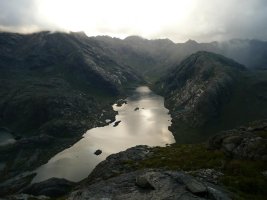
One of my favourite images, taken on a Lumix TZ3 compact, in the days before I had a digital SLR isn't technically great, the sky is blown out in the centre, it may be a bit dark for some people's tastes, it's a relatively low resolution jpeg, I would have used a wider focal length if I had it to use at the time, etc etc. But the image conveys at least something of what I experienced that magnificent day- the lighting, the majesty of what I saw, the toil that it was to walk/climb to this point and how knackered I was, and a pursuit that I love. In short, a memory, something that makes me want to return.
 

Attachments

  • CORUISK.JPG
    CORUISK.JPG
    129.4 KB · Views: 240
Upvote 0