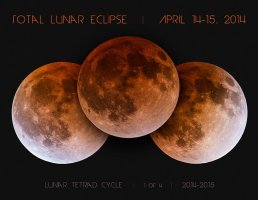
Total Lunar Eclipse - #1 of 4 - April 2014

jrista

EOL
Dec 3, 2011
5,348
37
33,651
jonrista.com
There are FOUR total lunar eclipses occurring over the next two years. Tonight is the first of the four. It starts at 1:58pm ET, 11:58 MT, and 10:58 PT. If you are planning on photographing the first lunar eclipse this year, share your photos here!

I'm aiming to get a full sequence of the entire eclipse, from the first penumbral dimming through totality and ending at the point the moon moves out of the penumbra (for me, that's from 11:58pm through 3:30am.)

For more details, see here: http://www.mreclipse.com/LEdata/TLE2014Apr15/TLE2014Apr15.html
For exposure tips, see here: http://www.mreclipse.com/LEphoto/LEphoto.html
 
jrista said:
There are FOUR total lunar eclipses occurring over the next two years. This is a very rare event. It's occurred twice last century, and before that it had not occurred for many hundreds of years. After this, four total lunar eclipses will not occur again for hundreds of years.

Tonight is the first of the four. It starts at 1:58pm ET, 11:58 MT, and 10:58 PT. If you are planning on photographing the first lunar eclipse this year, share your photos here!

I'm aiming to get a full sequence of the entire eclipse, from the first penumbral dimming through totality and ending at the point the moon moves out of the penumbra (for me, that's from 11:58pm through 3:30am.)

For more details, see here: http://www.mreclipse.com/LEdata/TLE2014Apr15/TLE2014Apr15.html
For exposure tips, see here: http://www.mreclipse.com/LEphoto/LEphoto.html

Good Luck. We've been having clear evenings, until tonight, that is. There are supposed to be breaks in the clouds that will let a person view the eclipse, but photos might be a problem, since it may be a short window before the storm hits us early AM.

I went out last night and tried several exposures, and verified a clear view was possible. Today, I pulled out my seldom used TC-80N3 and set it to take a image every 5 minutes, so I'll go out and set the camera, and just let it run, snapping a image every 5 minutes until its over, or I wake up tomorrow morning and turn it off.

I'll have to use a fairly wide angle lens to do that.

BTW, The next Tetrad happens in 2032-2033 which is 20 years from now, not hundreds of years. There are eight Tetrads happening in the 21st Century.

http://eclipse.gsfc.nasa.gov/OH/OH2014.html#tetrads
 
Upvote 0
Ah, looks like they come in cycles. There was a 300 year gap up through 1908. Looks like the total cycle time is 565 years, so we'll have a bunch for a couple centuries, then another lull. I don't know what I read before, but I'm not even sure it actually projected future cycles...I guess I just assumed that it was a rarer event based on the history of Tetrads.

Anyway, here is one of my shots, taken as the moon was entering the umbra:
 

Attachments

  • Entering the Umbra.jpg
    Entering the Umbra.jpg
    182.3 KB · Views: 503
Upvote 0
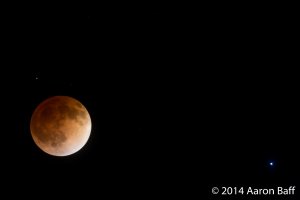
*sigh* I wish I had a real lens. I took mine with one of the Opteka mirror lenses. 800mm f/8, and it came with a 2x TC, so the closeups (all when the moon was starting to eclipse, so brighter) are f/16. I'm actually too embarrassed to shot the closeup that I took, although I haven't sorted through them all. So, here's one with a few stars around. I _think_ that's Mars in the lower right, although for some reason it's blue.
 

Attachments

  • 2014041500253-2.jpg
    2014041500253-2.jpg
    96.3 KB · Views: 474
Upvote 0
I think you did a great job, Drizzt! Especially considering you used an Opteka mirror lens, and at f/16!

BTW, the blue star is Spica, one of the key stars in the constellation Virgo. It's blue, rather than orange, simply because it isn't Mars. :P

The other star, I suspect, is 76 Virginis, assuming that your image is from the beginning of the eclipse rather than the end.
 
Upvote 0
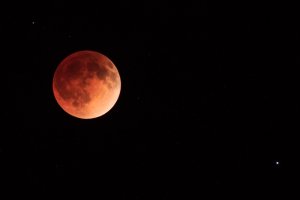
Here's one I took with my little Canon 55-250 lens. It's cropped down to about 1/5 the original resolution, then downsampled to post on the web. There's a lot of noise left in the moon at 100%, but the downsampled version is not too bad.
 

Attachments

  • IMG_6703.jpg
    IMG_6703.jpg
    164.7 KB · Views: 474
Upvote 0
jrista said:
Ah, looks like they come in cycles. There was a 300 year gap up through 1908. Looks like the total cycle time is 565 years, so we'll have a bunch for a couple centuries, then another lull. I don't know what I read before, but I'm not even sure it actually projected future cycles...I guess I just assumed that it was a rarer event based on the history of Tetrads.

Anyway, here is one of my shots, taken as the moon was entering the umbra:

That's beautiful shot jrista :)

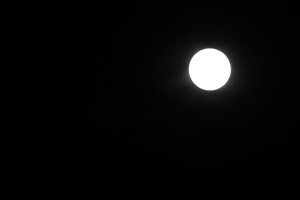
I have never photograph the moon before. Last night, I gave it a try. Result I got is "indescribable" :-\ :-\ :-\
 

Attachments

  • _Y1C6032.JPG
    _Y1C6032.JPG
    280 KB · Views: 433
Upvote 0
jrista said:
Ah, looks like they come in cycles. There was a 300 year gap up through 1908. Looks like the total cycle time is 565 years, so we'll have a bunch for a couple centuries, then another lull. I don't know what I read before, but I'm not even sure it actually projected future cycles...I guess I just assumed that it was a rarer event based on the history of Tetrads.

Anyway, here is one of my shots, taken as the moon was entering the umbra:

Nice shot! I wanted to play with the 600 and see what I could get... but it was SNOWING!!!!!!
 
Upvote 0
Dylan777 said:
jrista said:
Ah, looks like they come in cycles. There was a 300 year gap up through 1908. Looks like the total cycle time is 565 years, so we'll have a bunch for a couple centuries, then another lull. I don't know what I read before, but I'm not even sure it actually projected future cycles...I guess I just assumed that it was a rarer event based on the history of Tetrads.

Anyway, here is one of my shots, taken as the moon was entering the umbra:

That's beautiful shot jrista :)

I have never photograph the moon before. Last night, I gave it a try. Result I got is "indescribable" :-\ :-\ :-\

Derp. You need to use live view to dial in the exposure, or at least start with a pretty high shutter speed and work your way down to the point where the histogram just separates from the right-hand edge. For a full moon, you can start with 1/500th second, and work down from there. A full moon that is within the umbra, however, might need anywhere from 0.5s to 20s of exposure time...you just kind of have to experiment. It depends on how deeply within the umbra the moon passes (last night the moon passed through one edge of the umbra, missing the dead center, so it did not get as dark as it can...a total eclipse that passes right through the center of the earths umbra can get so dark as to be difficult to even see, like a new moon.)

Also, you have to make CERTAIN you are using Manual (M) mode...you can't really photograph the moon with any automatic modes, as there is simply too much contrast for evaluative metering to choose the right settings. Spot metering mode, metered off the moon itself, might do it, but it's still best to go full manual.
 
Upvote 0
I didn't get out last night to shoot the blood moon. I appreciate the photos I've seen so far. Glad I have a few more chances coming up.

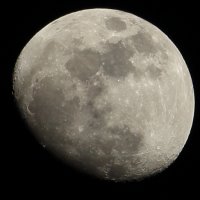
Here's one I took last month for practice using the M and 55-250 STM on a tripod at 250mm with manual focus and manual exposure. Its a 100% crop of an OOC image at ISO 100, f/11, 1/90, Daylight WB. I believe I spot metered off the moon to get in the ballpark, then dialed it in with manual and did some exposure bracketing.

Don't normally mount my EF lenses on the M, but this seems to be one case it does make sense. I plan to try the 70-200 f/4 with 1.4xIII and 2xIII one of these nights. Or the Tamron 150-600 when it arrives. I probably would have been out there if the Tamron had already arrived.
 

Attachments

  • IMG_2482crop.JPG
    IMG_2482crop.JPG
    174.3 KB · Views: 483
Upvote 0
jrista said:
I think you did a great job, Drizzt! Especially considering you used an Opteka mirror lens, and at f/16!

BTW, the blue star is Spica, one of the key stars in the constellation Virgo. It's blue, rather than orange, simply because it isn't Mars. :P

The other star, I suspect, is 76 Virginis, assuming that your image is from the beginning of the eclipse rather than the end.

Thanks, but that one wasn't at f/16, that one was just the lens itself so f/8. I never appreciated how much 2-stops of light could mean in the viewfinder!

The image is from near maximum totality (10-20 min before). I thought I had seen somewhere that Mars was going to be leading slightly below the moon last night. Ah ha! There's the image http://blogs.discovermagazine.com/outthere/files/2014/04/EclipseFinderChart.jpg from Discovery Blog. Reading it a bit more, looks like it was 10-degrees off from the moon, and 800mm gives a 3-degree field of view. So I couldn't have captured Mars :( Oh darn.

Maybe for the next tetrad I'll have the Tamron 150-600 with a 1.4x or 2x TC. Got to be much higher quality than the Opteka. Frankly, it'd be hard not to be.
 
Upvote 0
jrista said:
Dylan777 said:
jrista said:
Ah, looks like they come in cycles. There was a 300 year gap up through 1908. Looks like the total cycle time is 565 years, so we'll have a bunch for a couple centuries, then another lull. I don't know what I read before, but I'm not even sure it actually projected future cycles...I guess I just assumed that it was a rarer event based on the history of Tetrads.

Anyway, here is one of my shots, taken as the moon was entering the umbra:

That's beautiful shot jrista :)

I have never photograph the moon before. Last night, I gave it a try. Result I got is "indescribable" :-\ :-\ :-\

Derp. You need to use live view to dial in the exposure, or at least start with a pretty high shutter speed and work your way down to the point where the histogram just separates from the right-hand edge. For a full moon, you can start with 1/500th second, and work down from there. A full moon that is within the umbra, however, might need anywhere from 0.5s to 20s of exposure time...you just kind of have to experiment. It depends on how deeply within the umbra the moon passes (last night the moon passed through one edge of the umbra, missing the dead center, so it did not get as dark as it can...a total eclipse that passes right through the center of the earths umbra can get so dark as to be difficult to even see, like a new moon.)

Also, you have to make CERTAIN you are using Manual (M) mode...you can't really photograph the moon with any automatic modes, as there is simply too much contrast for evaluative metering to choose the right settings. Spot metering mode, metered off the moon itself, might do it, but it's still best to go full manual.

Will use your info on next shooting. Thanks
 
Upvote 0
I finally managed to get some processing on my images done. Out of 200 frames, I've picked 17 that encompass the total sequence from first shadow to last shadow. Still working on that composite. In the mean time, here is my Totality Triad composite, all spiced up:
 

Attachments

  • Total Lunar Eclipse April 2014 - Totality Triad CN.jpg
    Total Lunar Eclipse April 2014 - Totality Triad CN.jpg
    53.6 KB · Views: 448
Upvote 0
Dylan777 said:
That's beautiful shot jrista :)

I have never photograph the moon before. Last night, I gave it a try. Result I got is "indescribable" :-\ :-\ :-\

That pretty much looks just like what mine would have, except I didn't bother to try knowing how bad it would be. :-[

Thanks jrista for starting this thread, and any additional tips/tricks/how to's would be much appreciated! I have no delusions (or particular interest) in being a great astrophotographer, but it would seem that just a nice shot of the moon should be within reach skill-wise and equipment-wise for most of us with a little help from our friends here. Still 3 more chances!
 
Upvote 0
jrista said:
I finally managed to get some processing on my images done. Out of 200 frames, I've picked 17 that encompass the total sequence from first shadow to last shadow. Still working on that composite. In the mean time, here is my Totality Triad composite, all spiced up:

Well, that's mildly...freaking awesome! Can I buy a print of that off ya?
 
Upvote 0
thepancakeman said:
Dylan777 said:
That's beautiful shot jrista :)

I have never photograph the moon before. Last night, I gave it a try. Result I got is "indescribable" :-\ :-\ :-\

That pretty much looks just like what mine would have, except I didn't bother to try knowing how bad it would be. :-[

Thanks jrista for starting this thread, and any additional tips/tricks/how to's would be much appreciated! I have no delusions (or particular interest) in being a great astrophotographer, but it would seem that just a nice shot of the moon should be within reach skill-wise and equipment-wise for most of us with a little help from our friends here. Still 3 more chances!

Thanks!

I'm happy to share my expertise as well. I actually learned a few things myself last night. I'll put some more information together in another thread, so we can keep this one more of a "Share Your's" kind of thread.

Quick note on the other chances...while one or two of them will be visible from the US, for about half or so, the eclipse will occur at moonrise or moonset, so you'll really only be able to see about half of it...and it will be pretty low in the horizon. It's still definitely possible, but it will be tougher to get good detail, and you will have to be ready to go as soon as the moon rises (or well before it sets) to get the shots. For the fourth, I don't think it will be visible from the US at all, however if you live elsewhere, then check the times and dates and see if you'll get a good view.
 
Upvote 0