Total Lunar Eclipse - #1 of 4 - April 2014

mackguyver said:
jrista, you really have mastered astrophotography and these shots are amazing!

Thanks. I've been imaging the moon a LOT longer than I've been doing deep sky astrophotography, and I'm more of a master of the moon than I am of astrophotography. Maybe at some point I'll be as good with AP as I am with the moon, but at the moment, I'm still a noob compared to some astrophotography wizards.
 
Upvote 0
thepancakeman said:
jrista said:
I finally managed to get some processing on my images done. Out of 200 frames, I've picked 17 that encompass the total sequence from first shadow to last shadow. Still working on that composite. In the mean time, here is my Totality Triad composite, all spiced up:

Well, that's mildly...freaking awesome! Can I buy a print of that off ya?

Sure! I am actually trying to build a storefront site for my photography. I don't have it rolling yet, but I'll send you the link when I do. I guess I could do something ad-hoc, through paypal, if you really wanted a print right now. I use a nice high quality printer that can ship directly from print lab to my customers. Just let me know.
 
Upvote 0
Drizzt321 said:
Wow jrista! That's a really awesome triad shot! Well done sir.

What equipment do you shoot with? Especially which tripod head? I've got a decent enough Benro with ball-head, and it worked, sorta, but I kept wishing it was geared in some way or another to fine tune.

Thanks. :)

I used a Canon 7D, EF 600mm f/4 L II lens, but the equipment that really allowed me to get the kind of detail I did during totality was the Orion Atlas equatorial tracking mount. I did not have to jack my ISO way up to 3200 or 6400 to get images during totality...I kept it at ISO 100, tracked in lunar time, and simply increased my exposure times. At full moon, my shutter was 1/250th. At maximum totality, it was 8s to 15s. Since I was tracking the moon itself, I could expose for that long of a time without experiencing blur due to the moon transiting across the frame.
 
Upvote 0
Some great shots by Jrista and Slyham.

I have not had time to fully sort through the photos I took last night with my 800mm and the 150-600, but most of the ones taken during the full eclipse had too much motion blur. As the moon got darker, I just increased exposure time. This was a mistake. The moon moves rather quickly across the sky and the longer exposure introduced blur. On the small screen of the camera they looked deceptively okay, but when I downloaded them to the computer you could tell the moon had moved a good bit even during a one second exposure.

I just now did a little research on the issue and saw a web site which recommended that for lunar photography you should take 250 and divide it by the mm of your lens to get the maximum exposure time to avoid blur. See http://www.amlunsoc.org/photography.htm For my 800mm lens, that would be no more than a 30th of a second and about a 40th of a second for the 600mm. (this seems to be similar to the 500 or 600 rule applied to star photography) Or I could do it right like jrista and get an equatorial tracking mount. Unfortunately, I would also need Mr. Spock to help me operate it.

It is a good thing there may be a few more of these events coming up. Time to crank up the ISO and open up the lens if I am going to use the long lenses to photo the next one.

 
Upvote 0
jrista said:
Drizzt321 said:
Wow jrista! That's a really awesome triad shot! Well done sir.

What equipment do you shoot with? Especially which tripod head? I've got a decent enough Benro with ball-head, and it worked, sorta, but I kept wishing it was geared in some way or another to fine tune.

Thanks. :)

I used a Canon 7D, EF 600mm f/4 L II lens, but the equipment that really allowed me to get the kind of detail I did during totality was the Orion Atlas equatorial tracking mount. I did not have to jack my ISO way up to 3200 or 6400 to get images during totality...I kept it at ISO 100, tracked in lunar time, and simply increased my exposure times. At full moon, my shutter was 1/250th. At maximum totality, it was 8s to 15s. Since I was tracking the moon itself, I could expose for that long of a time without experiencing blur due to the moon transiting across the frame.

Ah yes, good old tracking mounts. Don't know if I'll ever get one, as I don't generally do much in the way of astrophotography (in which I include the Moon/ISS, etc). I suspect if I get into astro ever, I'll probably want to get a crop-sensor camera to get the higher density/narrower FoV.
 
Upvote 0
Lloyd said:
Some great shots by Jrista and Slyham.

I have not had time to fully sort through the photos I took last night with my 800mm and the 150-600, but most of the ones taken during the full eclipse had too much motion blur. As the moon got darker, I just increased exposure time. This was a mistake. The moon moves rather quickly across the sky and the longer exposure introduced blur. On the small screen of the camera they looked deceptively okay, but when I downloaded them to the computer you could tell the moon had moved a good bit even during a one second exposure.

I just now did a little research on the issue and saw a web site which recommended that for lunar photography you should take 250 and divide it by the mm of your lens to get the maximum exposure time to avoid blur. See http://www.amlunsoc.org/photography.htm For my 800mm lens, that would be no more than a 30th of a second and about a 40th of a second for the 600mm. (this seems to be similar to the 500 or 600 rule applied to star photography) Or I could do it right like jrista and get an equatorial tracking mount. Unfortunately, I would also need Mr. Spock to help me operate it.

It is a good thing there may be a few more of these events coming up. Time to crank up the ISO and open up the lens if I am going to use the long lenses to photo the next one.

Equatorial mounts are a lot easier to use than that. They sound very technical, but they are actually simple and elegant devices. All you would really need to do is use the hand controller, set it to lunar time tracking (vs. sidereal, which is the default used for stars), pick the moon to point, center (there is always a bit of pointing error), and start imaging. Once you set it, you can pretty much forget it. The only extra bit of work is the meridian flip...once the moon passes the meridian (from east to west crossing the imaginary "12 o'clock line" overhead), you need to tell the mount to goto the moon again, and it will flip the mount to the inverse orientation...then you can image for the rest of the night.
 
Upvote 0
jrista said:
Equatorial mounts are a lot easier to use than that. They sound very technical, but they are actually simple and elegant devices. All you would really need to do is use the hand controller, set it to lunar time tracking (vs. sidereal, which is the default used for stars), pick the moon to point, center (there is always a bit of pointing error), and start imaging. Once you set it, you can pretty much forget it. The only extra bit of work is the meridian flip...once the moon passes the meridian (from east to west crossing the imaginary "12 o'clock line" overhead), you need to tell the mount to goto the moon again, and it will flip the mount to the inverse orientation...then you can image for the rest of the night.

Jrista, you have failed to convince me that an attempt by me to mount the equator would in any way be seen as elegant. Plus, I live in Texas and such an act is probably illegal. I am also concerned that if I tried one of those meridian flips, I would end up in the hospital. Take care, thanks for the tips and keep posting those great photos.
 
Upvote 0
jrista said:
I finally managed to get some processing on my images done. Out of 200 frames, I've picked 17 that encompass the total sequence from first shadow to last shadow. Still working on that composite. In the mean time, here is my Totality Triad composite, all spiced up:


Beautiful image jrista. 8) Well done Sir!
 
Upvote 0
Lloyd said:
jrista said:
Equatorial mounts are a lot easier to use than that. They sound very technical, but they are actually simple and elegant devices. All you would really need to do is use the hand controller, set it to lunar time tracking (vs. sidereal, which is the default used for stars), pick the moon to point, center (there is always a bit of pointing error), and start imaging. Once you set it, you can pretty much forget it. The only extra bit of work is the meridian flip...once the moon passes the meridian (from east to west crossing the imaginary "12 o'clock line" overhead), you need to tell the mount to goto the moon again, and it will flip the mount to the inverse orientation...then you can image for the rest of the night.

Jrista, you have failed to convince me that an attempt by me to mount the equator would in any way be seen as elegant. Plus, I live in Texas and such an act is probably illegal. I am also concerned that if I tried one of those meridian flips, I would end up in the hospital. Take care, thanks for the tips and keep posting those great photos.

++
 
Upvote 0
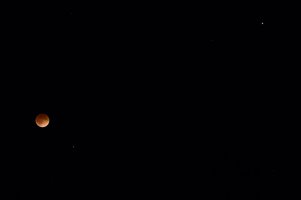
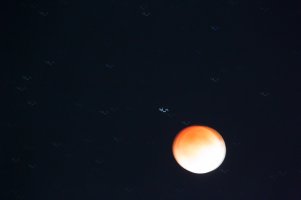
The bad. Let me know what you think is the cause of this. It only occurred on the 5diii with the Tamron 150-600. I don't think the tripod moved this much and I don't think it is from the shutter, but it could be. Most all of the Tamron ones exhibited this shake when I was taking longer exposures. The first one is really odd as it duplicated the shaken star all over the frame. The first was a 20 sec exposure and the 2nd was a 3.2 sec exposure. I had the Tamron version of IS on. I was also using the CamRanger to activate the shutter. Any thoughts?
 

Attachments

  • Lunar Eclipse Bad-1.jpg
    Lunar Eclipse Bad-1.jpg
    228.9 KB · Views: 396
  • Lunar Eclipse Bad-2.jpg
    Lunar Eclipse Bad-2.jpg
    138 KB · Views: 400
Upvote 0
That definitely looks like IS messing with your stability, Lloyd. You gotta turn IS off when doing astrophotography with a camera lens.

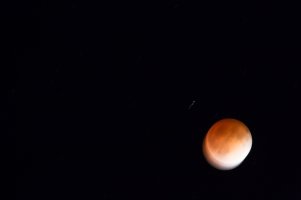
The good looks great! You got Spica and Mars along with the eclipsed moon. I was hoping to do that, but decided I didn't want to interrupt my imaging sequence to do it.
 
Upvote 0
Two more composites:

total-lunar-eclipse-april-2014-short-sequence-blog1.jpg


total-lunar-eclipse-april-2014-full-series-blog1.jpg
 
Upvote 0
Lloyd said:
The bad. Let me know what you think is the cause of this. It only occurred on the 5diii with the Tamron 150-600. I don't think the tripod moved this much and I don't think it is from the shutter, but it could be. Most all of the Tamron ones exhibited this shake when I was taking longer exposures. The first one is really odd as it duplicated the shaken star all over the frame. The first was a 20 sec exposure and the 2nd was a 3.2 sec exposure. I had the Tamron version of IS on. I was also using the CamRanger to activate the shutter. Any thoughts?

Possibly the VC. Tamron recommends you turn it off when using a tripod or long exposures. Try again with it off to see if that improves the images.
http://tamron.cdngc.net/inst/pdf/a009inst_1207_en.pdf
 
Upvote 0