Truth in photography

Status
Not open for further replies.
SFischer said:
One of my concerns with these more blatant modifications is that it cheapens the field of photography, and turns it into more of a field for those with the best graphics artists skills. Consumers and viewers of such art may become more jaded and question more and more geniune work from that in which the capture was "cheated" and not necessarily know the difference. More honest photographers trying to capture the real image and portray the scene as it appeared suffer from this type of abuse.

As a consequence of this today it is typical to see some photo contest or submission requirements state "no photoshop". But this type of blatant statement disregards the distinction between edits that I would define as addressing the limitations of the camera capture and edits that are simply creating a scene or composition that simply did not exist. Edits for addressing exposure, spot removal, color calibration, etc. are really no different than what was possible before in the dark room, albeit at a much higher level of quality and ease. At the risk of being accused of self promotion, I have written about that here (http://www.stephenfischerphotography.com/Commentaries/Limits_of_photoshop/Ethical_limits_of_photoshop.html) in the context of potentially using forensic techniques as discussed by Dr. Neal Krawetz in his blog: http://www.hackerfactor.com/blog/. But there is probably no point in such a dissection here, as it is already clear. It would be interesting to see more photo tool development go toward identifying such work, as I think that would be handy to help improve the "truthiness" in the field of photography.
Nice article. that shot of the birds is good I take it was yours? got some more details on the shot? camera lens aperture shutter speed etc? were you quivering with anticipation?
 
Upvote 0
Like good and evil, like light and dark, truth and non-truth coexist. Without one, there is no other.

This is just as true in photography as it is in Literature and journalism and philosophy and physics.

All photographs have truths, all have lies. How we interpret what we see determines where we draw the line.

All reality is simply what we percieve it to be. The purest image of what I see as reality is the light reflected off an object going directly into my eyes and interpreted by the brain. Even what our eyes see is not what the brain reports, even at the most fundamental level -- the eye sees everything upside down. I guess you'd call that the first RAW image. It's fundamentally unreadable without conversion.

For me, the truth of a photograph is the frozen moment. None of us sees everything that happens before our eyes in any given second (or portion of one). The photograph stops everything in that moment so my mind has a chance to catch up. I can look at a photograph for 10 full seconds if I like -- I can look at it for 10 minutes if I like. I can explore everything that was happening at that instant within range of the photograph's report.

The lie of the photograph is perhaps what happened the second before or the second after or what's hidden in the out of focus area or shadows. The lie can be what's not inside the frame. A picture of a man swinging a baseball bat may have outside the frame a baseball or another person. Who or what will take the hit?

Having worked in journalism, the first thing that occurs to me in this discussion is what you don't see. A photographer may make 500 images of a certain event. A photo editor determines what you, the reader, will see. So, perhaps 99% of the photo reporting is not seen. Does that make it a lie?

Like it or not, print publications alter images. They always have, and the Internet simply compounds the practice. I can't tell you how many times I bent over a light table looking at a color reversal image through a 10x loupe to make sure what was being published was what we wanted published.

Reality is only what we perceive it to be (and it's almost certainly not even that). Photography has a place in helping us determine our reality, but it has its limitations, as do all our discernment tools.

For me, I enjoy creating images and I enjoy viewing images. I give them the place I think they deserve on the truth/non-truth continuum -- and then I go on to the next image.

Maybe the next picture will be the one with real truth in it! The search goes on.
 
Upvote 0
Photography is a funny case, because it's an 'art form' yet it may be heavily criticized when people take 'artistic liberties' with the images they create, such as photoshopping or double-exposing or whatnot. Clearly these are unacceptable in photojournalism - where 'truth' really maters and is a cornerstone of the ethics of the field - but in any other area of photography? Who cares, it's art. The only commonly-accepted ethical principle in photography I see is that misrepresenting someone else's work as your own is a terrible thing to do.

However, lying about how you made an image is just silly. If you don't want people to know how you made something, don't say and let them guess or ponder it. That process of allowing your audience to wonder how something was created is part of photographic art and art theory. I think trying to create a false sense of authenticity by b.s.-ing about the methods you used to create something smacks of someone who should be selling penny stocks or used cars, not artwork.

Good discussion.
 
Upvote 0
"Reasonable Expectation"

It really comes down to the "reasonable expectation" test. Different types of photography create different levels of "reasonable expectation." I think I can better illustrate this with examples than with philosophical discourse

  • Model in advertising photo for clothing: it's reasonable to expect that the clothes would not be altered to deviate from reality, nor should the model's figure be altered; however, the model's complexion or hair could be altered.
  • "Car babe" model with car, in advertising for the car: as with the clothing example, the model could be altered, but not the car.
  • Wildlife: a photo of a Siberian Tiger ought not be marketed as having been taken in the wild with a 200mm lens when, in fact, it was in a zoo with a 600mm lens.
  • Photojournalism: as little as possible should be altered. Brightness, contrast, dodge/burn are OK so long as they don't misrepresent the actual event. Cloning or cut & patch is, in the words of the Pythons, "right out." Cropping is a hard question: merely by choosing a lens the photographer is, effectively, cropping. We cannot currently take instant panoramas, so selective framing is inevitable, giving a selective view of "reality" at that point. That being said, the photo should not be cropped (nor selectively framed) to misrepresent the actual event, nor with the willful or negligent effect of decreasing important context.
  • "Art" photos: (I use quotes because art is in the eye of the beholder). The basic rule of "do not misrepresent" is probably all we get here. Just as it is not acceptable to misrepresent a hand-drawn copy of a Michelangelo sketch as though it were the real thing, it is similarly not acceptable to misrepresent a composite as a single image, nor to misrepresent the conditions under which the image was created. Silence is acceptable, again though, to the extent that it does not misrepresent.
 
Upvote 0
OK

2 different animals

A Photograph is AN IMAGE taken by a camera and not significantly manipulated

A work of photographic ART, on the other hand, may combine several images, many different kinds of manipulation - it is NOT a representation of something REAL

The problem seems to be people wanting one to be the other and to force their opinions on others
 
Upvote 0
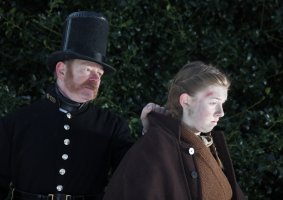
Here is a picture that I took over the weekend. First picture is cropped from 3:2 to A size (it is for a print) and small anount of level work.

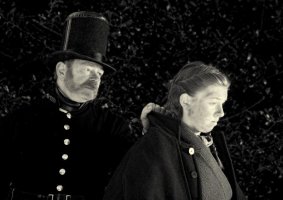
Second picture is the photoshopped version to monchrome and added grain to age it

So how far do we go? Of course neither are 'true' as it is done by actors.
 

Attachments

  • IMG_2743.JPG
    IMG_2743.JPG
    356.1 KB · Views: 445
  • IMG_2743x.jpg
    IMG_2743x.jpg
    51.3 KB · Views: 432
Upvote 0
briansquibb said:
Here is a picture that I took over the weekend. First picture is cropped from 3:2 to A size (it is for a print) and small anount of level work.

Second picture is the photoshopped version to monchrome and added grain to age it

So how far do we go? Of course neither are 'true' as it is done by actors.
yeah its not quite finished... what about adding a setting moon? ;)
 
Upvote 0
Status
Not open for further replies.