Dirzzt, in general I'd want a faster aperture for the money too, but if you look at the history of retrofocus (wide-angle) SLR lens design, you pretty much have two choices:
- modest aperture like f/2.8 (or f/3.5 in my 20mm Color Skopar), compact, and well-controlled distortion. Also not too pricey. I wouldn't be surprised at all if the construction of this new Voigt is almost identical to my "made in West Germany" C/Y Zeiss Distagon, which is also a 28mm f/2.8, razor-sharp wide open, & fits comfortably in a shirt pocket. Cosina makes them both now anyway...
- f/2 & faster lenses specifically designed for wide apertures, that are big, heavy, expensive, and have soft corners & more distortion (not to mention usually slower AF as they have a lot of glass to move around). Nice ones like the new mkII Canon Ls go a good distance towards controlling some of this, but you pay through the nose for it (not to mention size & weight).
The 40mm Canon pancake (& the Voigt 40mm f/2 Nokton pancake) are a completely different class of lens as they're not retrofocus & can't really be considered a wide-angle on full-frame. There's a room full of difference between 40mm & 28, and it wasn't that long ago that 24mm was considered ultrawide on FF...
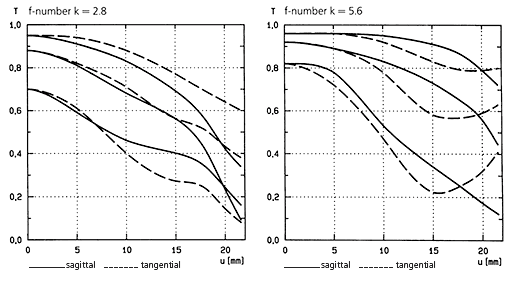
You can see it in Canon's new 24 & 28 designs too. They're both f/2.8 because they were optimizing for compactness and high IQ across the frame wide-open. Of course having IS comes at a price, but these things are pretty much L IQ & AF and close to L build (albeit without weatherseals). Again, looks a lot like my old Distagon. Even the MTF charts resemble each other fairly closely (the point I'm making is to look at the shape of the curves & distance between sagittal & tangental, not the raw numbers):

Fast wide-angle SLR lenses are a black art, & probably the hardest lenses to design as there are so many tradeoffs involved. I think this is one reason Fuji entered the mirrorless market with their own mount rather than continuing to try to make DSLRs or piggyback on someone else's system (I imagine that they considered μ4/3 but decided that the sensor wasn't big enough for them to go after the professional market, plus there are a lot more APS-C size fabs available). The Fujinon XF 35mm f/1.4 (which only costs $600) is so good & so cheap because the X-Pro 1 doesn't need retrofocus lenses. The XF mount has such a short registration distance that anything 18mm or longer can use a much simpler design, and that's a pretty decent wide-angle focal length on APS-C.



 Although the Zeiss lens would be quite nice to have, unfortunately not something I really can afford.
 . Honestly I like this place a lot more now that the Smite button is gone. <grin>
