What is the typical DR for following?

nc0b said:
In respect to the DR of the eye, age is certainly a factor. A few years ago three of us were in a car: me in my 60s, a father in his 50s and his son age 13. I was looking for 16th street, and was stopped at a traffic light. I said I cannot see a sign in the intersection. The 50 year old said he could see the sign, but he could not read it. The 13 year old said the sign says 16th street.
With all due respect, that sounds like a genetic, or, traffic, aberration.
Age has nothing to with sight. The two leading factors that have the greatest influence on vision, are, food quality and quantity, and the correct lighting conditions.

I once knew a very nice fellow, 109yo. He would walk six miles into town for supplies, a six mile walk each way. He could see better than me. I watched him throw a stone and kill a rabbit for his supper a number of times.

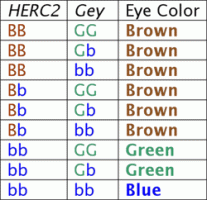
So, what coloured eyes see the best ? And what coloured eyes come from a Recessive-Gene ?
A hint:- you will not find the answer on the Internet.
 
Upvote 0
PropeNonComposMentis said:
nc0b said:
In respect to the DR of the eye, age is certainly a factor. A few years ago three of us were in a car: me in my 60s, a father in his 50s and his son age 13. I was looking for 16th street, and was stopped at a traffic light. I said I cannot see a sign in the intersection. The 50 year old said he could see the sign, but he could not read it. The 13 year old said the sign says 16th street.
With all due respect, that sounds like a genetic, or, traffic, aberration.
Age has nothing to with sight. The two leading factors that have the greatest influence on vision, are, food quality and quantity, and the correct lighting conditions.

I once knew a very nice fellow, 109yo...
With all due respect, too, cataract and glaucoma are more typical to old or to young people?
And can you tell me that just food or lighting conditions are reasons for those eye diseases?
And how about getting bad eyes because of extensive VDU work? Typical occupational disease these days.
Or is there possibly something like age?

Lucky one, your nice 109yo fellow. But I believe, he has good genes on one side and also "trained" his eyes well by using them almost in "prehistorical" conditions, outdoors and so on. Or did he also do VDU work?

I don't know anybody 70 years or older having better eyes than me.
 
Upvote 0
PropeNonComposMentis said:
nc0b said:
In respect to the DR of the eye, age is certainly a factor. A few years ago three of us were in a car: me in my 60s, a father in his 50s and his son age 13. I was looking for 16th street, and was stopped at a traffic light. I said I cannot see a sign in the intersection. The 50 year old said he could see the sign, but he could not read it. The 13 year old said the sign says 16th street.
With all due respect, that sounds like a genetic, or, traffic, aberration.
Age has nothing to with sight. The two leading factors that have the greatest influence on vision, are, food quality and quantity, and the correct lighting conditions.

I once knew a very nice fellow, 109yo. He would walk six miles into town for supplies, a six mile walk each way. He could see better than me. I watched him throw a stone and kill a rabbit for his supper a number of times.

So, what coloured eyes see the best ? And what coloured eyes come from a Recessive-Gene ?
A hint:- you will not find the answer on the Internet.

That sounds like a geriatric abberation :o
 
Upvote 0
Here is a test you can do right in from of your monitor:
1) First, is your monitor is in a dimly lit room (as it should be)?
2) Place a dark object next to the monitor.
3) Open a web page which is predominantly bright.
4) Close one of your eyes.
5) Look at corner of the screen adjacent to the dark object.
6) Note whether or not you can you see see detail on the dark object and the bright screen at the same time?
7) Take a picture with the your DSLR by using the "Expose to the right" (ETTR) approach
8) look at the Image histogram.

The Canon histogram shows 10 stops of dynamic range. If scene exceeds that then there will be a tall stack at the left edge of the histogram indicating details which would be lost in the shadows. If your eye could see those details then your eye has more instantaneous DR than 10stops.
 
Upvote 0
PropeNonComposMentis said:
So, what coloured eyes see the best ? And what coloured eyes come from a Recessive-Gene ?
A hint:- you will not find the answer on the Internet.

It isn't strictly the eye colour that 'sees' best it is the brightness. But 'best' is subjective, are we talking better able to deal with high contrast 'best' or better able to discern colours 'best. If the former, darker eyes, typically brown would be best, if the latter lighter eyes, typically blue, would be better.

The recessive gene for eye colour is easily found on the internet.
 

Attachments

  • EyeColorChart2.gif
    EyeColorChart2.gif
    16.4 KB · Views: 358
Upvote 0
PropeNonComposMentis said:
privatebydesign said:
.....
The recessive gene for eye colour is easily found on the internet.

No its not !

Your chart shows an ignorance of Genetics, as do a number of hasty assumptions above.

The Human Genome has been mapped, dont you know !

Your old persona was pretty annoying, this new one, where you claim greater knowledge and experience than everybody without actually imparting any of it whilst hinting at your vastly superior intellect is, boring. Goodbye.
 
Upvote 0
privatebydesign said:
PropeNonComposMentis said:
privatebydesign said:
.....
The recessive gene for eye colour is easily found on the internet.

No its not !

Your chart shows an ignorance of Genetics, as do a number of hasty assumptions above.

The Human Genome has been mapped, dont you know !

Your old persona was pretty annoying, this new one, where you claim greater knowledge and experience than everybody without actually imparting any of it whilst hinting at your vastly superior intellect is, boring. Goodbye.

Dont recall making any assertions regarding my intellect.

I know what I know. If I am wrong, prove it. I am more than happy to learn. But I will not stand quiet in the presence of indolent urban mythology being flogged as reality.
 
Upvote 0
StudentOfLight said:
Here is a test you can do right in from of your monitor:
1) First, is your monitor is in a dimly lit room (as it should be)?
2) Place a dark object next to the monitor.
3) Open a web page which is predominantly bright.
4) Close one of your eyes.
5) Look at corner of the screen adjacent to the dark object.
6) Note whether or not you can you see see detail on the dark object and the bright screen at the same time?
7) Take a picture with the your DSLR by using the "Expose to the right" (ETTR) approach
8) look at the Image histogram.

The Canon histogram shows 10 stops of dynamic range. If scene exceeds that then there will be a tall stack at the left edge of the histogram indicating details which would be lost in the shadows. If your eye could see those details then your eye has more instantaneous DR than 10stops.

I'll have what he's having !
 
Upvote 0
Maximilian said:
PropeNonComposMentis said:
nc0b said:
In respect to the DR of the eye, age is certainly a factor. A few years ago three of us were in a car: me in my 60s, a father in his 50s and his son age 13. I was looking for 16th street, and was stopped at a traffic light. I said I cannot see a sign in the intersection. The 50 year old said he could see the sign, but he could not read it. The 13 year old said the sign says 16th street.
With all due respect, that sounds like a genetic, or, traffic, aberration.
Age has nothing to with sight. The two leading factors that have the greatest influence on vision, are, food quality and quantity, and the correct lighting conditions.

I once knew a very nice fellow, 109yo...
With all due respect, too, cataract and glaucoma are more typical to old or to young people?
And can you tell me that just food or lighting conditions are reasons for those eye diseases?
And how about getting bad eyes because of extensive VDU work? Typical occupational disease these days.
Or is there possibly something like age?

Lucky one, your nice 109yo fellow. But I believe, he has good genes on one side and also "trained" his eyes well by using them almost in "prehistorical" conditions, outdoors and so on. Or did he also do VDU work?

I don't know anybody 70 years or older having better eyes than me.

Hi Max.
Cataract and Glaucoma favor neither age nor sex.
can you tell me that just food or lighting conditions are reasons for those eye diseases?
Can you tell me the difference between Disease / Disorder / Sickness / Syndrome ? People use these words every day, anyone actually Know the difference ?

I ask my questions and challenge statements here in the hope that some of you will actually go away from here and find and learn for yourselves. Dont just take my word, or anyone's word as the only truth.

My 109yo friend was Asian. NO DISRESPECT Asian are know to be genetically predisposed to poor eye sight.
My friend was born, lived and worked his whole life, and died in 1980, on a small island with just two villages and a visiting floating market.
If any of you care to take a few moments and look into a book, you will find that all the Asian countries have invaded and occupied each other so very often and for many 1,000's of years.
It was he who told me about Asians and Sight issues, and continued on to say he had never learned to read or write because he could not see well enough.

He taught me a lifetime in the final ten weeks of his life. What a gracious gift.
How did such a man know and understand Genetics !

Sorry Max, no straight answers. Wish I knew more, to give you better answers.
 
Upvote 0
PropeNonComposMentis said:
Hi Max.
Cataract and Glaucoma favor neither age nor sex.
can you tell me that just food or lighting conditions are reasons for those eye diseases?
Can you tell me the difference between Disease / Disorder / Sickness / Syndrome ? People use these words every day, anyone actually Know the difference ?

I ask my questions and challenge statements here in the hope that some of you will actually go away from here and find and learn for yourselves. Dont just take my word, or anyone's word as the only truth.

My 109yo friend was Asian. NO DISRESPECT Asian are know to be genetically predisposed to poor eye sight.
My friend was born, lived and worked his whole life, and died in 1980, on a small island with just two villages and a visiting floating market.
If any of you care to take a few moments and look into a book, you will find that all the Asian countries have invaded and occupied each other so very often and for many 1,000's of years.
It was he who told me about Asians and Sight issues, and continued on to say he had never learned to read or write because he could not see well enough.

He taught me a lifetime in the final ten weeks of his life. What a gracious gift.
How did such a man know and understand Genetics !

Sorry Max, no straight answers. Wish I knew more, to give you better answers.
Hello again, PropeNonComposMentis!

First of all please note that English is not my mother tongue. I am German, as you can read from my profile.
Second, therefore I sometimes need to rely on dictionaries. And there is common uses of words, that can be understand right - normally. So please stop hairsplitting about words. And if anything about my post could be read as offensive please note that I didn't intend to. Especially about your 109yo friend. I really meant what I wrote there.

Thirdly:
I ask my questions and challenge statements here in the hope that some of you will actually go away from here and find and learn for yourselves.
I respect (edit:) and really appreciate your intention here, as I sometimes also think people should learn for themselves. "RTFM" is one of my most beloved abbreviations. Of course I seldom use it because it's too offensive. But sometimes it is also justifiable to ask such a question as the OP did, because if an eye specialist can answer such a complex question within minutes you don't have to study the science of the eye or ophthalmology for several years.

Fourthly, back on topic:
It was YOU who stated
Age has nothing to with sight. The two leading factors that have the greatest influence on vision, are, food quality and quantity, and the correct lighting conditions.
without any further prove of this statement. And now it's YOU who says
...no straight answers.

I give you straight answers:
about Cataract (http://en.wikipedia.org/wiki/Cataract)
"Age is the most common cause.[2] Lens proteins denature and degrade over time, and this process is accelerated by diseases such as diabetes mellitus and hypertension. Environmental factors, including toxins, radiation, and ultraviolet light, have cumulative effects, which are worsened by the loss of protective and restorative mechanisms due to alterations in gene expression and chemical processes within the eye.[10]"

about Glaucoma: (http://en.wikipedia.org/wiki/Glaucoma)
"Glaucoma affects one in 200 people aged 50 and younger, and one in 10 over the age of 80" (so much about age)
"Women are three times more likely than men to develop acute angle closure glaucoma due to their shallower anterior chambers" (so much about sex)

Of course wikipedia.org is not a clinical study but the people posting there are referring on clinical studies.
Of course age is not THE factor but with higher age the factors add up.
Of course not everybody gets a Cataract or Glaucoma but everybody's eyes are ageing like the rest of the body does as well.
And that was the reason why I couldn't leave your original statement without comment. (edit:) Otherwise I wouldn't have posted in this thread as I am not an eye specialist or did any deep research on this topic as well. But I was interested, if anybody could give a detailed answer.
And Cataract and Glaucoma were just examples.
And by the way: you didn't say anything about extensive VDU (or computer desk, I looked it up) work.
I meant here reduced flexibility of focusing and adapting and the "Office Eye Syndrome".


Your turn.

 
Upvote 0
Hi Maximilian.
What is rude about Read The Flaming Manual? ;D ;D The way it is said? I used to regularly get "Don't talk to me in that tone of voice" from mother, I didn't know I had a tone of voice! ::)

Cheers, Graham.


Maximilian said:
I respect (edit:) and really appreciate your intention here, as I sometimes also think people should learn for themselves. "RTFM" is one of my most beloved abbreviations. Of course I seldom use it because it's too offensive. But sometimes it is also justifiable to ask such a question as the OP did, because if an eye specialist can answer such a complex question within minutes you don't have to study the science of the eye or ophthalmology for several years.
 
Upvote 0
It's not difficult to put an upper limit on the eye's dynamic range. Occasionally, the moon will pass in front of the star Antares. If this happens near full moon, the brightness is well known (-12.74m) while Antares' brightness is +0.96m. The brightness difference is thus 13.7m which can be converted into linear units using

Ratio = 2.512^13.7 = 302000. This in turn can be converted into bits using

DR(bits) = log(302000)/0.301 = 18.2bits.

The million dollar question is whether you can actually see Antares right up to the point where it is occluded by the moon. I've never been able to do this, so all I can say from this measurement is that my eye's dynamic range is definitively less than 18.2 bits when both images fall on the macula but it's quite easy to see both when they are separated by a moon diameter (nadits half a degree.)

A while back, I was contemplating the purchase of a 10-bit display. Since these are hideously expensive, I decided to test my eye's dynamic range on images. I created a test pattern with 1-bit increases in grey from an 8-bit input. Depending on the monitor, it was either impossible or marginal for me to discern a difference. This suggested that for an extended object, I could resolve 8 bits, 9 bits would be difficult and 10 bits was improbable. The 10-bit display stayed in the shop.

However, my observations of binary stars suggest a different answer. Antares - mentioned above - has a blue companion which shines at 5.5m. This represents a brightness difference of only 65.5x or 6 bits. The companion star has good contrast in colour and so should be easily visible in small telescopes. In practice it is an extremely difficult, requiring good seeing, superior optics and high magnification. Since 8 bits corresponds to 6m and 10 bits to 7.5m, it seems that the angular size of the object plays a role.

A second anecdote from my youth. When I was 18, I was regularly able to observe two or three of the Galilean moons of Jupiter without a telescope. These are typically 6.5-7.5m ( 400-1000 times, 8.6-10 bits) dimmer yet they were comparatively easy.

The reason seems to be glare - most of which results from scatter within the eye itself. This glare is attributed to floaters (dead cells within the aqueous and vitreous humors) which accumulate with age. When an extended object is observed, scattering within the eye may average out.

Conclusion - when young, the true dynamic range was around 9 bits. Now scattering has reduced it to less than 6 bits and it may get worse. Contrary to assertions above, my vision has degraded measurably with age. As others have observed - growing old sucks.... but it's better than the alternative.
 
Upvote 0
noisejammer said:
This glare is attributed to floaters (dead cells within the aqueous and vitreous humors) which accumulate with age. When an extended object is observed, scattering within the eye may average out.

You're saying there are dead things floating around inside my eyes, and they're increasing!? Ugh, that's not what you want to read :-o

PropeNonComposMentis said:
Asian are know to be genetically predisposed to poor eye sight.

Interesting, I'm seeing this study: http://www.asianscientist.com/2013/03/health/genetic-poor-eyesight-clearer-032013/

However, this is a recent study and I'd advise caution when basing conclusions on genetic factors. And who's an "Asian" anyway ... no so long ago people in my country tried to figure out who other "they" and "we" were, fortunately to no avail. Unless you do the reverse definition, i.e. people with poor eyesight have to be Asian :-p

Reminds me of the stereotypical Asian bad guy in Tintin comics, btw. This was in the time before they produced all the dslr equipment we're currently using :->

tintin-season1-06.jpg
 
Upvote 0
Thank you, noisejammer, for your detailed thoughts.

Your
noisejammer said:
Conclusion - when young, the true dynamic range was around 9 bits. Now scattering has reduced it to less than 6 bits and it may get worse. Contrary to assertions above, my vision has degraded measurably with age. As others have observed - growing old sucks.... but it's better than the alternative.
meets quite well with my gut instinct. So todays DSLRs deliver much more than you normally need, if you expose right ;)

I was really impressed about this
When I was 18, I was regularly able to observe two or three of the Galilean moons of Jupiter without a telescope.
although I belive you, I must say it is hard to believe.
I have had my own astronomical experiences in my youth. And I had good eyes, too. But I never had this experience like you had. Maybe the seeing wasn't good enough. But being on Elba in a really dark summer night should have worked.
 
Upvote 0
IglooEater said:
Cambridgeincolour puts the dynamic range of the human eye at around 10-14 stops. http://www.cambridgeincolour.com/tutorials/cameras-vs-human-eye.htm#sensitivity

10-14 is the answer they give for a theoretical situation where the eye's pupil does not change size. The estimated amount of DR for actual vision (in the same article) is estimated to be approx. 24 stops. This makes far more sense, as anyone who takes photos of a sunset notices that the camera falls far short in DR to capture both the highlights and shadows. So, sensors (even the Exmor) still fall far short of being able to come close to what the eye sees. That's one reason many of us just won't get that excited at the 2 stop difference in DR between Canon and Sony/Nikon.
 
Upvote 0
Maximilian said:
.... I was really impressed about this
When I was 18, I was regularly able to observe two or three of the Galilean moons of Jupiter without a telescope.
although I belive you, I must say it is hard to believe. ...
Maximillian, I can offer better than anecdotes. A friend studies the ancient lore of San people. He has shown me evidence that they recognised Saturn as oval shaped and recorded it in carvings or rock paintings - I forget which. Even at their most open, the rings only subtend about 40x25 arcsec but the evidence is irrefutable and pre-dates the invention of the telescope.

I think that eyes degrade over the years but so does the brain's capacity to correct for aberration. This was particularly obvious to me as I wound my way through my academic career. I had refractive surgery to ease the burden about a decade back. After my eyes settled - this took perhaps a year or so - I found that the Galilean moons were again visible (but with difficulty). I have also claimed a naked eye observation of Venus' crescent (it's quite a large target but is difficult because of glare) and _think_ I've seen Saturn as an out of round point.

Of course, it's near impossible to convince the sceptical of this and being a frequent observer I know more or less what I expect to see. It can be hard to convince myself.
 
Upvote 0
noisejammer said:
Maximillian, I can offer better than anecdotes. ...
The only really good anecdote about my eyesight is the following:
When I was about 23 my girlfriend at that time was looking for a new spectacles frame. She was shortsighted.
I was bored and stood around in the shop and remembering my last eye test back when I made my drivers license I looked at the test chart at the wall with all the letters on it. I asked the shop owner about the reading distance and he told me right there from where I was standing.
Without cheating I asked him: "what about F, S, T, A, etc. and the small numbers reading 160% on the side of this line."
(don't know the original row of letters I could read back then)
He looked at me with a strange and puzzled look and then said: "Man, that would have been really good - if I had switched on the backlight of this chart. But now I believe I won't make much money with you." And smiled.
 
Upvote 0