
Why doesn't Canon simply uppdate the IS in great optics like the 300 4L? With four stop IS, I guess a lot of people would pay a few hundred more. Is it so costly to change production or do you have to change the optical design as well?
You are using an out of date browser. It may not display this or other websites correctly.
You should upgrade or use an alternative browser.
You should upgrade or use an alternative browser.
Why not uppdate just the IS
- Thread starter henriksandstrom
- Start date

henriksandstrom said:Why doesn't Canon simply uppdate the IS in great optics like the 300 4L? With four stop IS, I guess a lot of people would pay a few hundred more. Is it so costly to change production or do you have to change the optical design as well?
Why not just update the transmission in your 1991 Automobile? There is more than just the IS that needs updating. The design is good, but its 24 years old. It does not have coatings on the lens elements to prevent reflections from the sensor, which reduces contrast. It is also not all that sharp compared to newer lenses, and suffers from LOCA's or purple fringing.
I would not pay $500 more for it with better IS, it does not compete at that price. For its existing cost, its a good lens that allows those who are trying to save money to purchase. Many sports shooters turn off IS in any event, since it does not help with moving subjects.
Upvote
0
henriksandstrom said:Why doesn't Canon simply uppdate the IS in great optics like the 300 4L? With four stop IS, I guess a lot of people would pay a few hundred more. Is it so costly to change production or do you have to change the optical design as well?
I don't know how much about Canon's claim that IS needs to be customized to the lens is true, but if it is, then updating the IS of the 300L will require separate R&D. They couldn't just plonk the IS of, for example the 100-400, in there.
There might be an issue about production as well. For example, they could just add the newest coatings on the 800L and raise the price a tad. But they don't do that.
Of course, all of this is mere speculation on my part...
Upvote
0

henriksandstrom said:Why doesn't Canon simply uppdate the IS in great optics like the 300 4L? With four stop IS, I guess a lot of people would pay a few hundred more. Is it so costly to change production or do you have to change the optical design as well?
The whole lens need a serious update, Its optically not up to current standards. A half baked solution would not make sense.
Personally, I do not understand that they have not released an update yet. I am sure it would sell very well. Maybe protecting the sales of the 300mm f/2.8 IS L II which seem to have been quite low so far?
Upvote
0
They will have to work harder. Just like when they upgraded the 70-200 2.8L IS to 70-200 2.8L IS II.
My reasoning comes from the fact that the original (non-IS) 300mm f/4L is sharper than 300 f/4L IS (especially when making comparisons with 1.4X Canon teleconverter).
My reasoning comes from the fact that the original (non-IS) 300mm f/4L is sharper than 300 f/4L IS (especially when making comparisons with 1.4X Canon teleconverter).
Upvote
0
tron said:They will have to work harder. Just like when they upgraded the 70-200 2.8L IS to 70-200 2.8L IS II.
My reasoning comes from the fact that the original (non-IS) 300mm f/4L is sharper than 300 f/4L IS (especially when making comparisons with 1.4X Canon teleconverter).
+1 Exactly. 70-200 f/2.8 IS L II was a significant improvement in every aspect.
Upvote
0
Mt Spokane Photography said:Why not just update the transmission in your 1991 Automobile? There is more than just the IS that needs updating. The design is good, but its 24 years old. It does not have coatings on the lens elements to prevent reflections from the sensor, which reduces contrast. It is also not all that sharp compared to newer lenses, and suffers from LOCA's or purple fringing.
Um...what? ??? We are talking about the 300 f/4L IS USM, right?
One of the better lenses Canon makes. My only lens that's actually worth more today then when I bought it as market demand allowed Canon to push up the price.
It's as sharp as the much newer 70-300 f/4-5.6L IS USM and 100-400 II. It's not as sharp as the 300 f/2.8L IS USM II, but it's close enough that after post processing I doubt anyone could tell them apart. I'm struggling to think of lenses that are sharper, and among those I can think of (the f/2.8 version; Zeiss primes and Sigma ART primes) it's only by a small amount.
CA and flare are both very well controlled. I've never seen sensor reflections or lost contrast even in very harsh light. (The 300 f/4L IS is my go to surfing lens when shooting from a pier. Also my go to airshow lens. Those are about as harsh/high contrast as it gets.)
LOCA's are present but aren't bad at all. They are a fact of life with relatively fast lenses (f/4 is fast for 300mm), and there's only so much you can do to eliminate them.
Many sports shooters turn off IS in any event, since it does not help with moving subjects.
I don't know about anyone else, but IS helps me track the target, especially after a long day of shooting. If I'm hand holding a lens it's on. And it's a solid 2 stop / often 3 stop gain with this lens.
Canon could make it as sharp as its f/2.8 big brother and add 4 stop IS for an update. But it's darn near perfect as is.
Upvote
0
dtaylor said:Canon could make it as sharp as its f/2.8 big brother and add 4 stop IS for an update. But it's darn near perfect as is.
From what I have seen it has a hard time matching the new 100-400mm IS L II for sharpness. Here any prime should be noticably better than a general purpose zoom imho. I therefore believe that a new version would be a significant improvement.
Its surely the weakest performing white prime lens in the current Canon line-up. No wonder given its age.
Upvote
0
Maiaibing said:From what I have seen it has a hard time matching the new 100-400mm IS L II for sharpness.
What have you seen? Were they testing a flawed copy?
Head over to TDP. At 300mm they are as close as two lenses get at the same apertures. Heck, f/5.6, f/8, and f/11 on either lens is pretty much interchangeable with the other lens/aperture combos.
Now compare to the f/2.8L II. Is the f/2.8 version sharper? Yes. By a large amount? Not really. The difference is greatest at f/4 and still smaller then post processing choices.
The new 100-400 II certainly does better at 400mm then the 300 f/4L IS + 1.4x, but that's to be expected.
Here any prime should be noticably better than a general purpose zoom imho.
Based on what? The old adage that primes are always better then zooms hasn't been true in years thanks to modern lens design and manufacturing. The 100-400 II was a significant update and no primes blow it away now.
I therefore believe that a new version would be a significant improvement.
That would put it well above the f/2.8L II. I don't expect that to happen. There's not a lot of room to move here as all of the lenses we're discussing are quite sharp. If you can't produce hair splitting 20x30" prints with any of these lenses then something is wrong.
Its surely the weakest performing white prime lens in the current Canon line-up. No wonder given its age.
I have no idea where you got this impression of the 300 f/4L IS. It's a stellar performer. Even if we were to split line pairs and concluded that it was the "weakest" of the current line up, that would still make it better then 99% of lenses in existence. (Actually, the 400 f/5.6L is probably the "weakest" of the white lenses right now, and still an incredible performer.)
It will be interesting to see what the new 100-400 II does to sales of the 300 f/4L IS. But the 70-300L didn't knock demand or price down.
Upvote
0
dtaylor said:I have no idea where you got this impression of the 300 f/4L IS.
But the 70-300L didn't knock demand or price down.
1) I used them all (except the very longest).
I also took stock of DTP to gauge the sharpness and you seem to agree that the 300L IS looks no sharper than the new 100-400L IS. To me that is unconvincing performance. What was "excellent" prime performance yesterday is not "excellent" when new tech produces ever better lenses. Progress moves the goal posts. And that's natural.
That does not mean your 300IS L takes any lesser pictures than yesterday. But it shows that an upgrade could be even better. Why be troubled by that?
I upgraded to the 300mm f/2.8 IS L II and here you cannot see any difference from the former model unless you know exactly what to look for. I love my new lens but for the money, I do not recommend it to others as an upgrade. No reason to be blind to the realities of our lenses.
2) 70-300L IS II (which I also have) is only OK and cannot compare with the 300mm L IS - so the zoom is simply not a viable replacement. That's why I will likely change it for the new 100-400IS L II. Still, I have taken some great pictures with it and I am sure you have taken even better with your 300mm IS L.
Upvote
0

dtaylor said:Based on what? The old adage that primes are always better then zooms hasn't been true in years thanks to modern lens design and manufacturing. The 100-400 II was a significant update and no primes blow it away now.
Are you sure?
Yes, some of the new zooms are better than the old primes, but given the same technology and materials the prime will always be better than the zoom.
The prime will have less elements, and that means less transmissive loss and less surfaces for reflection.
The prime will not have to worry about alignment of the zoom mechanism.
The optical design will be optimized for a single focal length, not a range.
The prime will be mechanically superior.
The prime (usually) will not be sucking air in/out as you zoom or focus, so there are less dust/moisture problems.
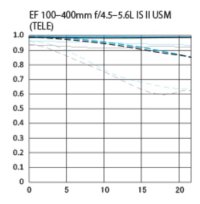
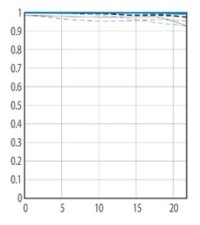
Look at the two MTF charts.... which one is for a brand new "state of the art" zoom, and which one is for a couple of years old prime?
Attachments
Upvote
0
I agree with other posts. The 300/4 is by no means a perfect lens and could definitely use optical updates above and beyond an updated IS system especially with moving to higher resolution APS-C sensors. For a while I strongly considered getting the 300/4 but postponed after reading about wide sample variation of the 300/4 vs the 400/5.6.
Anyway, Canon has reportedly focused on improved production processes and quality control has being tightened over the past decade. Most modern lenses (even those from third party manufacturers) display much lower chromatic aberration than the older designs which is especially helpful when shooting fine details with higher res crop-sensors in hard light. With the improved quality controls I would guess that consistency in performance from one sample to the next would also be much improved over the old generation lenses.
One of the interesting features of the 300/4 is the sliding lens hood, which is really convenient... if I remember correctly people complained that it can get jammed and that it was quite expensive to repair, so one had to be a bit cautious with use and storage. I would guess that the sliding lens hood would be dropped from a new 300/4 design in favor of a more traditional hood.
Anyway, Canon has reportedly focused on improved production processes and quality control has being tightened over the past decade. Most modern lenses (even those from third party manufacturers) display much lower chromatic aberration than the older designs which is especially helpful when shooting fine details with higher res crop-sensors in hard light. With the improved quality controls I would guess that consistency in performance from one sample to the next would also be much improved over the old generation lenses.
One of the interesting features of the 300/4 is the sliding lens hood, which is really convenient... if I remember correctly people complained that it can get jammed and that it was quite expensive to repair, so one had to be a bit cautious with use and storage. I would guess that the sliding lens hood would be dropped from a new 300/4 design in favor of a more traditional hood.
Upvote
0
Maiaibing said:I also took stock of DTP to gauge the sharpness and you seem to agree that the 300L IS looks no sharper than the new 100-400L IS. To me that is unconvincing performance.
Then the 100-400 mark II, yes. It's quite a bit sharper then the mark I.
What was "excellent" prime performance yesterday is not "excellent" when new tech produces ever better lenses.
The mark II isn't better, though it pulls even. You're assuming that for a given level of lens design/manufacturing tech that primes should always be much better then zooms. That's a false assumption.
None of Canon's primes, not even their most expensive and newest mark II super telephotos, are significantly sharper then the 300 f/4L IS OR the 100-400 mark II. Their most recent L zooms...the 70-300L, 100-400 II, and the latest 70-200L variants...quite dramatically closed the gap on all of their primes vs. the situation we had just a decade ago.
The same is true even for the Sigma ART and Zeiss Otus primes. Sharper then the L zooms? Yes. But by small amounts.
The way you described the 300 f/4L IS someone might think it's mediocre and that a new version would be dramatically better. Old design or not, it's one of the sharper lenses in existence, and you have to look at the very best primes made to find even a slight improvement. At the level we're debating IQ gains are very small and very, very expensive.
That does not mean your 300IS L takes any lesser pictures than yesterday. But it shows that an upgrade could be even better. Why be troubled by that?
The gain seen in the 100-400 II does not mean an updated 300 f/4L IS would be much better. A perfect lens is diffraction limited wide open. If you look at the 300 f/2.8L II it's roughly one stop away from that right now. f/4 is better then f/2.8 (barely). There's no gain at f/5.6, and f/8 sees degradation. I don't expect a new 300 f/4L would do any better then this, and this is a relatively small gain in IQ vs. the current f/4L IS.
2) 70-300L IS II (which I also have) is only OK and cannot compare with the 300mm L IS
"Only OK?" :

The edges are better on the primes, with mid-frame and center being only very slightly better (f/4L or f/2.8L II). But the high contrast TDP charts emphasize any differences. Given a real scene...good post processing technique...you would be hard pressed to pick unlabeled prints from one or the other.
Doesn't mean I wouldn't pick one of the primes. Aperture is aperture and even a single stop can be huge. But we are splitting hairs when debating the IQ of any of these lenses. EF-S 55-250 STM vs. one of the 300L primes...THERE'S a big difference, easily print visible, no post processing away that. 70-300L vs. one of the 300 primes? Eh...the Ferrari does 185 mph, the Porsche does 187 mph, either one will get you a nasty ticket

Upvote
0
Don Haines said:dtaylor said:Based on what? The old adage that primes are always better then zooms hasn't been true in years thanks to modern lens design and manufacturing. The 100-400 II was a significant update and no primes blow it away now.
Are you sure?
Quite sure on both statements.
Yes, some of the new zooms are better than the old primes, but given the same technology and materials the prime will always be better than the zoom.
A prime cannot be better then a diffraction limited zoom. And yes, someday soon we will start to see diffraction limited primes and zooms for small format. (A few such lenses exist for medium format.)
We're not at that point yet in small format lenses. But as we approach that point we see diminishing returns in IQ gains. Improved tech benefits the zooms more then the primes and closes the gap. This is exactly what we're seeing as Canon (and others) update their lenses.
The prime will have less elements, and that means less transmissive loss and less surfaces for reflection.
Given modern coatings this is rarely, if ever, human observable.
The prime will not have to worry about alignment of the zoom mechanism.
Given the complexity of any lens design which approaches diffraction limited IQ this is a non-issue. Either will have very complex alignment and manufacturing tolerances. I don't think there's a white tele shipping today with less then a dozen elements.
The prime will be mechanically superior.
How so?
Look at the two MTF charts.... which one is for a brand new "state of the art" zoom, and which one is for a couple of years old prime?
Did you bother to look at test shots for each? The differences are smaller then your post processing choices. While the prime is better, it does not by any stretch of the imagination "blow away" the zoom.
The prime is amazing in that there's not much IQ difference between f/2.8 and f/5.6 where the zoom starts at f/5.6. But I highly doubt you could tell unlabeled prints from these lenses apart.
Some background: with small format if I can clearly see a difference in unlabeled 24" prints I consider it significant. If I can only see it in 36" prints then I consider it minor. If I can't reliably detect the difference in unlabeled 36" prints then I consider it "tiny" and inconsequential no matter what it looks like on a graph or when pixel peeping B&W line charts.
"Unlabeled" is key because human psychology being what it is we will perceive one to be better if we expect it to be. I don't mean to say that someone will lie because they want their lens/camera/wine/whatever to win. Your personal experience of A will literally be better if you expect, or are told, that A is better then B before the test. Take away the labels and the results are often surprising.
I believe you would be very hard pressed to detect any of the lenses we're discussing given 36" prints of real world scenes, especially if they have been processed.
Upvote
0

+1Mt Spokane Photography said:henriksandstrom said:Why doesn't Canon simply uppdate the IS in great optics like the 300 4L? With four stop IS, I guess a lot of people would pay a few hundred more. Is it so costly to change production or do you have to change the optical design as well?
Why not just update the transmission in your 1991 Automobile? There is more than just the IS that needs updating. The design is good, but its 24 years old. It does not have coatings on the lens elements to prevent reflections from the sensor, which reduces contrast. It is also not all that sharp compared to newer lenses, and suffers from LOCA's or purple fringing.
I would not pay $500 more for it with better IS, it does not compete at that price. For its existing cost, its a good lens that allows those who are trying to save money to purchase. Many sports shooters turn off IS in any event, since it does not help with moving subjects.
Upvote
0
Similar threads


- Replies
- 15
- Views
- 2K


D
- Replies
- 32
- Views
- 5K
