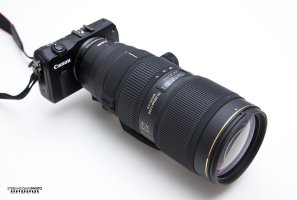
Why the obsession with mirrorless, rather than features?

To me, the weight of a DSLR is a comfort, it seems to add stability and balance
When I first picked up a 1DX, that's what immediately struck me
Without even looking into the viewfinder or delving into the impressive specs, I had found the weight and heft of the camera to be one of it's more desirable "features"
A 5Ds or 5Dsr is on the horizon and I am thinking I'll be adding a grip just for that reason
So if the world does indeed go sans mirror, I may just end up buying some lead fishing weights to tape to the bottom of my fancy new mirrorless
 
Upvote 0
joe_r said:
I have a question that's been bugging me for a while - why is there such an obsession with the mirror in a DSLR?

For me, mirrorless cameras are the only possible known and currently available, working technology to get
* smaller, lighter cameras than DSLR
* smaller, lighter lenses for my most frequently used focal lengths (24mm to 100 mm)
* 100% vibration-free cameras
* 100% noise free cameras
* less expensive, 100% solid state electronic cameras

I do not need more than 5 or 6 fps and i have no need for focal lengths beyond 200mm - so for me mirrorless cameras will do everything a DSLR can do and then a lot more in a significantly smaller and (eventually) cheaper package. I've not switched to Sony yet for a number of reasons - both product and maker related shortcomings. I'd definitely buy a Canon FF mirrorless camera as capable, not bigger, not more expensive than A7 II. Especially Canon (Raw) colors, Canon user interface (with touchscreen) and Canon glass (without need for thirdparty metabones adapter) have kept me in their camp until now. However, while i did buy the 5D3 ... and am rather happy with it. But ... I shoot 80% of the time with my EOS M, simply because i am not willing to lug around the 5D3 plus f/2.8 zooms. So it was definitely the last DSLR i've bought. Next up will be mirrorless, preferably FF but if Canon comes up with a fantastic, small and reasonably priced EOS M4 i might settle on APS-C and EF-M lenses and call it a day.
 
Upvote 0
neuroanatomist said:
And yet...Canon first release rapidly became the #2 best-selling MILC in the largest global market for that segment, trouncing all but one model from one manufacturer. So it may be that your doubts are misplaced (unless, of course, you're going to judge 'trouncing' by your personal standards, DxO's Biaesd Scores, or some other totally subjective set of criteria).

It depends what is meant by trounced. Jrisra may have been referring to quality rather than quantity.

The worlds best selling cameras are not the best cameras....
 
Upvote 0
jrista said:
This is a bit of a misnomer. Canon cannot directly benefit from other companies such as Sony "working out the bugs" and then suddenly switch without having any problems. The things that currently limit mirrorless cameras and the things companies that sell mirrorless cameras are fixing and resolving are the same things Canon is going to have to deal with if and when they finally decide to take the plunge. However, because they have delayed, they aren't going to be ahead of the curve...they will be behind it.

Unless Canon is cranking away on some unknown technology in a box somewhere, hiding it from the world, not even filing any patents on it, it seems doubtful Canon will just race out the gate on a mirrorless winner that trounces all the competition. DPAF is their SOLE mirrorless-benefitting technology at the moment (one which they hardly even use for mirrorless...or have they even used it at all??)...and there are several companies (Sony does NOT appear to be one of them) out there now working on the same thing (and some of the patents filed over the last year seem technologically superior to Canon's approach.) Canon will not hold this theoretically superior technological advantage with DPAF for long, especially if they refuse to implement it broadly in the cameras that can best benefit from it.

I'd dispute that. Take a much more complex product to make, such as a car. Even though much of the underlying technology may have patents surrounding it, there is nothing to stop anyone new to the scene learning from the best and produce a vehicle which jumps right in on a level playing field, or in some cases and from some angles, surpass the competition.

Tesla Motors launched the Model S when the company was just 9 years old. If Tesla Motors were formed back in 1769 when Nicolas-Joseph Cugnot launched his steam powered tricycle, the Model S would not have existed in 1778. It is built on all the accumulated progress made by all the manufacturers and developers over the years. And they came out of no-where and arguably surpassed the best.

Canon have very deep pockets. What technical reason stops Canon from overtaking those who are perceived as the mirrorless leaders when/if they see the time is right?
 
Upvote 0
lw said:
neuroanatomist said:
And yet...Canon first release rapidly became the #2 best-selling MILC in the largest global market for that segment, trouncing all but one model from one manufacturer. So it may be that your doubts are misplaced (unless, of course, you're going to judge 'trouncing' by your personal standards, DxO's Biaesd Scores, or some other totally subjective set of criteria).

It depends what is meant by trounced. Jrisra may have been referring to quality rather than quantity.

The worlds best selling cameras are not the best cameras....

Likeky he was, like most people he focuses on his own personal needs and standards (for example, he has stated that Canon sensors deliver, "...poor, sub-par, unacceptable image quality,"). The problem is that there's no objective definition of 'best' as everyone's criteria are different. But it is reasonable to state that a top selling model/brand best meets the needs/wants of the majority of buyers...and sales numbers are objective. If Canon dSLR sensors truly delivered what most people considered to be poor IQ, they would clearly not have remained the #1 brand for over a decade. So clearly, I cannot choose the wine quality standards in front of jrista.
 
Upvote 0
dak723 said:
I agree with the OP. Perhaps I am missing something, but the only advantage I see to mirrorless is the ability to make a smaller, lighter camera. Yet, whenever people bring up size and weight, even those who want mirrorless say that those factors are not the main reason.

Here's my running list of the better future mirrorless could offer that have nothing to do with size:

1) You can shoot through the viewfinder without mirror slap without need to resort to MLU or LiveView.

2) Focus peaking in the EVF is a super handy tool for shooting with manual focus lenses at large apertures.

3) The EVF can show you more than basic LCD indicators -- drop in a realtime histo (if so inclined) or whatever other heads-up information you'd like to see. Some folks prefer a spartan VF, while others want the fighter cockpit blasting information all over the screen. Unlike an OVF, you can dial that in to your preference.

4) Removing the mirror box allows the flange to sensor distance to be dramatically reduced. Though we think of that principally in mirrorless rigs getting thinner front to back, that's not all that does for us. Reducing that flange distance allows you to use adaptors to use other manufacturer's lenses. That is massive if you have lots of glass from older systems and don't need razor fast AF.

5) An EVF can have its brightness turned up in dark environments. They can't see in the dark, but they can bail you out in environments that OVFs on SLRs can struggle with (nighttime shooting, dark events like concerts, etc.).

6) There are less mechanical things to wear out or fail in a mirrorless rig than an SLR, so mirrorless should be more mechanically reliable than an SLR. (This is somewhat contentious, because there are some 'mechanical-stuff-is-more-reliable' rebuttals the SLR camp could make. So, yes, a mirror box's effectiveness can wear down, but a more 'driven by wire' mirrorless system could (I suppose) could have more electronic avenues to fail. You can't short out an OVF, right?)

7) I'm not well read on this, but I thought I read that going mirrorless has a lower (or no?) AFMA hassle level -- so dialing in lenses in mirrorless is less of a burden.

8 ) Mirrorless can pull off some comically fast shutter speeds if you have the need & have the light. I believe Fuji (and maybe some others?) have a rig that shoots 1/32,000s, which SLRs simply cannot muster.

This is not an exhaustive list, but these are the more mentioned upsides I've read about.

Keep in mind that I prefer SLRs and will continue to do so until mirrorless technology eliminates the critical 'pain points' for how I shoot -- lag, responsiveness, burst rate with AF/AE, etc. I have a 5D3 and my next primary rig will undoubtedly be another SLR, but perhaps after that I'd consider giving FF mirrorless my money.

- A

 
Upvote 0
jrista said:
Don Haines said:
takesome1 said:
Probably more interst than obsession.

Shooting off the LCDis not a bad thing. I think of many reasons it could be a benefit in the future.

IMO mirrors are a holdover from the non-digital days. It's a dinosaur that hasn't meet it's time yet.
We might be fans of the conventional view finder and mirror because were set in our way. But change will eventually come and it will be at a slow pace.

It will be a while. Problems will have to be solved like overheating, AF efficiency and speed and other. Plus once it arrives they will have to convert the masses who love dinosaurs.
+1
Canon moves slowly. Some interpret that as resistant to change, others as "make sure it works before you sell it"... Once the bugs are out and the overall performance of mirror less exceeds mirrored cameras, you can expect the switch....

I expect that one day, the 5D? and 1D? will be released as mirror less....

This is a bit of a misnomer. Canon cannot directly benefit from other companies such as Sony "working out the bugs" and then suddenly switch without having any problems. The things that currently limit mirrorless cameras and the things companies that sell mirrorless cameras are fixing and resolving are the same things Canon is going to have to deal with if and when they finally decide to take the plunge. However, because they have delayed, they aren't going to be ahead of the curve...they will be behind it.

Unless Canon is cranking away on some unknown technology in a box somewhere, hiding it from the world, not even filing any patents on it, it seems doubtful Canon will just race out the gate on a mirrorless winner that trounces all the competition. DPAF is their SOLE mirrorless-benefitting technology at the moment (one which they hardly even use for mirrorless...or have they even used it at all??)...and there are several companies (Sony does NOT appear to be one of them) out there now working on the same thing (and some of the patents filed over the last year seem technologically superior to Canon's approach.) Canon will not hold this theoretically superior technological advantage with DPAF for long, especially if they refuse to implement it broadly in the cameras that can best benefit from it.
And yet they have the EOS-M, proof that they are working on Mirrorless......
 
Upvote 0
neuroanatomist said:
jrista said:
Unless Canon is cranking away on some unknown technology in a box somewhere, hiding it from the world, not even filing any patents on it, it seems doubtful Canon will just race out the gate on a mirrorless winner that trounces all the competition.

And yet...Canon first release rapidly became the #2 best-selling MILC in the largest global market for that segment, trouncing all but one model from one manufacturer. So it may be that your doubts are misplaced (unless, of course, you're going to judge 'trouncing' by your personal standards, DxO's Biaesd Scores, or some other totally subjective set of criteria).

+1. Canon has a mad level of excellence at getting their s--- to work well consistently.

Will their first FF mirrorless offering have the highest resolution, most responsive EVF? No.
Will it have the fastest AF? Hell no.
Will it have the best sensor? [Giggle.] Oh, you were serious. Next question.

But what it will have is the basic guts of a solid working rig: excellent ergonomics, solid build quality, menus that don't make you want to kill someone with a hammer, and an assload of lenses, flashes, accessories you know and love will work with it on day one.

It will be under-spec'd feature by feature against Sony, but it will still sell very, very well. And it will have a far, far, far less likelihood of letting you down with a knuckleheaded technical miss like the Nikon D600 debacle, Sony light leaks, Sony compressed RAW, etc. based on its very good quality track-record.

- A
 
Upvote 0
It is great that there are so many choices out there.

When talking about smaller and lighter remember one thing: A heavier system will give less vibration or movement during operation.

I realize that that is exactly the argument made against DSLRs by the mirrorless fans.

However, heavier also means less shake and movement caused by the camera holder. Someone is going to ask me why I know that. Because it works that way with hand guns.

The great whites weighing so much is a good thing. A really good thing.

A real lightweight gun is subject to heavier kick and movement during operation and also more movement in the hands of the shooter compared to the same round fired from a heavier handgun.

While a camera has far, far less internal movement than a handgun, you are still pulling a trigger (shutter button), and still having to hold steady to get the shot. That's why we use tripods and monopods or sand bags... same thing in the gun world. Both hobbies use the word shooting.
 
Upvote 0
CanonFanBoy said:
It is great that there are so many choices out there.

When talking about smaller and lighter remember one thing: A heavier system will give less vibration or movement during operation.

I realize that that is exactly the argument made against DSLRs by the mirrorless fans.

However, heavier also means less shake and movement caused by the camera holder. Someone is going to ask me why I know that. Because it works that way with hand guns.

The great whites weighing so much is a good thing. A really good thing.

A real lightweight gun is subject to heavier kick and movement during operation and also more movement in the hands of the shooter compared to the same round fired from a heavier handgun.

While a camera has far, far less internal movement than a handgun, you are still pulling a trigger (shutter button), and still having to hold steady to get the shot. That's why we use tripods and monopods or sand bags... same thing in the gun world. Both hobbies use the word shooting.

Sony A7 II, A7r II and A7s II all have built-in IS on the sensor. It works very well. I've shot some night shots @ 1/10 hand-held. Getting sharp images is not that difficult with primes, wide open end.
 
Upvote 0
brad-man said:
When they get the EVF right, I'm all in. The ability to see the image thru the viewfinder exactly the same way the sensor will record it is of great value to me. Also eliminating the lubricants required for the shutter and the mirror box mechanisms can only be a positive move for reliability, as well as the ability of the camera to survive extremes in temperature as well as shocks (impact resistance). There really is no down side.

No down side. Try only works when the camera is on - requires batteries.
Try is lower resolution than an OVF.
Try has lower DR than your eye.

There are downsides as well as upsides. Each person needs to decide for themselves if the trade offs are worth it.
 
Upvote 0
RGF said:
brad-man said:
When they get the EVF right, I'm all in. The ability to see the image thru the viewfinder exactly the same way the sensor will record it is of great value to me. Also eliminating the lubricants required for the shutter and the mirror box mechanisms can only be a positive move for reliability, as well as the ability of the camera to survive extremes in temperature as well as shocks (impact resistance). There really is no down side.

No down side. Try only works when the camera is on - requires batteries....... So what?
Try is lower resolution than an OVF.............................................................. As long as resolution matches the sensor, so what?
Try has lower DR than your eye................................................................... As long as DR matches the sensor, so what?

There are downsides as well as upsides. Each person needs to decide for themselves if the trade offs are worth it.

As the first line in my response said, "When they get the EVF right..."
 
Upvote 0
brad-man said:
RGF said:
brad-man said:
When they get the EVF right, I'm all in. The ability to see the image thru the viewfinder exactly the same way the sensor will record it is of great value to me. Also eliminating the lubricants required for the shutter and the mirror box mechanisms can only be a positive move for reliability, as well as the ability of the camera to survive extremes in temperature as well as shocks (impact resistance). There really is no down side.

No down side. Try only works when the camera is on - requires batteries....... So what?
Try is lower resolution than an OVF.............................................................. As long as resolution matches the sensor, so what?
Try has lower DR than your eye................................................................... As long as DR matches the sensor, so what?

There are downsides as well as upsides. Each person needs to decide for themselves if the trade offs are worth it.

As the first line in my response said, "When they get the EVF right..."

I've never understood why people even think they need high dynamic range through the viewfinder. Unless you have two cameras strapped to your face while you're walking around, you saw whatever it is you're taking a picture of before you looked into the camera.
The only place where viewfinder refresh rate really matters is action, it's well established that a professional sports shooter is probably not going to be using one of these for a while, but the question that actually matters is what's good enough for the consumer?
I think we're well past that point.
 
Upvote 0
Orangutan said:
CanonFanBoy said:
When talking about smaller and lighter remember one thing: A heavier system will give less vibration or movement during operation.

That's what IS is for. Also, you can add ballast to stabilize a light body.

Agree on IS, but Canon is unlikely to pursue IBIS with their FF mirrorless offering and not all lenses offer IS. Also, you can only add ballast to bodies that allow such. See picture -- there is no defense for that ergonomically.

My vote for FF mirrorless is to concede that:

1) People will want to use anything in the EF portfolio on it

2) Physics is physics

1 + 2 = big/heavy lenses will exist in this FF system. So we need a grip chunky enough to comfortably hold a 70-200 f/2.8 lens -- native or adapted (they'll both be about the same size and weight). Anything longer than 200mm would need a vertical grip added.

That doesn't mean it needs to be a huge grip like a 5D. A 70D-sized grip might be fine, but I don't think it will be small and SL1-like.

- A
 

Attachments

  • 8508676495_c3ae9c602a_b.jpg
    8508676495_c3ae9c602a_b.jpg
    194.3 KB · Views: 176
Upvote 0
jrista said:
This is a bit of a misnomer. Canon cannot directly benefit from other companies such as Sony "working out the bugs" and then suddenly switch without having any problems. The things that currently limit mirrorless cameras and the things companies that sell mirrorless cameras are fixing and resolving are the same things Canon is going to have to deal with if and when they finally decide to take the plunge. However, because they have delayed, they aren't going to be ahead of the curve...they will be behind it.


You realize that every shot taken in live view is shot mirror less.
The research is taking place right in front of us.
 
Upvote 0
ahsanford said:
Orangutan said:
CanonFanBoy said:
When talking about smaller and lighter remember one thing: A heavier system will give less vibration or movement during operation.

That's what IS is for. Also, you can add ballast to stabilize a light body.

Agree on IS, but Canon is unlikely to pursue IBIS with their FF mirrorless offering and not all lenses offer IS. Also, you can only add ballast to bodies that allow such. See picture -- there is no defense for that ergonomically.

My vote for FF mirrorless is to concede that:

1) People will want to use anything in the EF portfolio on it

2) Physics is physics

1 + 2 = big/heavy lenses will exist in this FF system. So we need a grip chunky enough to comfortably hold a 70-200 f/2.8 lens -- native or adapted (they'll both be about the same size and weight). Anything longer than 200mm would need a vertical grip added.

That doesn't mean it needs to be a huge grip like a 5D. A 70D-sized grip might be fine, but I don't think it will be small and SL1-like.

- A

The EOS-M would be a fantastic body design to use with supertelophoto lenses, and quite frankly I want something smaller.
Last year I got rid of my 5D2 with battery grip because it weighs more than the 400f5.6 itself and adds almost exactly two pounds to the setup compared to using the 1100D (I was using AA batteries), and if you're hiking with it all day, well, I ditched the 5D.

A large body with a battery grip works great with a pancake lens, I took that setup through Disneyland with no problems, on rollercoasters, splash mountain and everything. It slips in and out of my backpack like a P&S because it's only large in one dimension (maybe that's an exaggeration, but it works). Give it a long lens however and all of a sudden it's one of the most cumbersome things you could ask a person to hold. It's like walking around carrying a bread mixer.
With the 1100D I can strap the lens to my body and hike comfortably, the 5D is basically impossible to make work in that setup. Even just holding it by my side I'm constantly bumping into it with my leg. I'm constantly bumping into the 1100D too, but it's small enough it's not incredibly annoying.
Ideally, what I really want, is a body that will fit with the lens inside a bottle holder. Those are extremely common, designed to be readily accessible and they're basically made to hold something the same size and weight as a large lens.
Whether the lens is in your hand or in your pack, I want a camera body as small as possible.
 
Upvote 0
takesome1 said:
You realize that every shot taken in live view is shot mirror less.
The research is taking place right in front of us.

I spent three days last week doing technical photography in VERY cramped quarters, all shot in live view, focus and exposure was perfect on every shot... Live View works quite well! For about half of the shots I really could have used a tilt/swivel screen.... and for the second two days I brought in my 60D from home so I could.... Some of the pictures were shot with a P/S camera because the DSLR would not fit in! (to be fair, an EOS-M with a pancake lens would fit, but nothing bigger) Professional photography takes many forms and not all of it takes place in a comfortable well lit studio.

For some people, even with it's current shortfalls, mirrorless is long overdue. We do not all have the same requirements so although it might not fit person A's requirements yet, don't deny person B the proper tool for their job....
 
Upvote 0
brad-man said:
When they get the EVF right, I'm all in. The ability to see the image thru the viewfinder exactly the same way the sensor will record it is of great value to me. Also eliminating the lubricants required for the shutter and the mirror box mechanisms can only be a positive move for reliability, as well as the ability of the camera to survive extremes in temperature as well as shocks (impact resistance). There really is no down side.

NO DOWN SIDE??

I don't think so.....

If I am stranded on a deserted island I can take apart my 60D, remove the mirror, and use it to signal passing ships...... Good luck trying that with a mirrorless camera.....
 
Upvote 0
Don Haines said:
brad-man said:
When they get the EVF right, I'm all in. The ability to see the image thru the viewfinder exactly the same way the sensor will record it is of great value to me. Also eliminating the lubricants required for the shutter and the mirror box mechanisms can only be a positive move for reliability, as well as the ability of the camera to survive extremes in temperature as well as shocks (impact resistance). There really is no down side.

NO DOWN SIDE??

I don't think so.....

If I am stranded on a deserted island I can take apart my 60D, remove the mirror, and use it to signal passing ships...... Good luck trying that with a mirrorless camera.....

You're not fooling anyone. You want to keep the mirror so you can play with your cat in case your laser pointer craps out...
 
Upvote 0