Will it be the EOS M1? [CR2]

scyrene said:
sanj said:
One day there will be no mirror cameras. Current lenses will be challenged by smaller (comparatively) lenses with great IQ.

How do you propose mirrorless bodies will shrink lenses of 200mm and greater? Until and unless new optics are devised, the ergonomics of many types of photography will be governed by the lens size.

Just the same way lenses of 200mm and lesser will shrink. Of course it will be all relative and take it's own time. IMHO
 
Upvote 0
jolyonralph said:
Ian_of_glos said:
For those of us who are not particularly familiar with mirrorless cameras, what are the other advantages apart from size and weight?

For me weight is a key advantage, but the main advantage is the electronic viewfinder.

Yes, the electronic viewfinder is slower than optical so inappropriate (at least in the consumer level devices I've used so far) for things such as fast action, but it offers three key advantages - the ability to boost low light situations - so you see what you're going to get in your image, the ability to zoom in when using manual focus so you know you're absolutely nailing the focus correctly, and the most important thing for me, the ability to use the viewfinder to review your images, including with zoom to check focus and sharpness.

Yes, you can do this on the rear display, but outdoors on a sunny day that's almost impossible even if you have perfect eyesight. Using the viewfinder makes this job so much easier.

Finally, mirrorless allows for much faster framerates. Although I haven't used the Sony A9 yet, this looks an outstanding camera and a good indication of what Mirrorless can offer beyond reduced weight.

Now, I wonder if the rumours running around that Canon are doing new DO lenses may be connected with this new mirrorless?

Imagine a compact 24-70/f2.8 IS DO STM for the new mount. You may all be upset about the idea of shifting to a new format, but if Canon actually come out with something revolutionary for it you'll all be changing your tune soon enough :)
Thank you for summarising of the advantages of an EVF. On the one mirrorless camera that I have tried (the Fuji XT2) the EVF was by far its biggest weakness. Are other manufacturer's products any better in this area? I want to keep an open mind about this but so far my experiences have convinced me that I should stay with an OVF.
In low light, I don't really understand how an EVF can be better than an OVF. If I can see what I am photographing with my eyes then I should be able to see it through the OVF as well and it is certainly not something I have ever had a problem with. Don't EVFs begin to struggle in low light in the way my camera's sensor does? I assume that they must amplify the signal in some way and so introduce noise, or the image takes longer to form in the viewfinder making it slow to refresh.
However on your final point I think you are right and that the move to professional grade mirrorless cameras will be driven by the availability of small, high quality lenses. Sticking a canon 70-200 F2.8 on a Sony A7 looks ridiculous and in my opinion using such a large lens eliminates many of the benefits of using a small camera.
 
Upvote 0
No doubt there appears to be a spit between those who feel EF is critical and those who feel size reduction at all costs is critical. I can't help but wonder if Canon has a plan to address both..

There has been news on their development of electronically curved sensors, which to my limited understanding would let the sensor change shape moderately, allowing simpler lens constructions with greater light transmission potential. Between this and development of new DO lenses, I can't help but wonder if it is possible to shrink lenses while maintaining light transmission capabilities.

If they were to build a camera with an electronically curved sensor, would they not be able to build a mount which would take EF lenses and lenses built for only curved sensor bodies (kind of like how APS-C bodies take EF and EF-S, while FF bodies take only EF)? It would just mean they wouldn't save the flange distance in construction of the body wouldn't it (unless they go with an adapter to create the flange distance for EF lenses)?

I can't claim to know a lot about the technical side of this, but looking at recent developments and patents it seems reasonable that there could be other solutions to some of these problems...
 
Upvote 0
amorse said:
If they were to build a camera with an electronically curved sensor, would they not be able to build a mount which would take EF lenses and lenses built for only curved sensor bodies (kind of like how APS-C bodies take EF and EF-S, while FF bodies take only EF)?

A curved sensor would certainly make a lot of sense for a mirrorless full frame system, but I very much doubt that such a camera would be compatible with EF lenses without either a sensor that can flex between curved and flat (is that even possible?) or some extra glass in the EF->new adaptor.

So it's more likely such a system would appear in a FF fixed lens camera I think.
 
Upvote 0
jolyonralph said:
amorse said:
If they were to build a camera with an electronically curved sensor, would they not be able to build a mount which would take EF lenses and lenses built for only curved sensor bodies (kind of like how APS-C bodies take EF and EF-S, while FF bodies take only EF)?

A curved sensor would certainly make a lot of sense for a mirrorless full frame system, but I very much doubt that such a camera would be compatible with EF lenses without either a sensor that can flex between curved and flat (is that even possible?) or some extra glass in the EF->new adaptor.

So it's more likely such a system would appear in a FF fixed lens camera I think.

According to images from the patent it does appear possible to flex the sensor from completely flat to curved - see the below article from CR and figure a) vs b). That does seem to indicate the sensor could flex that much, but again I haven't read or tried to interpret the actual patent. Also, I did see a report in July that Nikon patented a 35mm f2 lens for a curved sensor camera, so it does appear that a lot of companies are moving in that direction somewhat rapidly.

http://www.canonrumors.com/patent-electronic-curved-sensor/
 
Upvote 0
amorse said:
According to images from the patent it does appear possible to flex the sensor from completely flat to curved - see the below article from CR and figure a) vs b). That does seem to indicate the sensor could flex that much, but again I haven't read or tried to interpret the actual patent. Also, I did see a report in July that Nikon patented a 35mm f2 lens for a curved sensor camera, so it does appear that a lot of companies are moving in that direction somewhat rapidly.

http://www.canonrumors.com/patent-electronic-curved-sensor/

Ah! Very interesting.

This could work very well if they can actually commercialise the technology. This is something far more important than flange distance that would justify a new lens mount.
 
Upvote 0
I think EF mount with optimized new lenses for mirrorless would be the way to go. Long time ago, there was also comnents that even ef-m mount can cover FF sensor. If it's a new mount there is a potential chance of immigration to new ecosystems and losing current customer base. Moroever, Canon has to invest more in development.

About OVF, I think the best you can get is what you have on a DSLR, why even bother a mirrirless?
 
Upvote 0
jolyonralph said:
I'm pretty much convinced that most of those who claim they wouldn't buy a Canon mirrorless camera unless it supported native EF mount are the sort of people who wouldn't buy any FF Canon mirrorless camera anyway.

I am in the camp of only considering a FF Canon mirrorless camera if I can use my current Canon lenses. And yes if one comes out and is "good" I will buy it. I am not using good as an escape clause but rather an objective evaluation. I would like to have a much lighter camera on which I can use my current set of lenses. In the ideal world I would like to see 2 FF ML cameras. 24 MP, high FPS and a higher MP camera (perhaps 40ish MP) for landscape.
 
Upvote 0
jolyonralph said:
amorse said:
According to images from the patent it does appear possible to flex the sensor from completely flat to curved - see the below article from CR and figure a) vs b). That does seem to indicate the sensor could flex that much, but again I haven't read or tried to interpret the actual patent. Also, I did see a report in July that Nikon patented a 35mm f2 lens for a curved sensor camera, so it does appear that a lot of companies are moving in that direction somewhat rapidly.

http://www.canonrumors.com/patent-electronic-curved-sensor/


Ah! Very interesting.

This could work very well if they can actually commercialise the technology. This is something far more important than flange distance that would justify a new lens mount.

The other possibility with this is to actually use a curved lens sensor that uses microlenses to adapt itself automatically. This way a mirrorless optimized lens that is designed for a curved sensor using a new generation of smaller DO lenses could perform well on the same physical mount that you use for the current EF lenses, and the sensor could adapt itself for "legacy" lenses. The microlenses would adjust themselves automatically when an ef lens is mounted to correct the focal point.

So then the questions is how would a mirrorless mount be smaller if it's using an ef mount? There's no reason why the rear elements of a lens could not protrude into the body when mounted. You could easily make a smaller rear final element of a lens that projects onto a curved sensor - this lens could essentially sit inside the circumference of the mount much close to the sensor, recovering the room given up by having the larger flange distance.

Canon has filed more patents in the last few years than just about anyone in the tech sector. There's even been talks on this site for microlenses that can do just this. http://www.canonrumors.com/patent-variable-shape-microlenses/. If they can electronically change the angle of these microlenses (or just shift/bend the entire sensor) they are good. Looking at the patents as a whole this might be something that they are looking at.
 
Upvote 0
neuroanatomist said:
jolyonralph said:
I can slip the A7RII and 35mm f/2.8 into a pocket. The 5DSR with 40mm 2.8 isn't bad, but it's certainly not pocketable.

Yes, both cameras are bulky when you add a 24-70 2.8 onto them, but the A7RII is no worse than the 5DSR in this case.

So you get benefits with some lenses, and with other lenses you are no worse off. So how in any reasonable view is this a disadvantage?

I use a 24-70/2.8 far more frequently than any prime lens, especially a relatively slow one. Holding and using a small body with a large lens is an ergonomic shitfest, which is a pretty big disadvantage in any reasonable view.

The A7r2 with a large lens is a pain indeed, but the vertical grip makes life much easier.
 
Upvote 0
AvTvM said:
scyrene said:
sanj said:
One day there will be no mirror cameras. Current lenses will be challenged by smaller (comparatively) lenses with great IQ.

How do you propose mirrorless bodies will shrink lenses of 200mm and greater? Until and unless new optics are devised, the ergonomics of many types of photography will be governed by the lens size.

99.9% of all image captures are made with lenses far shorter than 200mm focal length. most smartphones use around 24mm eq. FOV. even in professional context, tele lenses are a rare exception, limited to very few specialized fields of photography.

there is a huge size andyweight advantage to be had for the vast majority of FF gear use, once mirrorbox and viewfinder prism are eliminated from the equation AND IF the new FF lens parameters (flange distance and throat diameter) are optimally chosen (unlike Sony E-mount which was designed for APS-C image circle and pressed into FF usage only as an afterthought).

only a new native mount with short(er) Flange distance offers the best if both worlds: smaller / lighter gear for most photographic purposes - especially "general photography" AND use of existing EF glass of any size - depending on purpose/capture situation/photographer's intent abd preferences (sports, wildlife, low light, small DOF, macro, micro .. whatever - combined still less than 1% of all use scenarios).

gradually and over many years to come Canon Users will switch over their existing EF lens parks (used on mirrorless FF cams via simple and cheap adapter) to newly designed, native "EF-X lenses" with further improved specs and image quality (eg that blue gunk coating stuff etc.). instead of an EF 24-70/4 L IS mk. II or Mk. III, more and more people will buy a new, somewhat smaller, lighter, and optically better native mount EF-X 24-70/4 IS ... L and non L versions abailable at different size and price points. a lot more lenses to be sold for Canon over many years to come ... for that reason alone the future is obvious.

+ 10. If canon comes up with FF mirrorless, it should start from ground up and should not carry any previous baggage from EF or EF-M mount. EF mount forces shorter focal length (50mm and under) to have retro telephoto design and hence bigger than an traditionally designed lens. Example: Leica summicron is only 1 1/4 inch long and the front element only 3 inches from the sensor. There is no EF mount lens can beat it. As for EF-M mount, its frange distance is even not ideal for APS-C. Just look at the EF-M 22/2 lens. It stick out more than it should be and the rear element is a lot bigger than the front element and the light fall out is still bad. That is all due to the light incident angle is far from being vertical to the sensor. The existing sensor like to see the light incident angle close to be vertical to the sensor.
If Canon wants to make a good FF mirrorless, It need to work on the sensor such that it is not sensitive to the light incident angle. Offset micro lens at the corner is a good solution,.Unfortunately, Leica still has the pattern right. May be Canon should pay Leica the loyalty to get the FF mirrorless going.
 
Upvote 0
neuroanatomist said:
jolyonralph said:
I can slip the A7RII and 35mm f/2.8 into a pocket. The 5DSR with 40mm 2.8 isn't bad, but it's certainly not pocketable.

Yes, both cameras are bulky when you add a 24-70 2.8 onto them, but the A7RII is no worse than the 5DSR in this case.

So you get benefits with some lenses, and with other lenses you are no worse off. So how in any reasonable view is this a disadvantage?

I use a 24-70/2.8 far more frequently than any prime lens, especially a relatively slow one. Holding and using a small body with a large lens is an ergonomic shitfest, which is a pretty big disadvantage in any reasonable view.

Making a camera BIGGER = no problem. Grips, Rigs, cages ... GALORE.
Making a given camera SMALLER = impossible.

Besides: there is no reason whay Canon should (and would) not ALSO produce some larger / beefier models ... a new, short FFD mount does not preclude that in any way.

As long as there is one "fully competent, yet as small as possible" model in the lineup .. I'm gonna buy. Sony RX1R Mk. II form factor ... only with a Canon [EF-X] lens mount up front. 8)
 
Upvote 0
scyrene said:
sanj said:
One day there will be no mirror cameras. Current lenses will be challenged by smaller (comparatively) lenses with great IQ.

How do you propose mirrorless bodies will shrink lenses of 200mm and greater? Until and unless new optics are devised, the ergonomics of many types of photography will be governed by the lens size.

Moving elements closer to the sensor (possible without a mirror in the way) allows more compact and efficient designs.

That is why you can put a DSLR lens on a MILC with an adapter, but not the other way around.
 
Upvote 0
Tugela said:
scyrene said:
sanj said:
One day there will be no mirror cameras. Current lenses will be challenged by smaller (comparatively) lenses with great IQ.

How do you propose mirrorless bodies will shrink lenses of 200mm and greater? Until and unless new optics are devised, the ergonomics of many types of photography will be governed by the lens size.

Moving elements closer to the sensor (possible without a mirror in the way) allows more compact and efficient designs.

That is why you can put a DSLR lens on a MILC with an adapter, but not the other way around.

that's not true for anything over 60-80mm. because then your length of the lens is the determining factor which is around the same as the focal length.

I'd even go as far as saying you won't see any benefit over 42mm (the EF mount registration distance) as by then both lenses are retrofocal.
 
Upvote 0
AvTvM said:
neuroanatomist said:
jolyonralph said:
I can slip the A7RII and 35mm f/2.8 into a pocket. The 5DSR with 40mm 2.8 isn't bad, but it's certainly not pocketable.

Yes, both cameras are bulky when you add a 24-70 2.8 onto them, but the A7RII is no worse than the 5DSR in this case.

So you get benefits with some lenses, and with other lenses you are no worse off. So how in any reasonable view is this a disadvantage?

I use a 24-70/2.8 far more frequently than any prime lens, especially a relatively slow one. Holding and using a small body with a large lens is an ergonomic shitfest, which is a pretty big disadvantage in any reasonable view.

Making a camera BIGGER = no problem. Grips, Rigs, cages ... GALORE.
Making a given camera SMALLER = impossible.

wrong.

there's nothing stopping canon from coming out with an A7II clone with the same cramped horrid ergonomics with the EF mount.

the SL2 is the same size as the A7II and has similar ergonomics. Since it's an EF mount, changing it to mirrorless will make it smaller by nature of switching the pentaprism for EVF and removing the mirrorbox assembly and AF sensor.
 
Upvote 0
Ian_of_glos said:
Quackator said:
Just weighing in: I am waiting for a full frame that in an ideal world (for me)
is similar to a 5D MkIV - in a 5D MkIV body!

I have held and tried most of todays mirrorless offerings, and settled for EOS M
(M, M3,M5) as add-on to 5D MkII, 5D MkIII, 5D MkIV and 1D-X.

Not because I want a small camera (that is actually my biggest grievance with them)
but because I wanted mirrorless.

Yes, I have lenses that I use exclusively with the M-series (e.g. 55-250 STM)
with their own mount converter permanently attached - and it bug me to death.

Strange that so many people have the thought hardwired in their brains that
mirrorless=small is a law of nature.

That said: The minute Canon offers a mirrorless 5D MkIV in a 5D MkIV body,
two of these are heading my way. I'd even be content if being mirrorless was
the only difference between them and the current 5D MkIV.

But of course I'd drop from my chair wildly masturbating if it came with a global
shutter, eliminating the x-sync barrier forever. I'd even trade a global shutter
for the dynamic range of the 5D MkIII.

And I would love the possibility to use a layout overlay with onboard tools
inside the viewfinder. Load any image from the card that is then displayed
superimposed over the viewfinder picture. It would be a massive improvement
for editorial photography.
For those of use who are not particularly familiar with mirrorless cameras, what are the other advantages apart from size and weight? The people I know who have switched from a DSLR to a mirrorless camera have all said, without exception that the reason why they did so was because the DLSR was too big and heavy and they were tired of carrying it around all day. One other slight variation is that a large DSLR is too conspicuous for things like street photography. The people you are trying to photograph become aware that a large camera is pointing at them and they alter their behaviour. Some pose for the camera, some wave, some try and hide - probably not what the photographer wanted.
A few weeks ago I had the opportunity to shoot with a Fuji XT-2 for a day. There were many things I liked about the camera. It felt comfortable in my hands and the controls reminded me of my old film camera. There was a wide selection of lenses and every lens that I tried produced some excellent images.
However the one thing that I did not like was the electronic viewfinder. The optical viewfinder on my 5D mark 4 is much clearer and the electronic viewfinder on the XT2 always seemed to be just slightly behind the action.
I pointed this out to the Fuji representative and he said that you get used to it after a while. He said that you learn to anticipate what is going to happen when you are composing your shot. Well I don't understand why that is an improvement on my 5D mark 4 where I can see exactly what is happening and compose my shot in real time.
I can see that the mirror is a mechanical component that will eventually wear out, they are still quite noisy, and the movement of the mirror must limit the maximum number of shots per second. However it allows you to see through the lens without the intervention of any electronics and to me this is a huge benefit.

The main advantage is the ability to have all of your information, exposure tools and focusing aids directly available in your viewfinder. Personally I find DMF to be an extremely powerful tool for getting critical focus on fussy scenes, and you simply cannot do that at all with a DSLR. With a DSLR you just have to hope that the camera gets the right critical focus, you are removed from the equation. As a creative artist, that is a bad thing. DMF was a game changer for me, and I will never go back to a DSLR as a result. They are simply inadequate.

DSLRs had an advantage with focusing speed, especially in low light, but the most recent iterations of AF in higher end MILC models have caught up to that. DSLRs are about as good as they can get in terms of focusing and tracking, but MILCs have no ceiling in that respect.
 
Upvote 0
rrcphoto said:
there's nothing stopping canon from coming out with an A7II clone with the same cramped horrid ergonomics with the EF mount.

Agree, Sony's ergonomic decisions have been horrible. Disagree with AvTvM that manufacturers should aim small and let us build up the housing/grip with add-ons. Optimize a purpose-built larger rig and it just sings. Throwing out sensor size / AF points / VF size, etc., compare the basic shooting experience of a 5D-level camera versus an SL1/SL2 and tell me which you prefer to actually handle, aim, adjust settings and shoot.

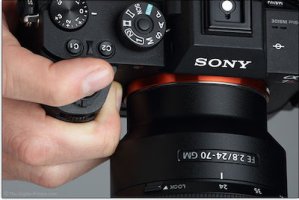
I still believe (regardless of flange distance / body thickness) this rig needs a proper 5D-like grip to it. More room for a larger battery, proper spacing from the lens mount for larger lenses (see pic), room for a top LCD and added controls, far more comfortable grip to wield whatever lens you want, etc.

- A
 

Attachments

  • Sony-24-70mm-GM-Lens-Grip 3.20.57 PM.jpeg
    Sony-24-70mm-GM-Lens-Grip 3.20.57 PM.jpeg
    32.1 KB · Views: 380
Upvote 0