Will it be the EOS M1? [CR2]

ahsanford said:
rrcphoto said:
there's nothing stopping canon from coming out with an A7II clone with the same cramped horrid ergonomics with the EF mount.

Agree, Sony's ergonomic decisions have been horrible.

I still believe (regardless of flange distance / body thickness) this rig needs a proper 5D-like grip to it. More room for a larger battery, proper spacing from the lens mount for larger lenses (see pic), room for a top LCD and added controls, far more comfortable grip to wield whatever lens you want, etc.

- A

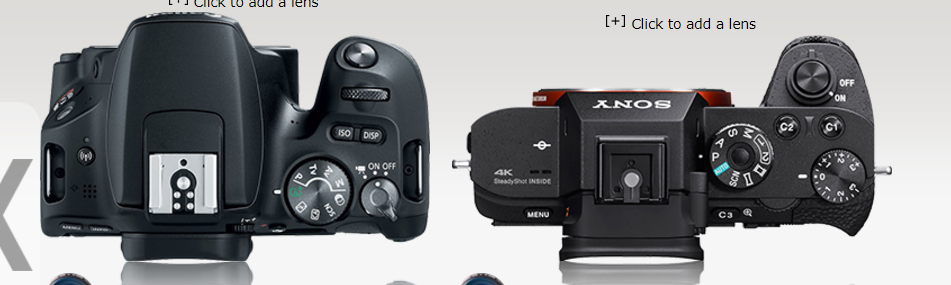
an EF mount camera with the same cramped ergonomics would be better because of the flange distance would be sticking out of the camera body more. providing a constant distance in between lens mount and grip.

whereas with the shorter registration distance, actually works against having a smaller body with bigger diameter lenses.
ca2a6c9f45f18ad7e34014365805d114.png


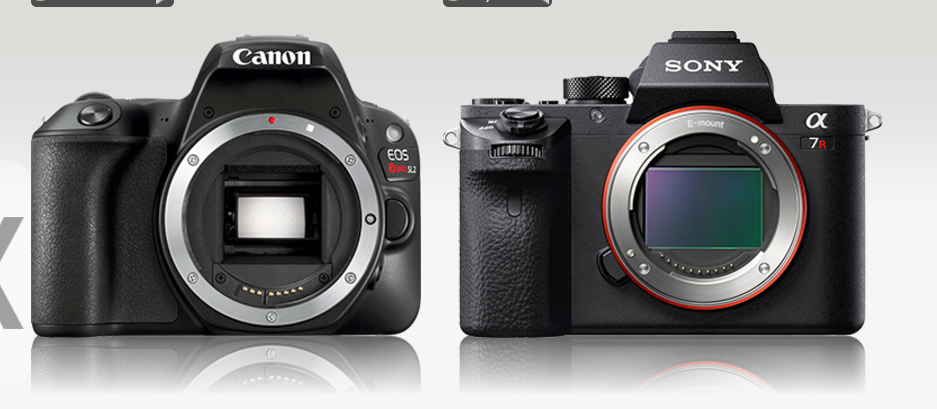
the SL2 with an EF mount is barely bigger than the A7II not to mention it has a built in flash which takes up more depth on the camera body. in both cases, the grip dominates the depth of the camera, not the mount.

you get rid of the flash, and move to an EVF, shorten the height because of no AF sensor at the bottom by 1-2mm and you have a camera full frame that is actually smaller and lighter than the A7II.

and it's an EF mount.

so the theory that you *must* go to a new mount to make a small camera is fictitious.
 
Upvote 0
neuroanatomist said:
jolyonralph said:
I can slip the A7RII and 35mm f/2.8 into a pocket. The 5DSR with 40mm 2.8 isn't bad, but it's certainly not pocketable.

Yes, both cameras are bulky when you add a 24-70 2.8 onto them, but the A7RII is no worse than the 5DSR in this case.

So you get benefits with some lenses, and with other lenses you are no worse off. So how in any reasonable view is this a disadvantage?

I have a NX1, and the 16-50mm F2.0 is a similar size to your lens. Holding it is NOT a problem, since the Samsung was designed with outstanding ergonomics. Even the 50-150mm lens, which is much bigger, feels perfectly natural, even when held with a single hand, due to the camera body design. It feels like a natural extension of my arm, whereas cameras like the 5D and 7D series are simply far to big to hold comfortable. With those cameras it feels more like you are trying to hold onto a big blob than the camera being an extension of yourself. The size of these cameras is an affection, a marketing effort so that consumers can feel "professional", they don't "need" to be that big. Historically SLRs which were the ancestors of todays FF Canikons were much smaller than todays cameras. Some were even smaller than the a7 series.

I use a 24-70/2.8 far more frequently than any prime lens, especially a relatively slow one. Holding and using a small body with a large lens is an ergonomic shitfest, which is a pretty big disadvantage in any reasonable view.
 
Upvote 0
rrcphoto said:
an EF mount camera with the same cramped ergonomics would be better because of the flange distance would be sticking out of the camera body more. providing a constant distance in between lens mount and grip.

whereas with the shorter registration distance, actually works against having a smaller body with bigger diameter lenses.
ca2a6c9f45f18ad7e34014365805d114.png

Both of those pictures make my fingers hurt just looking at them.

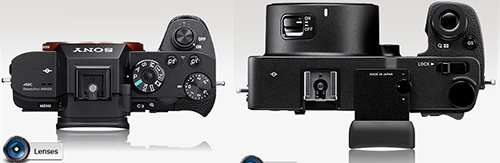
If it was full EF, I'd go more with the Sigma Quattro ILC setup, which uses that ugly but functional mount tube pushout -- at least that leaves room for the fingers!

- A
 

Attachments

  • a7 vs Sigma Quattro H.jpg
    a7 vs Sigma Quattro H.jpg
    46.1 KB · Views: 379
Upvote 0
ahsanford said:
If it was full EF, I'd go more with the Sigma Quattro ILC setup, which uses that ugly but functional mount tube pushout -- at least that leaves room for the fingers!

- A

the SL2 has far more room than the A7II. that's the top view.

52592e7242fc40f690a8f8683fff660f.png

however this is just an example that yes, you can make a small full frame mirrorless camera with an EF mount.

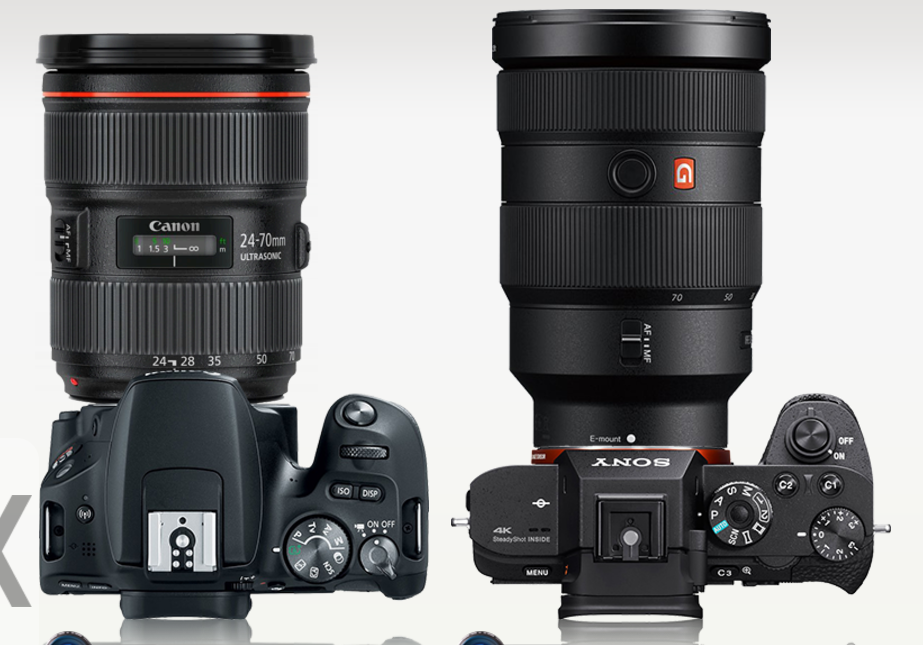
Consider with 24-70's.

7c53dda5a00d4c8d4ab81bcd7bcdd0dc.png


and you can see how having the EF mount on a small camera is actually a benefit. you have a constant finger width between the grip and the mount. not so with the E mount.
 
Upvote 0
ahsanford said:
rrcphoto said:
there's nothing stopping canon from coming out with an A7II clone with the same cramped horrid ergonomics with the EF mount.

Agree, Sony's ergonomic decisions have been horrible. Disagree with AvTvM that manufacturers should aim small and let us build up the housing/grip with add-ons. Optimize a purpose-built larger rig and it just sings. Throwing out sensor size / AF points / VF size, etc., compare the basic shooting experience of a 5D-level camera versus an SL1/SL2 and tell me which you prefer to actually handle, aim, adjust settings and shoot.

I still believe (regardless of flange distance / body thickness) this rig needs a proper 5D-like grip to it. More room for a larger battery, proper spacing from the lens mount for larger lenses (see pic), room for a top LCD and added controls, far more comfortable grip to wield whatever lens you want, etc.

- A

I absolutely hate Sony's ergonomics. It's so terrible that I would give up photography as a hobby and play video games and use a cell phone camera if all cameras were made like that. Poor ergonomics just sucks the joy out of using the device.

There is a build quality issue, too. I've never used an A9, but the A7 series cameras feel delicate and toy-like in comparison to Canon's similarly priced DSLRs. They have more handycam DNA in them than DSLR.

Since I don't think that DSLRs are too big or too heavy as professional or enthusiast tools, I wholeheartedly agree that a professional-grade mirrorless from Canon should be ergonomically pleasing in size and grip, and have battery life suitable for someone who wants to shoot for many hours without seeing low battery warnings and without having to resort to ridiculously constrained power saving modes that might be ok for snapping pictures while hiking, but just blacks out the screen at inconvenient times when you're engaged in photography.

rrcphoto said:
and you can see how having the EF mount on a small camera is actually a benefit. you have a constant finger width between the grip and the mount. not so with the E mount.

+1
 
Upvote 0
jolyonralph said:
amorse said:
According to images from the patent it does appear possible to flex the sensor from completely flat to curved - see the below article from CR and figure a) vs b). That does seem to indicate the sensor could flex that much, but again I haven't read or tried to interpret the actual patent. Also, I did see a report in July that Nikon patented a 35mm f2 lens for a curved sensor camera, so it does appear that a lot of companies are moving in that direction somewhat rapidly.

http://www.canonrumors.com/patent-electronic-curved-sensor/


Ah! Very interesting.

This could work very well if they can actually commercialise the technology. This is something far more important than flange distance that would justify a new lens mount.

Having a patent does NOT mean that you will actually be able to use it in a product, since there will probably be a lot of similar patents out there with overlapping claims. Even a bit of overlap can be enough for another company to block you from using the technology at all.

A lot of patents are filed by tech companies purely to block competitors, with no intention of ever being used in a product. Such is the nature of the tech business, especially when you are dealing with complex products that incorporate hundreds or thousands of pieces of IP. As consumers whatever you buy, no matter where it comes from, you are not getting the best thing the company can make due to this. Ever. There are a lot of improvements that a manufacturer would LIKE to add to a product, but can't because this or that piece of IP is owned by someone else.
 
Upvote 0
Talys said:
ahsanford said:
rrcphoto said:
there's nothing stopping canon from coming out with an A7II clone with the same cramped horrid ergonomics with the EF mount.

Agree, Sony's ergonomic decisions have been horrible. Disagree with AvTvM that manufacturers should aim small and let us build up the housing/grip with add-ons. Optimize a purpose-built larger rig and it just sings. Throwing out sensor size / AF points / VF size, etc., compare the basic shooting experience of a 5D-level camera versus an SL1/SL2 and tell me which you prefer to actually handle, aim, adjust settings and shoot.

I still believe (regardless of flange distance / body thickness) this rig needs a proper 5D-like grip to it. More room for a larger battery, proper spacing from the lens mount for larger lenses (see pic), room for a top LCD and added controls, far more comfortable grip to wield whatever lens you want, etc.

- A

I absolutely hate Sony's ergonomics. It's so terrible that I would give up photography as a hobby and play video games and use a cell phone camera if all cameras were made like that. Poor ergonomics just sucks the joy out of using the device.

There is a build quality issue, too. I've never used an A9, but the A7 series cameras feel delicate and toy-like in comparison to Canon's similarly priced DSLRs. They have more handycam DNA in them than DSLR.

Since I don't think that DSLRs are too big or too heavy as professional or enthusiast tools, I wholeheartedly agree that a professional-grade mirrorless from Canon should be ergonomically pleasing in size and grip, and have battery life suitable for someone who wants to shoot for many hours without seeing low battery warnings and without having to resort to ridiculously constrained power saving modes that might be ok for snapping pictures while hiking, but just blacks out the screen at inconvenient times when you're engaged in photography.

rrcphoto said:
and you can see how having the EF mount on a small camera is actually a benefit. you have a constant finger width between the grip and the mount. not so with the E mount.

+1

Canon 1/5/7D cameras are designed for large alpha males. For people with small to mid sized hands they are not the ideal size. Something with the approximate dimensions of a Rebel is more comfortable for those folk.

For me the higher end Canon cameras always feel like they are about to fall out of my hand because they are simply too big to hold properly. The buttons are not accessible, you have to move your hand physically while holding the camera by the lens with the other hand to reach them. It is just awkward, the cameras are incredibly poorly designed for most of the population (who are not large alpha males). You just don't get the confidence holding them that you do with the smaller bodies, and IMO creativity suffers as a result of that.
 
Upvote 0
Tugela said:
Canon 1/5/7D cameras are designed for large alpha males. For people with small to mid sized hands they are not the ideal size. Something with the approximate dimensions of a Rebel is more comfortable for those folk.

I have smaller hands and I can operate a 1/5/7 series camera without even taking my hands off the grip and they are distinctly comfortable to hold.
 
Upvote 0
I hope that Canons first MILC will be a high MP one like the 5DSR.
That could give users the possibilities to use EF-M lenses natively in some kind of crop mode with a compact overall size while maintaining a decent resolution and all the other EF lenses via an adaptor in FF-mode.
But I guess I am just dreaming
 
Upvote 0
Tugela said:
Canon 1/5/7D cameras are designed for large alpha males. For people with small to mid sized hands they are not the ideal size. Something with the approximate dimensions of a Rebel is more comfortable for those folk.

I'm 5'9" with a rather diminutive build, and slightly smaller than average hands. I generally don't like big beefy car steering wheels as they tend to tire my hands out, so I hear you.

When I jumped from a T1i to a 5D3, I admit I was concerned about the grip size at first. I felt like I jumped from a Honda sedan to a Cadillac SUV. It felt a bit too much. But over time, I realized my 'neurological mindset' / proprioceptive habits were trying to hold it like a Rebel. I had to somewhat de-program how that tinier T1i grip had informed how to hold a camera.

Closest analogy is realizing you've been unwittingly bowling with a ball that has too tight a hole spacing or playing hockey with too short a stick all this time. Once I just relaxed with the grip, I realized I didn't need to have my fingers clutching it in such a way and it just... got perfect. Hard to put to words. Other than maybe some extra 'landing' down by the battery cover that I could add for a more comfortable spread of my ring and pinky finger (which would ruin vertical grip compatibility), I would not change a single thing about the 5D grip. It's that good to me.

(I am not dismissing your concerns at all. You may have used a bigger grip rig for sometime and this never happened. Just sharing my experience, that's all.)

- A
 
Upvote 0
ahsanford said:
Disagree with AvTvM that manufacturers should aim small and let us build up the housing/grip with add-ons.
... room for a top LCD and added controls,

hell NO! mono-functional Tv dials, exposure compensation EV +/- dials and top-lcds were useful in the analogue FILM days. no need for them on any digital camera. 1 mode selection dial, 1 back focus button, 1 asterix button, 1 shutter button, 1 multifunction front wheel (and/or lens base ring!), 1 rear wheel, about 4 user assignable top deck and buttons (as Canon supplies in their EOS UI) and a fantastic, fully articulated, extremely responsive touch screen (like Canon has in some cams) are all the control points needed on a digital electronic camera.

all that freakin' 19th century steam-punk stuff - including aperture levers, dedicated "stop down preview" buttons and the like - needs to go. it should be relegated to totally stupid Nikon Df mirrorslappers and Leica red dot overpriced LeiLei land! but please! not on a finally upcoming Canon mirrorless FF EOS M1X ... !
 
Upvote 0
AvTvM said:
hell NO! mono-functional Tv dials, exposure compensation EV +/- dials and top-lcds were useful in the analogue FILM days. no need for them on any digital camera. 1 mode selection dial

Well, we all know that Canon doesn't give a crap about your opinion. But did Sony, perhaps, consult with you on ergonomics for their MILCs? ;)
 
Upvote 0
All of these "what is comfortable" comments are kind of funny. Within a reasonable range, what is comfortable is purely what you are used to. After a few months, most likely, someone who thinks the M series body is ideal, would easily adapt to a rebel sized body. Use that body for a couple years and a 5 series body would seem totally awkward if you changed back - until you got used to it, of course. Ergonomics is far more than size. The extent and shape of the grip are far more important than the overall size of the camera - something Sony can't seem to understand as the shape is all wrong and does not fit the hand. At least that is my experience after owning an Olympus OM-1, Film Rebel, Digital Rebel, 6D, SL1, and now an M5 and Olympus OM-D E-M1.

If you have a comfortable grip such as the SL2, this would seem to be an ideal size (or even a tad larger) for those that want smaller and still keep the EF mount. The idea that Canon needs to make a new mount to go smaller just doesn't carry any weight as so well demonstrated by rrcphoto's great examples..
 
Upvote 0
AvTvM said:
scyrene said:
sanj said:
One day there will be no mirror cameras. Current lenses will be challenged by smaller (comparatively) lenses with great IQ.

How do you propose mirrorless bodies will shrink lenses of 200mm and greater? Until and unless new optics are devised, the ergonomics of many types of photography will be governed by the lens size.

99.9% of all image captures are made with lenses far shorter than 200mm focal length. most smartphones use around 24mm eq. FOV. even in professional context, tele lenses are a rare exception, limited to very few specialized fields of photography.

there is a huge size andyweight advantage to be had for the vast majority of FF gear use, once mirrorbox and viewfinder prism are eliminated from the equation AND IF the new FF lens parameters (flange distance and throat diameter) are optimally chosen (unlike Sony E-mount which was designed for APS-C image circle and pressed into FF usage only as an afterthought).

only a new native mount with short(er) Flange distance offers the best if both worlds: smaller / lighter gear for most photographic purposes - especially "general photography" AND use of existing EF glass of any size - depending on purpose/capture situation/photographer's intent abd preferences (sports, wildlife, low light, small DOF, macro, micro .. whatever - combined still less than 1% of all use scenarios).

gradually and over many years to come Canon Users will switch over their existing EF lens parks (used on mirrorless FF cams via simple and cheap adapter) to newly designed, native "EF-X lenses" with further improved specs and image quality (eg that blue gunk coating stuff etc.). instead of an EF 24-70/4 L IS mk. II or Mk. III, more and more people will buy a new, somewhat smaller, lighter, and optically better native mount EF-X 24-70/4 IS ... L and non L versions abailable at different size and price points. a lot more lenses to be sold for Canon over many years to come ... for that reason alone the future is obvious.

I always wonder where people get their statistics for percentages. Also wonder why smartphones would even be included in this particular discussion. ???
 
Upvote 0
CanonFanBoy said:
AvTvM said:
scyrene said:
sanj said:
One day there will be no mirror cameras. Current lenses will be challenged by smaller (comparatively) lenses with great IQ.

How do you propose mirrorless bodies will shrink lenses of 200mm and greater? Until and unless new optics are devised, the ergonomics of many types of photography will be governed by the lens size.

99.9% of all image captures are made with lenses far shorter than 200mm focal length. most smartphones use around 24mm eq. FOV. even in professional context, tele lenses are a rare exception, limited to very few specialized fields of photography.

there is a huge size andyweight advantage to be had for the vast majority of FF gear use, once mirrorbox and viewfinder prism are eliminated from the equation AND IF the new FF lens parameters (flange distance and throat diameter) are optimally chosen (unlike Sony E-mount which was designed for APS-C image circle and pressed into FF usage only as an afterthought).

only a new native mount with short(er) Flange distance offers the best if both worlds: smaller / lighter gear for most photographic purposes - especially "general photography" AND use of existing EF glass of any size - depending on purpose/capture situation/photographer's intent abd preferences (sports, wildlife, low light, small DOF, macro, micro .. whatever - combined still less than 1% of all use scenarios).

gradually and over many years to come Canon Users will switch over their existing EF lens parks (used on mirrorless FF cams via simple and cheap adapter) to newly designed, native "EF-X lenses" with further improved specs and image quality (eg that blue gunk coating stuff etc.). instead of an EF 24-70/4 L IS mk. II or Mk. III, more and more people will buy a new, somewhat smaller, lighter, and optically better native mount EF-X 24-70/4 IS ... L and non L versions abailable at different size and price points. a lot more lenses to be sold for Canon over many years to come ... for that reason alone the future is obvious.

I always wonder where people get their statistics for percentages. Also wonder why smartphones would even be included in this particular discussion. ???

They make them up, of course, and this particular one is ridiculous.

The idea that folks are using small primes is very odd, since the majority of DSLRs and Mirrorless cameras are sold with kit lenses that are approximately 28-80 FF equivalent. Many folks like myself have been getting the newer "all-in-one" lenses. My main lenses on my two mirrorless rigs are 18-150mm on my M5 and 12-100 (equiv 24-200) on my M4/3 Olympus. These lenses are not getting shorter with any new mount.
 
Upvote 0
itsab1989 said:
I hope that Canons first MILC will be a high MP one like the 5DSR.
That could give users the possibilities to use EF-M lenses natively in some kind of crop mode with a compact overall size while maintaining a decent resolution and all the other EF lenses via an adaptor in FF-mode.
But I guess I am just dreaming

I think this is the most likely scenario I feel. Keeps it small for those who want something small. EF-M mount should technically be able to support FF like SOny e mount with same flange distance. So FF EF-M lenses should be able to be released. I personally like my EF-M lenses. They seem to outperform most EF-S lenses. For those who want to use a big lens on it, you can with the adaptor. I could see a weatherproof grade adaptor for FF mode, it wouldn't be called pro, but just designated with a II like how they upgraded their teleconverters to be weatherproof.
 
Upvote 0