


When you purchase through links on our site, we may earn an affiliate commission. Here’s how it works. |
The Sony A7 V has arrived, and we get to see now how Sony’s latest prosumer full-frame camera measures up to Canon’s latest prosumer full-frame, the Canon EOS R6 Mark III. So let’s dig into the Canon R6 Mark III and Sony A7 V comparison.
In prior years, we’d be talking about how Canon is chasing Sony, but now the script seems to be reversed, with the A7 IV showing its age even though it’s only 4 years old. Sony had to make an excellent camera to match the field of not only the Canon R6 Mark III, but Nikon as well, since Nikon is flexing its RED muscles.
So, in times past, Sony was able to coast a bit, knowing that whatever they came out with would raise the bar on what a camera should be; it’s now not really the case. Now, Sony must reach up to the bar.
The Sensors
The Sony sensor leverages lessons learnt from the Nikon Z6 III, using a partially stacked sensor, and improves on them. A partially stacked sensor is a vague term, and even when Nikon introduced it, Nikon was vague on what it actually is. Maybe Sony will whitepaper it and explain it better than Nikon did.
From what I understand is that the sensor is stacked “around” and actually on top of the sensor substrate portion containing the pixels, so the logic and ADC conversion areas are stacked to maximize performance, and the actual sensor pixels are essentially a normal back-side illuminated sensor. That being said, you may still get into performance issues with speed versus image quality, because the sensor pixel area is still non non-stacked sensor. But it should exhibit less of a problem with backside illumination versus Canon’s use of front side illumination.
This is going to be the big “forum difference” between the Canon EOS R6 Mark III and the Sony A7 V. While the Canon R6 Mark III is arguably faster at around a 13.5ms readout speed, the A7 V is no slouch either at 15.1ms. But the big difference to users will be that Sony does that with 14-bit readout, giving the Sony A7 V, arguably, around 1 to 1.5EV better dynamic range than the Canon EOS R6 Mark III when using the electronic shutter.

To be fair to Canon here, Canon has to move more pixels around than Sony does, as a dual pixel auto focus sensor has twice as the pixels as a regular sensor does. So Canon has to move around the equivalent of 66 million pixels versus Sony’s 33 million. This dual pixel sensor gives Canon a much broader auto focus coverage of nearly 100%, while the Sony A7 V uses spread out phase detection pixels throughout the sensor to derive around 90% coverage.
Sony touts that this camera has 16 stops DR, which sounds like video speak, and not stills. We’ll have to see what this sensor actually does in stills, as a lot of trickery can be done on video that simply does not work for stills photography. Keep in mind that Sony only provides 4K output, so in essence, reading out the full 7K video and downsampling will increase inherent overall image dynamic range by reducing noise – especially when Sony basically admits, there is noise reduction turned on by default. As they suggest by turning on a new mode called “angle of view priority” it disables the automatic in-camera noise reduction, go figure.
Again, Sony isn’t alone in this; all video camera companies tend to do things with video to improve their image quality, and Canon does as well. I mention this only to say that if you see a review touting the camera’s video dynamic range, there may not be a correlation to stills performance.
Video
I never thought I would say this, but it seems like Canon needs to sue Sony for patent infringement on the Canon cripple hammer, because Sony has decided to copy it. Behold the Sony Cripple Hammer™.
Sony has expanded its ILC lineup to include the FX series of camera bodies, so it could be that they didn’t want to cannibalize that lineup’s sales. But as Steve Jobs stated, “If you don’t cannibalize yourself, someone else will”. And now, it seems that Canon, Nikon, and Panasonic have far better featured video capabilities in their prosumer hybrid cameras than Sony.
While Open Gate for me is a nothing burger, for some people, I get it, and it can certainly be useful for choosing different aspect ratios after shooting. But more importantly, I think, is that there is no full-resolution video output from the camera. This eliminates any post-processing that you may want to do for noise, cropping, etc, that you would be afforded if you had 7K output.
More R6 Mark III Comparisons

Also, with that, the camera shoots no RAW video formats, which also makes me wonder how much of that 16 top DR is some software magic that RAW output would not have. With Nikon, Panasonic, and Canon all offering far more recording options, this again seems like a miss. Sony does, though, have a faster slow motion mode, capable of up to 240fps, while the Canon R6 Mark III is limited to 180fps, but conversely, the Canon R6 Mark III offers 120fps 4K at full sensor width, while the A7 V requires a 1.5x crop for 4k120p.
Canon also, for once, offers more video composition tools, such as waveform, than the Sony A7 V. See the cripple hammer for more details. But Sony does have some tricks, such as its auto framing.
Overheating seems to be in the Sony A7 V’s favor, though, with times limited down to 30 minutes or so at 4k60p fine mode, depending on your video record options on the EOS R6 Mark III, and Sony claims the A7 V can record up to 90 minutes of 4k60p. Both cameras offer essentially unrestricted recording on their lower, less intensive video record settings.
The Camera
Outside of the sensor, there are some differences between the Sony A7 V and the Canon EOS R6 Mark III that I appreciate from both companies. I personally never liked the side articulating screen that Canon has kept on all its cameras since the EOS 60D. Sony, on the other hand, has adopted quite a few different hinge configurations over the years, and this latest one seems to offer an excellent compromise that I would wish Canon would explore.
While the hinge assembly seems to make the LCD on the A7 V stick out a bit more in its resting position, it allows for both a side articulating view for video, a tilting screen for photography, and thus a more waist-level looking down at your camera approach. The tilting screen is something I miss coming from the EOS-M series of cameras, such as the M5 and M6. The screen itself is larger on the A7 V, with it being 3.2″ and a 2.09 million dot display, versus the Canon 3″ 1.62 million dot display. But to be honest, it feels as if the Sony screen is too big for the camera body, as the rear controls are all squished. Something that seems to be a consistent theme with the Sony A7 V.
Pre-Order the Sony A7 V
The EOS R6 Mark III has a much more substantial grip and also more room between your right-hand fingers gripping the camera and the lens mount. Sony’s desire to squish that space down to the bare minimum when the lens release button is like, RIGHT THERE (not to mention the lens release for teleconverters), seems like such a weird thing to do. I’m sure some Sony fans will tell me this is the right way of doing things, but there’s a reason why Canon and Nikon purposely put the lens release on the other side. I can only assume the Sony method dramatically increases lens sales and lens repair profits.
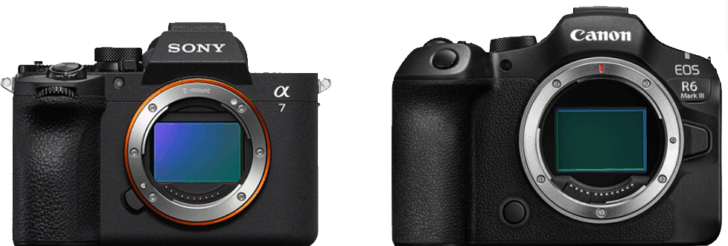
The same can be said for the top. While one-handed operation seems excellent, as Sony offers plenty of controls, you don’t have to remove your hand from supporting the lens. But it seems as if Sony’s right-handed operation forces you to do things unnaturally anyway, such as the dual adjustment mode dial, which has the lever adjusted from the front of the camera; instead, Canon placed that over on the left side.
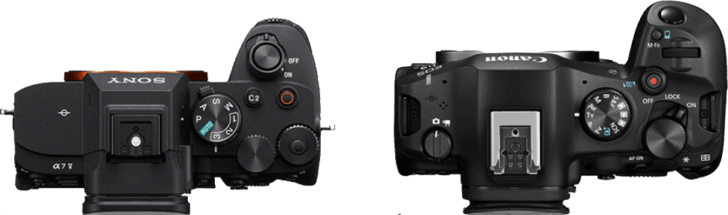
The positioning of the record button and C2 just seems like a glove nightmare waiting to happen, while Canon separates the m-fn and the record button on either side of the aperture/shutter speed dial, aka the main dial, minimizing accidental presses. Same with the mode dial lever to the front of the camera. Gloves? Good luck. I do like that Sony has two control dials on the right-hand upper top, versus Canon’s single dial and control dial arrangement, though in practice, those two dials seem really close together and gloves again. Maybe it’s the Canadian in me, but I have taken pictures at -60C, and I think I had on two pairs of gloves while doing so.
To be fair to Sony here, this is the same layout format as their top-tier A9 and A1 series cameras, so for Sony users, switching between cameras would use basically the same muscle memory on controls.
I forget who said it, but this seems prevalent for their entire camera line, as someone aptly put it that it seemed like their cameras were designed by the same people who designed the TV remote controls. I do appreciate that the Sony A7 V is much smaller and more compact than the R6 Mark III, and making a camera that small does come with compromises. However, if I had to use one of these cameras for long durations of time, there’s only one I would want to – and the Sony isn’t it.
Battery life is simply incredibly good on the A7 V, offering up to 630 shots using the EVF and 750 shots using the LCD, as determined by CIPA standards. In the real world, your actual shots per charge will vary, usually quite wildly from CIPA testing measurements. This is one of the last bastions that Sony simply excels at over Canon’s mirrorless cameras (Sony stomps all over Canon – it’s not close). But for stills, this really isn’t much of a problem anymore. It’s not as if Canon’s cameras are like Sigma’s Merrill compact cameras (which, from reading some threads today, you’d think they were). That being said, the difference is substantial by CIPA standards.
Closing Thoughts
It used to be where we’d have to come up with excuses for why Canon couldn’t match Sony’s level of expertise, whether it be for auto focus, video, etc. But these days, both companies are pretty much the same, and the differences in most cases are limited to forum wars. These two cameras are excellent, and unless you are in an extreme edge case, there would be little reason why you’d switch from either Canon or Sony simply for either camera.
Comparison Chart
| Sony a7 V | Canon EOS R6 III | |
|---|---|---|
| MSRP (US/UK) | $2899 / £2799 | $2799 / £2799 |
| Sensor type | Partially stacked CMOS | Dual Pixel AF FSI CMOS |
| Resolution | 33MP | 33MP |
| Viewfinder res/ magnification/eyepoint | 3.69M dot 0.78x 23mm | 3.69M dot 0.76x 23mm |
| Rear screen | 3.2″ 2.09M dot Tilt + Fully articulating | 3.0″ 1.62M dot Fully articulating |
| Image stabilization | 7.5EV | 8.5EV* |
| AF subject detection | Human Animal Bird Insect Car Train Plane Automatic | Human Animal (Dog / Cat / Bird / Horse) Vehicle (car, motorcycle, plane, train) Automatic |
| Maximum burst rate | 10fps mech. 30fps e-shutter (14-bit) | 12fps mech. 40fps e-shutter (12-bit) |
| Pre-burst capture? | Variable, up to 1 sec | Yes, up to 0.5 sec |
| Stills rolling shutter rate (ms) | ∼15.1ms | ∼13.5ms (12-bit) |
| HDR still output | HLG HEIF (no Raw) | PQ HEIF |
| Video resolutions | UHD 4K/60 (full-width, oversampled) UHD 4K/120 (1.5x crop) 1080/240 | 7K DCI/60 (Raw) 7K/30 open-gate 4K/120 (full-width, oversampled ≤60p) 1080/180 (full-width) |
| Raw video (internal) | No | C-Raw |
| Video assist tools | Log view assist Custom LUTs Auto Framing Framing Stabilizer | Waveform False color Log view assist Custom LUTs |
| Media types | 1x CFexpress type A/UHS-II SD 1x UHS-II SD | 1x CFexpress Type B 1x UHS-II SD |
| Battery life EVF / LCD | 630 / 750 | 270 / 510 |
| Dimensions | 130 x 96 x 72mm | 138 x 98 x 88mm |
| Weight | 695g (24.5oz) | 699g (24.7oz) |
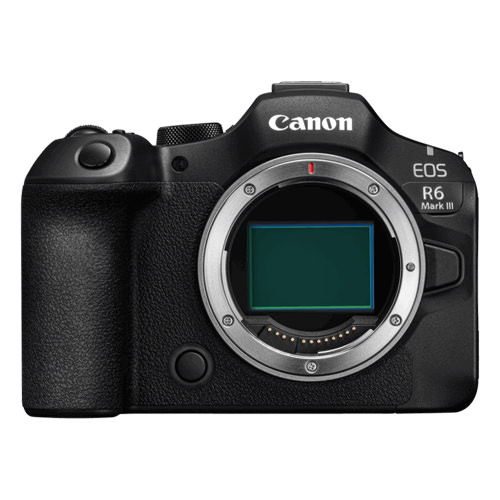
MSRP: $2799 • €2899 • £2799
32.5MP Full-Frame CMOS Sensor
7K 60p 12-Bit Internal RAW Light Video
Open Gate 7K 30p, High-Speed 4K 120p
Dual Pixel CMOS AF II & Movie Servo AF
Up to 40 fps & Pre-Continuous Shoot Mode
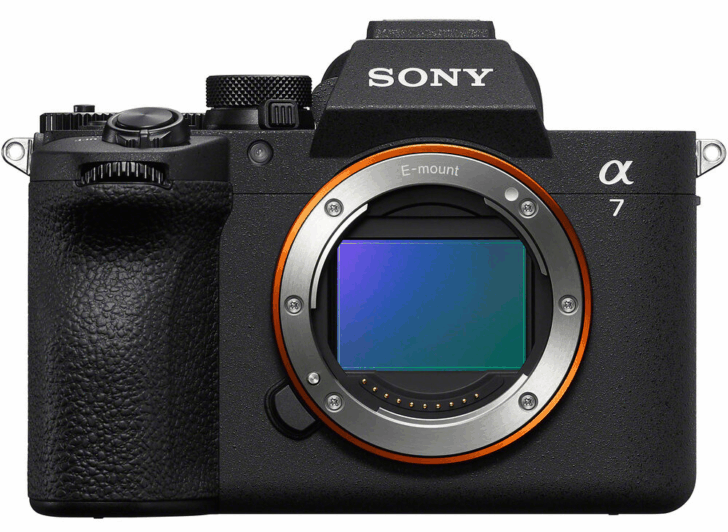
PREORDER the SONY A7 V



My hands are cramping just looking it at it. 😀
Lenses definitely matter. There can be 200 lenses available, how many are you actually buying? (some of us crazies around here aside). Some of the unique and niche ones will sway some customers for sure.
We live in a multi-crop video world. The lack of Open Gate will sway some. I wonder if cooling played a factor? Photography wise, I have no idea how anyone uses these things. I know ergonomics are a personal, but at a point... they're just bad.
Hopefully the A7IV's will start to flood the used market with some nice low prices
I own none of these lenses but would start like this. No need for 3rd party.
(Unfortunately, surgery didn't cost me a cent.)
If only I lived in the USA, I could make a fortune with help by an "ambulance hunter", after having spent it on hospital costs...
But yes, Sony A7 V is also a good Camera. Especially if you need one ore both lenses.
But boy, they got marketing clout to spare, especially the Youtubers.