


When you purchase through links on our site, we may earn an affiliate commission. Here's how it works. |
I have spent the last bunch of days going over the entire Canon lineup and getting a sense of what technology is in each lens. I was interested in knowing what type of focus motor each lens uses.
Canon currently uses 6 different types of focus motors. Dual Nano USM, Nano USM, Ring-Type USM, STM and VCM, which has been paired with Nano USM for all but the RF 14 f/1.4L VCM, which utlizes dual VCM motors.. We won't talk about the DC motor in the RF 75-300 f/4.5-5.6, as no other lens uses it and no other lens ever will.
The future of focus motors in Canon L lenses is likely going to be the VCM setup, and perhaps Dual Nano USM. They'll also continue to improve STM motors, the latest version is very good.
Observations
What I have noticed is a lot of the Ring-Type USM lenses are out of stock at major retailers, or at least very low in stock. A couple of retailers have said they have the lenses on order, but don't know when they'll be delivered.
The first thought is whether these lenses are going to be replaced in the coming year.
In the past, this has been a hint for new versions, though it's not guaranteed. Perhaps there is a supply chain or manufacturing issue, or it's simply that Canon makes ring-type USM motors in batches and they were focusing on other motors
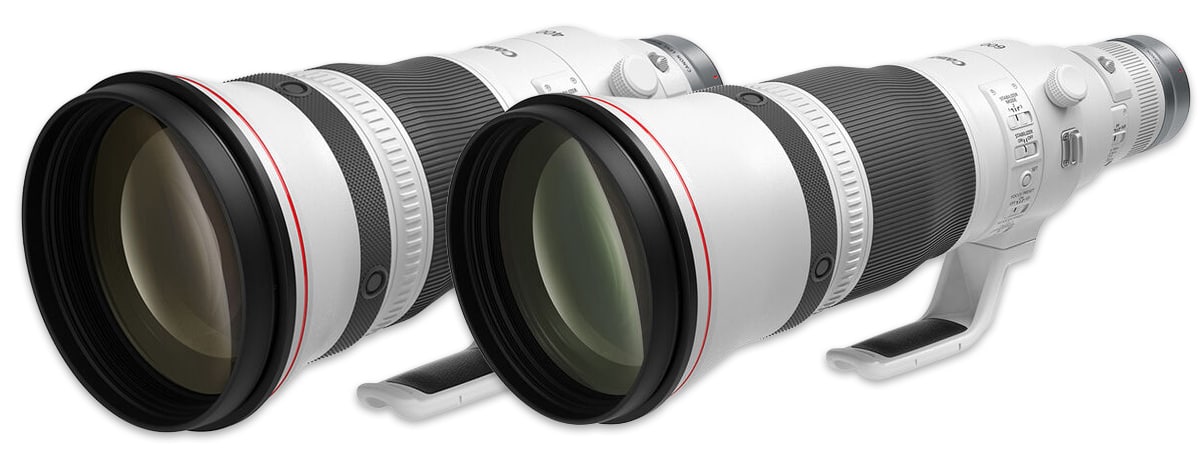
Canon Ring-Type USM Lenses
- RF 28-70mm f/2 L USM (Announced September 5, 2018)
- RF 50mm f/1.2 L USM (Announced September 5, 2018)
- RF 85mm f/1.2 L USM (Announced May 9, 2019)
- RF 85mm f/1.2 L USM DS (Announced May 9, 2019)
- RF 400mm f/2.8 L IS USM (Announced April 13, 2021)
- RF 600mm f/4 L IS USM (Announced April 13, 2021)
- RF 800mm f/5.6 L IS USM (Announced February 23, 2022)
- RF 1200mm f/8 L IS USM (Announced February 23, 2022)
The first thing that jumps out is that all of these are older lenses. If we consider that the RF 400 f/2.8 L IS USM and RF 600mm f/4 L IS USM were designed for the EF mount and launched in 2018, they are as old as the others on the list.
The RF 800mm f/5.6 L IS USM and RF 1200mm f/8 L IS USM are simply the RF 400 2.8 and RF 600 f/4 lenses with teleconverter added internally. So, they too are older designs.
I think it's obvious that the “big white” lenses are due for replacement due to their older design and there have been a lot of signs that it's going to happen sooner than later. I wouldn't be suprised to see at least a development announcement ahead of the World Cup in June.
I do have a crazy thought that both the 400 and 600 will be equipped with a built-in 1.4x and 2.0x extender. That would take care of ever having to make another 800mm or 1200mm lens. There is more money to be made making more of the same thing. I think the high prices of the latter lenses is due to economies of scale.

The f/1.2 Prime Lenses
The 50mm f/1.2L USM and 85mm f/1.2L lenses are out of stock in a lot of places, and I haven't see that for their entire existence. I think both of these lenses are in need of an update. It'd be nice to trim some size and weight from them. Heck, make them f/1. One can dream.
I hope to heck that if Canon is winding down production of the f/1.2 prime lenses that they don't think they can just roll with the VCM versions. While I own both the 50 f/1.4L VCM and 85 f/1.4L VCM lenses, there is a big need for the existence of the f/1.2 lenses. That would really tick off a lot of shooters.
The RF 28-70 f/2L USM is showing its age. Sony chopped a ton of size and weight off of their version and it's a fantastic lens.
Something to think about
I just wanted to share some observations from the last week as I build out a new feature for the web site. I'm not sure if it's sad that I analyze this stuff to such a degree, but my bigger interest lies in the business side of things more than the technical.
This could be much ado about nothing and as I mentioned, it could be a supply chain or manufacturing thing, but why continue to make something that you're likely never going to put in future lenses?
Food for thought and perhaps dreams.






Having one big, heavy focusing group necessitated Ring USM to move it fast enough. Even then, sometimes that wasn't very fast – like with the EF 85/1.2L (I and II), where the 'focusing group' was all of the glass in the lens except the thin rear element. One reason the RF 85/1.2L focuses much faster is that the focusing group is smaller, only 7 of the 13 elements and not including the two largest ones in front, but it still needs Ring USM to move it.
Thanks, I missed the Dual VCM on the 14. Here I had thought I had researched well.
VCM dual motor setups will have no problem moving large groups going forward. I think it's over for the rings. Nano and VCM are also easier to repair
- they are all heavy lenses
- at least the 50/85 primes and 28-70mm suffer (heavily) from focus breathing.
Of course, this could all be due to old lens designs. But maybe Canon hit a wall and realized that lighter or improved focus breathing is not possible or possibly ineffective with ring type usm. For me, this would (it´s all very hypothetical) make sense. Canon realized that these lenses have flaws which need a major redesign. Therefore, they might skip ring type USM and go ahead to develop the lenses differently.
This needs time and would explain the otherwise inexplicable long and silly absence of the 35mm F1.2. I always suggested, Canon skipped the lens because it fits the exact same built type as the three lenses above and the competition made better in the meantime. Also, I've always speculated that the 35mm F1.2 will feature new tech, be lighter and won't suffer from focus breathing.
I could see that as the main drawback of the focusing tech for hybrid shooters.
Geopolitics may be causing this.
I doubt any RF lens will get a Series II before 2028 or 2030. Based on EF L refresh cycle's typically every decade, dozen years or 2 decades.
Last month I started using the 2024 R1 on an 2006 EF 85mm f/1.2L II with DLO and other optical correction improvements enabled.
The EF 85mm's AF response time, focus speed and accuracy is as if I was upgraded to a Series III lens. Especially when the SOOC JPEG were largely missing CA and LoCA!
I used it effectively for evening indoor and outdoor pickleball. It locks into the head/eyes then rarely lets go of the AI Servo focus of it.
When I attach the R1 to a 2001 EF 70-200mm f/2.8L IS Series I it had difficulty locking onto focus for more than 20% of the action shots.
Having said that I wish I sold all my pre-2006 EF lenses & 2008 5D Mark II & 2009 1D Mark IV before 2018.
To maximize R1, R5 Mark II, R3 and R7 would be to use RF L lenses like the RF 70-200mm f/2.8L IS USM Z.
Canon, please put the fastest and most accurate AF into your lenses.
And if it is quiet, too, that would be perfect.
If this means that Ring USM is dead than that's the way of innovation and evolution.
What I want to see is for Canon to stop putting STM AF into lenses. There is no excuse for Canon to still be using STM. It's not fast enough and not good enough for the level of micro-adjustment needed by today's AF systems.
Ring USM was all about performance in the context of photography, manufacturing at scale, and reliability. Anything that replaces it with rock solid performance that can be achieved at quantity and be occasionally hit against a rock is equally a good solution. It looks like VCM is increasingly carrying the torch.
From a personal opinion standpoint, I dislike anything that can break when twisted and the power is off. So for the way some gear drives have been implemented I tend to avoid them in any brand's makeup.
But looking at the EF lens catalog, many of the initial offerings were limited in their drive capability. I stopped counting at 41, but glancing ahead on the page more than 41 EF lenses used gear or PZ or other drives. I don't think RF is doing anything different here in terms of equivalency. I think that where the RF lens stable is avoiding high performance drives in the 2020s is surprising to me, but Canon must have its reasons.
Of course, I only own USM EF lenses — save for the 40mm 2.8 STM — because I have other tools or remote / external mics for video. So I don't care if they're a little noisy — I care that they're responsive for their purpose. Also, while some USM lenses moved enough glass to be slow as compared to many, for typical use cases they AF just fine (the 50mm 1.2 is a typical portrait lens, for example, not an F1 straightway snapper — my peeps just don't move in a blurring motion; even the kids aren't that fast).
USM, VCM, whatever. Just be fast, reliable, and tough. Oh, and Canon — please stop releasing $2.5k+ lenses without focus rings. The sports folks might not care, but some of the rest of us do. 😎 Not that my opinion matters here. 🙃 A 200-800 lens without a dedicated focus ring is, well, just silly. In my opinion, of course.
I’d love to see winning EF designs recycled into quality but relatively affordable consumer lines that keep prices down by avoiding the glass R&D costs to keep OEM lenses with Canon benefits like DLO more affordable for younger shooters. I doubt that will happen any time soon, but over the expected life of the RF line probably not crazy.
I suspect a redesign would be needed, for either a smaller focusing group or two focusing groups. I believe Ring USM is still more powerful. Compare the focusing group of the RF 85/1.4L VCM (3 elements) with that of the RF 85/1.2L (7 elements), for example.
I still have an EF 35-135 USM which is not the sharpest of lenses, but I have kept it as a souvenir of those days.