
Japan BCN Sales for January 2025

Richard Cox
3 Min Read

When you purchase through links on our site, we may earn an affiliate commission. Here's how it works.

BCN is a top retail sales data aggregation company for the Japanese market. It gives us an excellent idea of what and who sells in Japan. I would imagine that BCN, outside of China's sales data, probably drives a lot of what Japanese companies do regarding products.

So why do you care? The companies near and dear to our little hearts are Japanese-based companies. They have a strong sense of tradition and pride in the Japanese market. Also, the Japanese market usually allows us to see trends early. As trends start to happen in Japan, we see these trends ripple out to other regions afterward.

It should be noted that BCN is simply units sold. Lower-cost cameras tend to sell in more volume than higher-cost items, so the data can be a bit disproportionate when it comes to total value market share.

According to BCN, Sony continues to sell very well in Japan and controls the market with 29.7% of retail sales; Canon is second with 26.3% of the market share.
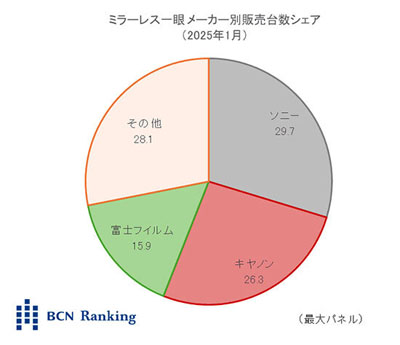
In the above graph, grey is Sony (29.7%), red is Canon (26.3%), and green is Fujifilm (15.9%). The rest of the market is represented by pink (28.1%)

The Canon EOS R50 was the top-selling camera in Japan for January 2025, but Canon was fairly quiet in the top 10, only having the EOS R10 and EOS R50.

Fujifilm continues to do well with the X-M5, which also caused Fujifilm to move into the number 3rd overall position for the first time since last August, overtaking Nikon by gaining 4.6% over the prior month.

Nikon continues to struggle somewhat with sales, and for the life of me, I have no idea why that is. I know Nikonians will state that Nikon isn't chasing the volume and market share, but that's a bad way of doing things. Mount market share is essential, especially when you want to attract third-party manufacturers to make stuff for your cameras. It is usually a good indicator of how active the used market is and, as well, simply your presence in the market.
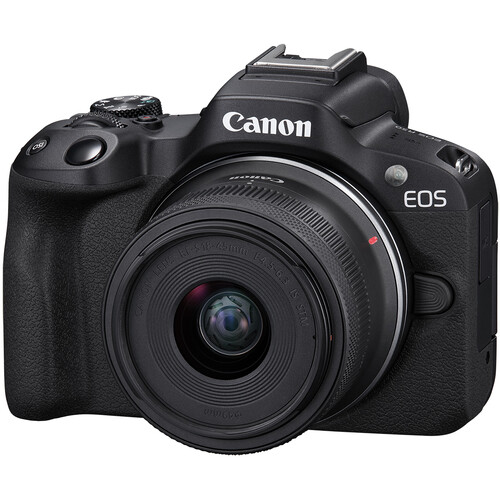
Canon EOS R50 – Japan's top selling camera of Jan 2025

The top cameras in Japan for January 2025 are;

  1. Canon EOS R50
  2. Sony VLOGCAM ZV-E10 II
  3. Fujifilm X-M5
  4. Sony VLOGCAM ZV-E10 II
  5. Sony A6400
  6. Canon EOS R10
  7. Olympus Pen E-P7
  8. Nikon Zfc
  9. Sony A7C II
  10. Panasonic Lumix G1000

I know the sharp-eyed ones out there will notice the PEN E-P7 on the list. That usually happens when a company dumps a camera onto the market at large discounts and also with multi-lens kits. Those tend to distort the market a bit, as they are volume sellers in Japan.


Source: BCN via Digicame

Go to discussion...

Share This Article
Follow:
Richard has been using Canon cameras since the 1990s, with his first being the now legendary EOS-3. Since then, Richard has continued to use Canon cameras and now focuses mostly on the genre of infrared photography.

41 comments

  1. I know Nikonians will state that Nikon isn’t chasing the volume and market share…
    That’s like when people say, “I don’t want to be rich, I don’t know what I’d do with all than money, anyway.”

    When you don’t have it, for some it’s a mental balm to say that you don’t want it.

    Nikon did have it…and lost it.
    • 0
  2. That’s like when people say, “I don’t want to be rich, I don’t know what I’d do with all than money, anyway.”

    When you don’t have it, for some it’s a mental balm to say that you don’t want it.

    Nikon did have it…and lost it.

    for reals. for reasons really unknown to me. their cameras seem top notch even from the initial Z entries, good sensors, great lenses. even came out with APS-C before Canon did.

    Smarter people then me probably know why I guess.

    Edit: did they mess up the legacy F-mount compatability? I can't recall.
    • 0
  3. for reals. for reasons really unknown to me. their cameras seem top notch even from the initial Z entries, good sensors, great lenses. even came out with APS-C before Canon did.

    Smarter people then me probably know why I guess.

    Edit: did they mess up the legacy F-mount compatability? I can't recall.
    The specifications of the R6 and R5 ran rings around the original Z6 and Z7.

    According to Ken Rockwell, the Z mount adapters seem compatible with most of their old lens types: https://kenrockwell.com/nikon/mirrorless/lenses/ftz.htm

    Sony manufactured the sensor’s for Nikon’s recent DSLR’s, I guess that made jumping to Sony mirrorless camera’s easier for Nikon owners.
    • 0
  4. The specifications of the R6 and R5 ran rings around the original Z6 and Z7.

    According to Ken Rockwell, the Z mount adapters seem compatible with most of their old lens types: https://kenrockwell.com/nikon/mirrorless/lenses/ftz.htm
    Odd that you should say that, because in my opinion, the Nikon offerings were similar to Canon's and definitely cheaper, if not at launch, but within a short time. The Z5, while not cheaper than the RP, was so much better spec and IQ wise, with Canon still using their old, non on-sensor ADC. I bought a used Nikon Z7 for $1700 when a used R5 could not be had for less than $3000. The difference in price between the cameras, and some better Nikon lens offerings, made me switch from Canon to Nikon a couple years ago. Alas, Canon color brought me back. I could not deal with the different, colder, more "metallic" (for lack of a better term) color that Nikon produces.

    It's funny how when people talk about market share and why some companies are doing well and others struggling, few people mention the main factor today in buying decisions, and that is the internet, social media and YouTube reviewers and influencers. Some of the top influencers mocked Nikon for years. Others, especially 5-10 years ago, sang Sony's praises to the roof (even thought their first 2 generations of cameras were crap). Guess who rose and guess who fell?
    • 0
  5. for reals. for reasons really unknown to me. their cameras seem top notch even from the initial Z entries, good sensors, great lenses. even came out with APS-C before Canon did.

    Smarter people then me probably know why I guess.

    Edit: did they mess up the legacy F-mount compatability? I can't recall.
    F-mount compatibility was fine. The only issues with the mount were historical, but that was a generational thing (when Canon switched to EF for autofocus and Nikon kept F and put AF motors in some lenses and some bodies, you needed a guidebook to know which lens worked with which camera...except in those days you didn't really need to know because you just told the people behind the photo store counter what camera you had, and they told you which lenses you could buy).

    IMO, it was Nikon's failed initial attempt at MILCs. Sony led the way (running away from CaNikon's dominance of the much larger DSLR market). The Nikon 1 system had some nice aspects (I still regret not buying the AW 1 and the waterproof lenses) but the 1" sensor killed it. Canon succeeded like gangbusters with the M series, which became the most popular MILC line globally and assured their continued market domination as the industry transitioned to mirrorless. Nikon missed the boat, and once they started with 'real' APS-C and FF MILCs, they were already bleeding market share to the point that recovery is a long road (so long they may never regain their long-time #2 market position).
    • 0
  6. Sony manufactured the sensor’s for Nikon’s recent DSLR’s, I guess that made jumping to Sony mirrorless camera’s easier for Nikon owners.
    I doubt that many people (other than small fraction of buyers who spend too much time on photography forums) knew or cared who made the sensors in Nikon ILCs.
    • 0
  7. Odd that you should say that, because in my opinion, the Nikon offerings were similar to Canon's and definitely cheaper, if not at launch, but within a short time.
    Better specifications of the R6 and R5, among others: better AF, higher speed, fully articulation screen, the R5 has a higher resolution viewfinder and better video.

    You are probably right about the influence of the Youtube “experts”, @neuroanatomist is right about Canon’s success with the M-series.
    • 0
  8. I doubt that many people (other than small fraction of buyers who spend too much time on photography forums) knew or cared who made the sensors in Nikon ILCs.
    You are right, only the “experts” know who makes the sensors, and the “experts” are a minority among camera buyers.
    • 0
  9. for reals. for reasons really unknown to me. their cameras seem top notch even from the initial Z entries, good sensors, great lenses. even came out with APS-C before Canon did.

    Smarter people then me probably know why I guess.

    Edit: did they mess up the legacy F-mount compatability? I can't recall.

    This doesn't really seem like a fair assesment of Nikon's market share. BCN sales data fluctuates wildly from month to month depending on the latest releases. They were up to over 17% market share in June 2024. A better view is where they end up for the entire year. You previously wrote an article about the 2024 BCN data for the entire year titled: "BCN Awards 2025: Sony and Nikon make Significant Gains in Japan"

    Seems odd to say Nikon has made gains over the entire year of 2024 and then knock them on market share a month later.

    In their financial reports Canon went from 2.88M DILC's sold in 2023 down to 2.84M DILC's sold in 2024 for a -1% growth rate. Meanwhile Nikon went from 700k DILC's sold in 2023 to 800k DIlC's sold in 2024 for a 14% growth rate. Nikon's market share increase for 2024 was the most of the big 3.

    Not that DSLR's matter much these days but they also grew their market share by almost 4% while Canon lost almost 8%.

    Canon's camera revenue grew 6.5% while Nikon's camera revenue grew 10.8%.

    Canon is clearly leading the market but what more do you want from Nikon? They grew their market share in terms of both units sold and revenue more than Canon did.
    • 0
  10. Canon is clearly leading the market but what more do you want from Nikon? They grew their market share in terms of both units sold and revenue more than Canon did.

    I guess the entire overall thought on that escaped you. So let's deal with it.

    Both Nikon and Canon had huge installed DSLR bases, and 10's of millions of legacy DSLR lenses. Canon stumbled with the RP and R and really didn't get going until the R5 and R6 models came out - almost 2 years after they released the RF mount.

    Meanwhile, both of nikon's lenses the Z6 and Z7 were objectively far far better than the RP and R, and included IBIS. Nikon even released their APS-C Z mount camera, again before Canon.

    All said, Nikon did more, and did it quicker than Canon, but failed to execute the pivot in terms of keeping their marketshare.

    That really wasn't that hard to get from my commentary on Nikon. it has nothing to do with the last quarter. Nikon is a distant third to Canon and Sony, and may even fall to a forth position if Fuji has a strong year. This is down from the DSLR days when Canon and Nikon would be neck and neck in marketshare for a significant period of time, and push each other to come up with better cameras and lenses.

    also: 14% of nothing is still nothing.
    • 0
  11. I guess the entire overall thought on that escaped you. So let's deal with it.
    Maybe it’s just an extension of the participation trophy mindset that seems so prevalent these days.

    “Great job, Nikon!” *pats Nikon on the head* “You barely managed to hang on to 3rd place in the race, but your time was 14% faster than last week, and the first place kid was 1% slower than last week, so you’re the real winner!! Here’s your participation trophy…”
    • 0
  12. Meanwhile, both of nikon's lenses the Z6 and Z7 were objectively far far better than the RP and R, and included IBIS. Nikon even released their APS-C Z mount camera, again before Canon.
    I know "objektiv" is lens in many languages, but I think the Z6 and Z7 are cameras. 😉
    • 0
  13. “Great job, Nikon!” *pats Nikon on the head* “You barely managed to hang on to 3rd place in the race, but your time was 14% faster than last week, and the first place kid was 1% slower than last week, so you’re the real winner!! Here’s your participation trophy…”
    A closer analogy is "Great job, Nikon! Your lap times have improved a lot. You're not only quickly catching up with the front runner but they're slowing down a little."

    It's not like it's a new race that restarts each year.
    • 0
  14. A closer analogy is "Great job, Nikon! Your lap times have improved a lot. You're not only quickly catching up with the front runner but they're slowing down a little."
    Clearly data analysis isn’t your forte. Canon sold 3.5 times as many ILCs as Nikon last year and 4 times as many the year before. That’s not ‘quickly catching up’. When you’ve been lapped a few times, catching up is hard.
    • 0
  15. I guess the entire overall thought on that escaped you. So let's deal with it.

    Both Nikon and Canon had huge installed DSLR bases, and 10's of millions of legacy DSLR lenses. Canon stumbled with the RP and R and really didn't get going until the R5 and R6 models came out - almost 2 years after they released the RF mount.

    Meanwhile, both of nikon's lenses the Z6 and Z7 were objectively far far better than the RP and R, and included IBIS. Nikon even released their APS-C Z mount camera, again before Canon.

    All said, Nikon did more, and did it quicker than Canon, but failed to execute the pivot in terms of keeping their marketshare.
    ...
    I know people don't really want to believe in the power of the internet, social media, and YouTube, but it explains the rise of Sony and the fall of Nikon. The Nikon Z5, Z6 and Z7 were better cameras for the money than any Canon or Sony offering at that time, in my opinion. Nikon Z lenses are as good, and is some aspects (focus breathing for one) better than Canon and Sony offerings. Certainly Nikon had as good a name recognition for camera buyers as Canon and Sony. They lost share to Sony because Sony dominated the internet marketing. I am sure I was not the only "victim" of the huge Sony infiltration of internet forums, with their propaganda and "trolls' constantly talking up Sony's huge advantage in camera tech. I had just bought a Canon 6D when I discovered various internet forums, and soon was told in no uncertain terms how Sony's A7 I and II were far superior. So, I bought the A7 II, thinking to replace my 6D. It was, by far, the worst camera I ever bought. I thought it must be defective (underexposed by 1 1/2 stops, very dim EVF, kit lens that was awful away from the center, etc.) so I exchanged it for a considerably cheaper a7 mark I. All the same issues and ergonomically even worse. And yet, somehow, Sony was able to build a large market share on these first 2 generations of cameras, that others more knowledgeable than I, came to refer to as "Beta" releases. There is only one logical explanation...internet marketing and influence.
    • 0
  16. I know people don't really want to believe in the power of the internet, social media, and YouTube, but it explains the rise of Sony and the fall of Nikon. The Nikon Z5, Z6 and Z7 were better cameras for the money than any Canon or Sony offering at that time, in my opinion. Nikon Z lenses are as good, and is some aspects (focus breathing for one) better than Canon and Sony offerings. Certainly Nikon had as good a name recognition for camera buyers as Canon and Sony. They lost share to Sony because Sony dominated the internet marketing. I am sure I was not the only "victim" of the huge Sony infiltration of internet forums, with their propaganda and "trolls' constantly talking up Sony's huge advantage in camera tech. I had just bought a Canon 6D when I discovered various internet forums, and soon was told in no uncertain terms how Sony's A7 I and II were far superior. So, I bought the A7 II, thinking to replace my 6D. It was, by far, the worst camera I ever bought. I thought it must be defective (underexposed by 1 1/2 stops, very dim EVF, kit lens that was awful away from the center, etc.) so I exchanged it for a considerably cheaper a7 mark I. All the same issues and ergonomically even worse. And yet, somehow, Sony was able to build a large market share on these first 2 generations of cameras, that others more knowledgeable than I, came to refer to as "Beta" releases. There is only one logical explanation...internet marketing and influence.
    On the one hand, I too see the main reason for Nikon's decline in the incessant "Sony is beautiful" paid internet propaganda.
    On the other hand, Canon didn't suffer from it, maybe because they had, thanks to important and popular innovations (AF, OIS and video- able stills cameras), acquired a strong reputation. Despite the temporary lack of Milfs, they managed not only to survive, but to thrive.
    PS: My own experience with Sony was also atrocious. Menus, colors, ergonomics, quality, EVF, lack of top LCD, mechanical quality of lenses, size of body.
    To put it in a nutshell: almost everything about the A7 (?) was a nightmare. 2 weeks later, I sold it and bought my 5 D III with the 24 TSE and the 100-400 L II.
    And have been happy since... 🙂
    • 0
  17. That really wasn't that hard to get from my commentary on Nikon. it has nothing to do with the last quarter. Nikon is a distant third to Canon and Sony, and may even fall to a forth position if Fuji has a strong year. This is down from the DSLR days when Canon and Nikon would be neck and neck in marketshare for a significant period of time, and push each other to come up with better cameras and lenses.
    I agree with this assement if were talking about the fall of Nikon which already years ago now. The company has been growing over the last few years, and in 2024 growing faster than Canon and Sony. Is there a lot of work to be done sure, but they are moving in the right direction.

    also: 14% of nothing is still nothing.

    How is 14% growth in a single year nothing? Keep in mind the per CIPA the DILC market as a whole grew by 10%. So Nikon outperformed the market a bit while Canon severly underperformed it.

    A closer analogy is "Great job, Nikon! Your lap times have improved a lot. You're not only quickly catching up with the front runner but they're slowing down a little."

    It's not like it's a new race that restarts each year.
    This is a good analyogy of what I see happened. Canon sold 400k less while Nikon sold 100k more so they got closer by 500k. And that is in a year when Canon released the outstanding R5mII and the long awaited R1. I doubt we'll see another year where the difference between the 2 companies is so stark. If that trend were to continue Nikon would be right with Canon in 4 years. Again I don't think that is remotely likely. Nikon will see moderate growth but I highly doubt Canon will be down 400k again next year.

    And while I get it were in a team Canon environment market share doesn't translate to revenue. From a revenue standpoint Canon makes about ¥580B from cameras in 2024 and Nikon made ¥293B or little over half. Think about that for a second. Canon sells "3.5 times as many ILCs as Nikon" and yet Nikon still has generates a little over half the revenue. The difference between units and revenue highlights that Canon dominates the low end of the market.

    Maybe status quo remains relatively unchanged, point and shoot cameras continue to regain a bit of their popularity and in 10 years were in roughly the same postion. OR maybe the low end of the market continues to get erroded to other tech (smartphones, action cameras, AI, etc) and in 10 years the camera segment is largely high end specialized cameras. Canon seems to be leaning toward the former while Nikon seems to be leaning toward the latter.
    • 0
  18. This is a good analyogy of what I see happened. Canon sold 400k less while Nikon sold 100k more so they got closer by 500k. And that is in a year when Canon released the outstanding R5mII and the long awaited R1.
    The number are what they are, but your subsequent statement relies on the idea that cameras costing $4000-6000 are big drivers of unit sales. 'Spin' falls flat when it fails the sniff test.
    • 0

Leave a comment

Please log in to your forum account to comment