
Kolari tears down the Canon EOS R5 Mark II

Richard Cox
3 Min Read

When you purchase through links on our site, we may earn an affiliate commission. Here's how it works.

KolariVision who is my personal favorite company to get my infrared camera conversions done, has released their teardown article on the Canon EOS R5 Mark II. I found this article fascinating because it clearly shows the ductwork inside of the camera which matches up well to our findings in the patent applications.

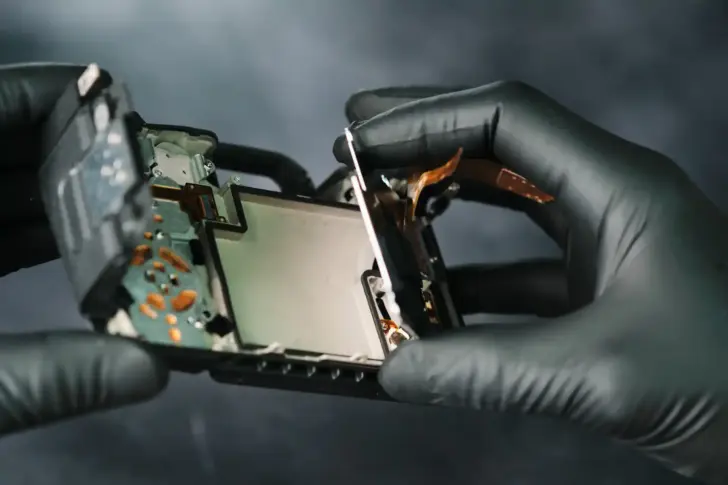
You can see in the series of images in the article, and also in the video – but we'll show one of the images here, where you can see how the path of the air flows through the back of the camera, and over top of the processors. The plate you see the technician holding is the heat transfer plate.
Another feature of the internal design of the Canon EOS R5 Mark II that is sure to please some, is that the HDMI port is no longer directly attached to the motherboard. Let's take a moment to pause and give silent thanks to the engineer who finally decided that replacing the entire motherboard when the HDMI port fails is a bad idea.
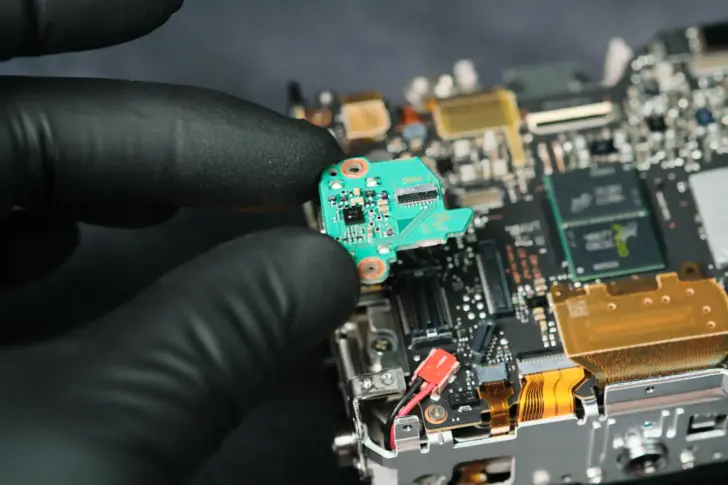
But while the HDMI port is on a separate daughterboard, the USB port is still curiously attached to the motherboard. I wonder if Canon was concerned that the larger HDMI full-sized port could accidentally cause more damage and need to be replaced more often than the mini-HDMI they have used before.

This is a step in the right direction for Canon's repairability, I'm hoping that future Canon cameras will have it so that motherboard replacement is only necessary when it's an internal problem, not an external connector.

Finally, we see the star of the show, the sensor and the IBIS unit itself. This assembly is attached to the camera body and adjusted using spring-loaded screws versus in the past when Canon used shims.
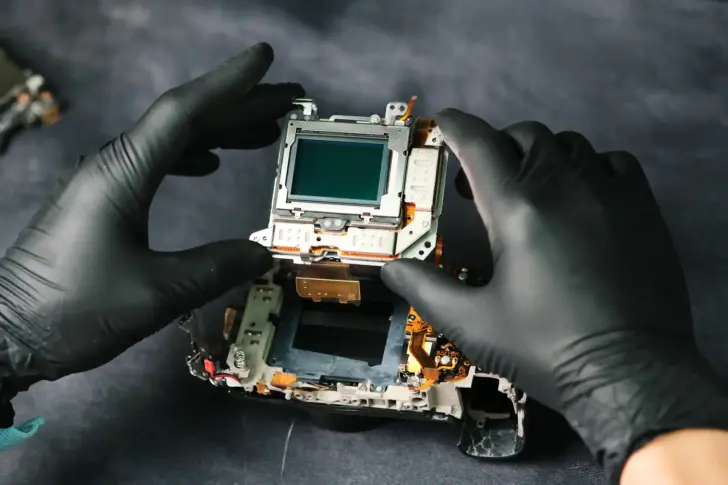
It's an interesting teardown into one of Canon's latest cameras, and one of the better cameras engineered for heat.

You can watch the entire teardown here in Kolari's video and also read their blog detailing far more images than we showed here.

I would love to see the images out of the camera after conversion, but I don't think I'll be able to get an EOS R5 Mark II converted. But I'll take a dual spectrum EOS R8, thank you.

If you are still sitting on the fence waiting to purchase a Canon EOS R5 Mark II, now is really the time. Order from one of our preferred vendors listed below.

Purchase Options

KolariVision Blog

Go to discussion...

Share This Article
Follow:
Richard has been using Canon cameras since the 1990s, with his first being the now legendary EOS-3. Since then, Richard has continued to use Canon cameras and now focuses mostly on the genre of infrared photography.

41 comments

  1. Getting my R8 converted is an interesting idea, but I should first use up the rolls of IR capable film in my fridge using my TLR before sending in my digital camera 🙂
  2. I now know how it can be weather sealed while having vent holes. Wonder if any moisture is trapped in there, or if it will quickly dry out. Might have a little garden in there if it’s not vented and dried well enough 😆
  3. Getting my R8 converted is an interesting idea, but I should first use up the rolls of IR capable film in my fridge using my TLR before sending in my digital camera 🙂

    oh sweet!
  4. I now know how it can be weather sealed while having vent holes. Wonder if any moisture is trapped in there, or if it will quickly dry out. Might have a little garden in there if it’s not vented and dried well enough 😆

    probably not much difference than making sure your lenses don't start growing mold, etc. just have a few bags of silica that your camera rests on will take care of anything.

    These big packs are great for gear - and they also keep my damned new Canadian passport from warping into a "U"
  5. I now know how it can be weather sealed while having vent holes. Wonder if any moisture is trapped in there, or if it will quickly dry out. Might have a little garden in there if it’s not vented and dried well enough 😆
    Don't think of it as holes going into the body, consider them weirdly shaped attachment points, they don't puncture the outer shell. The tripod socket is also a hole into the body and people don't get as upset with that as with these vent channels.
  6. Don't think of it as holes going into the body, consider them weirdly shaped attachment points, they don't puncture the outer shell. The tripod socket is also a hole into the body and people don't get as upset with that as with these vent channels.
    If they’re closed plastic dents, how do air travel through? I doubt much air flows through the tripod mount?
  7. KolariVision who is my personal favorite company to get my infrared camera conversions done, has released their teardown article on the Canon EOS R5 Mark II.

    Thanks Richard, such teardowns are what I liked most about LensRentals.
    I miss them, especially the lens teardowns...
  8. If they’re closed plastic dents, how do air travel through? I doubt much air flows through the tripod mount?
    If I blow cold air through my fist, it will cool my skin and through that, my hand. But the air doesn't go into my body, nor do my insides leak out through my fist. The R5II is similar, the vent channels won't let air into the electronics, the big metal plate shown in the article will dissipate the heat from the electronics to the vent channels.

    This is basically the same principle of glueing a heatsink to the outside of the camera and attaching the LCD to that. The fins will look like holes since they are sandwiched between the camera and the LCD, but their are still very much external.

    I realize that both English and Dutch doesn't have a clear way to distinguish between 'inside' as in 'bread inside a lunchbox' and 'inside' as in 'inside a tunnel', making this hard to express in writing. If they do have words or concepts like that, I'll be happy to be enlightened!
  9. I now know how it can be weather sealed while having vent holes. Wonder if any moisture is trapped in there, or if it will quickly dry out. Might have a little garden in there if it’s not vented and dried well enough 😆
    Be reassured, your "little garden" will be fully organic. Enjoy your free veggies!
  10. If I blow cold air through my fist, it will cool my skin and through that, my hand. But the air doesn't go into my body, nor do my insides leak out through my fist. The R5II is similar, the vent channels won't let air into the electronics, the big metal plate shown in the article will dissipate the heat from the electronics to the vent channels.

    This is basically the same principle of glueing a heatsink to the outside of the camera and attaching the LCD to that. The fins will look like holes since they are sandwiched between the camera and the LCD, but their are still very much external.

    I realize that both English and Dutch doesn't have a clear way to distinguish between 'inside' as in 'bread inside a lunchbox' and 'inside' as in 'inside a tunnel', making this hard to express in writing. If they do have words or concepts like that, I'll be happy to be enlightened!
    Excellent, thank you so much for explaining 😀
  11. If I blow cold air through my fist, it will cool my skin and through that, my hand. But the air doesn't go into my body, nor do my insides leak out through my fist. The R5II is similar, the vent channels won't let air into the electronics, the big metal plate shown in the article will dissipate the heat from the electronics to the vent channels.

    This is basically the same principle of glueing a heatsink to the outside of the camera and attaching the LCD to that. The fins will look like holes since they are sandwiched between the camera and the LCD, but their are still very much external.

    I realize that both English and Dutch doesn't have a clear way to distinguish between 'inside' as in 'bread inside a lunchbox' and 'inside' as in 'inside a tunnel', making this hard to express in writing. If they do have words or concepts like that, I'll be happy to be enlightened!
    Inside as an preposition (key inside a lock) vs. Interior as an adjective (interior house walls)?
  12. I totally forgot that the day I got my precious I was curious about the heat and checked the camera with my FLIR ONE Edge Pro.
    If anyone is interested and curious... I made these shots immediately after a test drive of shooting my cats in their natural home habitat 🙂)))

    No videos. Nothing fancy. If you want something specific let me know... will try to test it.

    Enjoy.


    Heat-R5m2-07.JPGHeat-R5m2-05.JPG

    Heat-R5m2-04.JPGHeat-R5m2-03.JPG
    Heat-R5m2-02.JPG
  13. I totally forgot that the day I got my precious I was curious about the heat and checked the camera with my FLIR ONE Edge Pro.
    If anyone is interested and curious... I made these shots immediately after a test drive of shooting my cats in their natural home habitat 🙂)))

    No videos. Nothing fancy. If you want something specific let me know... will try to test it.

    Enjoy.


    View attachment 220215View attachment 220216

    View attachment 220217View attachment 220218
    View attachment 220219
    wow nice!

    I'm actually a little surprised about the heat on the sensor itself actually.
  14. I now know how it can be weather sealed while having vent holes. Wonder if any moisture is trapped in there, or if it will quickly dry out. Might have a little garden in there if it’s not vented and dried well enough 😆
    all you have to do is shine a light down the vents to see that there is no exposure to the internal components. all you see is metal plating.
  15. If I blow cold air through my fist, it will cool my skin and through that, my hand. But the air doesn't go into my body, nor do my insides leak out through my fist. The R5II is similar, the vent channels won't let air into the electronics, the big metal plate shown in the article will dissipate the heat from the electronics to the vent channels.

    This is basically the same principle of glueing a heatsink to the outside of the camera and attaching the LCD to that. The fins will look like holes since they are sandwiched between the camera and the LCD, but their are still very much external.

    I realize that both English and Dutch doesn't have a clear way to distinguish between 'inside' as in 'bread inside a lunchbox' and 'inside' as in 'inside a tunnel', making this hard to express in writing. If they do have words or concepts like that, I'll be happy to be enlightened!
    it's a similar concept to the Canon V10 camera. It's not exactly the temperature that causes it to overheat. It's the inability for the surrounding environment to whisk away the heat. I had the camera in an enclosed room with no moving air that was around 70F. It overheated fairly quickly when I set it to the skin smoothening filter. But that the camera outside with even higher temperature but with some air blowing (even when it's warm air) is enough to keep the camera from overheating.
  16. it's a similar concept to the Canon V10 camera. It's not exactly the temperature that causes it to overheat. It's the inability for the surrounding environment to whisk away the heat. I had the camera in an enclosed room with no moving air that was around 70F. It overheated fairly quickly when I set it to the skin smoothening filter. But that the camera outside with even higher temperature but with some air blowing (even when it's warm air) is enough to keep the camera from overheating.

    yes, canon has spent a considerable amount of effort devising ways of shunting off that heat.

    it's even more complicated because of the moving IBIS platform.
  17. Getting my R8 converted is an interesting idea, but I should first use up the rolls of IR capable film in my fridge using my TLR before sending in my digital camera 🙂
    I have a IR converted 400D that I use for the occasional IR BnW shot. However, a IR converted R8 would be a nice full frame upgrade.

Leave a comment

Please log in to your forum account to comment