

When you purchase through links on our site, we may earn an affiliate commission. Here's how it works. |
The analysts at TrendForce have lately produced some analysis on the current trends in the DRAM and SSD prices, which is well above my pay grade. The detailed reports give us a good view of current DRAM and NAND pricing trends and just how much trouble we're actually in.
As of January 2026, the data shows pressure on the memory market. TrendForce says the DRAM contract prices will rise 55 to 60 percent quarter on quarter in the quarter of 2026, and the NAND flash prices will rise 33 to 38 percent. Client SSDs may face price increases of over 40 percent. These rises have happened throughout 2025 mainly because the AI server demand moved capacity toward margin products such as high bandwidth and enterprise memory.
TrendForce’s latest investigations indicate that DRAM suppliers in 1Q26 will continue to reallocate advanced process nodes and new capacity toward server and HBM products to support rising AI server demand. This shift has significantly limited supply in other markets, causing conventional DRAM contract prices to increase by about 55–60% QoQ. Meanwhile, disciplined capacity management by NAND Flash suppliers, along with robust server demand that is displacing other applications, is likely to increase contract prices across all NAND Flash product categories by 33–38%.
These trends can result in high costs for photographers and also for the companies that manufacture our cameras.
Memory Cards Are Getting More Expensive
SD cards, CFexpress cards, and other media use NAND flash. Suppliers are now prioritizing enterprise SSDs for data centers, and thus, the consumer-grade supply is more limited. The reliable 512GB high‑speed card has already become more expensive. The price may rise further by the middle of 2026.
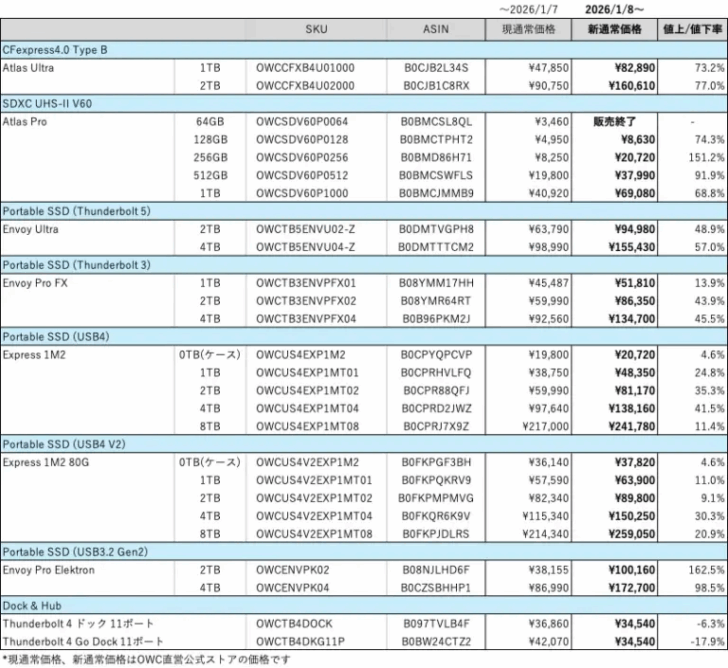
The price table shows the price increases that OWC (Other World Computing) is doing for its CFexpress, SDXC, and SSD / NVMe products on January 7th.
Photographers change cards often; if you don't, then you should. If you have been listening to me, rotating your cards and continuing to put new cards into your rotation is something I've always recommended doing over time.
Right now, we still see some decent deals on Sandisk CF Express Type B cards, with the 512GB card seemingly the most economical.
| Sandisk CF 64GB Type B | $69.99 |
| Sandisk CF 256GB Type B | $139.99 |
| Sandisk CF 512GB Type B | $159.99 |
But with significant price increases, it becomes far more burdensome to do so, and also opens up more possibilities of fraudulent cards like we've seen with SD cards in the past. Or some may continue to use older cards for longer than they should and suffer data loss.
Post-processing hardware costs are rising
Editing workflows, in Lightroom or Photoshop, need a lot of RAM and fast NVMe storage, not to mention video post-processing and editing. DDR5 RAM prices have risen to eye-watering levels already, not to mention NVMe drives have followed that pattern. This directly impacts the RAW file and also batch processing speeds, as both need enough memory and fast drive storage to keep the performance optimum. Higher component costs can complicate and delay workstation upgrades, and this delay creates longer processing times. If you are just a hobbyist, this may not matter as much, but for professionals, time is money.
There are still some deals to be had on NVMe's on Amazon. I strongly suggest you check them out if you are in need of storage now or in the future. We looked around and found these that still seem to be a reasonable price. Of course, this stock may not last long.
| Crucial P310 500GB NVMe SSD | $61.99 |
| Crucial P310 1TB SSD | $106.99 |
| Crucial P310 2TB SSD | $191.99 |
We have already seen PC manufacturers raising system prices in 2025, and I imagine we should expect more of the same in 2026 because of the increased costs of memory components.
Impact on Camera Internals and Future Models
Modern mirrorless cameras use a lot of DRAM for buffer memory. The DRAM in mirrorless cameras lets them shoot a burst of photos and then more slowly write out images to card storage. Luckily, as cards have become faster, the amount of DRAM hasn't necessarily needed to dramatically expand, but it still requires it.
Essentially, the more burst fast fps shooting you want before you see a busy wait, the more memory and the faster cards you will need. Rising component costs could add a not-so-insignificant amount to the price of new cameras, and make it impractical for Canon and other manufacturers to dramatically increase the megapixel (and thus the buffer space) needed in a new camera model. That spiffy new 40MP R7 Mark II may be downgraded to 32.5MP just because memory is a little out of touch with reality right now.
The camera companies could also opt to delay the release of new cameras entirely and take a wait-and-see approach. Similar to how new cameras were delayed in the post-COVID supply chain mess.
The Smartphones Are Affected Too
Hard to find a person, let alone a photographer, who doesn't have a smartphone or tablet for editing on the go. The memory, in a smartphone, usually makes up a fairly significant portion of a smartphone’s bill of materials. Forecasts suggest that the average selling price of smartphones may rise six to nine percent in 2026.
Entry-level models may go back to 4GB RAM and 128GB storage to keep the costs low. Flagship devices may launch $50 to $100 higher than in prior generations.
Outlook for 2026 and 2027
I think the analyst consensus says that the high prices will stay through most of 2026. The supply growth stays low. The supply growth is 16 percent a year for DRAM and about 17 percent a year for NAND. The supply growth still falls behind the demand. I personally do not see relief until the new fabrication plants start up in late 2027 or 2028, if they even bother to start up – a lot of major DRAM manufacturers seem to be holding out from expanding capacity, as they have stated they have no plans to increase production. To be fair, it takes a long time to spin up new fabrication lines and is significantly costly to support such a spike in demand.
One thing to watch is China's CXMT. CXMT just raised $4.2 billion in an IPO. CXMT will use the money to grow wafer capacity and to push technology like newer DDR5 and DDR5X versions. This growth may ease the DRAM shortage that could start in late 2026 or in 2027. The exact timing and how big the impact will be are still not clear.
Practical steps for the next year or two
Buy the memory cards, RAM, or drives now if the budget allows. Plan if you haven't started already.
The price increases do not change the day-to-day shooting for people who already have gear, of course, but when you are considering new purchases, the added expenses will certainly be more apparent.
And of course, watch for deals that we show here almost every day, many times, it's on memory cards. Though I'm not sure how long that will continue.
Whatever the case, it could be well into 2027 before we see some normalization.








Consumers getting screwed by AI again. I do remember 4000 series nVidia cards going nuts because of mining.
$199 in April 2025 to build a Windows PC with 128Gb RAM.
Now Micron is dropping out of the consumer memory business
in Q1 2026, and closing down Crucial. Those same DIMM’s
we’re selling on Amazon for over $600 USD before Christmas.
I bought some Crucial x10 Pro SSD’s during the Black Friday specials.
That was mostly the 30 series (Ampere), wasn't it?
Mostly because of OEM's attempts to use the awful M.2 standard in non-mobile applications.
Consider a card like a small SSD, there's a finite number of times that you can write to each cell before you start to get problems. and unlike SSD's where alot of the data on them is atypically static, cards typically get their entire contents flushed and re-written frequently. Also some cards have wear leveling, and some do not. it's not something they commonly mention either.
so it's just a bad idea to keep using the same few cards over and over, especially if you use your cameras frequently and take a ton of photos or video. To be fair, this is usually measured in years of use. it's not as if they'll die in 6 months, but if you tend to fill a card, wipe it and use it again, and do this over and over - just realize there are limits - especially with high capacity cards.
it's probably a good topic to discuss on it's own - sounds like an article in there. I may have to blow up a few cards to write it.
yeah I have a secondary nuc that I was looking to toss Linux on and then went looking for memory. that was a "welp, nope" moment.
I thought all cards with an integrated memory controller (everything after xD cards) employed wear-leveling.