

When you purchase through links on our site, we may earn an affiliate commission. Here's how it works. |
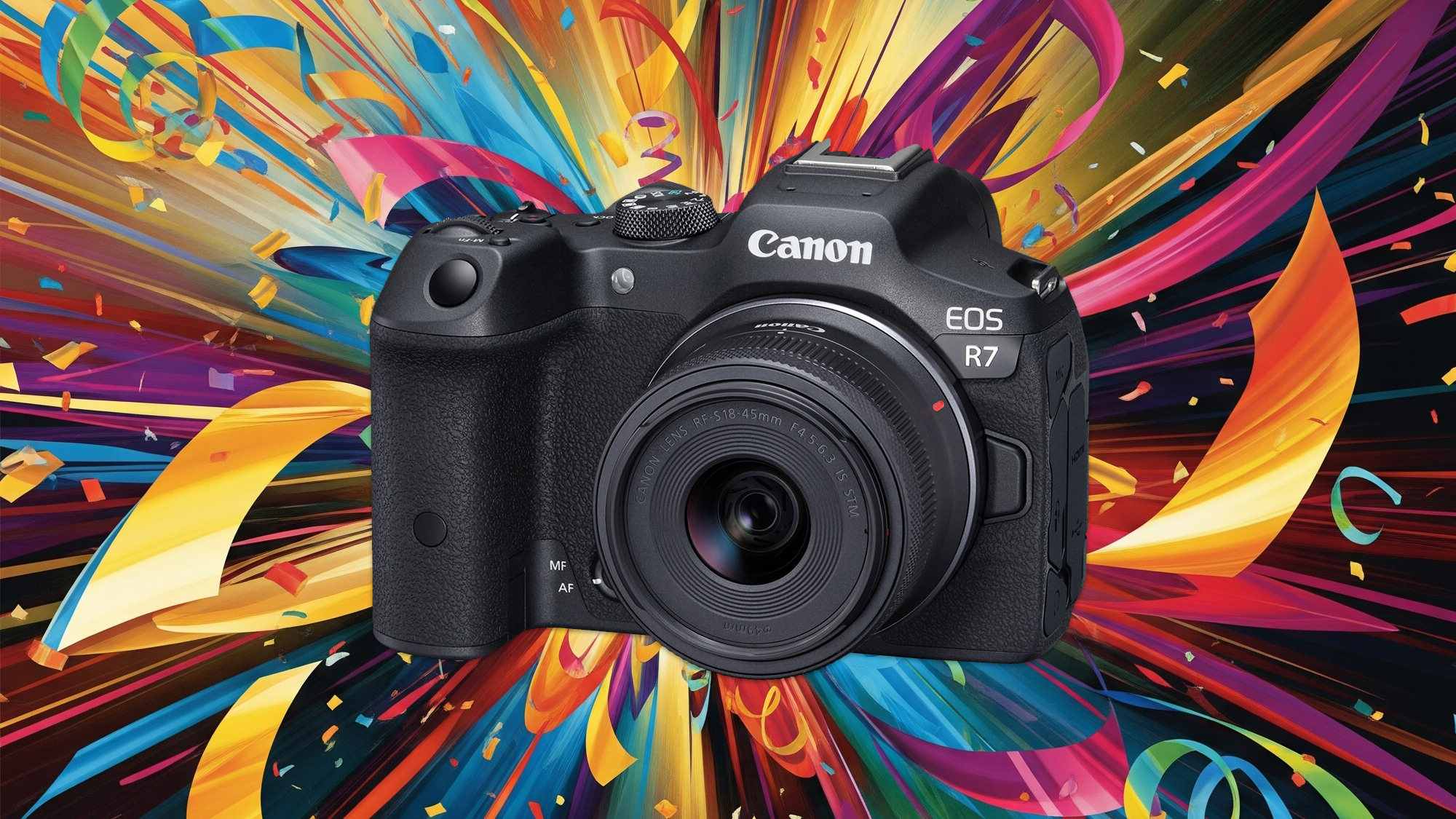
One of the most highly anticipated cameras coming from Canon is the EOS R7 Mark II. There is still a big market for the prosumer 7 series APS-C cameras and Canon plans to bring the next iteration “up market”.
One of the big claims is that the EOS R7 Mark II will be the first EOS R camera to do away with the mechanical shutter. Something that is inevitable in the future, and they have to start somewhere. If the readout speed is fast enough, we don't see a problem with doing so.
Nikon has already moved to no Mechanical Shutter in models like the Z8 and Z9 and things seem to be going well with those camera bodies in popularity and capabilities.
Rumored Specifications
- 33MP APS-C Stacked CMOS
- DIGIC X & DIGIC Accelerator
- 8.5 Stops of In-body Stabilization
- 2.36m-Dot OLED EVF
- 40 FPS Electronic Shutter
- Pre Continuous Shooting
- In-Camera Upscaling
- 4K120 10-Bit with CLog-3
- Larger Form factor than the R7

A New Powerhouse?
On the surface, it looks like the rumored EOS R7 Mark II will be an APS-C equipped EOS R5 Mark II. The finer detail may be what shows the difference between the two, other than the sensor size.
We didn't get what the memory card slots would be, the current EOS R7 uses a dual SDXC set up, but it's possible we see a CFexpress slots added with a second slot for an SDXC like the EOS R5 Mark II. We can't see it getting a dual CFe slot.
The Salt
The above information came to us anonymously, but we have seen similar things in the recent past and haven't published that information yet.
We know that new things are coming sometime in the next month, but we do think Canon is going to spread some announcements out over later Q3 and Q4.
We don't know if the tariff situation is going to have any effect on product announcement cycles, but we don't think it will.
Canon has IBC coming up in September, which is generally for the broadcast and cinema gear, but they have made EOS announcements in the past ahead of that show.
More to come…








Let's see how many MP it will be in the end...
I know Canon won't, but they should still include a built-in GPS.
And launch it with an RF-mount successor to the EF-S 15-85mm 🙂
What does that even mean?
45 megapixels in FF is 20 megapixels in APS-C. So the sensor is not the same, obviously...
Is it the button layout? The number of buttons? R7's are usually smaller so how would that work.
Three main things for me is I hope Canon start to standardise the layout rather than every camera having different ergonomics. Be nice to pick up cameras in a similar pro line and muscle memory to be retained like it used to be with the 5D and 7D line.
Secondly I hope that they can make the AF like the R5II, its so good that it rarely misses and the R7 is more hit and miss and the specs on paper dont really translate into the real world.
Third, I hope we have a quicker sensor to reduce rolling shutter, maybe not stacked like the R5II. Readout speeds of the R6II would be great.
It will be interesting to see how much faster and improved the new sensor will be over the almost 6 year old sensor in the 90D/M6 II/R7.
Hopefully version 1 of the firmware is not too buggy, they need to get a wide variety of real photographers shooting different subjects to test it out before release.
I would rather have 36mp than have diffraction kick in at f5.6.
Sony has higher mp sensors for A1 for instance and it hasn't stopped them being used for professional sports/action shots.
Has diffraction been a big issue with 100/160mp medium format sensors for landscape shots? Although focus stacking is an option.
CFe is only needed for 8k/30 or 4k/120 recording and a 33mp sensor can't support 8k. If 4k/120 is compressed/codec and not cropped raw then CFe speeds are not necessary.
CFe B (like Sony's CFe-A cards) will reduce the buffer clearance time compared to USH-ii cards which could be a factor but having mixed CFe/USH-ii cards defaults to the slowest card speed if recording in parallel. It didn't affect the R3 substantially but that is 24mp and had a big buffer.
No mechanical shutter should be feasible but Canon felt the need to keep it in the R1/R5ii. Has anyone had any limitations for ES with these bodies eg banding under lights? The sensor will need to be stacked to have low readout time of course.
Tariff issues are potentially a problem for product releases in the US because of the launch price. No point launching a product when the local US price will be changed up soon afterwards. Perhaps the rate is settled now but was threatened to be much more than the current 15%. The alternative is to have higher pricing at the beginning or a consistent price globally to level out the overall price changes.
The cases where the speed isn't fast enough, is maybe few.
But I think I sometimes see weird artifact when using ES on my R7.
And ES usually also hurts dynamic range. R5II mechanical vs ES on photonstophotos:
https://www.photonstophotos.net/Charts/PDR.htm#Canon EOS R5 Mark II,Canon EOS R5 Mark II(ES)