

When you purchase through links on our site, we may earn an affiliate commission. Here’s how it works. |
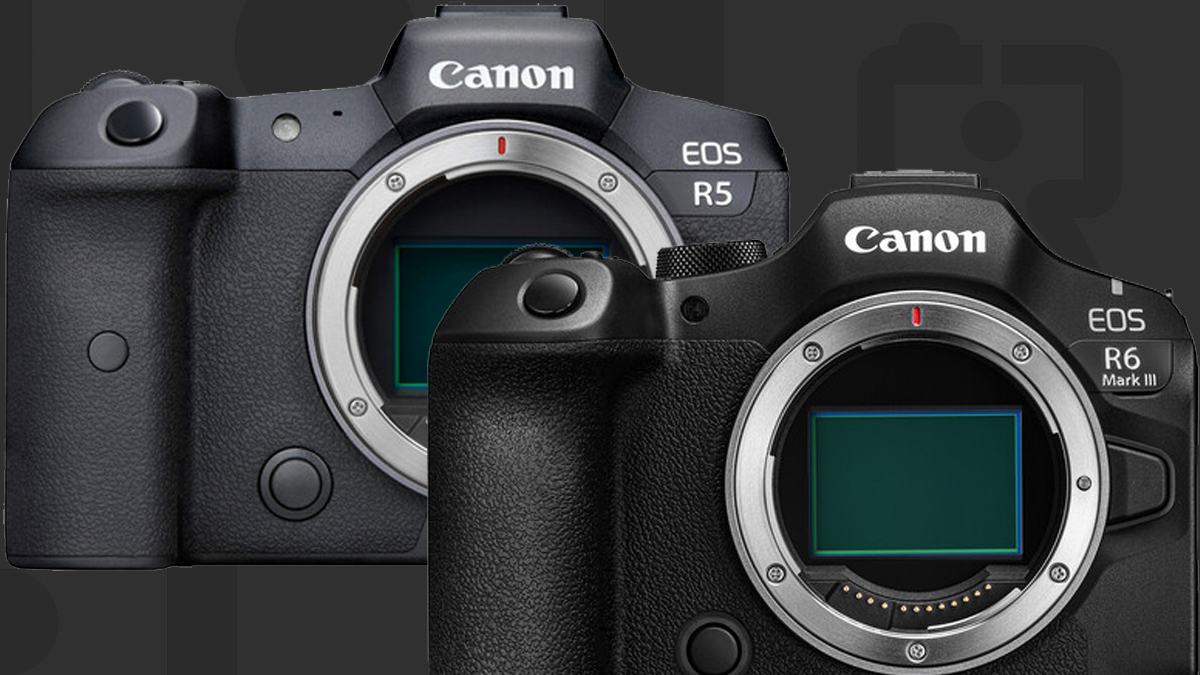
When I was wrapping up the Canon RF 45mm f/1.2 STM, a curious thought crossed my mind that the Canon EOS R6 Mark III could be better summed up as a poor man’s Canon EOS R5, than a successor to the successful Canon EOS R6 Mark II. So here we go, how well does this compare against the original R5, and we can all marvel at just how far Canon’s come in 5 years.
Stay tuned for future articles when we compare the R6 Mark III to other cameras, but this one is all about the EOS R5 versus the EOS R6 Mark III.



The Canon EOS R5 was introduced in 2020 for a list price of around $3899, or around $4000 in today’s valuation with inflation. It was the first 8K digital mirrorless camera to hit the market and was an impressive feat of engineering. However, it was prone to overheating, which was heavily publicized at the time. Suddenly, we all became experts in thermal heat dissipation and low-temperature burns.
And now, just announced, is the latest version of Canon’s R6 line, which, according to Canon, the R6 Mark II was the most successful full-frame camera in the world. So the R6 Mark III has some very big shoes to fill.
But I digress, let’s look at how well these two amazing cameras, the R5 and the R6 Mark III, compare.
[affiliatable id=’309719′] |
The Sensors
Yes, the obvious difference is that the R5 is 45 megapixels and the R6 Mark III is 32.5 megapixels. But for most shooting styles, you are not going to notice the 17% increase in sensor resolution.
Because we haven’t seen any real qualitative numbers of dynamic range, but Canon’s addition of Clog2 pretty much guarantees that they are confident in the sensors’ overall dynamic range capabilities. Canon did not put Clog2 in the original R5, but that could have been because they didn’t want to, versus actual sensor capability. Canon rarely decreases the overall sensor dynamic range significantly between consecutive camera models of the same line.
The R6 Mark III promises better heat management, and while it doesn’t meet the lofty goals of 8K recording, it gets close, with up to 7K60p recording. If you consider the number of pixels that the R6 Mark III is moving around, with it being up to twice the framerate, it’s impressive. The R6 Mark III will push out around 1.95 gigapixels per second, while the R5 manages 950 megapixels per second.
The R6 Mark III sensor itself promises to be a quicker version than that on the R5, as suggested by the top electronic frame rate being 40fps versus 20fps in the R5. We also see this as being a quicker sensor in the R6 Mark III, with the readout speed values from both cameras. As the Canon EOS R5 had a measured readout speed of around 16.3ms, the R6 Mark III is expected to have one slightly quicker than that of the R6 Mark II at 13.2ms. This should make the R6 Mark III more capable of shooting with less rolling shutter effect in both electronic shutter mode in stills and in video.
So, the sensor in the R6 Mark III gets extremely close to the original R5 resolution, eclipses the R5’s sensor in speed, and increases its video dynamic range. On top of that, the R6 Mark III offers quite a few video features not found on the R5.
More Video Features for Creators
The R6 Mark III has added a wealth of video features that were not there on the original R5.
Open Gate Recording
This must be the worst name possible for “full sensor area recording”. Yes, it came from the film era, but some terms should have been nailed to the floor and left there. Especially when “gate” means something entirely different in electronics, and as such, digital sensors. Basically, this allows for the entire sensor to be recorded instead of the common aspect ratios normally available for video, such as 16:9. The R5 did not have this ability.
LUT Support
LUTs, or look-up tables, allow you to apply a custom profile directly as you record. This is essential when you are video recording in high dynamic range video modes, such as clog, as your colors will tend to be displayed washed out as the camera captures the maximum possible dynamic range. Your video is post-processed after recording, and a custom LUT will help you see what it would look like after that post-processing as you shoot. The R6 Mark III allows you to import custom LUTs, while the R5 has no such facility and can only apply a basic LUT using what it calls View Assist.
Full-Size HDMI Port and More Cinema EOS Content Tools
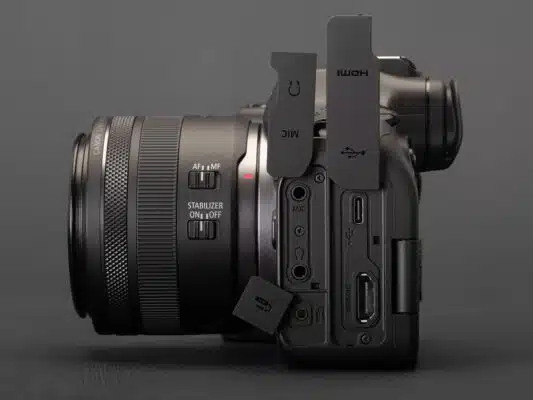
The R6 Mark III features a full-size HDMI port. Something for the longest of times, Canon resisted. I presume it’s because they thought they had the market cornered on micro HDMI cables or something. The R6 Mark III now has the same port size as Canon’s other more series cameras, the R1 and the R5 Mark II.
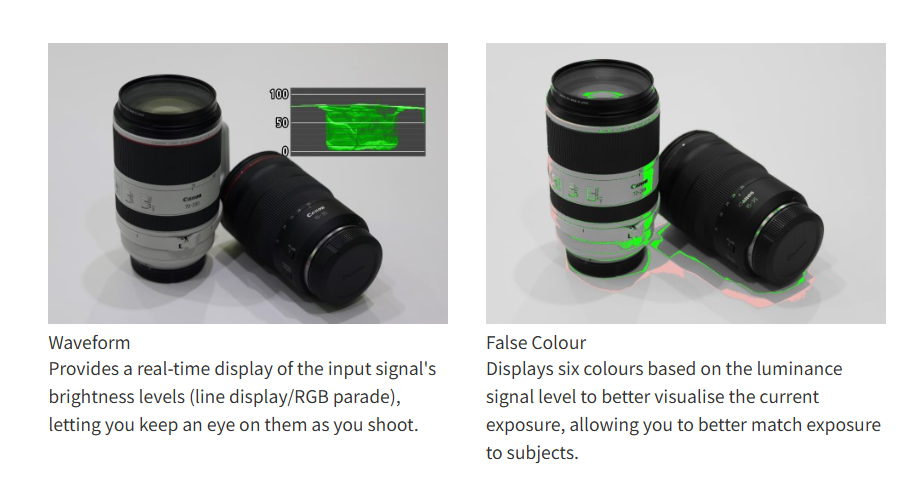
Also, the R6 Mark III has waveform monitoring and false color display to assist with video exposure monitoring at the time of recording. The R5 was limited to histogram and zebras to help with exposure monitoring.
The R5 Still Wins Some
Okay, it’s not all a win for the R6 Mark III, so don’t worry, your R5 is not going to quit working in abject shame today. The R5 has a high-resolution IBIS shot mode, a much higher resolution EVF at 5.69 million dots versus 3.69 million dots, 8K video, 8K RAW video, and, of course, a higher natural resolution of 45 megapixels as compared to 32.5 megapixels. If you are primarily interested in stills and still love that snick of a mechanical shutter, the R5 is the camera to beat.
Let’s not forget built quality, as the R5 has a more professional magnesium alloy body construction, which is perceived to be better for harsh environments. In contrast, the R6 Mark III has a magnesium alloy frame and polycarbonate body construction and could be considered less robust.
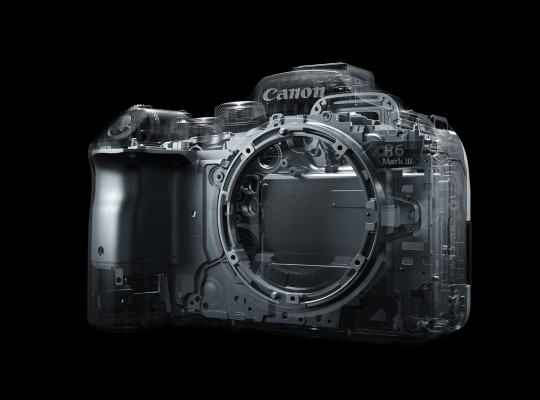
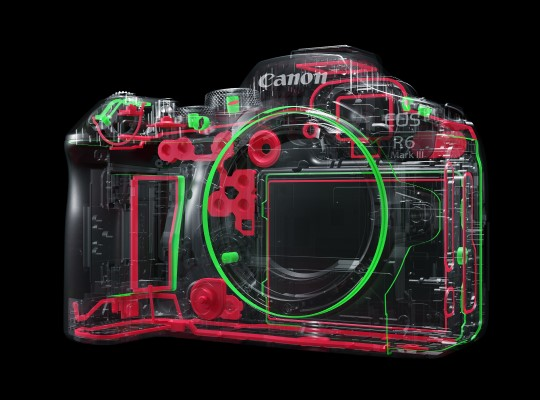
Ironically, I know of friends who preferred polycarbonate bodies because they didn’t dent as much as fully alloyed camera bodies. So, your preference may vary. The R5 also has more robust sealing against moisture, but the R6 Mark III does have actual seals and doesn’t rely on “mechanical fit”.
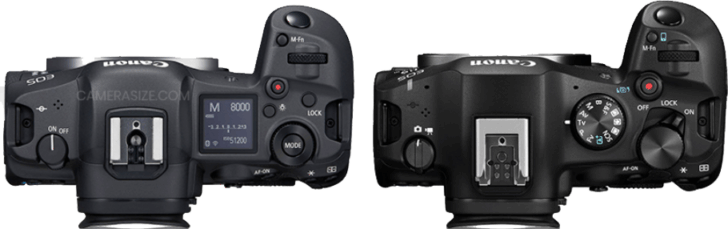
The R5 also has ergonomic niceties that you may enjoy, such as the top panel LCD for quick review of camera settings. I always found this helpful in a studio environment. Ergonomically, the R6 Mark III has what seems to be the more standard configuration that Canon has adopted for its right-hand ergonomics, with the power switch on the right-hand side and the video on the left-hand side. This is consistent with Canon’s other cameras, and even though it took some years, it seems that Canon is finally happy with this layout. The R5 has an older approach with the on/off switch on the left side of the camera.
The R6 Mark III is most likely more consistent with Canon’s cameras going forward, while the R5’s ergonomics have been refined and replaced.
The rear LCD is also slightly larger on the R5, with it being 3.2″ and 2.1 million dots, versus the 1.62 million dot 3″ display on the R6 Mark III.
Is it an “Upgrade” by “Downgrading”?
I had to check eBay before starting off this section. But here’s the thing: you can sell your EOS R5 and get an EOS R6 Mark III, complete with an active warranty, for essentially breaking even through sales platforms such as eBay. You can also do a “quick and less hassle sale” and sell the camera to B&H ($1400), or if you are in Europe, around €1800 at MPB. When everything is factored in, the actual cost of a new R6 Mark III may be around half price, or even less than that.
Is it worth it? From a stills photography perspective, with the R6 Mark III, you’ll have reduced resolution, but faster electronic shutter mode, perhaps easier files to process if you are not using all 45MP to your advantage, and better auto focus tracking.
Video features, if you don’t shoot 8K, are decidedly in the R6 Mark III’s favor, with improved creator tools, more recording options, and a faster sensor with less rolling shutter.
I can’t come up with the calculation that you’d have to do to determine if you upgrade, but it’s far closer to a decision than I would have thought a year ago when comparing the R5 series with the R6 series. One good thing right now is that the EOS R5 has been reduced in price, so if you do prioritize the EOS R5’s greater resolution and you are looking at either the R5 or the R6 Mark III, then right now you can get the R5 at the same price as the R6 Mark III.
Comparison Table between the EOS R5 and the EOS R6 Mark III
| Canon EOS R6 Mark III | Canon EOS R5 | |
|---|---|---|
| MSRP at launch | $2800 | $3,899 |
| Pixel count | 32.5MP | 45MP |
| Sensor type | Dual Pixel AF FSI CMOS | FSI CMOS (Dual Pixel) |
| Shutter type | Mech / Electronic | Mech / Electronic |
| Max frame rate | E: 40fps M: 12fps | E: 20fps M: 12fps |
| Flash sync speed | M: 1/250 E: 1/320 | M: 1/250 |
| Image stabilization | 8.5EV | 8EV |
| AF subject detection | Human Animal (Dog / Cat / Bird / Horse) Vehicle (car, motorcycle, plane, train) Automatic | Human Animal (Dog / Cat / Bird) Vehicle (car, motorcycle) Automatic |
| HDR still output | PQ HEIF | PQ HEIF |
| Max video res / rate | 7K/60 | 8K/30 |
| Video formats | Canon Raw Canon Raw Light H.265 MP4 H.264 MP4 | Canon Raw Canon Raw Light H.265 MP4 H.264 MP4 |
| Uncompressed video | C-Raw | C-Raw |
| Canon Log Formats | Clog2 and Clog3 | Clog3 |
| Waveforms, Corrected Log preview, False color | Yes/Yes/Yes | No/Yes/No |
| Viewfinder | 3.69M dot 0.76x | 5.76M dots 0.76x |
| Rear LCD | 3.0″ 1.62M dot Fully-articulated | 3.2″ 2.1M dot Fully-articulated |
| Video resolutions | 7K DCI/60 (Raw) 7K/30 open-gate 4K/120 (full-width) 1080p/180 (full-width) | 8K DCI/30 (Raw) 4K/120 (full-width) 1080p/180 (full-width) |
| Stills battery life EVF / LCD | 270 / 510 | 220/320 |
| Video battery life (LCD) Cont. / Actual | – / – | 120min / – |
| Dimensions | 138 x 98 x 88mm | 138 x 98 x 88mm |
| Weight | 699g | 738g |
[affiliatable id=’309719′] | [affiliatable id=’309722′] |





Prices also as expected (and of course too high 😉 ), In Germany 2899,- incl. VAT.
Now let's see the first RL hands on and sensor measurements and until then all the whiners whine 😛
Does this "new" mean, it is indeed a new sensor or the expected re-use of the (still quite new) EOS C50?
Never owned CFE cards and SD cards are more than enough for me. I was plenty satisfied with dual SD but I would get used to replace the SD card in place of letting the camera fill the second one when the first comes full
But from your answer it is still not 100% clear if it is the same sensor as the C50's (as rumored) the or an even newer one (maybe slightly improved).
However, the max iso has been reduced from the R6ii by 2/3rd of a stop. thisis uaully an indicator from Canon as to it's expected hit on the increased noise threshold those extra mp cause. If the ios noise between the R6ii to R5 was a whole stop then this increase in rez will affect the noise too. So maybe 1/2 to 2/3rd of a stop is about right.
this morning, I've heared numerous youtube influencers talking about the great features of the R6iii....most of these great features are alredy present in the R6ii....which goes to show how good the R6ii is / was.
Here in the Uk, the launch price is around £2700 GDP...whcih is very high considering I can buy a new R5ii (via grey import) for the same price. A mint used R5 for £1600 and a new R6ii (grey) for on;y £1350....for only a few new fetures...that's a lot of £££ for not a lot of benefits. I can literally buy a pair of R6ii's for the launch price of one R6iii.
I think if I was looking to jump from DSLR to mirrorless, this would be a great camera. I think upgraders from the EOS R and R6mk1 have a lot of milage in this upgrade. but for existing R6ii users....it's more of an expensive side grade. Slightly improved, more of an evolution that definatly builds on the shoulders of it's great predecessor. If Canon continues selling their R6ii alongside the R6iii, then the R6ii may become the true bargain of the canon range.
When [Cropping/aspect ratio: Full-frame] is set: 1/200 sec mechanical shutter / 1/250 electronic 1st curtain,
When [Cropping/aspect ratio: 1.6x (crop)] is set: 1/250 sec mechanical shutter / 1/320 electronic 1st curtain.
So the 1/320s sync speed is for 1.6x crop electronic 1st curtain.
As expected for non-stacked sensor, no flash sync using fully electronic shutter.
mic drop