
You are using an out of date browser. It may not display this or other websites correctly.
You should upgrade or use an alternative browser.
You should upgrade or use an alternative browser.
Canon Officially Announces the Canon EOS R6 Mark III
- Thread starter Richard-CN
- Start date
No worries, it wasn't about you, not at all!I think my account was suspended for a day. Sorry for making a comment about Sony. Just really excited about all the new camera models coming out and the R6 III is, in my opinion a fantastic camera.
No one was able to post anything for a day.

Upvote
0

What happened. I couldn't read any of the forum and then there was a message stating they will end I think the forum and not archive or sell any information. I don't see it now thoughNo worries, it wasn't about you, not at all!
No one was able to post anything for a day.
Upvote
0


Have all the galleries/threads of users' images disappeared? I can't see them anywhere.The forum has been temporarily closed.
It will change its URL in the near future
New URL will be: canonrumorsforum.com
Upvote
0
Have all the galleries/threads of users' images disappeared? I can't see them anywhere.
Same here. The forum is only partially open. We do not have full access.
Upvote
0
R6II ISO range is 100-102,400 expanded to 50-204,800. Greater than the R6III. Also expected with the larger pixel size. Not sure about the R6. But that’s incorrect.
The R6II also does not let you register specific people. That started with the R1 and R5II. R6III allows it as well. I don’t believe the R3 has had that capability added either.
Those were two errors that jumped out at me and made me wonder how much AI contributed to this latest article comparing the three R6 cameras.
The R6II also does not let you register specific people. That started with the R1 and R5II. R6III allows it as well. I don’t believe the R3 has had that capability added either.
Those were two errors that jumped out at me and made me wonder how much AI contributed to this latest article comparing the three R6 cameras.
Upvote
0

I am puzzled. Both the R6 and R6ii have a native ISO range quoted as 100-102,400, whereas the R6iii has a range of 100-64,000, i.e. R6iii's ISO range is actually shorter than both R6 & R6ii, not the other way round.The R6 Mark III’s new 32.5 megapixel sensor seems to be capable in low light, handling up to ISO 64,000, whereas the EOS R6 and R6 Mark II limit you to ISO 51,200.
See full article...
Last edited:
Upvote
0

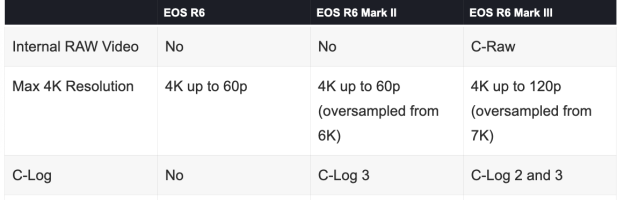
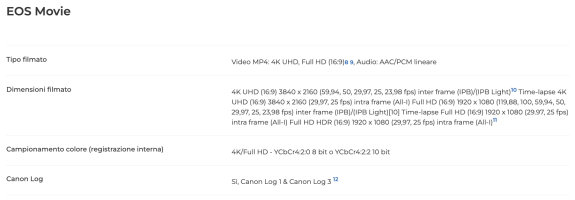
And Log View Assist as wellIn the last comparison article R6 is said to have NO CLOG, but actually has CLOG 1 and CLOG 3
View attachment 226846
View attachment 226847
Upvote
0

Thanks for the comparison, Richard. It seems to me, that an ugrade from my R6 to the R6III is not necessary. Most tech is the same! Rear screen, Viewfinder, subject detection, flash sync speed, IBIS, sensor type, high ISO etc. The electronic shooting rate does not bother me, neither readout speed or video-specs. Only the resolution increase of 27% may be interesting and of course the AF-Speed. But for most cases the R6 is good enough for me.
I will rather purchase some additonal Lenses (RF 85L?) or a monstrous tripod for my EF 400/2.8L II.
I will rather purchase some additonal Lenses (RF 85L?) or a monstrous tripod for my EF 400/2.8L II.
Upvote
0



Another option is if you have gps watch, its probably easy enough to match or take the nearest timecodes to get the gps location to the photoOn the subject of *** logging: Most of the time your phone is the only additional device you need, but connecting it reliably to the camera is problematic. So I've used it simply as *** logger with a simple and free program called ... "GPSlogger".Once you've given it sufficient permissions it will doggedly record your track as long as you don't turn your phone off. I have not noticed any excessive drain on battery. This on Android at least.
It would be really nice if the camera recorded compass heading, elevation angle and focus distance in the images. Those combined with the *** position would enable calculating the (approximate) focus point location later. Likely not relevant most of the time, but fun when recording far-away observations.

Upvote
0
Similar threads


- Replies
- 70
- Views
- 10K

- Replies
- 102
- Views
- 9K
- Replies
- 31
- Views
- 6K
- Replies
- 89
- Views
- 9K
