

When you purchase through links on our site, we may earn an affiliate commission. Here’s how it works. |
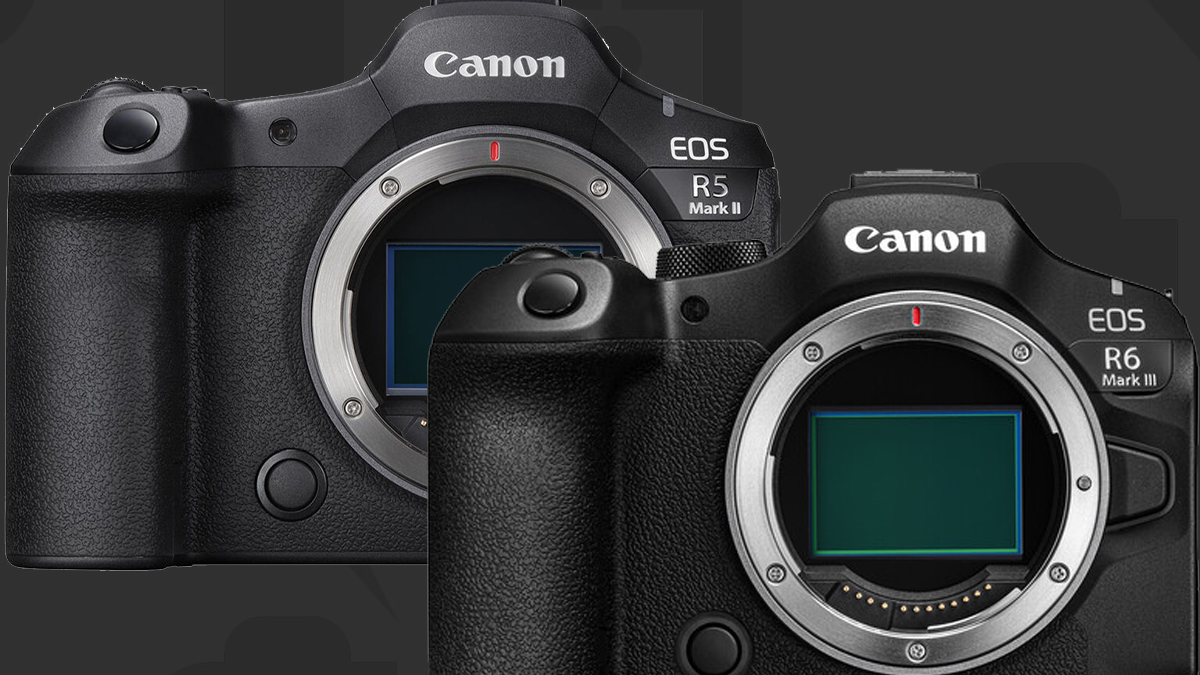
The second comparison was one that I really didn’t consider. The two cameras aren’t exactly in the same price range or professional camera segment, but there seems to be interest in drilling into these two cameras and seeing which one wins out in the end.
The Canon R5 Mark II was announced on July 17, 2024. It surprised me that this camera is now over 18 months old; how time flies. The Canon R5 Mark II is Canon’s premier all-around professional camera, meant to be adept for stills photography as it is for video. It has the resolution and the speed to do almost everything.
In the other corner is the brand new R6 Mark III. It’s really meant for those who really don’t have the budget for the R5 Mark II and still need something above the consumer grade in terms of performance and capability. Make sure you check out our comparison, which I feel is more comparable to the Canon EOS R5.
Read More
Because of the large price gap, some of the features won’t be there in the R6 Mark III that are present in the R5 Mark II. But that stands to reason. The extra $1100 for the camera must be for something. But is that worth it to you?
The R5 Mark II is simply Canon’s Latest Technology.
There are quite a few technological differences between these two cameras, but I’m going to focus on 3 of them.
[affiliatable id=’309719′] | [affiliatable id=’309718′] |
The Sensors
Canon made quite the jump, going from normal full-frame sensors directly into back-side illuminated stacked sensors with the release of the EOS R3. The R5 Mark II adopts this sensor technology to give the camera a very fast sensor. The R5 Mark II’s sensor readout is an impressive 6.3ms; meanwhile, the R6 Mark III, with its front-side illuminated sensor, has a readout speed of around 13.2ms. Simply put, why this matters is that the R5 Mark II will be able to use an electronic shutter in more scenarios than the R6 Mark III, and not be subject to as much rolling shutter distortion. Also, the faster readout speed minimizes banding caused by non-incandescent sources like LEDs and fluorescent lights.
DIGIC X Accelerator
The R5 Mark II also contains a DIGIC Accelerator, which is a separate co-processor used to offload some of the more computationally heavy chores, such as subject recognition, auto focus, and video processing.
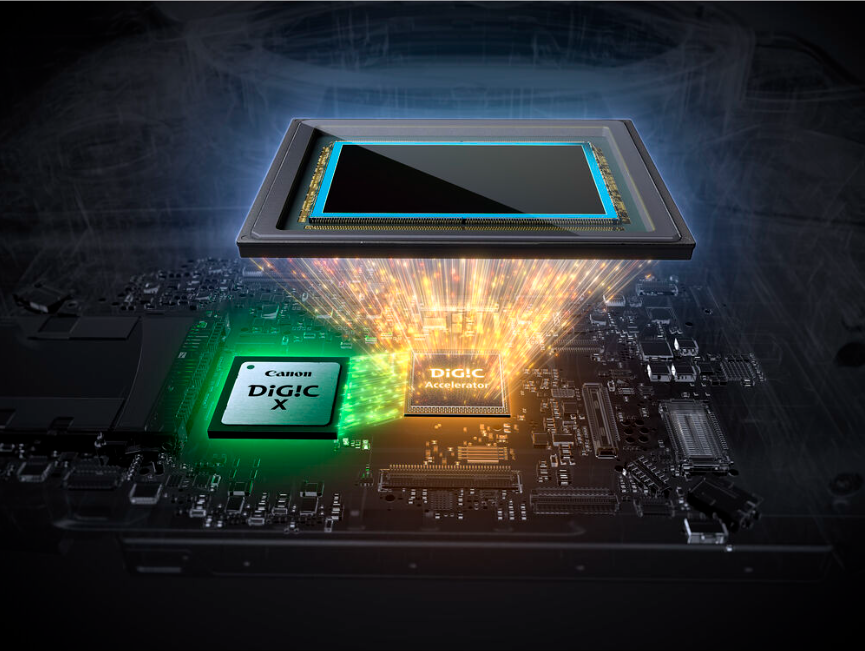
Overall, the R5 Mark II should perform at a faster rate, in terms of auto focus and general processing of image and video data. I would expect, even though we haven’t seen any clear comparisons yet, that the auto focus is snappier and quicker on the R5 Mark II than the R6 Mark II. However, the proof is yet to be seen with this. That all being said, if you were happy with the R5’s auto focus, you’d be just as pleased with the R6 Mark III’s. Canon’s auto focus technology is just that good. R5 Mark II and R1 take autofocus to a whole new level.
Eye Control Focus
The R5 Mark II also features Canon’s Eye Control Auto Focus – this is different than Eye Auto Focus, where the camera attempts to detect and focus on someone’s eye. This is when the camera detects where you are looking through the viewfinder and moves the focus point to that location. This is very much a feature that some love, and others loathe. But it is a good example of the different levels of technology that Canon has packed into the R5 Mark II.
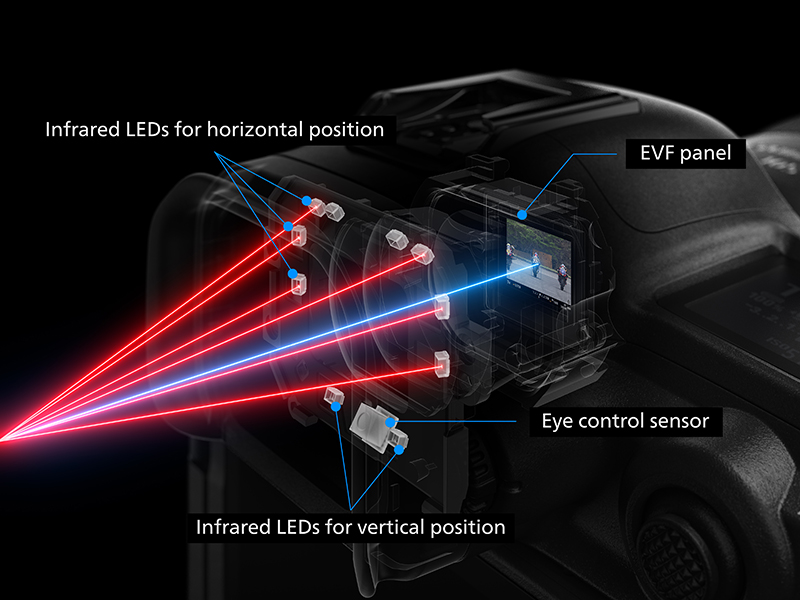
Of course, all this technology comes at a cost – with the R5 Mark II having slightly less battery performance than the R6 Mark III.
Cooling
The entire Mirrorless cooling turned into a significant forum and internet review “thing” with the R5’s release. That has certainly continued, and Canon took a different direction with the R5 Mark II. There’s a slot under the camera that allows for an air-circulating grip to be attached to provide active cooling. So, in scenarios where you are just using the camera for stills, you can use it without the grip or a normal battery grip. When you are shooting 8K RAW video all day, you can swap out the grip for one that will help keep the camera running cool.
The R6 Mark III uses passive cooling. While we haven’t seen any numbers yet for video record times with respect to temperature, I think it’s safe to say that the R5 Mark II provides far more options in this category.
Ergonomics and Handling
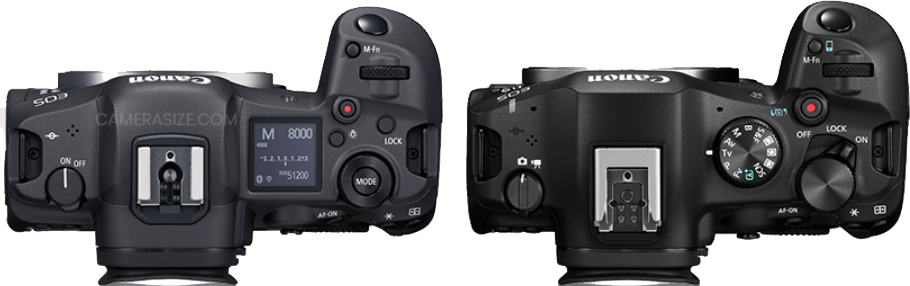
Both the R5 Mark II and the R6 Mark III support the same basic standards of Canon’s now locked-in mirrorless ergonomics. Canon was scattered all over the place for a while, but has now settled into how they want the right hand to operate the camera effectively. This includes the ability to turn on the camera with your right hand, instead of having to use your left hand to do so (as was the case with the original R5 and the original R6). The mode control is different in both cameras, partly because the R5 Mark II has a top plate LCD while the R6 Mark III does not. Otherwise, the cameras are quite similar to each other, and even if you had both, I suspect moving from one to another wouldn’t require a radical adjustment of muscle memory.
The R6 Mark III Has a Few Cool Things
The R6 Mark III has fewer megapixels, while some may consider that a negative, but it honestly depends on what you are shooting. Some photographers may enjoy the more lightweight image files that will process quicker and take up less room on your flash cards and ultimately your hard drive and cloud backup. As well, the R6 Mark III, most likely because the files are smaller, has a larger continuous shooting frame rate – able to capture up to 20 frames at 40 frames per second, while the R5 Mark II can capture 15 frames at 30 frames per second. Giving you more chances for that split-second image to be the perfect one.
On the video side, the R6 Mark III has Open Gate recording (which, as we discussed in our other comparison, means simply the full sensor area), of which, at the time of this article, the R5 Mark II does not currently have.
Closing Thoughts
Both cameras can easily be considered best in class for their respective price points at the time of writing this article. They are impressively fast, with a long list of features and capabilities that make them the top contenders in the market.


But there is a price difference of over $1000 between these two cameras. There’s nothing in the specifications that would jump out to be and say, “This alone is worth $1000 to me”, but there may be something, such as the extremely fast readout speed of the R5 Mark II, that makes it a must-have for you.
Alternatively, someone purchasing an R6 Mark III can get the Canon R6 Mark III kit with a 24-105 f/4L IS USM for less than the R5 Mark II body alone, which may make it a much better solution for those just starting and need lenses as much as a camera.
Summary Comparison between the R5 Mark II and the R6 Mark III
| Canon EOS R5 Mark II | Canon EOS R6 Mark III | |
|---|---|---|
| Sensor | 45MP full-frame back-illuminated stacked CMOS | 32.5MP full-frame CMOS |
| Processor | DIGIC X + DIGIC Accelerator (AI-enhanced) | DIGIC X |
| Burst Shooting | Up to 30 fps electronic (RAW), 12 fps mechanical; 15-frame pre-continuous | Up to 40 fps electronic (RAW Burst), 12 fps mechanical; 20-frame pre-continuous |
| ISO Range | 100–51,200 (expandable to 50–102,400) | 100–64,000 (expandable to 50–102,400) |
| Autofocus Sensitivity | -6.5 EV | -6.5 EV |
| Eye Control AF | Yes | No |
| Video Specs | 8K 60p RAW internal, 4K 120p uncropped, Canon Log 3 | 7K 60p RAW Light internal, 7K 30p open-gate, 4K 120p, Canon Log 3 |
| EVF | 5.76M-dot OLED (120Hz refresh) | 3.69M-dot OLED (120Hz refresh) |
| LCD | 3.2-inch 2.1M-dot vari-angle | 3-inch 1.62M-dot vari-angle |
| Stabilization | Up to 8.5 stops IBIS | Up to 8.5 stops IBIS |
| Storage | 1x CFexpress Type B, 1x UHS-II SD | 1x CFexpress Type B, 1x UHS-II SD |
| Battery Life (LCD/EVF) | 540/250 | 620/390 |
| Weight (with Battery) | 746g | 670g |
| Size | 139 x 101 x 94mm | 138 x 98 x 88mm |
| Price (Body Only) | $3,899 | $2,799 |
[affiliatable id=’309719′] | [affiliatable id=’309718′] |





Prices also as expected (and of course too high 😉 ), In Germany 2899,- incl. VAT.
Now let's see the first RL hands on and sensor measurements and until then all the whiners whine 😛
Does this "new" mean, it is indeed a new sensor or the expected re-use of the (still quite new) EOS C50?
Never owned CFE cards and SD cards are more than enough for me. I was plenty satisfied with dual SD but I would get used to replace the SD card in place of letting the camera fill the second one when the first comes full
But from your answer it is still not 100% clear if it is the same sensor as the C50's (as rumored) the or an even newer one (maybe slightly improved).
However, the max iso has been reduced from the R6ii by 2/3rd of a stop. thisis uaully an indicator from Canon as to it's expected hit on the increased noise threshold those extra mp cause. If the ios noise between the R6ii to R5 was a whole stop then this increase in rez will affect the noise too. So maybe 1/2 to 2/3rd of a stop is about right.
this morning, I've heared numerous youtube influencers talking about the great features of the R6iii....most of these great features are alredy present in the R6ii....which goes to show how good the R6ii is / was.
Here in the Uk, the launch price is around £2700 GDP...whcih is very high considering I can buy a new R5ii (via grey import) for the same price. A mint used R5 for £1600 and a new R6ii (grey) for on;y £1350....for only a few new fetures...that's a lot of £££ for not a lot of benefits. I can literally buy a pair of R6ii's for the launch price of one R6iii.
I think if I was looking to jump from DSLR to mirrorless, this would be a great camera. I think upgraders from the EOS R and R6mk1 have a lot of milage in this upgrade. but for existing R6ii users....it's more of an expensive side grade. Slightly improved, more of an evolution that definatly builds on the shoulders of it's great predecessor. If Canon continues selling their R6ii alongside the R6iii, then the R6ii may become the true bargain of the canon range.
When [Cropping/aspect ratio: Full-frame] is set: 1/200 sec mechanical shutter / 1/250 electronic 1st curtain,
When [Cropping/aspect ratio: 1.6x (crop)] is set: 1/250 sec mechanical shutter / 1/320 electronic 1st curtain.
So the 1/320s sync speed is for 1.6x crop electronic 1st curtain.
As expected for non-stacked sensor, no flash sync using fully electronic shutter.
mic drop