
Canon Rules the Camera Landscape

Richard Cox
4 Min Read

When you purchase through links on our site, we may earn an affiliate commission. Here's how it works.

There was the Nikkei Financial Yearbook released in Japan, and DCLife summarized camera shipments from the big Japanese manufacturers over the last 4 years. It's a fascinating look at the industry, and how DLRs have fallen off – but at different degrees of slope than one may have anticipated, given that we were looking back in 2018 when Nikon and Canon joined the mirrorless market en masse.

I could have made a lot of money betting Sony fanboys in 2017 that Canon would rule mirrorless by 2021. Alas, it was not the case, though I will accept donations ;)

The mirrorless market after the RF and Z mount introductions was Canon's and Nikon's to gain and take over from Sony, who controlled the market by default. While Canon managed to execute that pivot remarkably well, even with rather lackluster cameras in the RP and EOS R cameras, what happened was anything but a graceful pivot by Nikon, with arguably far superior cameras to the Canon releases. It wasn't until Canon released the R5 and R6 in 2020, that you could say they were fully invested in the platform and competitive in the market.

This is a look at what happened from a year after that point, from 2021 onwards, and after the dust had settled, it has been a two-horse race since – Canon and Sony.
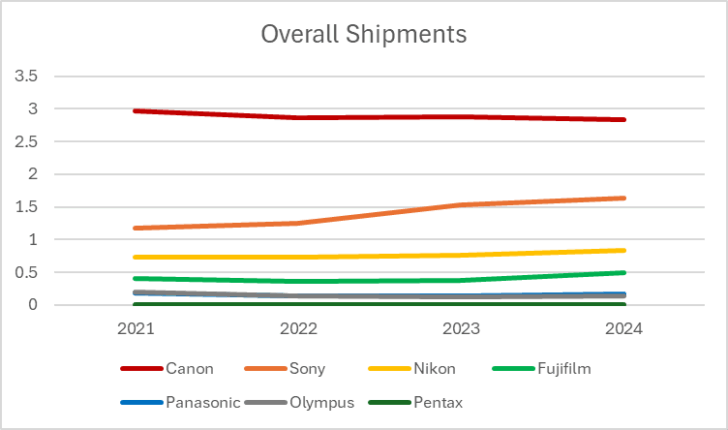
You could argue, I suppose, that Canon had history on their side, as they made a central pivot from the FD manual focus mount to the fully electronic EOS mount. So they had a working blueprint and arguably a much easier path forward, having trialled many of the technologies in the EOS-M mount. That being said, Canon not only dumped one mount, but two at the same time, with both the EOS-M and EF mounts rapidly replaced by the RF.

For all I gripe about Canon and its RF mount not having Sigma full-frame lenses – and the fact that Canon released a camera like the R100, it's a remarkable shift for Canon that they managed without losing their overall grip as the number one camera company in the market.

What About those DSLRs?

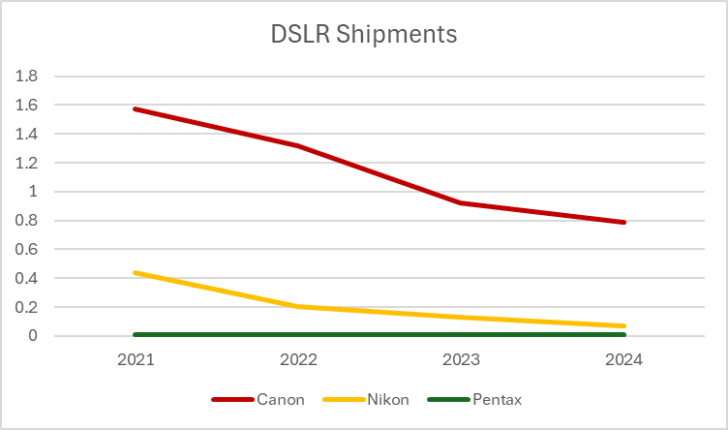
Overall, DSLR shipments have declined significantly. Canon has continued to ship significant quantities of DSLRs over the past four years, even as DSLR shipments declined from 1.54 million in 2021 to 790,000 in 2024. Nikon appears to have lost complete interest, and Pentax is content to be a minor player.
What About Just Mirrorless?

When we examine mirrorless, we see a two-company competition between Canon and Sony, with Canon leading the charge, shipping a commanding 2 million units in 2024—the highest number of mirrorless cameras that Canon has ever shipped.
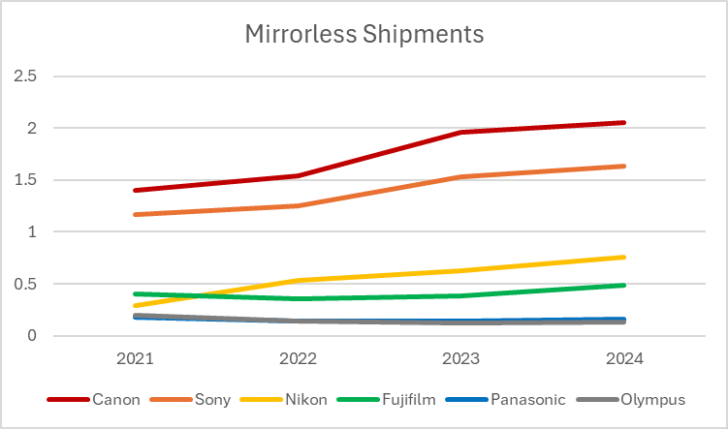
Interestingly, Nikon seems to be picking up the pace a bit as well, but it remains unknown if they can pull themselves up from the bottom tier of camera companies to take on either Canon or Sony.

The dark horses in all of this are what may or may not happen in China, with domestic brands such as DJI and Huawei rumored to be entering the market, and mobile phone juggernauts such as Xiaomi and Redmi experimenting with interchangeable lenses attached to smartphones.


Go to discussion...

Share This Article
Follow:
Richard has been using Canon cameras since the 1990s, with his first being the now legendary EOS-3. Since then, Richard has continued to use Canon cameras and now focuses mostly on the genre of infrared photography.

84 comments

  1. It looks like Nikon is gaining some momentum!
    They chose to occupy a niche, long "affordable" teles, where both Canon and the other one whose name I enjoy forgetting 😈 are still absent.
    It helped them to regain the interest of many wildlife, maybe also sports photographers.
    Good news for them, and also Canon.
    Canon/Nikon competition was good for both, not too long ago.
  2. If you look at Overall Shipments, note the narrowing gap between Canon and Sony. Sony, Nikon, and Fujifilm are all trending up, but Canon has a slight trend down. I'm not sure why this is, but of all the start-up pro photographers I personally know, none of them are going with Canon and their number one reason is the lack of third-party, full frame lenses, such as Sigma. I'm very heavily invested in mirrorless Canon equipment but in my conversations with photographers starting professional work, I now recommend Sony or Nikon, solely for the lack of of third party, full-frame lenses for Canon. I follow a few YouTube landscape photographers. In the last two years, almost all of the Canon DSLR YouTube influencers I have followed have now switched to Sony or Nikon. These people are significant influencers. The consequences of this are not large to start with - almost flat in the short term, but when they stay flat or start trending downward, there can be an accelerating effect, resulting in an increasing narrowing of the gap as we see in that graph. I gave Canon a two-year grace period with the expectation that they need to get their new RF lenses up and running and not let the competition in too soon. But that grace period is long gone now. I've been a Canon user since the 80's when I purchases my first F1, but even though I'll still be with Canon for the long haul, thanks to being so heavily invested in their new RF cameras and lenses, I have been recommending to all the up and coming pros or semi-pros to look at either Sony or Nikon and not to make the same mistake I have made re. this imaginary 'grace period'. I think Canon equipment is absolutely first class, but they need to drop their protectionism when it comes to full frame RF lenses. In the meantime, I'm praying they release a 14mm or 15mm f1.4 for night scapes.
  3. Richard, I've enjoyed your work here and other sites. Thanks for posting.

    I don't really understand what I am reading (hey that's not all that unusual!).

    What exactly do these data represent?

    Interchangable lens cameras only?

    Specifically, you write:

    When we examine mirrorless, we see a two-company competition between Canon and Sony, with Canon leading the charge, shipping a commanding 2 million units in 2024—the highest number of mirrorless cameras that Canon has ever shipped.

    How is mirrorless defined here?

    I have other questions, many of which indicate my cluelessness.
  4. Thanks @Richard CR, for such elaborated articles.

    Yeah if I were Canon I wouldn't sleep on these numbers (as they are currently).
    Do I read your post right that you think Canon is lazy and doing nothing to maintain that position?
    If so, where do you think they are lazy?
  5. If you look at Overall Shipments, note the narrowing gap between Canon and Sony. Sony, Nikon, and Fujifilm are all trending up, but Canon has a slight trend down. I'm not sure why this is

    It's all explained in the charts and article. The Overall Shipments include DSLRs and Mirrorless. In the DSLR chart Canon had a decline, however, they trended upward in Mirrorless. They're doing fine.
  6. It looks like Nikon is gaining some momentum!
    In their financial documents, Nikon forecasts that for the fiscal year ending March 2026, their interchangeable lens camera market share will be (950/6700) 14%, That's only a 1% increase over the previous fiscal year.

  7. If you look at Overall Shipments, note the narrowing gap between Canon and Sony. Sony, Nikon, and Fujifilm are all trending up, but Canon has a slight trend down. I'm not sure why this is, but of all the start-up pro photographers I personally know, none of them are going with Canon and their number one reason is the lack of third-party, full frame lenses, such as Sigma.
    I do not believe that the lack of FF 3rd party AF lenses is to blame here... reality is we care but we are a small niche.
    I think it's more the case that the DRLS market is disappearing fast and Canon is the last manufacturer that still sells a significant number of DSLRs, so their growth in mirrorless is countered by their decreasing DSLR sales. I assume that they will reverse the trend once DSLRs will disappear
  8. It is worth noting that while everybody in the mirrorless segment gained sales last year, they obviously didn't all gain as much as the segment grew.

    Overall, the mirrorless segment grew by 9.7% from 2023 to 2024.

    BrandUnit SalesSales Growth PercentageMarket ShareMarket share change
    Canon2,050,0004.6%39.27%-1.90%
    Sony1,630,0006.5%31.23%-0.92%
    Nikon760,00020.6%14.56%1.32%
    Fujifilm490,00028.9%9.39%1.40%
    Panasonic160,00014.3%3.07%0.12%
    OM Digital130,0008.3%2.49%-0.03%
  9. If you look at Overall Shipments, note the narrowing gap between Canon and Sony. Sony, Nikon, and Fujifilm are all trending up, but Canon has a slight trend down. I'm not sure why this is, but of all the start-up pro photographers I personally know, none of them are going with Canon and their number one reason is the lack of third-party, full frame lenses, such as Sigma. I'm very heavily invested in mirrorless Canon equipment but in my conversations with photographers starting professional work, I now recommend Sony or Nikon, solely for the lack of of third party, full-frame lenses for Canon. I follow a few YouTube landscape photographers. In the last two years, almost all of the Canon DSLR YouTube influencers I have followed have now switched to Sony or Nikon. These people are significant influencers. The consequences of this are not large to start with - almost flat in the short term, but when they stay flat or start trending downward, there can be an accelerating effect, resulting in an increasing narrowing of the gap as we see in that graph. I gave Canon a two-year grace period with the expectation that they need to get their new RF lenses up and running and not let the competition in too soon. But that grace period is long gone now. I've been a Canon user since the 80's when I purchases my first F1, but even though I'll still be with Canon for the long haul, thanks to being so heavily invested in their new RF cameras and lenses, I have been recommending to all the up and coming pros or semi-pros to look at either Sony or Nikon and not to make the same mistake I have made re. this imaginary 'grace period'. I think Canon equipment is absolutely first class, but they need to drop their protectionism when it comes to full frame RF lenses. In the meantime, I'm praying they release a 14mm or 15mm f1.4 for night scapes.
    I think you've misinterpreted the graphs. As Devon Jones points out, the "Overall Shipments" graph isn't really relevant, because that includes DSLRs for which Sony has no involvement (and for which shipments have been falling).

    The relevant graph -- the only one which can be relevant for your points about RF mount -- is the "Mirrorless Shipments" one. Here, obviously, the gap between Canon and Sony is smaller, because Canon's DSLR shipments are not included (but still remarkable considering that Canon started from zero FF mirrorless shipments in 2018), But, contrary to your point the gap increased between 2022 and 2023 and the difference appears pretty much unchanged since then. In fact, since 2023 the four leading shippers, Canon, Sony, Nikon and Fujifilm all seem to have increased their shipments "in parallel", whereas the others listed, Panasonic and Olympus/OM seem to be flatlining.

    I don't see any evidence to support your point, so Canon seems to be "managing" despite your recommendation to others to avoid your "mistake" and buy other brands. Personally, I think such a recommendation may be very short-sighted and not in the longer term interests of new photographers.
  10. It's all explained in the charts and article. The Overall Shipments include DSLRs and Mirrorless. In the DSLR chart Canon had a decline, however, they trended upward in Mirrorless. They're doing fine.
    In market share, though, it's the opposite.
    Canon had a decline in DSLR sales. It wasn't as bad a decline as the DSLR segment had overall so they gained market share.
    Canon had an increase in Mirrorless sales. It wasn't as good an increase as the Mirrorless segment had overall so they lost market share.
  11. Canon should do to Sony what AMD did to Intel with dual core CPU.

    While Intel was busy pasting 2 single core CPUs together, AMD designed the first single silicon die dual core processor. Then Intel took their pasted two core design and pasted them together with another pasted dual core CPU and created the first quad core CPU, while AMD designed the first quad core on a single silicon die. Each time AMD beat the pants off Intel.

    A year ago I responded to a questionnaire sent by Canon and I asked about a triple layer BSI sensor. Considering Sony announced plans to do so, Canon needs to design and release a new sensor architecture, from the ground up, to pull away from the pack. Canon behaves like AMD, its mirrorless camera and lens design and innovation is slow and methodical. It can beat the pants off Sony and Nikon. Couple that with their excellent customer support. No 3rd party repairs for Canon products and I've never been ignored or turned away by customer support.
  12. In their financial documents, Nikon forecasts that for the fiscal year ending March 2026, their interchangeable lens camera market share will be (950/6700) 14%, That's only a 1% increase over the previous fiscal year.

    This is right, but like Canon's slight decline, mostly due to the DSLRs, while their mirrorless sales show an upward trend.
    As to Canon, my feeling is that they are no longer being considered as THE innovation company. Canon often seems to be following trends set by competition.
    And Chinese companies are waiting...
  13. A year ago I responded to a questionnaire sent by Canon and I asked about a triple layer BSI sensor. Considering Sony announced plans to do so, Canon needs to design and release a new sensor architecture, from the ground up, to pull away from the pack. Canon behaves like AMD, its mirrorless camera and lens design and innovation is slow and methodical. It can beat the pants off Sony and Nikon. Couple that with their excellent customer support. No 3rd party repairs for Canon products and I've never been ignored or turned away by customer support.
    Canon has patent applications for triple layer sensor(s). See: https://www.canonrumors.com/canon-patent-application-triple-layer-high-speed-stacked-sensor/ and https://www.canonrumors.com/canon-patent-application-improving-stacked-sensors/
  14. Ah yes, I remember it like it was yesterday. The year was 1933, and the prophecy fortold Canon’s impending doom! Dun dun dun. Of course we called them the Precision Optical Laboratory back then. Canon would have many names in the early years, but one thing was always certain - Canon is doomed! A World War loss, some beatles albums, and many iPhone generations later, the doom is nigh!!! Any day now they say…. And they say it a lot!!!
  15. I do not believe that the lack of FF 3rd party AF lenses is to blame here... reality is we care but we are a small niche.
    I think it's more the case that the DRLS market is disappearing fast and Canon is the last manufacturer that still sells a significant number of DSLRs, so their growth in mirrorless is countered by their decreasing DSLR sales. I assume that they will reverse the trend once DSLRs will disappear

    Not sure why you wouldn't believe it and its certainly not niche for someone to divert from the canon ecosystem. Its only been going on for years.

    I personally have been canvasing options now that I have access to all sigma lenses. It's a YUUUGE deal. That's literally money not going to canon. My next 2 lenses will not be going to canon....maybe a 35, or 28-70 or 24-70...hmm....choices matter.

    Ironically n the salespersons at BH..in the CANON booth complain about it.

    Every single week customers are reminded that they are in canon lens jail. Do you really think that's insignificant? Feel however you want but that's exceedingly unrealistic.

    Now back to my sigma lens shopping..hmm..this one, or that one...hmmm.

Leave a comment

Please log in to your forum account to comment