Show your Bird Portraits
- By Click
- Animal Kingdom
- 32672 Replies
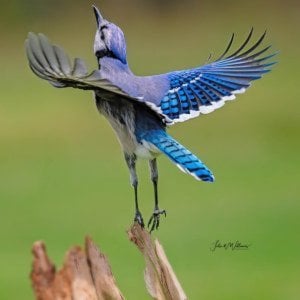
Lovely shot. Amazing details of the bird. Beautiful pose in a clear background. Nicely done, ISv.
Upvote
0
Because I can't resist going off topic, does anyone know the evolutionary advantages of various properties of mushrooms?"A small number of mushrooms are in the ‘edible and tasty’ category, and an even smaller number are in the ‘deadly if ingested’ category."
I agree with that but what is "tasty" for some is kind of "mediocre" or "not tasty" for others!
In most cases it actually deepens on how you prepare it: you don't make chicken, pork, beef e.t.c the same way, no?
Grifola frondosa (aka "hen-of-the-woods") has a flavor similar of some Amanitas (yes! there are edible Amanitas like the most known A. rubescens and even the highly prized A. cesarea) and some other mushrooms (like Leucopaxillus giganteus that is by far more meaty!) with the similar flavor. You may like or dislike it but it's just a different flavor!
I could be an exception but for example I don't like the flavor of any Truffles! Or may be I just haven't tried some prepared by a good chef?!
And a case from Sweden: I went out to look for Boletus edulis but instead found +/- 2 pounds of Cantharellis cibarius. Met a family with two small children and when they saw my basked they were like "where did you find these? We are looking for these!!!"
I gave them my C. cibarius because I'm not realy fan of it.
For my big surprize they gave me their collection of B. edulis!!! I asked few times "are you sure?!!!" but they were so happy with the Cantharelle!
It was more Boletus than I was expecting to find and lately gave half to a friend!
"... this land is happy and gayyyy!"Now you know how Franz Liebkind felt. We have a Maximilian posting (not Bialystsock, fortunately) and we need more of the cast.
Answered by others already, I think. But I did enjoy watching The Nutcracker performed by the Boston Ballet while those answers were provided.Wait, are you saying that Canon’s digitally corrected lenses are already corrected in the raw file itself and digital optimizer isn’t needed? And therefore any third party editor gets the same benefit of Canon’s software corrections before their own third party corrections are applied? i.e., I could theoretically put the RF lens on a Nikon or Sony body with an adapter and get the same image for the same shooting situation like I could with an EF lens?
It’s the lens optics. The EF 50/1.2 is the standard double Gauss design that’s been around almost as long as lenses, the RF 50/1.2 is a modern design that delivers much better performance.Is the RF performance equal or better without correction? Or did Canon just try harder with the software? Not being facetious, I don’t know the answer and you might.

I get the preference. But ‘better source material’ isn’t free, the cost is usually size, weight, and actual cost (for example, the RF 50/1.2 lists for over $1000 more than the EF).Uh, huh — I didn’t say that I don’t use corrective software, the opposite. I just prefer to start with better source material and apply software as an option and not a necessity for missing corner data, etc.
We don’t capture images in the lab with MILC lenses, we use microscope objectives. Our automated cell-based high-throughout screening system for small molecule libraries captures ~64,500 images per day. Each of those images has digital corrections applied before being processed by ML-driven algorithms to quantify the effects of the compounds on the cells.For personal work I’m OK with optional correction that I tend to do all the time anyhow. For lab image capture and processing by AI pipelines I’ll hope the labs stick with EF or third party for now.
Only this from today! And for this one I was scolded: "you got so close to the bird!" - you scared it!!! Well, I was actually "zooming" back because the bird was coming closer and closer to me! That women passed in front of my lens and the bird was still there!!!
Some people are ignorant or just a morons?! Any way, only the bird from today...

"A small number of mushrooms are in the ‘edible and tasty’ category, and an even smaller number are in the ‘deadly if ingested’ category."No idea about the specific mushroom, but the overwhelming majority of mushrooms fall into the category of ‘edible but not tasty and will probably cause some GI discomfort’. A small number of mushrooms are in the ‘edible and tasty’ category, and an even smaller number are in the ‘deadly if ingested’ category.
The hen-of-the-woods falls into the large edible but not tasty group.
View attachment 227204
I don't think the edibility is known but judging by some other features they should be in section Xanthodermatei. It means they should be +/- mildly to moderate toxic (as all others from that section of the genus). In the literature you may find that "some people can eat" specifically A. xanthodermus. I don't think it's about the person who eats it. I had an experience in Bulgaria when one of my colleagues came with a jar of marinated A. xanthodermus. She was insisting that "many people" of that place are collecting the mushrooms without ill effects. We (5-6 people) tried it and nothing happen (symptoms are coming rather fast with that kind of toxins). I think it's a case of where you are collecting such a mushrooms!This is the first time I've seen this mushroom. They're very pretty with their white stripes. Are they edible?
I just returned to Canon after 25+ years with EOS and a switch to Fuji for the past 4. I thought the switchback through carefully and slept on it for the past year.Meanwhile, Fujy sells a lot of compatcs with buttons and dials. And probably those looking again for compact cameras and using old models are not exactly looing for touch screens, Since a camera unlike a smartphone is designed for a single task, it's bette driven by a specific interface. Sure, the smartphone crowd has to learn something new - if this is a real barrier... mankind is doomed.
Sure - it’s when missing data is guessed.Please explain the 2nd sentence. I do have a little background in molecular biology but the meaning escapes me.
OMG.Uh, yeah… DPP or the camera applies the DLO data. Let me extract the rake from my face. And then get more coffee…
Actually, I have to correct myself: the files from the R5 II do the same, but those from my original R6 do not.Interesting! Maybe they’re sharing now, at least partially!

Please explain the 2nd sentence. I do have a little background in molecular biology but the meaning escapes me.I guess so long as one is as truthy as the other. Makes me think of cringy imputed gene expression values for mediocre slides.
OMG.I’ll say again, DLO does nothing to RAW files
(in-camera, that is, of course)
(1) Effects are only applied to the JPEG file
The in-camera DLO function makes corrections in real time, but its effects are applied only onto JPEG files at the time of recording. To apply DLO to RAW files, you can either;
- Post-process your RAW files in-camera. You can apply DLO (if it wasn’t already enabled) or change the effect level, and the effects will be visible in the exported JPEG image.
- Use Canon’s free Digital Photo Professional (DPP) software to post-process your RAW files on the computer.
Interesting! Maybe they’re sharing now, at least partially!the way, recently I’ve seen a difference. RAW files from the R6 Mark III have the lens profile built-in, as noted by Adobe Camera RAW (which does not have a profile for the RF 45mm yet), where the files appear with a profile loaded by default and it’s not an Adobe one. And it’s the camera, not the lens, as RAW files from the R5 II do not exhibit the same behaviour.
Oh, totally. It’s why I do use them.And people really ignore how much profile corrections EF lenses had. I’ve shared examples in this forum a few weeks ago. While distortions were usually more corrected optically, vignetting levels were very similar to those of RF lenses.
It does read the optimizer data and performs the adjustments. Third parties aren’t provided with instructions on how to parse the optimizer data and need to do their own math, which is often limited to apparent distortion, shading, etc. and less so the physics of the lens that Canon’s engineers have bothered to calculate.DLO does nothing to RAW files.
I guess so long as one is as truthy as the other. Makes me think of cringy imputed gene expression values for mediocre slides.I'm also a bit of a scientist, and I see no scientific objections to correcting via digital rather than by analogue methods.
DLO does nothing to RAW files.Wait, are you saying that Canon’s digitally corrected lenses are already corrected in the raw file itself and digital optimizer isn’t needed?
Wait, are you saying that Canon’s digitally corrected lenses are already corrected in the raw file itself and digital optimizer isn’t needed? And therefore any third party editor gets the same benefit of Canon’s software corrections before their own third party corrections are applied? i.e., I could theoretically put the RF lens on a Nikon or Sony body with an adapter and get the same image for the same shooting situation like I could with an EF lens?If you want to use Canon's Digital Lens Optimizer, then yes you need to take JPGs from the camera or use Canon's DPP for RAW conversions. But 3rd party RAW converters have profiles for RF lenses that require digital correction, and they work just fine. Personally, I view using Canon's DPP with the same affection that I view getting a Norovirus infection. I use DxO PhotoLab for RAW conversions, which is what I did for the aforementioned RF 14-35/4 vs. EF 11-24/4 comparison, though I also included camera JPGs along with DPP and Adobe RAW conversions for completeness.
It's not. I see no reason to use Canon's software to process Canon RAWs. DxO, Adobe, Affinity, CaptureOne, and a bunch of others seem to manage just fine (as they do with RAW files from Nikon, Sony, Fuji, etc.). IMO, DxO handles noise reduction much better than Canon's DPP, for example. No reason a software pipeline couldn't run demosaicing and image corrections if properly coded, just as 3rd party RAW converters do.
Ah. OK.The film analogy was broader – it's about resistance to change. People (at the time, not now) argued that film was analog and pure while digital was 'fake' and 'computer trickery'. The only 'true' workflow was negative to print or slide film to projection. Your suggestion of scanning the developed film would not satisfy those folks, that's just more digital trickery. Interesting that you used that same word about digital
Agreed.Also worth noting that RAW images from the camera are never 'good to go'. At a minimum, they require demosaicing / color interpolation.
Is the RF performance equal or better without correction? Or did Canon just try harder with the software? Not being facetious, I don’t know the answer and you might.The EF 50/1.2L has 1.5% barrel distortion (enough to be noticeable, almost as much as the 1.7% of the EF 14/2.8L II), strong axial CA and significant focus shift...it can produce lovely, dreamy images but as example of what can be achieved with pure performance based on physics it leaves much to be desired. OTOH, the RF 50/1.2L has a native 0.2% barrel distortion and requires no digital correction, it has very little axial CA (especially for an f/1.2 lens), no focus shift and is very sharp.
Did I miss a new Canon RF 17-40 that avoids those issues without correction?Leaving that aside, for your 'pick any other L EF lens challenge, I pick the EF 17-40mm f/4L. Convince me that the physics-based optical corrections are doing the job there. Unless you like the fisheye-esque look, that lens desperately needs 'a little push' to correct the ~4% barrel distortion, as does the EF 11-24/4L.
Uh, huh — I didn’t say that I don’t use corrective software, the opposite. I just prefer to start with better source material and apply software as an option and not a necessity for missing corner data, etc.Sorry, I disagree with your conclusion that 'any other' L EF lenses is 'good to go' without some digital correction applied. Unless you're shooting in-camera JPGs or are happy with distorted images with visible chromatic aberration, most images benefit from digital correction even if they don't strictly require it.
Haha! I’m certainly not going to argue against you being results oriented!I'm definitely results oriented. I can promise you that the 0.6 kg RF 10-20/4L that I pack for a trip will deliver significantly better flexibility and outcomes than the 1.2 kg EF 11-24/4L that I would often leave at home.