Canon EOS R6 Mark III & RF 45 F1.2 STM November 6

Anyway, I never bought f/1.4 for portraits, I did it for the light, because f/2.8 to f/1.4 is a very big difference, and not every environment allows the use of flash.

Then the EF 50mm f/1.2 L is not a lens for you. But just because it does not meet your needs doesn't mean it is not an excellent lens for other use cases.
 
  • Like
Reactions: 1 user
Upvote 0
I'd never dare to say that a line of shamelessly optically uncorrected lenses with extreme vignetting is 'a great accomplishment'. I don't even think the VCM line is worth of the red ring. At that price tag the least I expect is the lenses to be optically corrected.

View attachment 226634
What I hope for and expect with any lens, especially L lenses, is for the actual images they produce, using whatever corrections they are designed for (optical, digital, or both) to be really good. Since the images from the VCM lenses are not just really good, but actually outstanding, I also think they are a remarkable accomplishment. I own and use four of them (24, 35, 50, 85), so I actually know what I'm talking about (unlike people who tiresomely scream "but digital corrections, but digital corrections" over and over and over, without actually owning and using the lenses). When I bought my 50 F1.4, I thought I might hang onto my RF 50 F1.2, which is a truly wonderful lens. However, I just didn't find myself using it. The results from the VCM version are just as good, no-one notices the 1/3 stop difference between F1.2 and F1.4, and the VCM version is so much smaller and lighter. So I've just sold my F1.2. The latest, which is the 85 F1.4, is my favorite 85 ever. It's just superb. You can, of course, stick your head in the mud, ignore the fact that designing lenses for digital corrections (which the VCM lenses employ to a greater or lesser extent, depending on which lens we're talking about--the 85 probably the least) makes possible not just particular body designs but also the kinds of optical performance that would be hard, if not impossible, to achieve with optical corrections only, and thereby miss out on some fabulous lenses. Your choice.

 
  • Like
  • Haha
Reactions: 13 users
Upvote 0
One of the benefots (sic) of the EF 135mm f2.0 L is that it can take a 1.4x tc with minimal drop in IQ.

The achillies (sic) heel of the EF 135mm f2.0 L (and also the EF 85mm f1.2 II L) is strong magenta / green Loca (sic) on spectacular highlights. it's easily corrected in Lightroom, but it is very strong on these two lenses.

My experience with an EF 135mm f/2 L + EF1.4X III was rather disappointing. The images were well below the quality of the bare lens or even my EF 70-200mm f/2.8 L IS II at 135mm.

I did AFMA with the Camera + 1.4X + 135/2 before the shoot for which I used it while my EF 70-200mm f/2.8 L IS II was off to CPS for a new IS unit (at age 9 years and a LOT of heavy use with plenty of hard bumps and bangs along the way).

I've never noticed any offensive colors of specular highlights with the EF 135mm f/2 L. But then I usually shoot with it in darker environments where there aren't a lot of bright points in the out of focus areas.
 
  • Like
Reactions: 1 user
Upvote 0
What I hope for and expect with any lens, especially L lenses, is for the actual images they produce, using whatever corrections they are designed for (optical, digital, or both) to be really good. Since the images from the VCM lenses are not just really good, but actually outstanding, I also think they are a remarkable accomplishment. I own and use four of them (24, 35, 50, 85), so I actually know what I'm talking about (unlike people who tiresomely scream "but digital corrections, but digital corrections" over and over and over, without actually owning and using the lenses). When I bought my 50 F1.4, I thought I might hang onto my RF 50 F1.2, which is a truly wonderful lens. However, I just didn't find myself using it. The results from the VCM version are just as good, no-one notices the 1/3 stop difference between F1.2 and F1.4, and the VCM version is so much smaller and lighter. So I've just sold my F1.2. The latest, which is the 85 F1.4, is my favorite 85 ever. It's just superb. You can, of course, stick your head in the mud, ignore the fact that designing lenses for digital corrections (which the VCM lenses employ to a greater or lesser extent, depending on which lens we're talking about--the 85 probably the least) makes possible not just particular body designs but also the kinds of optical performance that would be hard, if not impossible, to achieve with optical corrections only, and thereby miss out on some fabulous lenses. Your choice.
I still want the trend to be for corrections in-lens as able, but the reality is I turned on the digital optimizer in my R6 and the rest is history. I'm even seeing some relatively fantastic 70-200 + EX2 photos that simply would have been trash in my DSLR days with the same combo. So, I'd have to agree at the end of the day...
 
Upvote 0
Prior to the R, the primary general purpose 35mm DSLRs for Canon were the 5D and 6D series, right? The 5D was configured in a way that it best assured things got done for people who needed to do it—whatever that was—and priced it accordingly. The 6D was configured to be technically eligible: For a much lower price, one got a 35mm sensor with OK light sensitivity, half the shutter ceiling, and passable weather sealing. Thus it was in one shade or another for years.

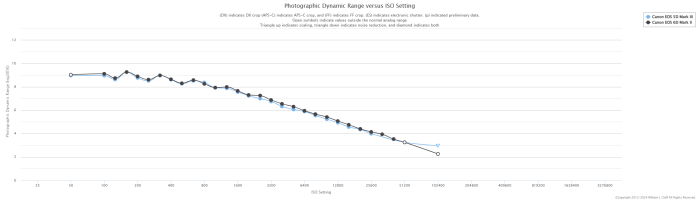
Compare the spec sheets of the 2012 5D Mark III to the 2017 6D Mark II. They're practically identical, other than 1/3 stop difference in X-sync and 1/4000 vs 1/8000. On the other hand, the 6D Mark II had higher resolution (26MP) than the 5D Mark III (22MP), though not as high as the 2016 5D Mark IV (30.4). The 6D II had an articulated touch screen, WiFi and *** built in, DiG!C 7 vs DiG!C 5+, slightly more cross-type AF points, slightly higher burst rate, and flicker reduction (which all Canon bodies with less than 4 digits in the model name (xD, X0D, xx0D) beginning with the 7D Mark II in 2014 got).

DR at all ISOs was practically identical. SNR was also nearly identical.

screenshot.png
 
  • Like
Reactions: 2 users
Upvote 0
Compare the spec sheets of the 2012 5D Mark III to the 2017 6D Mark II. They're practically identical, other than 1/3 stop difference in X-sync and 1/4000 vs 1/8000. On the other hand, the 6D Mark II had higher resolution (26MP) than the 5D Mark III (22MP), though not as high as the 2016 5D Mark IV (30.4). The 6D II had an articulated touch screen, WiFi and *** built in, DiG!C 7 vs DiG!C 5+, slightly more cross-type AF points, slightly higher burst rate, and flicker reduction (which all Canon bodies with less than 4 digits in the model name (xD, X0D, xx0D) beginning with the 7D Mark II in 2014 got).

DR at all ISOs was practically identical. SNR was also nearly identical.

View attachment 226671
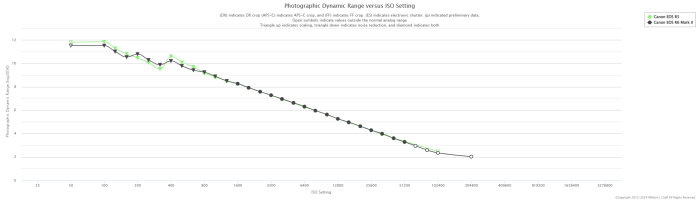
But really it's the 5D.4 / R vs the 6D.2 / RP we're talking about for the advent of the R5 and R6. The former was noticeably better at the bottom end. Things didn't fully sync up until ~ 3200 -- and that's with fewer pixels on the 6D II. The R6 tracks much more like the 5D.4.

Canon could have just moved the R (~5D.4) chip into the R6. It would have tracked with the 6D II vs 5D.4 gap, but now vs. the R5 in terms of further line differentiation. They went better, thankfully. As pointed out earlier, the R5 and R6 perform virtually the same along the numeric options, and thus for lower values likely to be used no quality difference.
 
Last edited:
Upvote 0
But really it's the 5D.4 / R vs the 6D.2 / RP we're talking about for the advent of the R5 and R6. The former was noticeably better at the bottom end. Things didn't fully sync up until ~ 3200 -- and that's with fewer pixels on the 6D II. The R6 tracks much more like the 5D.4.

Canon could have just moved the R (~5D.4) chip into the R6. It would have tracked with the 6D II vs 5D.4 gap, but now vs. the R5 in terms of further line differentiation. They went better, thankfully. As pointed out earlier, the R5 and R6 perform virtually the same along the numeric options, and thus for lower values likely to be used no quality difference.

The EOS R and EOS RP were one-off models to get Canon into the FF MILC at a time when lower end camera sales (i.e. APS-C) were drying up and FF was becoming a larger and larger part of the overall market. Introduced in 2018, they had to have been on the planning board since at least 2015 considering how long Canon takes to get a product to market.

In the entire history of the R5 and R6 series, the chief differentiator has been Resolution.

If "the R6 tracks more like the 5D Mark IV", that just proves the point.

The 6D Mark II came along 5 years after the 5D Mark III. The R6 came along 4 years after the 5D Mark IV. Other than resolution, the 6-Series trails the 5-Series by one model cycle (4-5 years) in terms of many features and spec sheet numbers.

Again, compare the EOS R5 to the next generation EOS R6 Mark II:

screenshot (1).png
 
  • Like
Reactions: 1 users
Upvote 0
My prediction, based on past history, is that if the R6 Mark III is essentially the R5 in a lower grade body, then the R5 will very soon disappear from dealers' inventories. It won't be up to Canon corporate. The dealers will return unsold R5 bodies to Canon for credit towards future purchases.

The (2017) 6D Mark II was essentially a (2012) 5D Mark III on the spec sheet. Though the 5D mark IV had supplanted the 5D Mark III in 2016, they were still available from many dealers until the 6D Mark II came along. Then the 5D Mark III vanished form new inventories practically overnight. It may or may not have been Canon corporate requiring them to return unsold 5D Mark III. The dealers surely realized the 5D Mark III would be a hard sell with the 6D Mark II priced roughly $1K less and so they returned them to Canon for credit on their balance sheets.
The RP is a mirrorless 6Dii and still being sold.
The EOS R was selling for a long time after the R6/R5 were released.
The R5 is still a great camera and 45mp is a lot more than 24 (or 32) at least in some minds. The R6iii will never be able shoot 8k :-)
 
  • Like
Reactions: 1 users
Upvote 0
In the entire history of the R5 and R6 series, the chief differentiator has been Resolution.
I agree. It comes down to that in terms of the sensor. In the history of the 6D vs 5D it was also body, shutter, lifetime of flaps, sealing, etc.

If "the R6 tracks more like the 5D Mark IV", that just proves the point.
I disagree. Moving from the 6D -> 6D II was meh, but from the 6D II to (spiritually, at least) the R6 it was wow. There are far fewer differences between the R6 and R5 when you take a photo or dunk the body in animal snot than what were with the 6D series vs 5D series. Similarly, the RP vs R or 5D.4 was meh. Canon could have kept with meh, but it ran strong. More my point about the 5D.4 comparison and use of the 1D III -ish chip. Canon didn't just hand the masses a road apple. They handed them a quality product by which only resolution and mode selection were the big differentiators.

Put this way:
For CAD $2k in moving from the R6 to R5 you get double the pixels and an LCD display. I guess more EVF pixels.
For CAD $2k in moving from the 6D II to 5D.4 you got double the pixels, better snot resistance, better daylight tolerance, better low end detail preservation, more flaps before failure, etc.

So in moderns times resolution. In the before times pretty much well the whole pie. Steering this back to my original moaning, I'm just hoping the R6.3, despite apparent advancement, isn't inching us back to the whole pie scenario.
 
Last edited:
Upvote 0
The high 2nd hand price of the ef100-400 and the cost of the 1.4x extender meant that the rf100-500 was a better choice for me. Lighter and shorter as well. I never thought that I would use those focal lengths as much as I have
I absolutely love the RF 100-500mm! It really is my favorite lens :) and it is so helpful for landscapes, details and of course wildlife.
 
  • Like
Reactions: 1 users
Upvote 0
The one thing I have found it doesn't do well is take an extender. When I needed to send my EF 70-200mm f/2.8 L IS II to CPS for a new IS unit, I used the EF 135/2 + EF1.4X III at a football game. I was disappointed with the results. Focus was accurate (I had done AFMA with the combination in preparation for the game), but the distance sharpest in focus was not up to what I expected out of the 135/2 even when accounting for an added extender. Acutance was also well under what I get out of the 70-200/2.8 IS II. The bare 135/2 beats the 70-20/2.8 IS II at 135mm fairly handily, and the zoom is no slouch at all.
I did some interesting close up stuff with 135 L + EF2.0 II back in the days, thanks to its already short MFD plus the extender, and I can tell you it was pretty sharp when stopped down

Screenshot 2025-10-31 alle 00.12.40.pngScreenshot 2025-10-31 alle 00.10.11.pngScreenshot 2025-10-31 alle 00.08.34.png Screenshot 2025-10-31 alle 00.10.34.png
 
  • Like
Reactions: 1 user
Upvote 0
I did some interesting close up stuff with 135 L + EF2.0 II back in the days, thanks to its already short MFD plus the extender, and I can tell you it was pretty sharp when stopped down

View attachment 226677View attachment 226679View attachment 226680 View attachment 226678

Well, I guess if you consider those shots to be sharp... (maybe it's the resizing?)

EF 135mm f/2 L, 5D Mark III, ISO 3200, f/2.8, 1/200 (handheld). You can see the windings on the lower strings at 100%.
2507230002MC539544HR.JPG

EF 135mm f/2 L, 5D Mark III, ISO 3200, f/2.2, 1/100 (handheld). Look at the string windings at the tailpiece, as well as the stitching on the shirt at 100%.
2302186002MC538905HR.JPG

EF 135mm f/2 L, 7D Mark II, ISO 100, f/2.8, 1/320 (handheld). Textile weaves and whiskers everywhere.
2408210039MC727222HR.JPG

EF 135mm f/2 L, 5D Mark III, ISO 400, f/2.2, 1/250 (handheld).
201807230013HR.JPG

EF 135mm f/2 L, 5D Mark IV, ISO 1600, f/2.5, 1/160 (handheld).
2207281001MC548285HR.JPG

EF 135mm f/2 L, 5D Mark IV, ISO 3200, f/2.2, 1/500 (handheld). Look at the detail on Jerry Phillips' jacket at 100%.
2107261010MC548202HR.JPG
 
Last edited:
  • Like
Reactions: 2 users
Upvote 0
The RP is a mirrorless 6Dii and still being sold.
The EOS R was selling for a long time after the R6/R5 were released.
The R5 is still a great camera and 45mp is a lot more than 24 (or 32) at least in some minds. The R6iii will never be able shoot 8k :-)

What cheaper model has been released since the RP with the RP's spec sheet?

The EOS R was cheaper than the R6 and R5 by the time the R6 & R5 came out, not more expensive.

The R5 is still a great camera. But if the R6 comes with a 30+ MP sensor for around the same price as the R5 is currently commanding on the NEW market, the R5 will disappear from authorized Canon dealers' shelves.

If an older, higher end model is selling new for less than the newer mid-tier product with the same basic capabilities, then dealers will continue to stock the older model as long as Canon will let them because it's easier to sell an older model with the same capabilities if it's cheaper than the newer model.

If an older, higher end model is selling new for more than the newer mid-tier product with the same basic capabilities, then dealers will not continue to stock the older model because it's very hard to sell an older model when there's a newer model on their shelves that can do the same thing and is priced lower. They'll return those units to Canon for credit. Canon will then use them for parts sources for the next seven years or so until they drop that model from official support.
 
Last edited:
  • Like
Reactions: 1 user
Upvote 0
Moving from the 6D -> 6D II was meh, but from the 6D II to (spiritually, at least) the R6 it was wow. There are far fewer differences between the R6 and R5 when you take a photo or dunk the body in animal snot than what were with the 6D series vs 5D series. Similarly, the RP vs R or 5D.4 was meh. Canon could have kept with meh, but it ran strong. More my point about the 5D.4 comparison and use of the 1D III -ish chip. Canon didn't just hand the masses a road apple. They handed them a quality product by which only resolution and mode selection were the big differentiators.

So in moderns times resolution. In the before times pretty much well the whole pie. Steering this back to my original moaning, I'm just hoping the R6.3, despite apparent advancement, isn't inching us back to the whole pie scenario.

The move from DSLR to the 2020 and later EOS MILCs were all a pretty big jump. It wasn't just the 6-Series. (The R and RP were a bit more hit or miss how much an improvement they were over the 5D Mark IV or 6D Mark II - it all depended upon one's use case. For example, many shooters preferred the optical viewfinders of the DLSRs to the limited resolution and refresh rate EVFs of the R and RP.)

I've never known of anyone who had weather resistance issues with a 6D, 6D Mark II, R6, or R6 Mark II. Are the 6-Series bodies as solid as the 5-Series bodies (DSLR or MILC)? No. But then the 5-Series is not as tough as the 1-Series (or the R3), either. Having said that, way back at the beginning of this discussion I said that the R6 Mark III "matching" the R5 in a way that was reminiscent of the 6D Mark II matching the 5D Mark III was, in both cases, on the spec sheet, but not in terms of build quality.

For CAD $2k in moving from the 6D II to 5D.4 you got double the pixels, better snot resistance, better daylight tolerance, better low end detail preservation, more flaps before failure, etc.

You got slightly better DR from ISO 400-800. You got moderately better DR at ISO 100-200.

"Double the pixels." What?!?! 30.4MP (5D Mark IV) is not twice 26.2MP (6D Mark II).
"Better low end detail". What is that? Low end of what?
"Better daylight tolerance." Again, what is that? Are you repeating DR that you already brought up above?

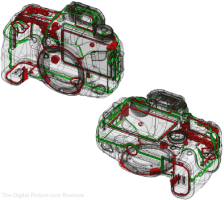
"Better snot resistance." See above. No one has had major issues with 6D bodies and weather resistance. Here's a diagram of the sealing points of the 6D Mark II.
1761885847861.png

In this teardown of the EOS R, Roger Cicala referred to it as "a Canon 6D Mark II quality mirrorless camera." He's talking about the R, not the RP.

The 5D Mark IV and 5D Mark III both had a shutter life rating of 150,000. The 6D Mark II had no publicly released shutter rating from Canon. Website ShutterCheck claims it has a 150,000 actuation rating. Take that however you want. The 6D had a 100,000 shutter life rating. Canon shutters tend to either fail early in their life or go well past the rating number. The 7D Mark II had a shutter rating of 200,000. My copy is well past that mark and the shutter still works flawlessly. I've got photojournalist friends who put over 1,000,000 clicks on original 1D X bodies that were rated for 400,000 actuations.
 
Last edited:
Upvote 0
Higher resolution sensors can reveal lens flaws more clearly when viewed 100%. But a higher resolution sensor cannot resolve less detail with the same lens than a lower resolution sensor at the image level (when all other shooting parameters are equal). And if you downscale from a higher MP sensor to match the lower one, the images will be virtually identical - the higher resolution sensor should always be at least as good, and maybe better, as pixel-level noise will be finer. Technically-minded forum users have been explaining these things for many years (I'm simply paraphrasing them).

Depending how the pixel pitch ratios work out, you could theoretically have issues resizing from a higher resolution file to a lower resolution one. But it would likely be more in terms of odd artifacts than increased blur.
 
  • Like
Reactions: 1 user
Upvote 0
I can’t speak for B&H, they’re irrelevant on this side of the Atlantic, but the EF 50mm f/1.2 doesn’t attach to a Canon mirrorless camera in any different way than the Sigma 50mm f/1.4 Art does. For the price the canon EF lens costs, if buying new is impossible, better buy a second hand Sigma and send it in for maintenance. You could probably buy two or three of the Sigma lens for the price of one EF 50mm f/1.2.


Jesus :ROFLMAO:
I’ve passed on the RF 50mm f/1.2 for about the same price twice this year, here in Portugal (not imported). Actually cheaper, once.

It's the Sigma 50mm f/1.4 in EF mount (also Nikon F mount) that has been discontinued, not the EF 50mm f/1.2 L.
 
Upvote 0
The move from DSLR to the 2020 and later EOS MILCs were all a pretty big jump. It wasn't just the 6-Series. (The R and RP were a bit more hit or miss how much an improvement they were over the 5D Mark IV or 6D Mark II - it all depended upon one's use case. For example, many shooters preferred the optical viewfinders of the DLSRs to the limited resolution and refresh rate EVFs of the R and RP.)
True! Especially by the time Canon was playing catch-up.

I've never known of anyone who had weather resistance issues with a 6D, 6D Mark II, R6, or R6 Mark II. Are the 6-Series bodies as solid as the 5-Series bodies (DSLR or MILC)?
I have. It’s a sad day when that happens. Probably though just a numbers game, and the character of s/he who holds the gear. And the environment is also a factor: wet campsites, animals enclosures, soggy moss, damp gear bags, etc.

You got slightly better DR from ISO 400-800. You got moderately better DR at ISO 100-200.
Better is better. Enough to notice when photons are scarce. Enough to make someone pay for it.

"Double the pixels." What?!?! 30.4MP (5D Mark IV) is not twice 26.2MP (6D Mark II).
Okay, okay! I stand humbled. Silly of me. The idea stands, but my statement stinks. Truly, enthusiasm swept me up. But I own this slip in the back and forth.

"Better low end detail". What is that? Low end of what?
That DR discussion above…

"Better daylight tolerance." Again, what is that? Are you repeating DR that you already brought up above?
1/4000 vs 1/8000 might seem like a small detail, but it isn’t for some people. It’s an ND filter, or smaller aperture by a stop. Unlike ISO, this is an easy ceiling to hit.

"Better snot resistance." See above. No one has had major issues with 6D bodies and weather resistance.
I’m glad this is your experience! I have my own colleagues. See above.

The 5D Mark IV and 5D Mark III both had a shutter life rating of 150,000. The 6D Mark II had no publicly released shutter rating from Canon.
That is the sales pitch. My Rebel is still going strong, which tickles me pink. But still, they’re making you pay for the sales pitch and not luck.

BTW, really appreciate your thoughts on this. I think my concerns or observations mostly stand within my context, but I’ve read many of your remarks over time and taken away good insights. Ditto for others here. It’s a pleasure to be vocal in the crowd. I’ll try to listen more than rant.

I’m certainly less on the pre-release therapy side and more on the let’s see what reality brings side of the fence now.
 
Last edited:
  • Like
Reactions: 1 user
Upvote 0