
You are using an out of date browser. It may not display this or other websites correctly.
You should upgrade or use an alternative browser.
You should upgrade or use an alternative browser.
Is a ‘Holy Trinity’ of f/2.8 STM Zoom Lenses on the Horizon?
- Thread starter Canon Rumors
- Start date


Just use a 70-200/2.8 on APS-C or a Z version + 1.4x extender, equals to 100-280mm f/4L (with better minimum focus distance).
They won't make lenses that already exist as such...
I could be wrong, but I don't think there are any native mount RF 70-300 lenses, despite that length being massibely common for EF.
Upvote
0
Though often criticised , the EF 24-70 f/4 was indeed an excellent lens, offering nice close-up possibilities. The only valid criticism was, in my opinion, after 2 samples, the wobbling extending lens tube.One day there'll be a RF 24-70/f4 that's at least as optically good as the EF24-70/f4 for a similar price. ah dreams.
Meanwhile, there'll be a 70-200 for every ocassion.
But the "similar price" would remain a pipe dream...
Upvote
0

GMCPhotographics
Canon Rumors Premium
Most 70-200/2.8 lenses are actually a bit short on the 200mm end. They often loose focal length as they focus closer (called focus breathing). A lot of 70-200 designs work out to be nearer 135mm at min focus distance.I would rather have 80-200 than 70-180, imho the tele part is where it matters.
My old Ef 70-200 f2.8 Lis mkii is longer at mfd and at infinity (@200mm) than the current RF 70-200mm f2.8 Lis. Some brands are already selling their 70-200/2.8’s where they are actually 75-185mm lenses.
Personally, I would welcome a non L 70-180/2.8 L STM if it was even lighter and more compact that the current L zoom.
Especially if it’s conceptually modelled after the very sweet Tamron variant of this lens, although that’s not got an image stabiliser. It’s light, small, cheap, sharp and very effective.
Upvote
0

Most 70-200/2.8 lenses are actually a bit short on the 200mm end. They often loose focal length as they focus closer (called focus breathing). A lot of 70-200 designs work out to be nearer 135mm at min focus distance.
My old Ef 70-200 f2.8 Lis mkii is longer at mfd and at infinity (@200mm) than the current RF 70-200mm f2.8 Lis. Some brands are already selling their 70-200/2.8’s where they are actually 75-185mm lenses.
Personally, I would welcome a non L 70-180/2.8 L STM if it was even lighter and more compact that the current L zoom.
Especially if it’s conceptually modelled after the very sweet Tamron variant of this lens, although that’s not got an image stabiliser. It’s light, small, cheap, sharp and very effective.
Have you ever seen anyone actually do testing on this topic?
I did a 50mm thing back in the day, 9 lenses... all different, some were around 55, others 45. One was even about 60. I have long since lost all of that testing.
It's an interesting topic and a lot of people don't realize "70-200" is simply the marketing, everyone knows what that means. No one is going to notice that it's a 75-185, even if their previous version was different.
Upvote
0
GMCPhotographics
Canon Rumors Premium
I was first aware of this issue with long zooms way back when I bought a Sigma 120-300mm f2.8 OS. I had high hopes for this lens, the Canon 100-300 f2.8 is a thing of beauty and so versatile. But the Sigma was a worse case of a bunch of compromises that led me to sell the lens a fer months later. The focus breathing was extreme. Even at infinity, it was well short of even 280mm. If I put a 1.4x TC on my EF 70-200mm f2.8 LIS II, the Canon lens had noticably more reach. If I foccussed on anything fairly close, the focal length would drop so short, I had more reach with my native 70-200mm f2.8. Plus the poor AF tracking and hesitiant AF lock, plus the truely awful optical image stabiliser....yes this "lens of dissapointment" went back. it was not worth the size, weight and cost over the Canon EF 70-200mm f2.8 LIS II with a teleconverter. Unlike the more modern and better engineered Canon RF 100-300mm f2.8 which is just amazing and really delivers on that particular focal range and brightness.Have you ever seen anyone actually do testing on this topic?
I did a 50mm thing back in the day, 9 lenses... all different, some were around 55, others 45. One was even about 60. I have long since lost all of that testing.
It's an interesting topic and a lot of people don't realize "70-200" is simply the marketing, everyone knows what that means. No one is going to notice that it's a 75-185, even if their previous version was different.
I often choose a EF 135mm f2.8 L prime as my light weight travel companion instead of the far bulier 70-200mm f2.8. This is because it looses less focal length at MFD and the diffrence between 135mm and what's reported as 200mm in a zoom isn't that much. Sure, it's a bit wider but take a step or two closer to the subject and it's pretty much the same look.
Which brings me to a lens that I'm really frustrated with, the RF 135mm f1.8 LIS. It's a fantastic piece of engineering and a remarkably sharp lens. However it's totally missed the point of the previous lens and makes me wonder who or why would anyone buy it over the current RF 70-200mm f2.8 or even the legacy EF135mm f2.0 L which I currently own.
While the zoom has become smaller and lighter, the prime has grown and become heavier and bulkier. To the point that all of the versatility and portability has been lost in the newer RF verion. On paper it's superior in every metric, except that now it's become bloaty and over sized. Curiously, it's now an even more niche lens that the EF version. The old EF 135mm f2.0 was a master piece of unobtrusiveness telephoto shooting. It was like a ninja stealth lens, especially if you took the hood off. The newer lens is massive in comparison and not much different to the f2.8 zoom in terms of size and weight or sheer bulk. In fact the RF 70-200mm f4 LIS is pretty much the same size and weight as the EF 135mm f2.0L, which says a lot about how much engineering has gone into the f4 zoom. It's a remarkable lens for sure. I just wish Canon has kept the original use case scenario for the EF 135mm as it's primary design objective and not just added features and bulk. Yes, it's brighter, it's sharper, yes it focusses closer, yes it's got IS....but look at the size of the thing!
It would be really cool if Canon considers a 135mm f2.0 in their new hybrid VCM primes range. Or even in their F2 lens line up, Canon could easily drop a 135mm f2 and a 200mm f2! The 135's design criterior that has an eye on size, bulk, price and brightness. It could be the sweetest lens of the pick.
Last edited:
Upvote
0
Which brings me to a lens that I'm really dissapointed with, the RF 135mm f1.8 LIS. It's a fantastic piece of engineering and a remarkable sharp lens. However it's totally missed the point of the previous lens and makes me wonder who or why would anyone buy it over the current RF 70-200mm f2.8 or even the legacy EF135mm f2.0 L which I currently own.
While the zoom has become smaller and lighter, the prime has grown and become heavier and bulkier. To the point that all of the versatility and portability has been lost in the newer RF verions. On paper it's superior in every metric, except that now it's become bloaty and over sized. Curiously, it's now an even more niche lens that the EF version. The old EF 135mm f2.0 was a master of unobtrusiveness. The newer lens is massive in comparison and not much different to the f2.8 zoom.
I just hope Canon considers a 135mm f2.0 in their new hybrid VCM primes range. One that has an eye on size, bulk, price and brightness. It could be the sweetest lens of the pick.
You are bang on about the 135. I rented it, I was excited to do so. Optically remarkable, and way too big just to hit a meaningless f/1.8. Though, the IS probably doesn't help in this regard. I'm golden with IBIS, I'm not sure why it got IS. Though it goes back to, 'just because it doesn't make sense to me, it may for others.'
I would definitely prefer a VCM variant. I am all-in on the VCM lenses. 20, 50, 85... and they need to add a you-know-what.

Upvote
0

I did use the 45/1.2 STM yesterday at an outdoor event in the evening. I did shot while I was moving or while my subjects moved. Or in some moments both of us. Most of the time I shot a f/1.2. And not a single time the AF missed. Yeah, not USM or VCM fast. But worked fast enough for walking people. I'm not going to use it for sports. But I will going to test it at a Basketball game. If it fails: no problem. Still have my 28-70/2 and 70-200/2.8 Z with me ;-)
Upvote
0
I did use the 45/1.2 STM yesterday at an outdoor event in the evening. I did shot while I was moving or while my subjects moved. Or in some moments both of us. Most of the time I shot a f/1.2. And not a single time the AF missed. Yeah, not USM or VCM fast. But worked fast enough for walking people. I'm not going to use it for sports. But I will going to test it at a Basketball game. If it fails: no problem. Still have my 28-70/2 and 70-200/2.8 Z with me ;-)
That has been experience as well. I haven't captured any good stuff yet, but I will do some kind of a review for it.
As for autofocus speed, some of us will remember the EF 85 f/1.2L II

Upvote
0
GMCPhotographics
Canon Rumors Premium
It's a bit dissapointing for me because I was hoping this would be my first RF lens. The EF 135L is such a used lens by me and I was hoping for a clear upgrade for it. I'm currently thinking my first RF lens might be the RF 70-200 2.8 LIS. Followed by the RF 10-20L. I'm still on the fence between my EF 100-400mm f5.6 II L and the RF 100-500L.You are bang on about the 135. I rented it, I was excited to do so. Optically remarkable, and way too big just to hit a meaningless f/1.8. Though, the IS probably doesn't help in this regard. I'm golden with IBIS, I'm not sure why it got IS. Though it goes back to, 'just because it doesn't make sense to me, it may for others.'
I would definitely prefer a VCM variant. I am all-in on the VCM lenses. 20, 50, 85... and they need to add a you-know-what.
I have such a good set of top tier premium EF glass, it gives RF glass a really hard time with it's upgrade path. Even my current EF 400mm f2.8 LIS II has sharpness benefits when using a tele converter over the current RF model.
If I had a EF 600mm f4 II L, the newer RF lens's weight advantage vs the slight drop in sharpness is a more convincing argument for the RF lens. But with the 400mm f2.8, the drop in IQ with a 2x is actualy quite a lot for only 1 kg in weight saving. The 600mm f1.4 only needs a 1.4x TC a similar reach so it's less of an issue.
Last edited:
Upvote
0
Let me risk a very difficult guess, maybe a 28mm f/1,4 ???You are bang on about the 135. I rented it, I was excited to do so. Optically remarkable, and way too big just to hit a meaningless f/1.8. Though, the IS probably doesn't help in this regard. I'm golden with IBIS, I'm not sure why it got IS. Though it goes back to, 'just because it doesn't make sense to me, it may for others.'
I would definitely prefer a VCM variant. I am all-in on the VCM lenses. 20, 50, 85... and they need to add a you-know-what.


Upvote
0
It's a bit dissapointing for me because I was hoping this would be my first RF lens. The EF 135L is such a used lens by me and I was hoping for a clear upgrade for it. I'm currently thinking my first RF lens might be the RF 70-200 2.8 LIS. Followed by the RF 10-20L. I'm still on the fence between my EF 100-400mm f5.6 II L and the RF 100-500L.
I have such a good set of top tier premium EF glass, it gives RF glass a really hard time with it's upgrade path. Even my current EF 400mm f2.8 LIS II has sharpness benefits when using a tele converter over the current RF model.
If I had a EF 600mm f4 II L, the newer RF lens's weight advantage vs the slight drop in sharpness is a more convincing argument for the RF lens. But with the 400mm f2.8, the drop in IQ with a 2x is actualy quite a lot for only 1 kg in weight saving. The 600mm f1.4 only needs a 1.4x TC a similar reach so it's less of an issue.
I was using the EF 85 1.4 until the VCM came. I'm going to keep it, I continue to use the EF 200 f/2 (I would buy an RF variant).
I am also seriously considering the EF 800 5.6, I have seen them as low as $3000. The only thing "wrong" with it is it vignettes at 5.6.
Upvote
0

I’ve been tempted by the RF 135/1.8 a couple of times, but then I remember that I didn’t use my EF 135/2 that much after getting the EF 70-200/2.8 II, and the size difference was very meaningful then. Now…what size difference?You are bang on about the 135. I rented it, I was excited to do so. Optically remarkable, and way too big just to hit a meaningless f/1.8.
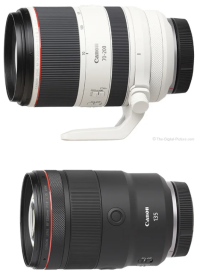
Agree on this, as well…no real need in most use cases, I think. The focal length isn’t long enough that IBIS loses effectiveness, the 135/1.8 gets the same 2.5-3 stop bump as shorter lenses (by comparison, the 100-300/2.8 gains only a 0.5-stop bump from IBIS). Probably the 135/1.8 wouldn’t hit 8 stops without OIS, so maybe that’s a marketing reason to include it.Though, the IS probably doesn't help in this regard. I'm golden with IBIS, I'm not sure why it got IS. Though it goes back to, 'just because it doesn't make sense to me, it may for others.'
Upvote
0

drmikeinpdx
Celebrating 20 years of model photography!
I love my 28-70mm f/2.8. It stays on my studio camera almost full time now. For my work with models, where I move around a lot, it is virtually the perfect all around lens. The only time I use a different lens is when I want to have some fun with shallow DOF. For example, I use my old EF 135mm F/2 L with adapter to get a certain look.
Upvote
0
So many unused lenses (85, 100, 135, 200mm) "thanks" to these wonderful, compact new 70-200 lenses!
Even though the 70-200 Z is a truly exceptional lens, I won't replace my extending 70-200 zoom with it.
But maybe buy it as an addition. Christmas is getting closer.
Even though the 70-200 Z is a truly exceptional lens, I won't replace my extending 70-200 zoom with it.
But maybe buy it as an addition. Christmas is getting closer.
Upvote
0

roby17269
R5, X2D II 100c, DJI Mavic 4 Pro & Mini 5 Pro
Welcome back!Agree on this, as well…no real need in most use cases, I think. The focal length isn’t long enough that IBIS loses effectiveness, the 135/1.8 gets the same 2.5-3 stop bump as shorter lenses (by comparison, the 100-300/2.8 gains only a 0.5-stop bump from IBIS). Probably the 135/1.8 wouldn’t hit 8 stops without OIS, so maybe that’s a marketing reason to include it.
It is also about the most frequent use case for a lens... AFAIK the 135mm fl is mostly used for portraits (candid or not) and that's not a use case where you should depend on stabilization too much, since your subject won't be perfectly still.
Personally I don't mind the size and weight of the RF 135 1.8L, and I think it performs well, but I would even have preferred that Canon had gone the Nikon way with their 135 1.8 Plena: no IS but also even less compromises
Upvote
0
TY. Another common use case (for me, at least) was indoor performances. The shutter speed obviating the need for IS still applies.Welcome back!
It is also about the most frequent use case for a lens... AFAIK the 135mm fl is mostly used for portraits (candid or not) and that's not a use case where you should depend on stabilization too much, since your subject won't be perfectly still.
Upvote
0

I never though of the RF 135mm as being too big, to be honest, but I never tried the EF 135mm f/2, which means I never established such comparison. Being over one f-stop faster than the zoom sounds good enough to me.
I tried the RF 135 last year, found it "cheap" and sold for profit, for a guy that uses it for indoor sports. Brilliant autofocus, the fastest I ever seen on a non-VCM Canon lens.
I never intended to keep it, as I don't own any prime lens longer than 50mm because I know I won't use them (had in the past, sold all of them) - having a 70-200mm f/2.8 is enough to me, but I have to say, the RF 135 seemed to be an absolutely amazing lens. The guy I sold it to never bought the 70-200 after getting the 135 from me.
Meanwhile, Sony alpha rumors is saying there's a 16-28mm f/2.0 GM coming.
I tried the RF 135 last year, found it "cheap" and sold for profit, for a guy that uses it for indoor sports. Brilliant autofocus, the fastest I ever seen on a non-VCM Canon lens.
I never intended to keep it, as I don't own any prime lens longer than 50mm because I know I won't use them (had in the past, sold all of them) - having a 70-200mm f/2.8 is enough to me, but I have to say, the RF 135 seemed to be an absolutely amazing lens. The guy I sold it to never bought the 70-200 after getting the 135 from me.
Meanwhile, Sony alpha rumors is saying there's a 16-28mm f/2.0 GM coming.
Upvote
0

It's not hard for Canon to design and produce such lenses, from a technical standpoint. From a strategic standpoint, Canon doesn't care what you personally want, they care what a significant number of users will buy.I just want a 300-600 that is around 6k USD that works with extenders + internal zooms
And an 14 or 16 mm lens with large aperture. Why is it so hard Canon?!
Upvote
0
Similar threads
- Replies
- 67
- Views
- 14K

- Replies
- 73
- Views
- 8K
- Replies
- 141
- Views
- 14K
